

5kW Inverter Guide: Top Hybrid Tech for South African Homes
A 5kw inverter represents the most efficient entry point for South African households seeking total energy independence. Most homeowners are currently struggling with the persistent reality of load shedding and the technical complexity of choosing between hybrid and off-grid systems. There is a valid concern regarding the purchase of expensive hardware that might prove incompatible with modern lithium battery standards.
You need a power solution that functions reliably without constant troubleshooting. This guide provides the technical specifications and brand comparisons necessary to secure a stable 24/7 energy supply. We focus on the practical requirements for seamless integration and long-term performance to ensure your household remains powered during grid failures.
We examine the performance profiles of the LuxPower SNA5000, Sunsynk, and Deye ranges. This overview clarifies load capacities and battery compatibility; specifically focusing on high-discharge lithium units like the Hubble AM2. By following this technical breakdown, you can confidently select the components required for a robust domestic solar installation that meets your specific electrical demands.
Key Takeaways
- Identify why a 5kw inverter is the optimal capacity for medium-sized South African households seeking to balance cost and performance.
- Understand critical technical specifications including the necessity of Pure Sine Wave output and MPPT efficiency for appliance safety.
- Compare the technical advantages of leading hardware brands like LuxPower, Sunsynk, and Deye to find the right fit for your budget.
- Master the requirements for seamless BMS communication between your inverter and high-performance Hubble lithium batteries.
- Learn how to reduce system costs by sourcing professional-grade solar hardware directly through an efficient retail model.
Understanding the 5kW Inverter: The Residential Standard
A 5kw inverter functions as the primary energy hub for a modern residential solar system. It synchronises input from solar panels and battery storage whilst maintaining a connection to the Eskom grid. To understand the fundamental mechanics of these devices, one might ask, What is a Solar Inverter? Essentially, it converts DC electricity from panels or batteries into the AC power required by household appliances. This hardware is the standard for South African households because it balances cost efficiency with sufficient capacity for medium-sized properties.
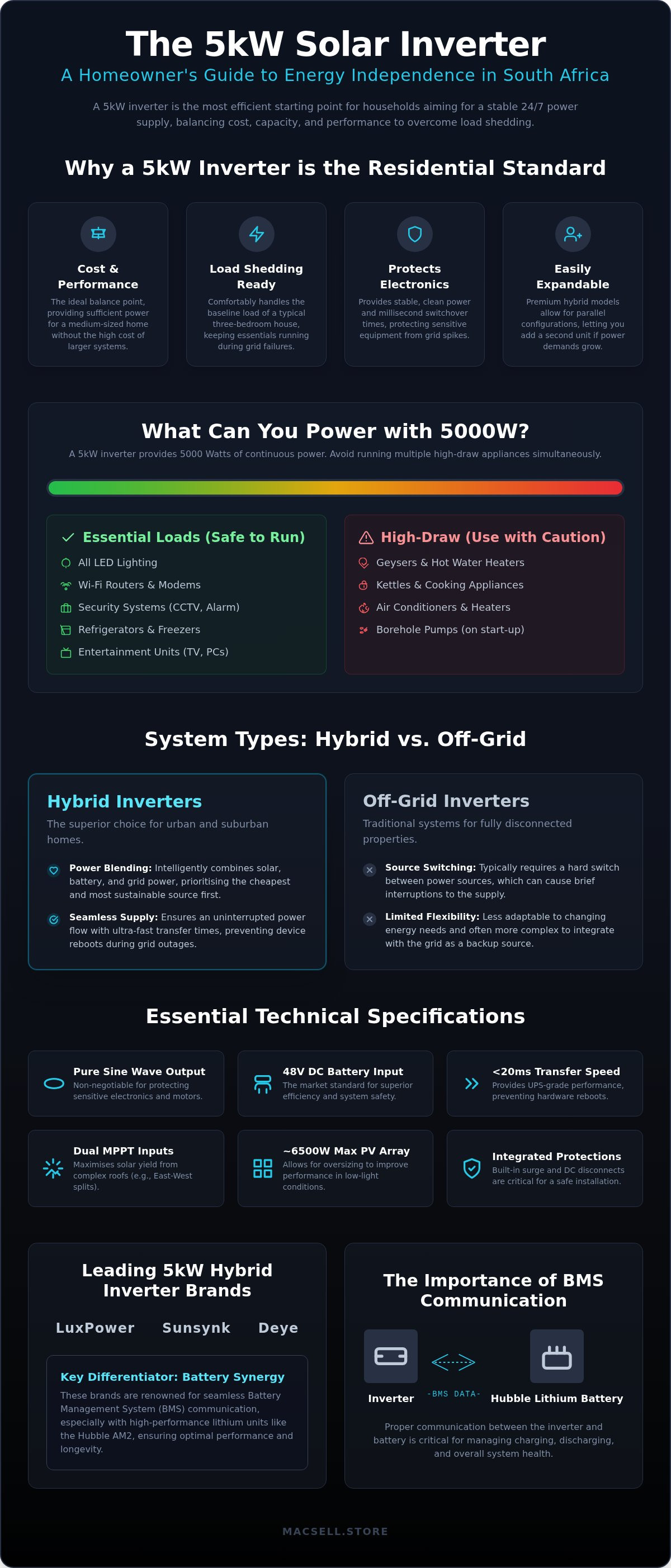
Capacity is a critical metric. A 5kW unit provides 5000W of continuous power. This differs from peak power, which is the short-term surge capacity used to start motors in appliances like refrigerators or borehole pumps. For a South African home, this capacity is the "sweet spot". It handles the baseline load of a three-bedroom house comfortably while providing a buffer for additional electronics. During load shedding, the inverter manages the transition to battery power in milliseconds. This protects sensitive electronics from the voltage spikes often associated with grid restoration.
What Can You Power with 5kW?
A 5kw inverter supports all essential low-wattage loads. This includes LED lighting, Wi-Fi routers, security systems, and entertainment units. Refrigeration is easily managed, provided the startup surge is within the inverter's peak rating. Users must avoid running multiple high-draw appliances simultaneously. Kettles, geysers, and air conditioners can quickly exceed the 5000W limit. Calculating concurrent watt usage is mandatory. If a geyser draws 3000W and a kettle draws 2000W, the system is at maximum capacity before a single light is switched on.
Hybrid vs Off-Grid 5kW Hardware
Hybrid units, such as the LuxPower SNA5000, Sunsynk, or Deye models, offer superior flexibility for urban environments. Unlike traditional off-grid hardware, hybrid inverters can blend power sources. They prioritise solar energy, supplement with battery power, and use the grid only as a final resort. This blending capability ensures a seamless power supply. Off-grid units often require a hard switch between sources, which can cause temporary interruptions. Hybrid hardware also facilitates easier system expansion. Most premium 5kW hybrid models allow for parallel configurations, enabling homeowners to add a second unit if power demands increase.
Essential Technical Specifications for 5kW Hardware
Technical performance in a 5kw inverter is defined by its ability to provide a clean, stable power signal. Pure Sine Wave output is a non-negotiable requirement for modern residential systems. Unlike modified sine wave alternatives, pure sine wave hardware produces electricity identical to the grid, which prevents damage to sensitive electronics and humming in household motors. When reviewing a homeowner's guide to solar energy, the emphasis is often on hardware durability and signal quality. Selecting the correct hardware parameters ensures long-term system stability; you can browse professional-grade 5kW hardware to compare specific model datasheets.
Voltage configuration is another critical standard. The 48V DC battery input dominates the 5kW market because it offers superior efficiency compared to 12V or 24V systems. Higher voltage reduces the current flow required to achieve 5000W of output, which minimises heat generation in the cabling and improves overall system safety. For households running desktop computers or security servers, transfer speed is vital. High-end hybrid units offer a transfer time of less than 20 milliseconds, providing UPS-grade performance that prevents hardware reboots during a grid failure.
MPPT Efficiency and Solar Input
MPPT technology continuously adjusts the electrical operating point of the modules to ensure the system extracts the maximum available power from the PV array during varying weather conditions. Most modern 5kw inverter models feature dual MPPT inputs. This is essential for South African homes with complex roof orientations, such as East-West splits, as it allows each string of panels to operate at its own peak efficiency. A typical 5kW unit supports a maximum PV array sizing of approximately 6500W to 7000W, allowing for over-provisioning to ensure better performance during low-light winter months.
Protection Features and Durability
Durability in the South African climate requires specific hardware protections. Built-in surge protection and integrated DC disconnects are standard requirements for a compliant installation. Inverters are generally rated as IP20 for indoor installation or IP65 for outdoor placement. Indoor units require adequate ventilation space to manage heat. In the extreme temperatures of the South African interior, active cooling mechanisms, such as variable-speed fans, are necessary to prevent thermal throttling. This ensures the inverter maintains its continuous 5000W rating even during peak summer afternoon heat.
Top 5kW Inverter Brands: LuxPower vs Sunsynk vs Deye
Selecting a 5kw inverter requires a choice between value-driven hardware and premium feature sets. The South African market is currently dominated by three primary brands: LuxPower, Sunsynk, and Deye. Each manufacturer targets a specific user profile based on budget and technical requirements. While LuxPower offers a high-value entry point for those prioritising cost efficiency, Sunsynk and Deye provide advanced management features for complex residential installations. Local technical support and established repair centres are available for all three brands, which is a critical factor for long-term maintenance within South Africa.
Warranty periods for these brands typically range from five to ten years. Deye and Sunsynk often provide extended warranty terms when the hardware is paired with approved lithium storage. Technical support infrastructure is robust; firmware updates and hardware diagnostics are handled by local distributors. This ensures that your system remains operational without the delays associated with international shipping for repairs.
LuxPower SNA5000 Performance Review
The LuxPower SNA5000 Hybrid Inverter is a favourite choice for load shedding backup kits. It delivers reliable performance at a competitive price point, functioning effectively as both an off-grid and hybrid unit. One of its primary technical advantages is its parallel capability. Users can scale their system from a single 5kW unit up to 50kW by connecting additional inverters in parallel. This allows for significant system growth if household energy demands increase. The integrated monitoring software and mobile app provide real-time data on solar yield and battery health, facilitating precise energy management.
Sunsynk and Deye: The Premium Tier
Sunsynk and Deye represent the premium tier of the 5kW market. These brands share a similar hardware architecture, resulting in comparable efficiency ratings and high build quality. Sunsynk is particularly renowned for its industry-leading user interface. It features a colour touch-screen that allows for intuitive programming directly on the unit. These inverters integrate seamlessly with smart home ecosystems, allowing for complex load management and the prioritisation of essential circuits. For homeowners considering larger configurations or integrated storage, the Sunsynk 8KVA and Hubble AM2 Combo Kit demonstrates the brand's capacity for high-demand environments. Deye units offer similar high-efficiency hardware and are frequently chosen for their robust performance in harsh South African temperature conditions.
Battery Synergy: Matching Your Inverter to Lithium Storage
Efficient energy storage depends on the technical synergy between the battery bank and the 5kw inverter hardware. The primary requirement for a stable system is the Battery Management System (BMS) communication. Without a direct data link via CAN-bus or RS485 protocols, the inverter cannot accurately monitor the State of Charge (SoC), temperature, or cell voltage. This "blind" operation often leads to inefficient charging cycles or unexpected system shutdowns. Modern hybrid units require this intelligence to optimise the lifespan of the cells and ensure the hardware operates within safe thermal parameters.
Discharge rates are equally critical. A 5kw inverter pulling a full load requires approximately 104 Amps from a 48V battery bank. If the connected battery cannot sustain this continuous discharge current, the BMS will trigger a protection fault, cutting power to the house. Homeowners must verify that their battery bank is sized to match the peak demand of the inverter. To ensure your system remains operational during extended outages, you can view high-performance lithium batteries designed for high-discharge residential applications.
Hubble AM2 and 5kW Inverter Integration
The Hubble AM2 is the preferred choice for 5kW systems in South Africa due to its 5.5kWh capacity and robust 1C discharge rating. This battery utilise LiFePO4 (Lithium Iron Phosphate) chemistry, which is inherently safer and more stable than older lithium variants. Technical integration with Sunsynk, Deye, and LuxPower units is seamless; the Hubble BMS is pre-configured with the necessary communication protocols. Using a 5.5kWh unit provides a better buffer for the 5000W output compared to smaller 2.4kWh or 4.8kWh alternatives. This ensures the battery isn't constantly stressed at its maximum operating limit.
Avoid Common Sizing Mistakes
Undersizing the battery bank is a frequent error in DIY installations. While a 5kw inverter can technically run on a single small battery, doing so limits the available output and shortens the hardware's cycle life. Depth of Discharge (DoD) should typically be set to 80% or 90% to balance usable energy with longevity. Thermal management is also vital. You must organise your battery rack with sufficient spacing between units to allow for airflow. Heat build-up during rapid discharge cycles can lead to thermal throttling, where the BMS reduces output to protect the cells, resulting in a temporary loss of power to your essential circuits.
Procuring Your 5kW Solar Hardware from MacSell
MacSell Solar Outlet operates on a direct-to-consumer hardware retail model. This approach is designed specifically for independent installers and DIY enthusiasts who require high-performance solar components without the additional markup of turnkey service providers. By sourcing a 5kw inverter directly, homeowners can significantly reduce the capital expenditure of their solar project. We maintain a technical inventory that includes the LuxPower SNA5000, Sunsynk, and Deye ranges, ensuring that customers have access to the exact hardware specifications required for their energy profile.
Direct Retail vs Full-Service Installation
Purchasing hardware directly allows for granular control over component selection. Turnkey installers often limit hardware choices based on their own brand partnerships. MacSell Solar Outlet prioritises variety and technical accuracy, acting as a specialised warehouse for premium solar equipment. Whilst we provide the hardware, the final electrical connection must be performed by a registered electrician. This is a legal requirement in South Africa to obtain a Certificate of Compliance (CoC). This document is necessary for insurance purposes and property sales. Our hardware-only model focuses on the efficient distribution of high-end brands like Sunsynk and LuxPower, providing a cost-effective alternative to full-service contracts.
National Delivery and Hardware Availability
Managing the logistics of sensitive electronic hardware requires a specialised approach. Solar inverters and lithium batteries are heavy, high-value items that require secure handling during transit. MacSell Solar Outlet ensures national delivery across South Africa, coordinating the transport of components from our Pretoria base to your location. Every unit we distribute is an authentic product backed by the original manufacturer’s warranty. This ensures that your investment in a 5kw inverter is protected against technical defects. You can browse our range of 5kW Hybrid Inverters to check current stock levels and technical specifications.
Before finalising your purchase, perform a final technical audit of your system design. Confirm that your chosen battery bank, such as the Hubble AM2, is fully compatible with your inverter’s BMS communication protocol. Verify that the continuous discharge current of your battery bank meets the 5000W demand of the inverter. Ensure you have planned for a compliant installation area with sufficient ventilation and that a certified electrician is scheduled for the final sign-off. This methodical approach prevents hardware mismatches and ensures your household achieves reliable energy independence through modern hybrid technology.
Securing Your Energy Independence with Professional Hardware
Achieving a reliable 24/7 power solution requires precise hardware matching and a clear understanding of load capacities. A high-performance 5kw inverter serves as the foundation for this stability; provided it's paired with compatible lithium storage like the Hubble AM2. Selecting the right brand, whether it's the high-value LuxPower SNA5000 or the premium Sunsynk range, ensures your system meets specific household demands whilst protecting sensitive electronics from grid instability.
MacSell Solar Outlet facilitates this transition by acting as official stockists of LuxPower and Sunsynk hardware. We prioritise technical accuracy and provide national delivery across South Africa for all heavy solar components. Our inventory includes high-performance Hubble battery combos designed for seamless integration with modern hybrid systems. Sourcing your hardware directly reduces project overheads and maintains control over the quality of your installation.
Take the final step toward domestic energy security today. View the latest LuxPower and Sunsynk 5kW Inverter Prices and secure the components needed for a robust solar solution. You've got the technical knowledge required to build a system that lasts.
Frequently Asked Questions
Can a 5kW inverter run a whole house during load shedding?
A 5kW inverter cannot typically power an entire house if high-draw appliances are active simultaneously. It is designed to manage essential loads like lighting, refrigeration, Wi-Fi, and security systems. Heavy loads such as geysers, kettles, and air conditioners must be excluded or managed carefully to prevent the hardware from tripping due to an overload.
What is the difference between a hybrid and an off-grid 5kW inverter?
Hybrid inverters can blend power from solar, batteries, and the grid simultaneously to meet load requirements. Off-grid units typically switch between sources, which can lead to minor power interruptions during the transition. Hybrid hardware is the preferred choice for urban South African homes because it offers superior flexibility and better integration with the local municipal grid.
How many solar panels do I need for a 5kW inverter system?
Most systems require between 6 and 10 high-efficiency solar panels, depending on the individual panel wattage. A 5kw inverter often supports a total PV array of up to 6500W. Over-provisioning the solar array ensures that the batteries charge sufficiently even during overcast weather or shorter winter days in the Highveld or Western Cape.
Is a 5kW inverter compatible with all lithium batteries?
Compatibility is not universal across all brands. A 5kW unit requires a 48V lithium battery with a compatible Battery Management System (BMS). Brands like Sunsynk and LuxPower require specific communication protocols, such as CAN or RS485, to communicate with high-performance units like the Hubble AM2 effectively. Always verify the compatibility list provided by the manufacturer.
Can I parallel multiple 5kW inverters for more power later?
Many premium models, including the LuxPower SNA5000 and Sunsynk ranges, support parallel configurations. This allows you to add a second or third inverter as your power needs grow. You must ensure the specific model purchased includes the necessary parallel ports and firmware to support multi-unit synchronisation for a larger total output.
What is the expected lifespan of a premium 5kW hybrid inverter?
A premium 5kw inverter typically has an operational lifespan of 10 to 15 years. While the electronic components are durable, performance depends on environmental factors like adequate ventilation and temperature control. Most manufacturers provide a standard 5-year warranty, which is often extendable to 10 years when the unit is paired with approved battery storage.
Does a 5kW inverter require a specific type of DB board modification?
Yes, a DB board modification is necessary to separate essential loads from non-essential loads. This ensures that high-draw appliances like geysers don't drain your batteries or overload the system during load shedding. A certified electrician must install a changeover switch and appropriate surge protection to meet South African SANS regulatory standards.
Why should I choose a LuxPower 5kW unit over cheaper alternatives?
The LuxPower SNA5000 offers a balance of affordability and professional-grade features that cheaper, generic units lack. It provides robust parallel capabilities, integrated mobile monitoring, and proven compatibility with the South African grid. Choosing a recognised brand ensures you have access to local technical support and valid manufacturer warranties if hardware issues arise.