

8KVA Hybrid Inverter South Africa: The Comprehensive Hardware Guide (2026)
Can your solar setup actually power a geyser, aircon, and oven simultaneously during a winter peak? For most South African households, a standard 5kW system fails when heavy loads kick in. This is why the 8KVA hybrid inverter South Africa market has seen a massive surge in 2026. With Eskom direct tariffs increasing by 8.76% this year, the shift from emergency backup to total economic independence is no longer optional; it's a financial necessity.
You likely feel the frustration of navigating technical jargon like MPPT ranges and NRS 097-2-1 certifications. It's common to worry about buying expensive batteries that might not communicate correctly with your inverter. We promise to clear that confusion by providing a direct hardware roadmap for your energy transition. This guide breaks down the essential specifications of leading units from Sunsynk, Deye, and LuxPower. You'll learn how to select compatible components that handle heavy domestic demands while remaining fully compliant with municipal regulations and SSEG registration requirements.
Key Takeaways
- Learn why upgrading to an 8KVA system is the definitive solution for running high-drain appliances like geysers and air conditioners during outages.
- Identify the mandatory technical specifications for an 8KVA hybrid inverter South Africa installation, including NRS 097-2-1 grid-tie compliance and dual MPPT configurations.
- Compare the performance benchmarks of industry-leading hardware from Sunsynk, Deye, and LuxPower to determine which unit suits your specific energy profile.
- Master the requirements for seamless battery-to-inverter communication, specifically when utilising high-performance lithium options like the Hubble AM2 5.5KWh.
- Optimise your procurement strategy by evaluating pre-configured hardware combo kits designed for guaranteed compatibility and simplified national delivery.
Scaling Up: Why 8KVA is the New Standard for South African Homes
The transition from basic load shedding protection to comprehensive energy independence has redefined hardware requirements for local households. An 8KVA unit is no longer a luxury; it's a multi-input power management hub. Unlike older backup systems, these units function as the central nervous system of a modern home. Reviewing the technical specifications for hybrid inverters reveals that these systems manage solar, battery, and grid inputs simultaneously. This ensures your home remains powered even when the grid fails or when electricity costs spike during peak tariff periods.
The primary driver for the 8KVA hybrid inverter South Africa market is the need to handle inductive loads. Appliances with motors, such as borehole pumps and large air conditioning units, require a massive initial current to start. A smaller system often trips under this pressure. An 8KVA system provides the necessary headroom to start these heavy loads without compromising the rest of the household's power supply. With over 5,800 MW of rooftop solar added since 2022, South Africans are clearly prioritising systems that offer this level of robust performance.
8KVA vs 5KVA: Understanding the Capacity Gap
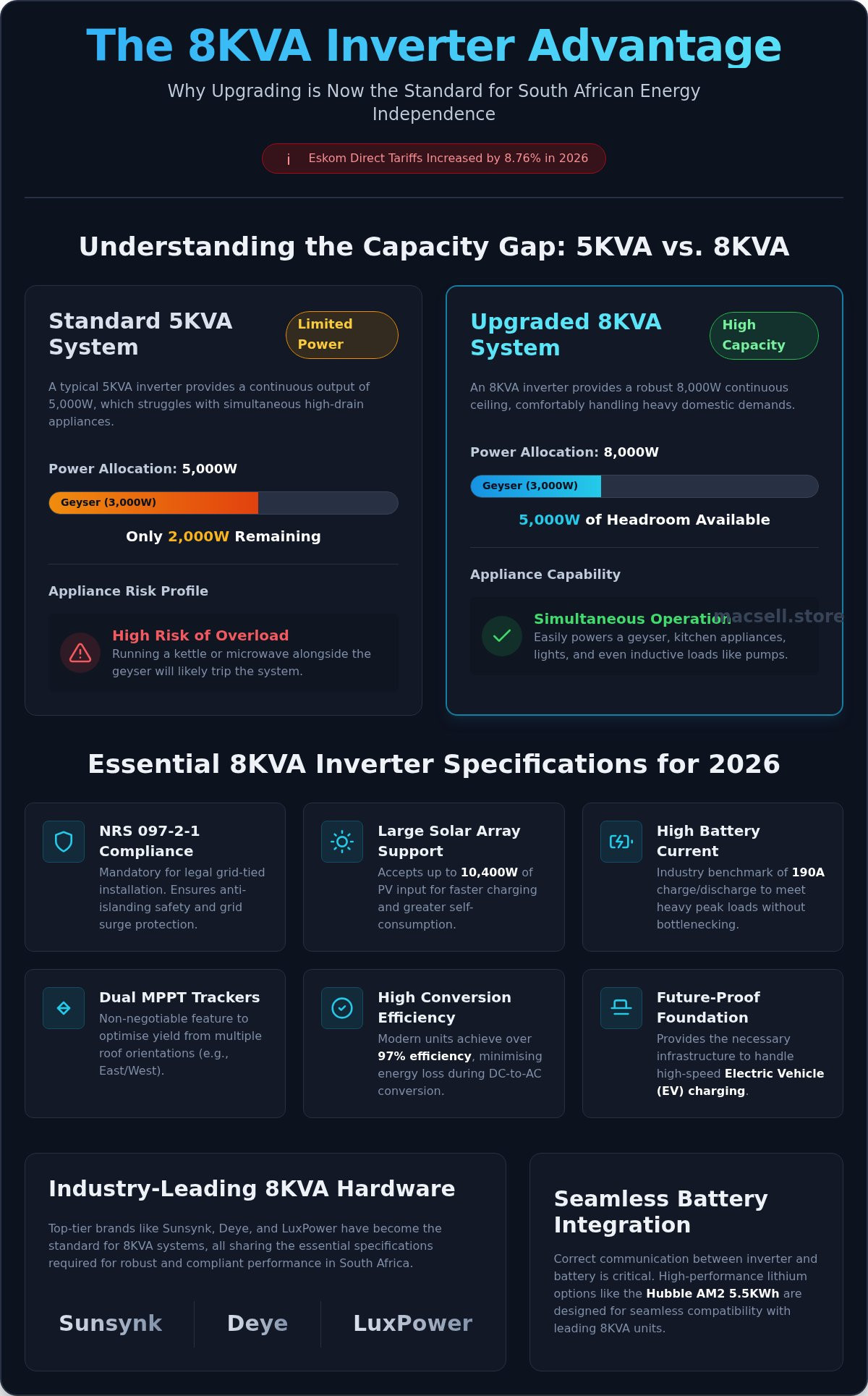
The technical difference between a 5KVA and an 8KVA unit is substantial. A 5KVA inverter typically provides a continuous output of roughly 5,000W. A standard electric geyser consumes approximately 3,000W. If your geyser is running on a 5KVA system, you only have 2,000W left for the rest of your home. Turning on a kettle or a microwave will likely overload the inverter. An 8KVA unit provides a 8,000W continuous ceiling. This allows for geyser integration whilst simultaneously running kitchen appliances and lights. It's the difference between managing your electricity and actually using it.
The Economic Case for Higher Capacity Hardware
Investing in higher capacity hardware is a strategic move against rising costs. Eskom direct customer tariffs increased by 8.76% in April 2026, making grid reliance increasingly expensive. An 8KVA hybrid inverter supports larger solar arrays, often allowing up to 10,400W of PV input. This enables faster battery charging and greater self-consumption of free solar energy. Furthermore, these units are designed for future-proofing. As electric vehicle (EV) adoption grows, having an 8KVA foundation ensures your home infrastructure can handle the high-speed charging requirements of a modern vehicle without needing a complete system overhaul.
Essential Technical Specifications for Hybrid Inverters in 2026
Selecting an 8KVA hybrid inverter South Africa requires a focus on specific hardware parameters that ensure long-term stability. In 2026, the industry benchmark for battery interfacing has shifted to a 190A charge and discharge current. This high-rate capability is essential for 8KVA systems. It allows the inverter to pull sufficient energy from the battery bank to meet heavy peak loads, like a geyser and oven running simultaneously, without bottlenecking the system. Efficiency is another critical metric. High-end hardware now achieves over 97% conversion efficiency. This minimises energy loss during the DC-to-AC transformation process; it ensures every watt generated by your panels or stored in your batteries is used effectively.
NRS 097 Compliance and Grid Integration
Legal installation in South Africa hinges on NRS 097-2-1 certification. This standard is mandatory for any grid-tied or hybrid system. It ensures the inverter includes anti-islanding protection. This prevents your system from feeding power back into the grid during a blackout, which is a vital safety requirement to protect technicians working on the lines. Beyond safety, certified hardware provides superior protection against grid surges. These surges are increasingly common as the Renewable Energy Market in South Africa evolves with more distributed generation. If you're unsure about specific model compliance, you can browse NRS-approved hardware in our current inventory to ensure your system meets municipal standards.
MPPT Trackers and Solar Yield Optimisation
Dual Maximum Power Point Tracking (MPPT) is a non-negotiable feature for residential 8KVA systems. Most South African homes have multi-faceted roofs with varying orientations. Dual MPPTs allow you to run two separate strings of solar panels, such as one on an East-facing roof and one on a West-facing roof, without the performance of one string dragging down the other. MPPT is the mechanism that matches panel voltage to battery requirements to ensure the highest possible energy transfer. By utilising dual trackers, you maximise your daily solar yield. This ensures your batteries are fully charged earlier in the day, even during the shorter sunlight hours of winter. This setup is particularly effective for managing the high-input capacities of 8KVA units, which can often handle over 10,000W of total solar PV. Using dual trackers prevents the "mismatch loss" that occurs when panels in different light conditions are connected to a single input.
Comparing Top 8KVA Hardware: Sunsynk, Deye, and LuxPower
The 8KVA hybrid inverter South Africa market is dominated by three primary manufacturers: Sunsynk, Deye, and LuxPower. Each brand offers distinct advantages in hardware architecture and software integration. Sunsynk has established itself as the industry favourite due to its exceptional software stability and intuitive user interface. It's often the first choice for residential users who want a balance of high performance and ease of use. For those seeking a turnkey solution, the Sunsynk 8KVA and Hubble AM2 combo kit provides a pre-verified hardware pairing that eliminates communication errors between the inverter and the battery bank.
Deye offers a robust hardware architecture that shares many technical similarities with Sunsynk, often featuring high-speed battery interfacing and rugged internal components. The Deye 8KW model SUN-8K-SG05LP1-EU-SM2 is particularly well-regarded for its ability to manage complex solar arrays and high-discharge lithium batteries. LuxPower presents a competitive alternative with its GEN3-LB-EU series. These units focus on modularity and simplified setup procedures, making them an attractive option for installers who prioritise rapid deployment without sacrificing the 8,000W continuous output required for modern homes.
User Interface and Remote Monitoring Capability
Monitoring your energy production is vital for maximising ROI. Sunsynk utilises the Sunsynk Logger platform, which provides granular data on every aspect of your system's performance. It's widely considered the most intuitive mobile application experience in the local market. Deye systems typically use the Solarman platform. While Solarman is technically comprehensive and offers deep diagnostic tools, it has a steeper learning curve than Sunsynk's interface. LuxPower provides a simplified monitoring solution that focuses on the most critical metrics, such as battery state-of-charge and current solar yield. All three brands offer remote monitoring, but Sunsynk leads in providing real-time data that helps households manage consumption patterns effectively.
Hardware Durability and Thermal Management
Thermal management is a critical factor for 8KVA units because they handle significant current. Most 8KVA hybrid inverters from Sunsynk and Deye utilise active fan cooling to maintain optimal operating temperatures during high-load periods. This is essential in the South African climate, where ambient temperatures can impact electronic efficiency. These units carry an IP65 rating, which means they're dust-tight and protected against water jets, making them suitable for external mounting in sheltered areas. Warranty periods for these top-tier brands typically range from 5 to 10 years, depending on the specific model and battery pairing. This long-term hardware support is a key reason why these three brands remain the benchmark for energy independence in 2026.
Battery Compatibility and Load Management for 8KVA Systems
The performance of an 8KVA hybrid inverter South Africa installation depends heavily on the battery bank's ability to sustain high discharge rates. Pairing an 8,000W inverter with an undersized or low-rate battery bank leads to system tripping and reduced hardware lifespan. For a standard 8KVA setup, a minimum capacity of 10kWh is recommended. This is typically achieved by installing two units like the Hubble AM2 5.5KWh lithium battery in parallel. This configuration ensures that the battery bank can comfortably handle the 190A discharge current that 8KVA inverters require during peak load periods. You can find pre-configured hardware pairings in our home inverter and battery combo guide for 2026.
Active BMS (Battery Management System) communication is the most critical factor for system health. Unlike basic setups that rely on voltage-based charging, high-end 8KVA systems use CAN or RS485 protocols to "talk" to the battery. This allows the inverter to receive real-time data on cell temperature, state of charge, and health. This precise communication prevents over-discharging and ensures the inverter adjusts its output based on the battery's actual limits. Without this digital handshake, you risk voiding warranties and significantly shortening the life of your lithium cells.
Lithium Iron Phosphate (LiFePO4) vs Older Technologies
Modern 8KVA systems exclusively utilise Lithium Iron Phosphate (LiFePO4) technology. Traditional lead-acid or gel batteries cannot handle the rapid discharge cycles required by high-capacity hybrid inverters. LiFePO4 batteries offer over 6,000 cycles at an 80% depth of discharge; this provides a decade or more of reliable service. In contrast, older technologies often fail within 500 to 1,000 cycles when subjected to the frequent cycling common in the South African energy market. Additionally, LiFePO4 chemistry is exceptionally stable; it eliminates the thermal runaway risks associated with other lithium variants in residential environments.
Smart Load and Essential Load Configuration
Effective load management requires a physical separation of circuits on your distribution board. Essential loads, such as lights, Wi-Fi, security systems, and refrigeration, are connected to the inverter's main output for uninterrupted power. Non-essential loads remain on the grid-side. However, 8KVA units feature a "Smart Load" or "Aux" output. This allows you to power heavy appliances like geysers or pool pumps only when solar production is high and batteries are full. This strategy prevents unnecessary battery depletion during extended outages while still allowing you to utilise excess solar energy for high-drain tasks. To ensure your system is configured for maximum efficiency, view our range of high-discharge lithium batteries compatible with the latest 8KVA hardware.
Procurement Strategy: Sourcing Your 8KVA Hybrid Inverter Hardware
Sourcing the 8KVA hybrid inverter South Africa requires more than just price comparison. It's about hardware compatibility and long-term technical support. MacSell Solar Outlet operates as a national distributor, specialising in high-end hardware like the Sunsynk 8KVA and Deye units. Selecting the best hybrid inverter South Africa for your specific needs involves verifying the retailer's authorised status. This ensures you receive genuine 2026 models with the latest NRS 097-2-1 certifications and full manufacturer warranties. Buying from an authorised source protects your investment against the 400% historical tariff increases seen since 2010 by ensuring your hardware remains supported for its entire decade-long lifespan.
The procurement process should focus on hardware that meets the specific 2026 winter outlook requirements. With municipal bulk tariffs rising by an average of 9.01% in July 2026, the efficiency of your hardware directly impacts your monthly savings. Authorised distributors like MacSell provide the technical assurance that your 8KVA unit is a legitimate, grid-compliant device. This is essential for SSEG registration with Eskom or your local municipality, which remains a legal requirement for all hybrid systems under 100kVA.
Why Hardware Combo Kits Offer Superior Value
Purchasing a Sunsynk 8KVA & 2X Hubble AM2 5.5 KWh Combo Kit eliminates the risk of component mismatch. These kits are pre-configured to ensure the inverter and battery BMS communicate seamlessly via CAN bus protocols. Sourcing your entire system from a single retail outlet reduces procurement friction. It also ensures all necessary communication cables and DC breakers are correctly sized for the 8,000W output. These kits are designed for residential efficiency; they provide a balanced ratio of generation to storage. This prevents the common mistake of pairing a high-capacity inverter with an undersized battery bank, which often leads to system shutdowns during peak demand.
National Delivery and Hardware Availability
Heavy hardware logistics require established distribution networks. MacSell Solar Outlet provides national hardware procurement and delivery across South Africa. This is vital for 8KVA units and large lithium battery banks, which are high-weight items requiring specialised handling. Before finalising your 8KVA hybrid inverter purchase, verify the current stock levels and lead times. A reliable distributor should offer transparent availability for premium brands like Sunsynk and Deye. Choosing a partner with national reach ensures your components arrive safely and on schedule, regardless of your provincial location.
Final checklist before finalising your purchase:
- Verify NRS 097-2-1 certification for 2026 grid-tie compliance.
- Confirm authorised retailer status for Sunsynk, Deye, or LuxPower warranty protection.
- Check battery compatibility specifically for high-speed CAN/RS485 communication.
- Ensure the national delivery service includes insurance for high-value solar hardware.
- Review the PV input capacity to match your planned solar panel array, typically up to 10,400W for 8KVA units.
Securing Your Energy Independence with 8KVA Hardware
Transitioning to a high-capacity system is the most effective way to insulate your home from rising electricity costs. An 8KVA hybrid inverter South Africa setup offers the 8,000W continuous ceiling necessary for running geysers and air conditioners simultaneously. It's a significant upgrade from entry-level backup systems. Success depends on selecting NRS 097-2-1 certified hardware and ensuring your lithium battery bank supports the high discharge rates required for peak performance.
MacSell Solar Outlet simplifies this transition as an authorised Sunsynk and Deye retailer. Our pre-configured high-performance combo kits eliminate the risk of hardware mismatch; they're ready for immediate deployment. With national delivery across South Africa, getting the right components to your door is straightforward. It's time to move beyond basic backup and invest in a system that truly handles your household's demand.
Browse our 8KVA Hybrid Inverter Hardware Range to find the right technical fit for your home.
Frequently Asked Questions
Can an 8KVA hybrid inverter run a geyser?
Yes, an 8KVA unit comfortably handles a standard 3,000W electric geyser. Since the inverter provides 8,000W of continuous power, you can run the geyser whilst still having 5,000W available for other household loads. Most installers utilise the "Smart Load" or "Aux" output to ensure the geyser only draws power when solar production is high or when the battery state-of-charge is above a specific threshold.
Is Sunsynk better than Deye for 8KVA systems?
Neither brand is objectively better; the choice depends on your specific requirements for software and interface. Sunsynk is often preferred for its highly intuitive mobile application and superior local software support. Deye units utilise nearly identical hardware architecture and are regarded for their ruggedness. Both brands are top-tier choices for an 8KVA hybrid inverter South Africa installation and offer similar efficiency ratings and warranty periods.
What is the maximum solar input for an 8KVA inverter?
The maximum DC solar input for most 8KVA hybrid inverters is 10,400W. This allows you to "overclock" your solar array to ensure the system reaches its 8,000W AC output even during overcast conditions or low-light periods. The dual MPPT trackers manage this input by splitting the panels into two separate strings; this prevents the entire system's performance from dropping if one string is partially shaded.
Do I need to upgrade my battery if I move from 5KVA to 8KVA?
You will likely need to increase your battery capacity to match the higher discharge requirements. An 8KVA inverter can pull up to 190A from the battery bank during peak loads. A single 5kWh lithium battery is often limited to a 100A discharge rate, which would bottleneck an 8KVA system. Upgrading to a minimum of 10kWh ensures your battery bank can sustain the inverter's full power output without tripping.
How many solar panels do I need for an 8KVA hybrid inverter?
A typical 8KVA installation utilises between 14 and 18 solar panels, depending on the wattage of the individual modules. If you use modern 550W or 600W panels, 16 units will provide approximately 8,800W to 9,600W of generation. This setup provides enough energy to power the home during the day whilst simultaneously recharging a 10kWh battery bank for use during the night or outages.
Is an 8KVA inverter enough for a standard South African home?
An 8KVA system is considered the "sweet spot" for medium to large South African households. It provides enough capacity to run essential circuits plus heavy inductive loads like borehole pumps, pool motors, and air conditioners. Unlike 5KVA systems that require strict load management, an 8KVA unit allows for a more traditional lifestyle without the constant fear of overloading the inverter when multiple appliances are used.
What does NRS 097 certification mean for my inverter?
NRS 097-2-1 is the mandatory South African technical standard for grid-tied and hybrid inverters. It ensures the device has "anti-islanding" protection, which stops the inverter from feeding electricity back into the grid during a power failure. This is a legal requirement for SSEG registration. Without this certification, you cannot legally connect your system to the municipal or Eskom grid, and you may face issues with insurance claims.
Can I add more batteries to my 8KVA system later?
Yes, 8KVA hybrid inverters are designed for modular expansion. You can add more lithium batteries in parallel to increase your storage capacity as your budget allows or as your energy needs grow. Most leading brands like Sunsynk and Deye support the connection of up to 16 batteries in a single bank. It's important to ensure that any new batteries are the same model and version to maintain correct BMS communication.