

Home Inverter and Battery Combo: 2026 Hardware Guide
Buying the most expensive inverter and the largest battery as separate components is often the quickest way to void your hardware warranties and cause premature cell degradation. It's a common frustration for South African homeowners who feel overwhelmed by the technical jargon surrounding KVA versus KWh ratings. You want a system that runs your essential appliances without the constant fear of hardware incompatibility or catastrophic setting errors. We understand that precision is more important than marketing hype when it comes to securing your home's energy future.
This guide simplifies the process of selecting a high-performance inverter and battery combo for home use by focusing on technical compatibility and smart energy management. You'll learn how to master the specific hardware requirements needed to ensure your setup is reliable, efficient, and ready for future solar panel expansion. We provide a clear, technical breakdown of the communication protocols between inverters and battery management systems, focusing on industry-standard hardware like Sunsynk, Deye, and Hubble. By the end of this manual, you'll have the exact specifications needed to build a system that maximises battery lifespan and maintains its value for years to come.
Key Takeaways
- Understand the hybrid inverter's role as the system's central processor to ensure synchronised energy management across your household.
- Distinguish between KVA and KWh ratings to accurately size hardware against your specific baseload and peak demand requirements.
- Identify the optimal inverter and battery combo for home use by verifying seamless BMS communication via CAN-bus or RS485 protocols.
- Evaluate the technical architecture of Sunsynk, Deye, and LuxPower units to match hardware performance with your long-term energy goals.
- Recognise the reliability of pre-configured kits, such as the Sunsynk 8KVA and Hubble AM5+ pairing, for high-demand residential environments in South Africa.
Choosing the Right Inverter and Battery Combo for Home Use in 2026
A modern inverter and battery combo for home use is a precision-engineered power management system designed for residential stability. It integrates high-capacity storage with advanced power inversion to maintain household operations during grid failures. In the 2026 market, the hybrid inverter functions as the primary brain of your energy hub. It doesn't just convert DC to AC; it actively manages energy flow between the national grid, solar arrays, and home energy storage systems.
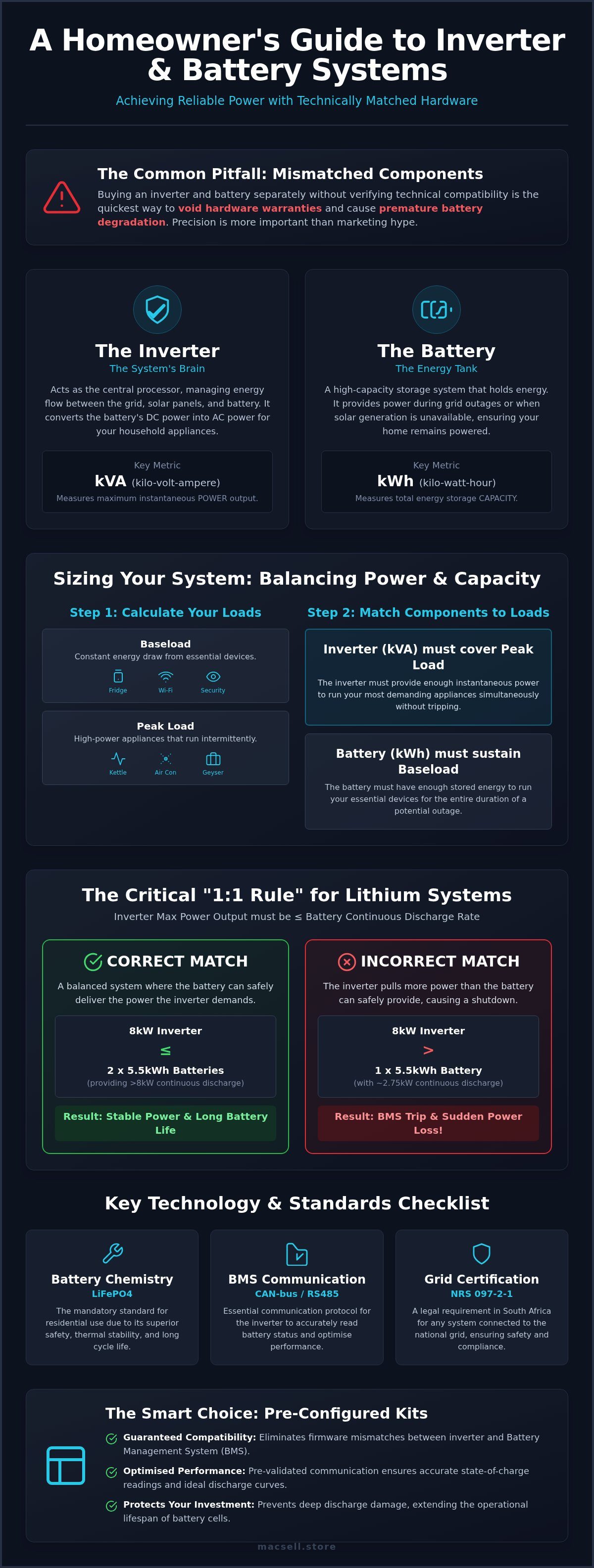
Technology has shifted decisively away from legacy lead-acid and gel batteries. Lithium Iron Phosphate (LiFePO4) is now the absolute requirement for residential hardware due to its superior thermal stability and higher cycle count. In South Africa, hardware must meet strict regulatory standards to ensure safety and grid stability. Every inverter in a residential setup should carry NRS 097-2-1 certification to remain legally grid-tied and compliant with municipal bylaws. This certification ensures the hardware can safely disconnect during a power failure, preventing dangerous feedback into the grid.
Why Buy a Pre-Configured Combo Kit?
Selecting a pre-configured kit eliminates the risk of firmware mismatches between the inverter and the Battery Management System (BMS). When these components are paired by the manufacturer, the communication protocols are pre-validated. This ensures the inverter can accurately read the battery's state of charge and temperature in real-time. These kits also include the necessary high-current cables and specialised communication links required for a safe installation. Proper hardware matching allows for optimised discharge curves. This protection prevents deep discharge damage and extends the operational lifespan of the battery cells, protecting your long-term investment.
The 2026 Energy Landscape: Backup vs. Independence
Energy requirements in South Africa have evolved beyond simple load shedding protection. You must decide if your goal is a basic backup system for essential lights and Wi-Fi or a full off-grid capable installation. Hybrid inverters facilitate this choice by allowing a seamless transition between the grid, battery storage, and solar generation. The hybrid inverter acts as the central gateway for home energy flow. For those seeking total independence, an inverter and battery combo for home use must be sized to handle peak loads without relying on external supply. Conversely, a backup-only setup prioritises battery capacity over inverter throughput to bridge shorter grid outages without the need for immediate solar expansion.
Sizing Your System: Balancing Inverter Capacity with Battery Storage
System sizing requires a precise understanding of two distinct metrics: KVA and KWh. KVA represents the maximum instantaneous power the inverter can deliver to your appliances. KWh measures the total energy stored within your battery bank. Miscalculating the relationship between these two leads to frequent system trips or insufficient backup duration. For a technical foundation on these metrics, the Homeowner's Guide to Solar Plus Storage provides essential data on how storage and power conversion interact within a residential environment.
You must calculate your baseload and peak load separately. Baseload is the constant energy draw from essential devices like refrigerators, security systems, and Wi-Fi routers. Peak load includes heavy resistive loads such as kettles, geysers, or air conditioners that cycle on and off. An 8kW inverter provides the necessary headroom to manage these spikes without shutting down. If you plan to expand your system, choosing an expandable hybrid inverter now prevents the need for a full hardware replacement when your energy needs grow.
The "1:1 Rule" is a mandatory safety standard for lithium-based setups. Your inverter's maximum output shouldn't exceed the continuous discharge rate of your battery bank. For instance, an 8kW inverter pulling full power from a single 5.12kWh battery with a 0.5C discharge rate will likely trigger the battery's Management System (BMS) to trip. This mismatch causes sudden power loss and potential hardware strain. Ensuring your inverter and battery combo for home use is balanced prevents these technical bottlenecks.
The 5kW vs. 8kW Debate for South African Households
The LuxPower SNA5000 is a reliable 5kW entry point for households focusing on essential circuits. It comfortably manages lighting, entertainment systems, and refrigeration. However, the Sunsynk 8KVA has become the preferred choice for larger South African homes. It offers superior load management for geysers and borehole pumps. You can evaluate high-performance inverter and battery kits to see which capacity aligns with your specific distribution board requirements.
Calculating Your Required Battery Autonomy
Usable energy depends heavily on the Depth of Discharge (DoD) settings. While modern lithium batteries allow for 95% DoD, maintaining an 80% limit often maximises the total cycle life of the cells. For a standard 4-hour load shedding window, a 10KWh bank (two 5KWh units) is the recommended standard for an 8KVA system. This provides a sufficient buffer to run essentials and occasional high-draw appliances without depleting the bank to critical levels before the grid returns.
Evaluating Leading Hybrid Inverter Brands: Sunsynk, Deye, and LuxPower
Selecting an inverter and battery combo for home use requires a technical evaluation of the three dominant manufacturers in the South African market: Sunsynk, Deye, and LuxPower. These brands provide the hardware backbone for most high-end residential installations. Sunsynk is the premium choice. It features advanced load management and a highly responsive colour touchscreen. Deye offers a robust alternative. It utilises the same hardware architecture as Sunsynk but targets a more competitive price point with a different software interface. LuxPower remains the favoured choice for off-grid and hybrid versatility, particularly with the SNA5000 series.
Manufacturer reliability is critical for long-term operations. All three brands maintain strong local support networks across South Africa. This ensures technical assistance and warranty processing are accessible. Sunsynk and Deye are hardware siblings. Ningbo Deye Inverter Technology manufactures both. The distinction lies in the firmware and user experience. Sunsynk prioritises a polished, user-centric interface. Deye focuses on industrial-grade reliability for users who prioritise technical performance over aesthetic software design. Both offer high-efficiency power conversion and strict compliance with local grid regulations.
Sunsynk 8KVA: The Smart Home Power Hub
The Sunsynk 8KVA model is a sophisticated energy manager. Its parallel capability allows you to scale your system by connecting multiple units as your power needs grow. One of its most significant technical advantages is the versatile auxiliary (Aux) port. This port allows you to manage non-essential loads, such as pool pumps or geysers, without risking your battery bank during a grid failure. It is widely considered the most stable platform for Hubble AM5+ battery integration. The Sunsynk app allows you to organise your energy usage remotely. You can monitor real-time production, consumption, and battery health from your smartphone with high precision.
LuxPower SNA5000: Value Meets Performance
The LuxPower SNA5000 hybrid inverter is a durable workhorse. It is a favourite for those starting their solar journey on a budget. The technical breakdown of the SNA5000 reveals a high tolerance for South Africa's harsh grid conditions. It functions effectively as a simple backup-only unit or a full hybrid system with solar input. When comparing LuxPower to Sunsynk for simple requirements, LuxPower offers a high cost-to-performance ratio. It lacks some of the advanced smart-load features of the Sunsynk 8KVA; however, it provides consistent, reliable power for essential circuits. It is the practical choice for homeowners who need a functional inverter and battery combo for home use without the premium investment required for high-end smart hubs.
Critical Performance Factors: Discharge Rates, Compatibility, and Efficiency
The technical success of an inverter and battery combo for home use depends on the speed and accuracy of the communication between the two units. Without a robust data link, the inverter cannot monitor individual cell voltages or temperatures. Most modern lithium systems utilise CAN-bus or RS485 protocols to facilitate this exchange. CAN-bus is generally preferred for its higher data transfer speeds and superior noise immunity in residential environments. When the inverter and battery "talk" effectively, the system can dynamically adjust charging currents to prevent cell imbalance and overcharging.
BMS Communication: The Key to Lifespan
The Battery Management System (BMS) acts as the safety controller for your energy storage. High-performance units like the Hubble AM5+ 5.12kWh are specifically engineered to integrate with Sunsynk firmware via a dedicated communication link. This deep integration ensures the inverter receives precise data, allowing it to maximise the battery's cycle life. If communication fails, the system often reverts to "voltage-based" charging. This is a high-risk state where the inverter guesses the state of charge based on terminal voltage, which often leads to inaccurate readings and potential battery damage. You can browse compatible lithium battery kits to ensure your hardware communication is pre-validated.
Discharge Rates and Load Spikes
Understanding "C-Ratings" is essential for managing heavy household loads. A battery with a 0.5C rating can only discharge half of its total capacity in one hour. If you have a 5.12kWh battery with a 0.5C limit, your maximum continuous draw is roughly 2.56kW. Attempting to run a 3kW kettle whilst a microwave is active will exceed this limit, causing the BMS to trip the system to protect the cells. A 1C rating allows a battery to discharge its full capacity in one hour. Organising your loads involves distinguishing between continuous power and surge power requirements. High-surge appliances like borehole pumps require batteries with high burst discharge capabilities to avoid nuisance tripping during startup.
Round-trip efficiency is another critical metric. This measures the energy lost during the AC-to-DC conversion when charging and the DC-to-AC conversion during discharge. High-quality hybrid inverters typically achieve over 95% efficiency, but poor thermal management can degrade these figures. Heat is the primary enemy of lithium chemistry. Inverter placement should prioritise ventilation to prevent the unit from derating its output or heating the adjacent battery bank. Maintaining a stable operating temperature ensures the inverter and battery combo for home use operates at peak efficiency whilst preserving the integrity of the internal components.
Procuring Your Hardware: Pre-Configured Kits for Energy Independence
Hardware procurement is the final technical step toward residential energy independence. MacSell Solar Outlet operates as a specialised "Hardware Only" distributor. This model serves clients who have already secured an independent installer and require high-end components without bundled service markups. Selecting an inverter and battery combo for home use through a dedicated retailer ensures you receive current 2026 stock with full manufacturer warranty support. Our nationwide logistics team manages national delivery for heavy lithium units to ensure hardware arrives in peak condition across South Africa.
A final technical checklist is mandatory before purchase. You must verify that your installation site has the structural integrity to support wall-mounted inverters and floor-standing battery racks. Ventilation is equally critical. High-capacity systems generate significant heat during peak inversion and charging cycles. Ensure your chosen installer is qualified to issue a Certificate of Compliance (CoC). This document is the only way to validate your warranty and ensure your insurance coverage remains active after the hardware is integrated into your home grid.
Featured Hardware: The Sunsynk & Hubble AM5+ Combo
The Sunsynk 8KVA and Hubble AM5+ pairing is the current national benchmark for residential power. This kit provides substantial total storage capacity — sufficient usable energy to bridge extended 4-hour outages whilst maintaining high-draw appliances. The technical synergy between Sunsynk firmware and the Hubble AM5+ Battery Management System (BMS) is pre-validated. This eliminates the communication errors common in mismatched systems. Using this approved combo protects your investment by ensuring both components operate within their designed thermal and electrical parameters.
Next Steps: From Procurement to Power
Ordering your system is a streamlined transactional process. You can browse our inventory and select the specific kit that matches your calculated peak load requirements. Once your order is confirmed, our logistics team organises secure transport for your lithium batteries and hybrid inverters. Prepare your premises by clearing a dedicated space near your main distribution board. This area must be dry, dust-free, and away from direct sunlight to maintain optimal operating temperatures for the lithium cells.
Shop Inverter & Battery Combos at MacSell Solar Outlet
Pre-validated hardware pairings with national delivery across South Africa — no installation contract required.
→ Shop Sunsynk 8KVA & Hubble Combo Kit
→ Shop Hubble AM5+ 5.12kWh Battery
→ Shop Sunsynk 8kW Lynks Hybrid Inverter
→ Browse All Inverter & Battery Combos
Secure Your Energy Future with Validated Hardware
Achieving residential energy independence requires a calculated approach to hardware selection. You now understand the technical necessity of balancing inverter throughput with battery discharge rates and the critical role of BMS communication. Choosing a pre-configured inverter and battery combo for home use eliminates the risks associated with firmware mismatches and warranty voids. By prioritising high-performance brands like Sunsynk, Deye, and LuxPower, you ensure your system remains efficient under heavy South African loads.
MacSell Solar Outlet acts as your authorised Sunsynk and Hubble hardware retailer. We provide specialised technical hardware kits designed for precision and longevity. Our logistics team handles national delivery across South Africa, ensuring your components arrive ready for a professional sign-off. Focus on procurement that supports your long-term energy goals and technical requirements. Selecting the right hardware today prevents costly upgrades tomorrow.
Browse our range of high-performance Inverter and Battery Combos
Frequently Asked Questions
Can I add more batteries to my inverter and battery combo later?
Yes, you can expand your storage capacity provided the new units are compatible with your existing Battery Management System. Modern lithium batteries, such as the Hubble AM5+, support parallel connections to increase total KWh. It is technically superior to add identical battery models to ensure balanced charging and discharge cycles across the entire bank.
What is the difference between a hybrid inverter and a standard backup inverter?
A hybrid inverter manages power from solar panels, the national grid, and battery storage simultaneously, whilst a standard backup inverter only manages the link between the grid and batteries. Hybrid units allow for energy blending, which reduces grid reliance by prioritising solar production. They are the required hardware for any homeowner planning future solar expansion.
How long will a 5.12kWh Hubble AM5+ battery last during a power cut?
Runtime depends entirely on your specific household load during the outage. A 5.12kWh battery offers approximately 4.1kWh of usable energy when set to an 80% Depth of Discharge. This capacity supports a constant 500W baseload for roughly 8 hours, or a heavier 2kW load for approximately 2 hours before reaching the cut-off limit.
Is the LuxPower SNA5000 compatible with all lithium battery brands?
No, the LuxPower SNA5000 requires batteries that support its specific communication protocols via CAN-bus or RS485. Whilst it is a versatile hybrid unit, it performs most reliably when paired with established brands like Hubble or Deye. Always verify the manufacturer's compatibility list to ensure the inverter can accurately monitor cell voltages and temperatures.
Why is it better to buy an inverter and battery combo instead of individual components?
Purchasing an inverter and battery combo for home use ensures that the hardware firmware and communication links are pre-validated for technical compatibility. This eliminates the risk of BMS communication failures that often lead to inefficient charging or system trips. Pre-configured kits also include the correct high-current DC cables and communication leads required for a safe installation.
Does the Sunsynk 8KVA inverter require a specific type of lithium battery?
The Sunsynk 8KVA is designed to work with 48V Lithium Iron Phosphate (LiFePO4) batteries that utilise CAN-bus communication. The Hubble AM5+ is the preferred pairing in South Africa due to its specialised firmware integration with Sunsynk. Using non-approved batteries may force the system into "voltage-based" charging, which reduces accuracy and can void hardware warranties.
What is the expected lifespan of a lithium-ion solar battery in 2026?
Modern lithium-ion batteries like the Hubble AM5+ are rated for unlimited cycles with LiFePO4 chemistry. In a standard residential setup, this provides a functional lifespan well beyond 15 years. You can maximise this duration by ensuring the inverter and battery combo for home use is installed in a well-ventilated area to maintain stable operating temperatures.
Can I use an inverter and battery combo without solar panels?
Yes, these systems function effectively as grid-tied backup solutions without any solar input. The inverter charges the battery bank from the utility grid when power is available and automatically switches to battery power during load shedding or grid failures. This hardware configuration allows for an immediate backup solution whilst remaining ready for solar panel integration at a later date.