

Lithium Ion Solar Battery Technology: The Complete 2026 Hardware Guide
South Africa’s current energy landscape requires that the raw capacity of a lithium ion solar battery matters far less than how quickly it can recover between load shedding cycles. If your setup fails to reach a full charge during a narrow two-hour window, you aren't just losing power; you're actively degrading your hardware. You’ve likely realised that traditional lead-acid batteries are no longer fit for purpose, often failing within 24 months under the strain of constant cycling. It's time to transition to a more robust, technically superior architecture.
This hardware guide ensures you master the technical specifications required to achieve genuine energy independence. You'll learn how to distinguish between 12V and 48V requirements and why specific discharge rates are critical for seamless hybrid inverter integration. We provide a detailed breakdown of the technical parameters for 2026 hardware, including the Sunsynk 8KVA and Hubble AM2 5.5 KWh systems. This analysis moves directly from hardware compatibility to long-term performance metrics, ensuring your system maintains its integrity for over 10 years.
Key Takeaways
- Learn why LiFePO4 chemistry is the preferred standard for South African households requiring high-density storage and rapid recharge.
- Understand how to calculate backup duration by evaluating lithium ion solar battery capacity in kWh rather than just Amp-hours.
- Identify the 2026 performance benchmark of 6,000 cycles at 80% Depth of Discharge to ensure a system lifespan exceeding 10 years.
- Master hardware requirements for 12V, 24V, and 48V systems to ensure seamless compatibility between batteries and hybrid inverters.
- Discover the technical synergy of pre-configured hardware kits, such as the Sunsynk 8KVA and Hubble AM2 pairing, for maximum reliability.
Understanding Lithium Ion Solar Battery Technology for 2026
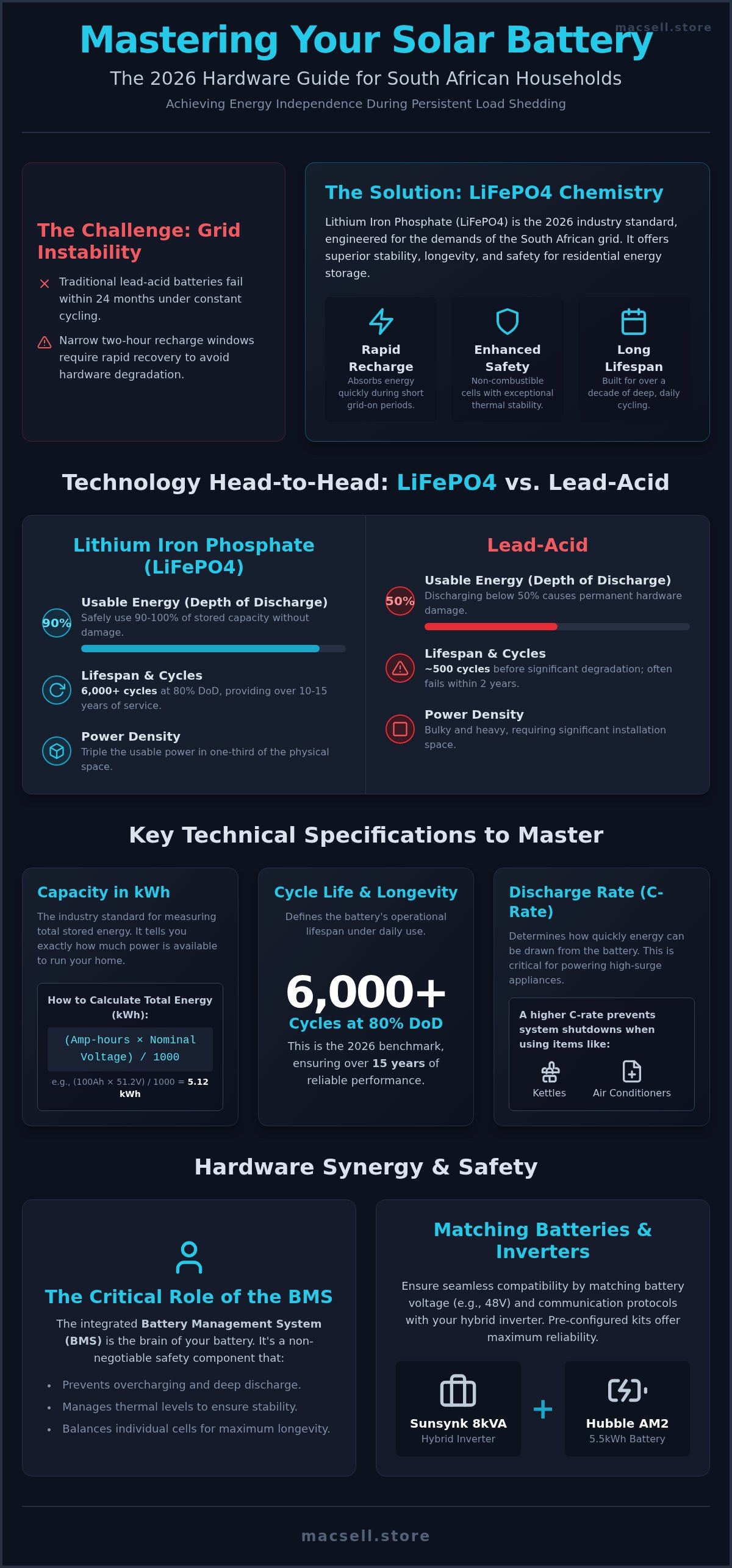
A lithium ion solar battery represents the current pinnacle of high-density energy storage for residential use. In 2026, the technology is defined by Lithium Iron Phosphate (LiFePO4) chemistry. This specific chemical structure provides the stability and longevity required for the harsh cycling demands of the South African grid. It's the favourite hardware choice for local households because it survives the relentless schedule of load shedding that typically destroys traditional alternatives. Unlike older technologies, these units are designed for deep, frequent discharges without immediate loss of capacity.
Modern lithium-ion battery technology integrates a sophisticated Battery Management System (BMS) directly into the hardware casing. The BMS is a critical safety component. It regulates individual cells to prevent overcharging, manages thermal levels, and ensures the battery doesn't discharge beyond safe limits. This internal intelligence allows for rapid charging capabilities whilst maintaining total system stability. You gain a low-maintenance solution that delivers high energy density in a compact form factor, allowing for more power in a smaller footprint.
The Shift from Lead-Acid to Lithium-Ion
The transition from lead-acid to lithium-ion is driven by hardware efficiency and usable power. Lithium units occupy roughly one-third of the physical space of lead-acid banks whilst providing triple the usable power. Lead-acid batteries suffer permanent damage if discharged below 50% of their capacity. In contrast, a lithium ion solar battery regularly handles a 90% to 100% Depth of Discharge without rapid degradation. Lithium technology also lacks the "memory effect" found in older battery types. You don't need to worry about partial charge cycles; the battery maintains its full capacity regardless of when you reconnect it to the inverter.
Why LiFePO4 is the Industry Standard for Safety
LiFePO4 chemistry is the non-negotiable standard for indoor solar installations in 2026. It offers exceptional thermal stability. Unlike other lithium variants, LiFePO4 cells are non-combustible. They don't react violently to high-temperature behaviour or internal short circuits. This makes the lithium ion solar battery safe for placement in garages, cupboards, or utility rooms within a home. It's a robust solution that prioritises hardware integrity and user safety. By choosing this chemistry, you ensure your energy system remains stable even during high-demand periods or extreme environmental conditions.
Key Technical Specifications: Capacity, Cycles, and C-Rates
Battery capacity measures total stored energy, typically expressed in kilowatt-hours (kWh) for residential systems. While smaller units or portable power stations might still use Amp-hours (Ah), kWh is the industry standard for 2026 hardware. This metric tells you exactly how much energy is available to run your home. Cycle life defines hardware longevity. A quality lithium ion solar battery should offer a benchmark of 6,000 cycles at 80% Depth of Discharge (DoD). This ensures the unit remains functional for over 15 years under daily cycling conditions. Reviewing the technical data sheets for premium lithium batteries allows you to verify these ratings before purchase.
C-rates determine the speed at which energy is pulled from the cells. This specification is often overlooked but dictates whether your system can handle high-surge appliances like kettles or air conditioners. In modern Solar-plus-storage systems, the interaction between the battery's discharge rate and the inverter's capacity determines which appliances stay on during an outage. A battery with a low C-rate may shut down or trigger an inverter fault if the load exceeds its instantaneous output capability, regardless of how much total energy remains stored.
Calculating Usable Energy and DoD
To calculate capacity, multiply the Amp-hour (Ah) rating by the nominal voltage. For a 51.2V system with 100Ah, the calculation is (100 × 51.2) / 1000, resulting in 5.12kWh of total energy. Depth of Discharge is the percentage of the battery that can be used without causing damage. While 100% discharge is technically possible with LiFePO4 chemistry, maintaining an 80% DoD buffer significantly extends the hardware's operational life. Consistently draining a unit to 0% increases internal stress and may void certain manufacturer warranties.
Understanding C-Rates for High-Load Appliances
The difference between a 0.5C and a 1C discharge rate is fundamental for South African households. A 5.5kWh battery with a 0.5C rating can only output 2.75kW of power at any given moment. Conversely, a 1C rated battery of the same capacity can deliver a full 5.5kW load. If you intend to run heavy appliances, a 1C rating is the necessary hardware standard. Typical household loads include:
- Electric Kettle: 2.0kW to 3.0kW
- Air Conditioner (9000 BTU): 1.2kW to 1.8kW
- Washing Machine (Heating cycle): 2.0kW to 2.5kW
- Borehole Pump: 0.75kW to 1.5kW
- LED Lighting and Entertainment: 0.2kW to 0.5kW
Selecting a battery with a 1C discharge rate ensures that even a single 5.5kWh unit can support a kettle and basic lighting simultaneously without compromising the internal cells.
Comparing Battery Voltages: 12V, 24V, and 48V Systems
Selecting the correct voltage for your lithium ion solar battery system determines the overall efficiency and scalability of your hardware. Voltage choice dictates the thickness of your cabling and the compatibility of your inverter. High-voltage systems, typically 48V or 51.2V, are the professional standard for residential backup in South Africa. Higher voltage reduces the current required to deliver a specific power load, which minimises heat loss and allows for thinner, more manageable cable gauges. This efficiency is vital when running high-load appliances that would otherwise require dangerously thick copper wiring in a lower-voltage setup.
While 12V and 24V options exist, they're generally restricted to specific niche applications. A 48V architecture allows for a more streamlined installation with lower resistive losses. This technical configuration ensures that your lithium ion solar battery operates within optimal thermal parameters, even during rapid charging cycles between power outages. Modern hybrid systems almost exclusively utilise the 48V standard to maintain hardware stability and ensure seamless integration across different component brands.
The 48V Standard for Modern Hybrid Inverters
Professional-grade hybrid inverters, such as Sunsynk and Deye, require 48V battery banks to function at peak efficiency. These systems rely on sophisticated communication protocols to manage energy flow. Scalable rack-mount units, like the Hubble AM2, use CAN bus or RS485 ports to establish "closed-loop" communication with the inverter. This connection allows the battery to dictate its own charging parameters based on real-time cell data, rather than the inverter guessing the state of charge. This precision prevents overcharging and ensures the battery reaches its full 6,000-cycle potential.
When to Choose 12V or 24V Lithium Units
12V lithium hardware is best suited for small-scale applications like gate motors, alarm systems, or portable camping setups. These units are often "drop-in" replacements for lead-acid batteries in existing low-draw systems. 24V systems serve as a middle ground for small cabins or medium-sized UPS setups, but they lack the scalability of 48V racks. Attempting to scale a 12V or 24V system for a full house is inefficient; the cost-per-kWh is frequently higher because these smaller units don't benefit from the advanced BMS and high-volume manufacturing found in 48V professional hardware. If your goal is energy independence, 48V is the only logical technical choice.
Selecting Hardware: Matching Batteries to Your Inverter
Matching a lithium ion solar battery to an inverter is a technical requirement that ensures system safety and performance. The primary verification step involves checking the communication protocol. Without a compatible CAN or RS485 link, the inverter cannot read the battery's State of Charge (SoC) accurately. This forces the system into "open-loop" operation, where it relies on voltage measurements that are notoriously inaccurate for lithium chemistries. A mismatch here leads to inefficient charging and potential hardware shutdowns during critical load shedding periods.
You must also align the continuous discharge current of the battery bank with the peak demand of the inverter. An 8kW hybrid inverter can pull approximately 160A at a nominal 48V. If your single lithium ion solar battery is only rated for a 100A continuous discharge, the BMS will trip the circuit when you attempt to run heavy appliances. To prevent this, you may need to parallel multiple battery units to ensure the combined discharge capacity meets or exceeds the inverter's maximum throughput. Verifying these specifications on the manufacturer data sheet is the only way to guarantee a stable power supply.
Compatibility with Sunsynk, Deye, and LuxPower
Sunsynk and Deye hybrid inverters are the most popular choices amongst South African solar enthusiasts. These units offer advanced firmware that supports a wide variety of battery communication profiles. LuxPower SNA5000 units also provide excellent versatility, allowing for seamless integration with various lithium protocols via dedicated communication ports. MacSell Solar Outlet specialises in these specific hardware pairings to ensure reliable performance. Investing in a pre-configured inverter and battery combo for home use eliminates the risk of communication errors and simplifies the commissioning process.
Physical Installation and Environment
The physical environment dictates the efficiency of your energy storage. A cool, dry centre for your battery bank is essential to prevent thermal derating, which occurs when the BMS limits performance to manage internal heat. Wall-mounted units offer a compact footprint for residential garages, whereas floor-standing racks are better suited for larger systems that require multiple battery modules. Ambient temperature significantly influences the chemical behaviour and efficiency of lithium cells. In South Africa, hardware should be installed in well-ventilated areas away from direct sunlight. Excessive heat causes the BMS to reduce charging speeds, which can prevent your system from reaching a full charge between power outages.
View our current stock of compatible lithium batteries and hybrid inverters to ensure your hardware components are perfectly matched for high-performance backup.
Procuring Premium Lithium Solar Batteries in South Africa
Procuring a lithium ion solar battery in 2026 requires a shift from general retail to hardware-specific procurement. South African consumers must prioritise stock availability and technical accuracy to avoid the delays common in the energy sector. Purchasing from a hardware specialist like MacSell Solar Outlet ensures you receive components that are verified for compatibility. This transactional efficiency is vital for those who have already secured an installer or are performing a DIY upgrade. National delivery across South Africa remains a core requirement for heavy hardware units that require specialised handling.
Price transparency is a critical factor in 2026. You should evaluate the lithium battery price based on the cost-per-cycle rather than the initial ZAR outlay. A battery that costs less upfront but only offers 2,000 cycles is significantly more expensive over a ten-year period than a premium unit. High-performance hardware maintains its value through long-term reliability and lower degradation rates. After-sales hardware support is equally important; ensure your distributor has direct channels to the manufacturer for firmware updates and technical queries.
Why the Sunsynk 8KVA and Hubble AM2 Combo is the 2026 Favourite
The Sunsynk 8KVA & 2X Hubble AM2 5.5 KWh Combo Kit has emerged as the preferred hardware pairing for residential systems. Each Hubble AM2 unit provides a 5.5kWh capacity and features a high-performance BMS capable of managing rapid charge cycles. The 8KVA Sunsynk inverter is technically robust, allowing it to manage multiple battery inputs for large homes with high peak demands. This kit provides a pre-configured solution that eliminates the trial-and-error often associated with mixing different hardware brands. MacSell Solar Outlet maintains stock of these specific pairings to facilitate immediate procurement and deployment.
Final Checklist for Your Lithium Battery Purchase
Before finalising your energy system upgrade, use this hardware checklist to ensure long-term performance. Every lithium ion solar battery purchase should meet these minimum criteria:
- Warranty Terms: Confirm a minimum 10-year warranty or 6,000 cycles at 80% Depth of Discharge.
- Local Technical Support: Verify that the brand has a physical presence in South Africa for hardware claims.
- Communication Cables: Ensure the correct CAN or RS485 cables are included for your specific inverter brand.
- Delivery Logistics: Confirm the distributor can deliver heavy lithium units safely to your province.
- Scalability: Check that the battery model allows for the addition of more units in parallel for future expansion.
By following these technical parameters, you secure a system that delivers consistent power for over a decade. Focus on hardware synergy and technical specifications to achieve genuine energy independence in the South African market.
Future-Proofing Your Energy Independence with Professional Hardware
Transitioning to a high-performance lithium ion solar battery system requires precision in hardware selection. You now understand that 48V architecture and 1C discharge rates are non-negotiable standards for modern South African households. By prioritising closed-loop communication and LiFePO4 chemistry, you ensure a system lifespan exceeding 15 years. Technical synergy between your hybrid inverter and battery bank remains the foundation of a reliable backup solution. Avoid the inefficiencies of mismatched components by opting for expert-curated solar combo kits designed for the 2026 grid environment.
MacSell Solar Outlet serves as an official Hubble and Sunsynk hardware retailer, providing national delivery across South Africa. We specialise in supplying the exact components needed for robust energy storage without unnecessary operational fluff. Our inventory focuses on technical accuracy and immediate availability for DIY-capable users and professionals alike. Browse our full range of high-performance lithium batteries at MacSell Solar Outlet to secure your hardware today. You're now equipped to make an informed technical decision for your home’s energy future.
Frequently Asked Questions
How long does a lithium ion solar battery actually last?
A quality lithium ion solar battery lasts between 10 and 15 years under standard daily cycling conditions. Most premium hardware is rated for 6,000 cycles at an 80% Depth of Discharge. This longevity far exceeds traditional lead-acid alternatives, which often fail within 24 months when subjected to the frequent load shedding cycles common in South Africa.
Is the lithium battery price justified compared to lead-acid?
The lithium battery price is justified by a significantly lower total cost of ownership over the system's lifespan. While the initial ZAR investment is higher, lithium units provide triple the usable energy and ten times the cycle life of lead-acid banks. You'll likely replace lead-acid batteries five times before a single lithium unit reaches its end of functional life.
Can I mix different brands of lithium batteries in one system?
You cannot mix different brands or chemistries of lithium batteries in a single parallel bank. Communication protocols vary between manufacturers, and mismatched internal resistances will cause uneven charging and premature cell failure. Always use identical hardware models, such as multiple Hubble AM2 units, to ensure the Battery Management System (BMS) functions correctly across the entire string.
What is the difference between a 1C and a 0.5C battery?
A 1C battery can discharge its entire rated capacity in one hour, whereas a 0.5C battery takes two hours. For a 5.12kWh unit, a 1C rating provides 5.12kW of instantaneous power; a 0.5C rating provides only 2.56kW. High-surge appliances like kettles or borehole pumps require the higher discharge capability of a 1C rated unit to avoid system trips.
Does a lithium ion solar battery require any regular maintenance?
A lithium ion solar battery requires zero active maintenance after the initial professional installation. Unlike lead-acid technology, there's no need for water top-ups or equalisation charges. The internal BMS automatically handles cell balancing and thermal regulation. You only need to ensure the installation centre remains clean, dry, and well-ventilated to prevent thermal derating during high-demand periods.
Can I use a lithium battery with my old non-hybrid inverter?
You can use lithium batteries with older non-hybrid inverters if the inverter supports custom voltage settings for bulk and float charging. However, you'll lose "closed-loop" communication, which means the inverter cannot receive real-time data from the battery BMS. This setup is less efficient and may reduce the hardware's lifespan compared to using a modern Sunsynk or Deye hybrid inverter.
How many lithium batteries do I need to run a standard house during load shedding?
A standard South African household typically requires at least two 5.5kWh lithium batteries to maintain essential services during a four-hour load shedding block. This capacity supports refrigerators, LED lighting, security systems, and basic entertainment. If you intend to run climate control, pool pumps, or electric ovens, you'll need to expand the bank to three or more units.
What happens if my lithium battery reaches 0% charge?
Reaching a true 0% charge triggers the BMS to shut down the hardware to prevent permanent chemical damage. Whilst the unit can often be recovered by a "jump-start" charge from a compatible solar controller, frequent deep discharges below safe limits will accelerate degradation. Consistently draining a unit to 0% may also void specific manufacturer warranties depending on the hardware brand.