
Deye Inverter Price South Africa: 2026 Hardware and Specification Guide
The true value of a solar installation isn't found on a simple price tag; it's hidden in the hardware compatibility and conversion efficiency. You've likely spent hours deciphering the difference between kW and kVA whilst trying to stay ahead of the next load shedding cycle. Finding a transparent Deye inverter price South Africa remains a challenge due to market volatility and confusing technical jargon. It's frustrating when you just need a reliable power solution that won't become obsolete before the 30 September 2026 SSEG fee waiver deadline.
This guide provides a clinical breakdown of the Deye hybrid range for 2026. We strip away the marketing hype to focus on raw specifications, MPPT efficiency, and hardware integration with components like Hubble AM-5+ You'll get a direct price-to-performance comparison across 5kW, 8kW, and 12kW models to help you organise a robust energy system. We're categorising every unit by its technical merit to ensure your hardware achieves long-term energy independence without unnecessary expenditure. This is about technical precision and hardware that works.
Key Takeaways
- Identify the functional benefits of hybrid technology for managing solar, battery, and grid power simultaneously in the South African context.
- Evaluate hardware upgrades in the 2026 V3 series, including improved surge capacity and expanded communication port options.
- Compare the Deye inverter price South Africa across various wattage tiers to determine the most efficient price-to-performance ratio for your system.
- Optimise system integration by ensuring precise BMS communication between Deye hardware and Hubble AM-5+ lithium batteries.
- Learn to verify technical specifications and hardware compatibility before procurement to ensure a seamless power transition.
Understanding Deye Hybrid Inverter Technology in South Africa
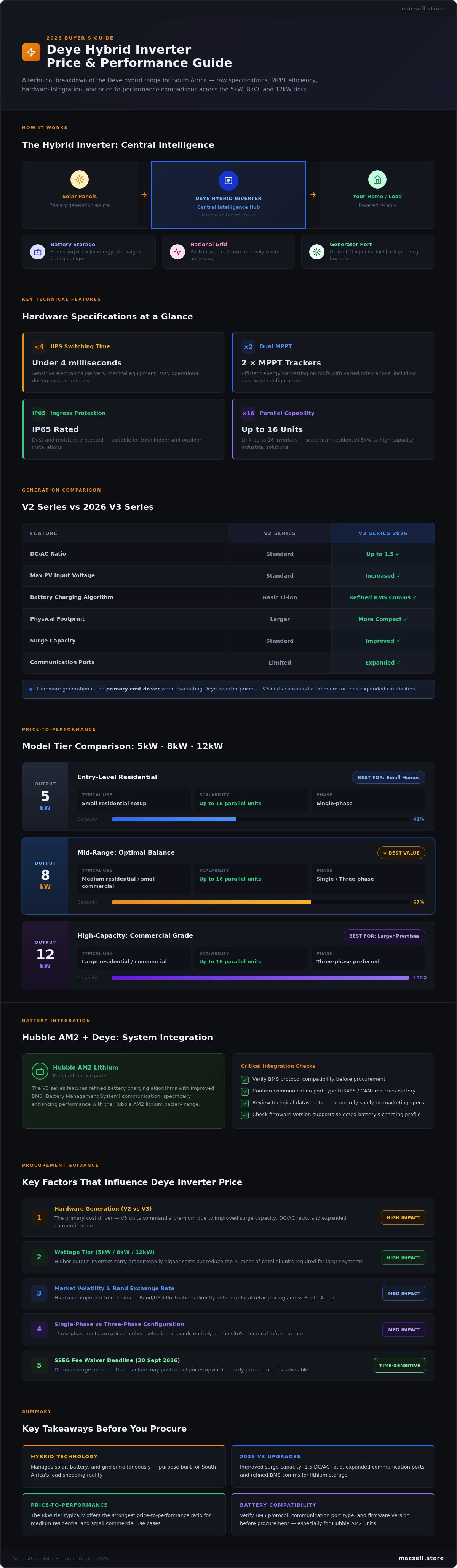
A hybrid inverter acts as the central intelligence of a modern power system. It manages energy flow between solar panels, lithium batteries, and the national grid simultaneously. This differs from traditional solar inverter technology which typically focuses on a single power source. Deye has secured its position as a market leader in South Africa by offering hardware that balances technical sophistication with practical reliability. The Deye ecosystem is extensive. It spans from compact micro-inverters for small residential setups to high-capacity commercial units, ensuring the Deye inverter price South Africa remains competitive across different market segments.
The brand's success amongst local enthusiasts stems from its hardware's ability to handle the specific rigours of the South African grid. Every unit is designed to operate as a multi-functional hub. It prioritises solar consumption, stores excess energy in batteries, and only draws from the grid when necessary. This logic is hard-coded into the firmware to maximise efficiency and reduce reliance on external power providers.
The Hybrid Advantage for Load Shedding
Reliability during grid instability is a primary driver for the Deye inverter price South Africa consumers are willing to pay. These units feature Uninterruptible Power Supply (UPS) functionality with a switching time of less than 4 milliseconds. This ensures sensitive electronics, such as servers or medical equipment, remain operational during sudden outages. Deye hardware includes a dedicated port for generator integration. This allows the system to charge batteries or power loads using a fuel-based backup during prolonged periods of low solar production. The inclusion of dual Maximum Power Point Trackers (MPPT) allows for efficient energy harvesting on roofs with varied orientations, such as east-west configurations.
Hardware Durability and Build Quality
Environmental resistance is a core feature of the Deye range. Most models carry an IP65 ingress protection rating. This makes the hardware suitable for both indoor and outdoor installations by protecting internal components from dust and moisture. Thermal management is equally robust. While smaller units utilise passive cooling to reduce noise, larger 2026 models feature intelligent fan-assisted systems to maintain optimal temperatures during high-load periods. The user interface has evolved significantly. The latest hardware prioritises high-resolution touchscreen LCDs. This allows for direct on-device configuration whilst supporting remote monitoring via mobile applications. This level of control is essential for managing sophisticated setups involving Hubble AM-5+ or other compatible storage solutions.
Deye Inverter Specifications: Comparing Hardware Generations
Hardware iterations in the Deye range reflect the maturing energy market in the region. The transition from the V2 series to the 2026 V3 models marks a significant shift in internal architecture and processing power. These upgrades are designed to align with the South African Renewable Energy Masterplan, which emphasises the need for robust grid integration and scalable storage solutions. One of the most critical hardware features across both generations is the parallel capability. Deye inverters allow for the linking of up to 16 units in a single system. This modularity means a residential 5kW setup can scale into a high-capacity industrial solution as energy requirements grow. When evaluating the Deye inverter price South Africa retailers offer, the hardware generation is often the primary cost driver.
Technical Differences: V2 vs V3 Models
The V3 series introduces several hardware enhancements over its predecessor. The DC/AC ratio has been optimised; many V3 models now support a ratio of 1.5, allowing for a significantly larger solar array relative to the inverter's rated output. Maximum PV input voltage has also seen an increase in specific models, which accommodates longer strings of high-efficiency panels. Battery charging algorithms have been refined to improve communication with lithium-ion storage, specifically enhancing the performance of high-end units like the Hubble AM-5+. Physically, the V3 hardware is slightly more compact, though it retains the rugged IP65 enclosure. If you are looking to secure hardware that matches these modern specifications, you can browse our current hybrid inverter inventory to compare available generations and technical datasheets.
Single-Phase vs Three-Phase Requirements
Selecting the correct hardware depends entirely on the electrical infrastructure of the property. Single-phase units, typically the 5kW and 8kW models, remain the standard for South African residential applications. They provide sufficient capacity for essential loads and standard household appliances. Three-phase hardware, such as the 12kW, 30kW, and 50kW units, is required for commercial properties or homes with heavy-duty machinery and borehole pumps. Both hardware types offer the following configuration flexibility:
- Grid-Tie Mode: Feeds excess solar energy back into the grid where municipal regulations allow.
- Off-Grid Mode: Operates independently of the utility provider, relying solely on solar and battery reserves.
- Hybrid Mode: Simultaneously manages grid, solar, and battery power to ensure the lowest possible Deye inverter price South Africa users face in long-term operational costs.
The 2026 hardware also features improved surge capacity, which is vital for starting inductive loads like air conditioners or refrigeration units during a power failure. This technical resilience ensures the inverter doesn't trip when high-draw appliances initiate.
Factors Influencing Deye Inverter Prices in 2026
The Deye inverter price South Africa consumers encounter is dictated by several macro-economic variables. Global supply chain dynamics remain the primary driver, as the cost of raw semiconductor materials and power electronics fluctuates based on international demand. Local hardware costs also include a combination of sea freight, insurance, and South African import duties. While the hardware itself is manufactured abroad, the final retail price reflects these logistical layers. Purchasing "Inverter Only" units provides the lowest entry cost, but "Combo Kits" often reduce the total cost-per-watt by bundling compatible lithium storage and protection components into a single transactional unit.
Wattage vs Cost: Finding the Sweet Spot
Selecting the correct capacity requires balancing initial capital expenditure against long-term energy needs. Entry-level 5kW units are priced between R16,000 and R20,000. These are ideal for basic backup systems that power essential circuits like lights, routers, and entertainment systems. The 8kW model is the most popular residential choice, typically retailing between R25,000 and R32,000. It offers enough headroom for heavy appliances such as kettles or microwaves without tripping the system. For large-scale residential loads or small businesses, the 12kW and 16kW units provide high-capacity throughput. The 12kW models range from R40,000 to R50,000, whilst the 16kW units sit between R50,000 and R60,000. These high-end models justify their investment through their ability to manage complex, multi-phase loads and large solar arrays.
Market Trends and Availability
Predicting price stability involves monitoring both currency performance and national infrastructure developments. The Rand's volatility against the US Dollar directly impacts the landing cost of renewable hardware. Research into the prospects for renewable energy in South Africa suggests that as grid infrastructure challenges persist, the demand for hybrid systems will maintain a steady price floor throughout the 2026 fiscal year. Local stock availability also plays a role. National distributors with established warehouse pipelines can often mitigate sudden price spikes caused by shipping delays. The value proposition of V2 units remains strong for budget-conscious buyers, whilst the V3 hardware commands a premium due to the improved specifications and surge capacities detailed in previous sections.
Battery Compatibility and System Integration
Efficiency in a hybrid system depends on the communication between the inverter and the storage medium. Deye hardware utilises sophisticated Battery Management System (BMS) protocols to ensure the inverter receives real-time data regarding voltage, current, and cell temperature. This integration is vital when configuring Deye hardware to work with Hubble AM-5+ Without active BMS communication, the system defaults to voltage-based charging, which is less accurate and can lead to premature cell degradation. Matching the inverter's maximum discharge rate with the battery's continuous discharge rating is critical for hardware longevity. Whilst the Deye inverter price South Africa market fluctuates, the technical necessity of matching discharge rates remains constant for system stability. If the demand exceeds the battery's capability, the BMS will trigger a protective shutdown, causing a total power loss.
Optimising with Hubble and Sunsynk Components
Technical setup for CAN-bus or RS485 communication is straightforward but requires precise pin-out alignment. Most modern lithium units, such as the Hubble AM-5+, use the CAN-bus port for high-speed data transfer. You must manually configure the "Battery Charge" and "Discharge" limits within the Deye settings to align with the manufacturer's warranty specifications. For example, the Sunsynk 8KVA and Hubble AM5 combo serves as a technical benchmark for residential systems. It demonstrates how perfectly synchronised hardware can maintain a 100% Depth of Discharge (DoD) whilst protecting the lithium cells from over-current events. To achieve this level of integration, you can browse pre-configured combo kits that have been tested for protocol compatibility.
Scalable Storage Solutions
Deye's architecture supports the parallel addition of battery banks without compromising inverter efficiency. You can start with a single 5.5kWh module and expand the capacity as your energy requirements grow. System health is monitored via the Solarman or Deye Cloud applications, providing granular data on energy production and consumption patterns. The "Time of Use" function allows you to prioritise load shedding protection during specific windows or maximise solar self-consumption. By managing load priorities, such as disabling non-essential geysers during low solar periods, you protect the battery's State of Charge (SoC). This strategic approach ensures the system remains operational during extended outages whilst maintaining the health of the lithium-ion chemistry.
Procuring Deye Hardware: Selection and Logistics
Efficient energy procurement relies on technical accuracy and logistical reliability. Choosing a hardware-focused outlet for solar components allows for greater transparency in the Deye inverter price South Africa consumers pay. By stripping away the overhead of installation services, you secure the hardware at direct market rates. This approach is ideal for contractors or property owners who already have access to qualified electrical professionals. National delivery logistics for these units are complex. A 16kW hybrid inverter or a 5.5kWh lithium battery is a heavy, high-value asset. Ensuring the courier has experience with fragile electronics is essential for maintaining the integrity of the hardware during transit.
Hardware-Only Procurement vs Full Service
Procuring hardware directly can significantly reduce the total capital expenditure of a solar project. Many full-service providers add a significant markup to the base cost of the inverter. By sourcing the unit yourself, you control the budget and the specific hardware generation you receive. It's vital to ensure your independent installer is familiar with Deye architecture. This includes the configuration of parallel systems and the specific BMS communication protocols discussed in previous sections. For a broader comparison of available hardware, consult our Hybrid Inverter Price South Africa: 2026 Hardware Buying Guide to see how Deye compares to other market leaders in the 2026 fiscal year.
Final Checklist for Your Deye Purchase
Technical verification before completing a purchase prevents costly compatibility errors. You must confirm that the MPPT voltage range of the chosen model aligns with the total VOC (Voltage Open Circuit) of your solar panel array. Incorrect string sizing can lead to underperformance or hardware damage. Always check the inventory list for included accessories. A standard Deye unit should include a Wi-Fi dongle for remote cloud monitoring and a CT clamp for managing grid-tie functions. Finally, verify that the unit carries a local manufacturer warranty. In the South African market, a 5 to 10-year warranty is standard, but it must be supported by a local service centre to avoid international shipping delays during a claim.
Shop Deye Inverters and Solar Hardware at MacSell
Deye V2 and V3 hybrid inverters in stock — single-phase and three-phase options with national delivery across South Africa.
→ Shop All Hybrid Solar Inverters
→ Shop Inverter & Battery Combo Kits
→ Shop Hubble AM2 5.5kWh Battery
Securing Your 2026 Energy Independence
Achieving long-term energy resilience in the South African market requires a focus on technical compatibility and hardware generation. The transition from V2 to the 2026 V3 series highlights the importance of surge capacity and refined battery communication protocols. By prioritising hardware that integrates seamlessly with Hubble AM2 lithium batteries, you ensure your system remains efficient during prolonged load shedding. Understanding the Deye inverter price South Africa market allows you to bypass unnecessary service markups and focus your budget on high-performance components. Direct procurement remains the most methodical way to build a scalable, professional-grade energy solution.
MacSell Solar Outlet provides specialised technical hardware expertise as official stockists of Deye and Hubble equipment. We offer national delivery across South Africa to facilitate your project logistics without the overhead of installation fees. Shop Deye Inverters and Solar Hardware at MacSell Solar Outlet to view our current inventory and technical specifications. Transitioning to a hybrid system is a practical investment in your property's operational continuity. Secure your hardware today to guarantee a reliable power supply for the years ahead.
Frequently Asked Questions
What is the average price of a Deye 5kW hybrid inverter in 2026?
Market rates for a Deye 5kW hybrid unit typically range between R16,000 and R20,000. This Deye inverter price South Africa retailers list depends on the hardware generation and current stock availability. The 5kW model remains a standard choice for essential residential circuits. It provides sufficient capacity to manage lighting, entertainment systems, and small appliances during load shedding whilst maintaining a high efficiency rating for solar harvesting.
Is the Deye V3 inverter worth the extra cost over the V2 model?
The V3 hardware offers technical advantages, including a higher DC/AC ratio and improved surge capacity. These enhancements allow for larger solar arrays and better handling of inductive loads like air conditioners or pumps. Whilst the V2 remains a reliable budget option, the V3 series provides better future-proofing for evolving energy requirements. The choice depends on whether your system requires the expanded PV input capabilities of the 2026 hardware.
Can I use a Deye inverter without solar panels for load shedding backup?
Yes, Deye hybrid inverters can operate as a high-capacity UPS without any solar input. The system will use grid power to maintain the lithium battery's state of charge. During an outage, the inverter switches to battery power in less than 4 milliseconds. This configuration allows you to secure your power supply immediately and add solar panels at a later date as your budget or energy requirements permit.
How many solar panels can I connect to a Deye 8kW inverter?
An 8kW Deye inverter generally supports a maximum PV input of 10,400W, depending on the specific model's DC/AC ratio. This typically equates to approximately 18 to 20 high-efficiency 550W solar panels. You must ensure the total string voltage does not exceed the MPPT limit of 500V. Proper string sizing is essential to maximise energy harvest whilst protecting the internal power electronics from over-voltage damage during peak sun.
Does the Deye inverter come with a warranty in South Africa?
Deye hardware typically carries a 10-year manufacturer warranty when paired with approved lithium batteries. It's critical to ensure your unit is sourced through an authorised retailer to guarantee local support. A valid warranty requires installation by a qualified professional and registration of the serial number. Local service centres handle technical claims, which avoids the costs and delays associated with international shipping for hardware repairs or component replacements.
Can I parallel a Deye inverter with a Sunsynk inverter?
No, you cannot parallel Deye and Sunsynk units together in the same system. Whilst they share similar hardware architecture from the same factory, their proprietary firmware and communication protocols are incompatible. Parallel configurations require identical models with matching firmware versions to ensure balanced load sharing. Mixing brands will lead to communication errors and potential hardware failure. Always use matching units for scalable energy storage systems to maintain stability.
What is the lead time for national delivery of Deye hardware?
National delivery for heavy solar components generally takes between 3 and 5 working days. This timeline depends on your proximity to major distribution hubs and the availability of specialised couriers. Because inverters and batteries are sensitive electronic items, they require professional handling and secure packaging. We prioritise efficient logistics to ensure your hardware arrives in optimal condition for your scheduled installation without unnecessary delays or transit damage.
Do Deye inverters support Hubble lithium battery communication?
Yes, Deye hardware fully supports native BMS communication with Hubble AM-5+ via the CAN-bus port. This integration allows the inverter to receive precise data regarding the battery's state of charge and health. Setting up this communication is vital for warranty compliance and system efficiency. It ensures the charging parameters are dynamically adjusted to protect the lithium cells, significantly extending the operational lifespan of your storage investment.