

Hybrid Inverter Price South Africa: 2026 Hardware Buying Guide
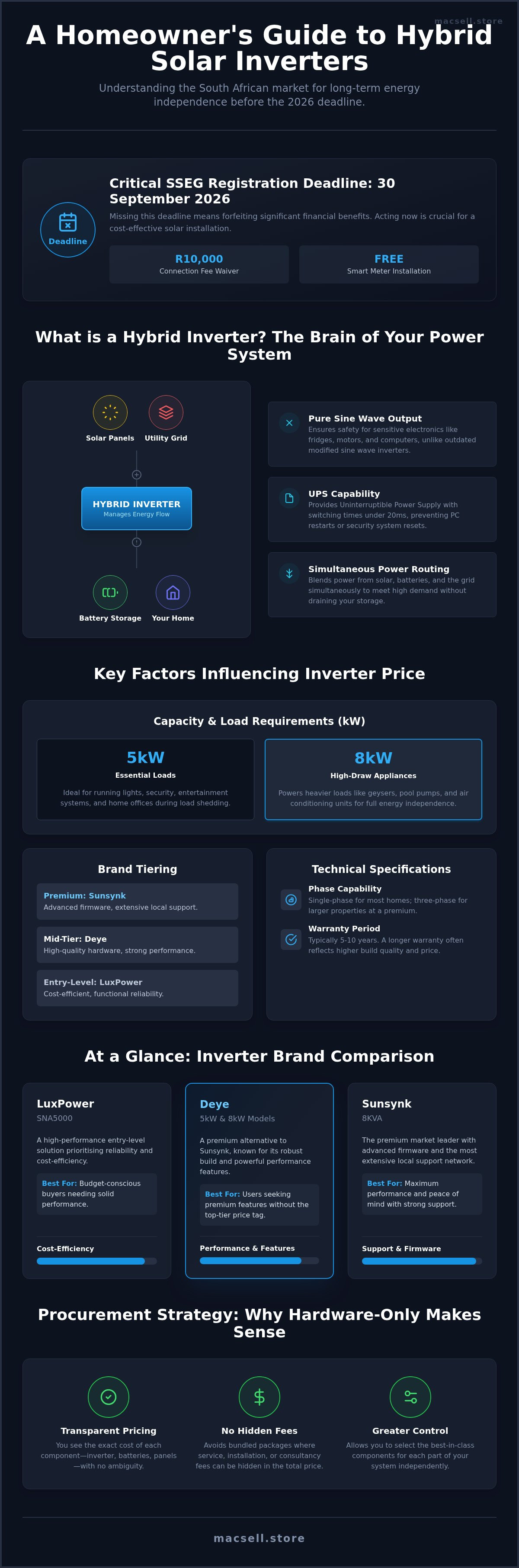
The 30 September 2026 SSEG registration deadline has fundamentally shifted the South African solar landscape. Missing this window means forfeiting the R10,000 connection fee waiver and a free smart meter, making your choice of hardware more critical than ever. You are likely feeling the pressure of rising electricity costs and the persistent need for reliable backup power during load shedding. Understanding the current hybrid inverter price South Africa market demands is the first step toward long-term energy independence.
We agree that the confusion between high-end units and entry-level alternatives makes securing a fair deal difficult. This guide promises a technical breakdown of hardware pricing, focusing on the specific performance metrics of Sunsynk, Deye, and LuxPower systems. We will compare 5kW and 8kW hardware specifications, examine the cost-efficiency of hardware-only procurement, and detail the integration requirements for premium lithium storage like the Hubble AM2. By the end of this analysis, you will have the data needed to select a system that balances technical capability with your specific budget requirements for the 2026 calendar year.
Key Takeaways
- Compare technical specifications and the current hybrid inverter price South Africa across leading brands like Sunsynk, Deye, and LuxPower.
- Identify the capacity differences between 5kW and 8kW units to ensure your hardware matches your specific load shedding requirements.
- Evaluate the LuxPower SNA5000 as a high-performance entry-level solution versus premium integrated kits like the Sunsynk 8KVA and Hubble AM2 combo.
- Understand the logistical benefits of hardware-only procurement to secure transparent component pricing without hidden service fees.
- Determine how phase capability and NERSA compliance affect the long-term value and legality of your solar hardware investment.
What defines a Hybrid Inverter and its value in South Africa?
A hybrid inverter functions as the central intelligence of a residential power system. It manages energy flow between solar panels, battery storage, and the utility grid within a single unit. Unlike standard grid-tie units, it remains fully operational during grid failures. When researching the hybrid inverter price South Africa consumers often find that this hardware replaces the need for separate chargers and controllers. What is a Hybrid Inverter? Technically, it's an intelligent device that enables the simultaneous connection of solar PV, batteries, and the grid to optimise energy usage. It provides a modular approach to energy independence.
Hardware quality is non-negotiable for appliance longevity. Modern hybrid units provide pure sine wave output. This ensures the safety of sensitive electronics like motors, fridges, and compressors. Modified sine wave versions are outdated; they often cause damage to modern household appliances and run less efficiently. Understanding the hybrid inverter price South Africa requires acknowledging these technical distinctions in power quality. High-end hardware protects your investment in expensive home appliances.
The core functions of modern hybrid hardware
Efficiency depends on simultaneous power routing. High-quality hardware like Deye or Sunsynk units can draw power from solar arrays and the grid at the same time to meet high demand. This prevents battery depletion during peak usage periods. Switching speeds are equally critical. Most hybrid units offer Uninterrupted Power Supply (UPS) capabilities with switching times under 20ms. This prevents PC restarts or security system resets during a grid drop. Integrated MPPT (Maximum Power Point Tracking) controllers maximise the energy harvested from solar arrays. These controllers adjust the electrical operating point of the modules to ensure they deliver maximum available power. This ensures peak performance even in variable South African weather conditions.
Why South African households are prioritising hybrid systems
Urban residential users benefit most from hybrid setups. Traditional off-grid inverters lack the intelligence to blend grid and solar power effectively. Hybrid systems manage these transitions without manual intervention. Load shedding intensity has made basic backup systems insufficient. Hybrid hardware provides a permanent solution for home offices and security infrastructure. Utility tariffs continue to escalate; self-generation is now a financial necessity. These systems are designed for seamless compatibility with lithium ion solar battery technology. This integration allows for deeper discharge cycles and longer hardware lifespans compared to older lead-acid setups. A hybrid system lets you prioritise solar usage during the day and battery discharge during peak evening rates, significantly reducing monthly operational costs.
Factors influencing Hybrid Inverter price in South Africa
The hybrid inverter price South Africa consumers encounter is primarily dictated by technical specifications rather than aesthetic design. Capacity, measured in kVA or kW, serves as the baseline for pricing. A 5kVA unit typically supports essential loads like lighting, security systems, and entertainment units. Upgrading to an 8kVA model increases the hardware cost but enables the management of high-draw appliances such as geysers, pool pumps, and air conditioning units. This decision is central to South Africa's Energy Transition, where households move from simple backup to full load-shifting capabilities.
Phase capability further differentiates hardware costs. Single-phase inverters are standard for most residential properties. Three-phase units are required for larger homes or commercial sites, carrying a price premium due to more complex internal circuitry. Brand tiering also plays a role. Sunsynk is positioned as a premium option with advanced firmware and extensive local support. LuxPower focuses on functional reliability and cost-efficiency for budget-conscious buyers. Warranty periods, typically ranging from 5 to 10 years, directly influence the upfront hardware price. A longer warranty period often reflects higher build quality and manufacturer confidence.
Capacity and Load Requirements
Choosing between a 5kW and 8kW unit requires a precise audit of your peak power consumption. 5kW units are cost-effective for households prioritising essential circuits during load shedding. If your goal is to run a geyser or large kitchen appliances, the 8kW bracket is necessary to prevent inverter overload. Calculating your peak load involves totalling the wattage of all simultaneously active devices. Buying the correct size now prevents the need for expensive hardware swaps later. You can browse current inverter stock to compare these capacity tiers directly.
Brand reliability and software integration
Hardware durability and software features justify price variations. Units with IP65 ratings are sealed against dust and water, allowing for outdoor installation. IP20 units are restricted to indoor placement. Software integration, including remote monitoring apps and cloud-based firmware updates, adds significant long-term value. NERSA compliance is another critical factor. Approved inverters meet specific safety standards for grid connection, ensuring your installation remains legal and insurable. Non-compliant units may be cheaper initially but carry significant regulatory risks and potential penalties.
Comparing LuxPower, Deye, and Sunsynk Inverter pricing
Brand selection is the final variable in determining the hybrid inverter price South Africa residents pay for energy security. While internal components across top-tier manufacturers are often similar, differences in firmware sophistication and local support structures create distinct price brackets. LuxPower, Deye, and Sunsynk dominate the local landscape by offering specific technical advantages at varying investment levels. Selecting between these brands requires balancing immediate hardware costs against long-term system scalability and software integration features.
Value is often measured by the Rand-per-watt ratio. Entry-level units focus on delivering core hybrid functionality, while premium models justify their cost through higher surge capacities and more refined power management algorithms. Hardware availability remains stable in 2026, but the total hybrid inverter price South Africa consumers face is influenced by whether they choose a standalone unit or a pre-configured combo kit designed for immediate compatibility with specific lithium storage brands.
LuxPower SNA5000 Technical Overview
The LuxPower SNA5000 Hybrid Inverter serves as the benchmark for high-performance, entry-level hardware. It's particularly effective for households starting with a basic backup system that requires future expansion. Key technical features include dual MPPT trackers, which allow for solar panels to be installed on two different roof orientations for maximum yield. It supports parallel capability, enabling users to link multiple units as energy demands grow. This model is fully compatible with modern lithium battery technology, ensuring efficient discharge cycles and communication. In the local retail market, the SNA5000 is positioned as a cost-effective 5kW solution, providing a lower entry point than its premium competitors without sacrificing essential hybrid features.
Sunsynk and Deye Hardware Specifications
Sunsynk has established itself as the industry standard for South African residential solar. Its popularity stems from a robust user interface and a highly functional mobile application that provides granular data on energy production and consumption. For larger residential systems, the Sunsynk 8kW Lynks Hybrid Inverter offers superior integration, especially when paired with high-performance storage like Hubble AM2 batteries. Deye provides a mid-range alternative, often sharing similar hardware architecture with Sunsynk but at a more aggressive price point. As of 2026, Deye is recognised as a top-selling residential brand in the country due to its hardware versatility. Both brands maintain strong local service centre support in South Africa. Choosing Sunsynk often involves an investment in a more refined software ecosystem, whilst Deye offers comparable hardware performance for those prioritising raw technical specifications.
Selecting the correct Hybrid Inverter for your energy goals
Assessing current electricity consumption requires a detailed log of peak usage periods. Future-proofing is a strategic financial decision. Buying a larger inverter now prevents the redundancy of replacing a 5kW unit when energy needs increase. The hybrid inverter price South Africa market data indicates that 8kW units often provide a lower cost-per-kilowatt over the system's lifespan when accounting for potential hardware upgrades. Precision in selection ensures you don't overspend on capacity you won't use or underspend on a system that trips under load.
Communication between hardware components is vital for system safety. Inverters and batteries must synchronise via CAN or RS485 protocols. This connection allows the Battery Management System (BMS) to regulate charge and discharge rates based on real-time cell data. Systems without active communication rely on voltage-based triggers, which are less accurate and can reduce battery longevity. Always verify protocol compatibility before finalising your hardware selection.
Small to Medium Households (5kW Focus)
Standard 2-3 bedroom homes typically benefit from a 5kW focus. This capacity is designed to manage essential loads during outages.
- Essential loads: Lighting, refrigeration, Wi-Fi routers, and security infrastructure.
- Non-essential loads: Geysers, stoves, and heaters are typically excluded from the backup circuit.
- Hardware synergy: Pair your unit with a compatible inverter and battery combo for home use to ensure seamless power transitions.
Large Households and Home Offices (8kW Focus)
Large properties or home offices with server racks and air conditioning require 8kVA capacity. This tier handles heavy-draw appliances like pool pumps and geysers simultaneously without risking an inverter overload. The Sunsynk 8KVA and Hubble AM2 combo kit represents a technical benchmark for this category, offering high surge capacity and proven integration. These systems scale effectively as they often support parallel configurations, allowing you to add more units if your energy requirements grow. You can view our professional-grade hybrid hardware to find a solution that matches your consumption profile.
Procuring your Solar Hardware: Why Retail-Only makes sense
Procuring solar components directly from a specialist retailer provides a level of financial clarity often lost in bundled service quotes. When evaluating the hybrid inverter price South Africa market offers, a retail-only approach lets you see the exact cost of each component. Full-service installation companies often include hardware markups that aren't immediately apparent. By separating the hardware purchase from the labour, you eliminate hidden commissions. This method ensures you pay the true market value for premium units like the Sunsynk 8KVA or Deye models.
Flexibility is a significant advantage of direct procurement. You aren't tied to a specific service provider's schedule or limited to their preferred brands. You can choose a qualified, NERSA-registered electrician who understands your local municipal requirements. This separation of duties ensures that your hardware is sourced from a specialist distributor, whilst your installation is handled by a local professional of your choice. It's a pragmatic way to manage a large-scale technical investment without unnecessary service overheads.
Hardware authenticity is guaranteed through official retail channels. Buying from a dedicated outlet ensures you receive original serial numbers and full manufacturer warranties. These documents are vital for insurance purposes and for the legal registration of your system. You don't have to worry about grey-market imports or refurbished stock. Every unit comes with the necessary technical datasheets to ensure a smooth sign-off process with your chosen installer.
How to buy Hybrid Inverters online in South Africa
The MacSell Solar Outlet catalogue is structured for technical efficiency. You can filter by kVA rating, brand, or phase capability to find the exact match for your consumption profile. Before finalising any purchase, it's essential to review the technical datasheets provided. This verification step ensures the inverter matches your battery's communication protocol. Logistics for heavy items like inverters and lithium batteries are managed through a national delivery network. This ensures that sensitive hardware arrives at your doorstep in Pretoria or anywhere else in South Africa without the risks associated with standard courier handling.
MacSell Solar Outlet: Your National Hardware Partner
We maintain a curated inventory of high-performance hardware, focusing on Sunsynk, Deye, and LuxPower units. For those seeking simplified procurement, our pre-configured combo kits provide guaranteed compatibility. The Sunsynk 8KVA and Hubble AM2 combo is a prime example of a premium benchmark system ready for immediate dispatch. Our direct-to-consumer pricing model removes unnecessary intermediaries. This focus on hardware-only sales allows us to offer competitive rates on the hybrid inverter price South Africa residents need to secure their energy future. You get the tools; you choose the professional to install them.
Secure Your Energy Independence with High-Performance Hardware
Achieving energy security in 2026 requires a precise understanding of technical specifications and market value. Selecting the right capacity, whether a 5kW unit for essential loads or an 8kW system for high-draw appliances, ensures your investment matches your consumption profile. Prioritising hardware from brands like Sunsynk, Deye, and LuxPower provides access to advanced firmware and robust local support. Understanding the hybrid inverter price South Africa residents face allows for a strategic, retail-first approach that eliminates hidden service markups and provides the flexibility to choose your own qualified installer.
MacSell Solar Outlet operates as an official Sunsynk and LuxPower retailer, specialising in the technical integration of Hubble AM2 lithium storage. We provide national South African delivery to ensure high-end renewable energy components reach your site safely and efficiently. As technical hardware specialists, we focus on providing the exact tools needed for your transition to self-generation. Browse our range of Hybrid Inverters or shop Combo Kits to secure your hardware today. It's a practical step toward long-term financial stability and grid independence.
Ready to Buy? Shop Hybrid Inverters at MacSell
Browse our full range of NERSA-compliant hybrid inverters from Sunsynk, Deye, and LuxPower — with national delivery across South Africa.
→ Shop Hybrid Solar Inverters
→ Shop Inverter & Battery Combo Kits
Frequently Asked Questions
How much does a 5kW hybrid inverter cost in South Africa?
The hybrid inverter price South Africa consumers pay is determined by capacity, brand tiering, and technical specifications. A 5kW unit represents the entry-level bracket for residential backup, with costs varying based on build quality and software features. Factors like IP65 weatherproofing and NERSA compliance influence the final investment. Reviewing a technical catalogue allows you to compare different hardware options to find a solution that fits your specific energy requirements.
Is a Sunsynk inverter better than a LuxPower for load shedding?
Both brands effectively manage load shedding, but they cater to different user requirements. Sunsynk is considered a premium option due to its advanced software ecosystem and granular monitoring capabilities. LuxPower, specifically the SNA5000, offers high-performance reliability as a cost-effective entry-level solution. Your choice should depend on whether you prioritise advanced firmware features or functional efficiency for essential household circuits.
Can I use a hybrid inverter without solar panels initially?
Yes, you can operate a hybrid inverter as a battery-only backup system before adding solar panels. This configuration functions like a high-capacity UPS, charging batteries from the grid to provide power during load shedding. It is a common strategy for households that want to secure immediate backup and expand their PV array as their budget allows. Ensure your hardware supports future solar integration to avoid technical bottlenecks.
What is the difference between a hybrid inverter and an off-grid inverter?
A hybrid inverter can blend power from the grid, solar panels, and batteries simultaneously, whereas an off-grid inverter cannot synchronise with the utility grid. Hybrid hardware allows for grid-tied features like load shifting and feedback. Off-grid units are typically used in remote areas where no utility connection exists. For urban South African residential use, hybrid technology is superior for managing frequent grid instability and rising electricity costs.
How long does a hybrid inverter last in South African conditions?
A high-quality hybrid inverter typically has a lifespan of 10 to 15 years when installed in a controlled environment. South African conditions, such as high ambient temperatures and frequent switching during load shedding, demand robust hardware build quality. Choosing units with IP65 ratings for outdoor placement or ensuring adequate ventilation for indoor units will maximise the operational life of your power electronics and protect your long-term investment.
Do I need a specific battery for a Sunsynk or Deye inverter?
While many hybrid inverters are compatible with various lithium batteries, using a battery with matching communication protocols is critical. Sunsynk and Deye units perform best when paired with batteries like the Hubble AM2, which support CAN or RS485 communication. This integration allows the inverter to receive real-time data from the Battery Management System, ensuring safer charging cycles and improved battery longevity compared to voltage-based configurations.
Are hybrid inverters NERSA approved for grid-tied use?
Many leading hybrid brands, including Sunsynk and specific LuxPower models, are on the NERSA-approved list for grid-tied installations. Compliance is a legal requirement for any system connected to the municipal or Eskom grid. Using approved hardware ensures that your installation meets SANS 10142-1 standards. This is necessary for obtaining a Certificate of Compliance, which is required for insurance purposes and municipal approval of your solar system.
Why should I buy hardware separately from installation?
Buying hardware separately provides transparency on the hybrid inverter price South Africa retailers offer without hidden service markups. This retail-only approach allows you to secure authentic components and full manufacturer warranties directly from a specialist distributor. You retain the flexibility to hire a qualified installer who fits your specific schedule and budget, ensuring that you pay for hardware and professional labour as distinct, manageable costs.