

Solar Batteries Buying Guide: Selecting the Right Energy Storage Hardware
An oversized battery bank is a wasted investment if the hardware communication protocols fail to synchronise with your hybrid inverter. It's frustrating to spend thousands on solar batteries only to find that your 48V system refuses to acknowledge the new lithium units. You've likely spent hours comparing 12V and 48V options; worrying if a high depth of discharge (DoD) will kill your cells within three years. You want a system that functions correctly from day one; providing reliable backup power whilst reducing your reliance on the national grid.
This guide simplifies the technical selection process for high-performance energy storage. You'll learn how to match specific hardware like Hubble AM-5+or Sunsynk units to your existing inverter setup for maximum efficiency. We'll break down the impact of lithium chemistry on lifespan and explain why hardware compatibility is the most critical factor for long-term energy independence. From understanding voltage requirements to optimising system performance; this is your roadmap to a reliable energy storage solution that delivers consistent power.
Key Takeaways
- Identify why Lithium Iron Phosphate (LiFePO4) chemistry is the preferred standard for long-term energy storage over lead-acid variants.
- Distinguish between Kilowatt-hours and Amp-hours to accurately size solar batteries for your daily energy consumption.
- Master the technical requirements of BMS communication, focusing on CAN and RS485 protocols for hardware synchronisation.
- Evaluate the specifications of industry-leading hardware like the Hubble AM-5+ and Dyness native battery range.
- Use a technical procurement checklist to verify inverter compatibility and select the correct DC disconnects and cabling.
Understanding Solar Battery Technologies for Energy Independence
Energy storage transforms a standard photovoltaic array into a resilient, off-grid capable power plant. Without integrated solar batteries, excess energy generated during peak sunlight hours is exported to the grid or wasted; leaving the site vulnerable during nocturnal periods or grid failures. Modern energy independence relies on the transition from simple backup to active load shifting. This requires hardware capable of high discharge rates and rapid recharge cycles. The battery bank acts as the central hub for energy management; ensuring that your generated power is available exactly when the demand spikes.
Lithium-Ion vs. Deep Cycle Gel Batteries
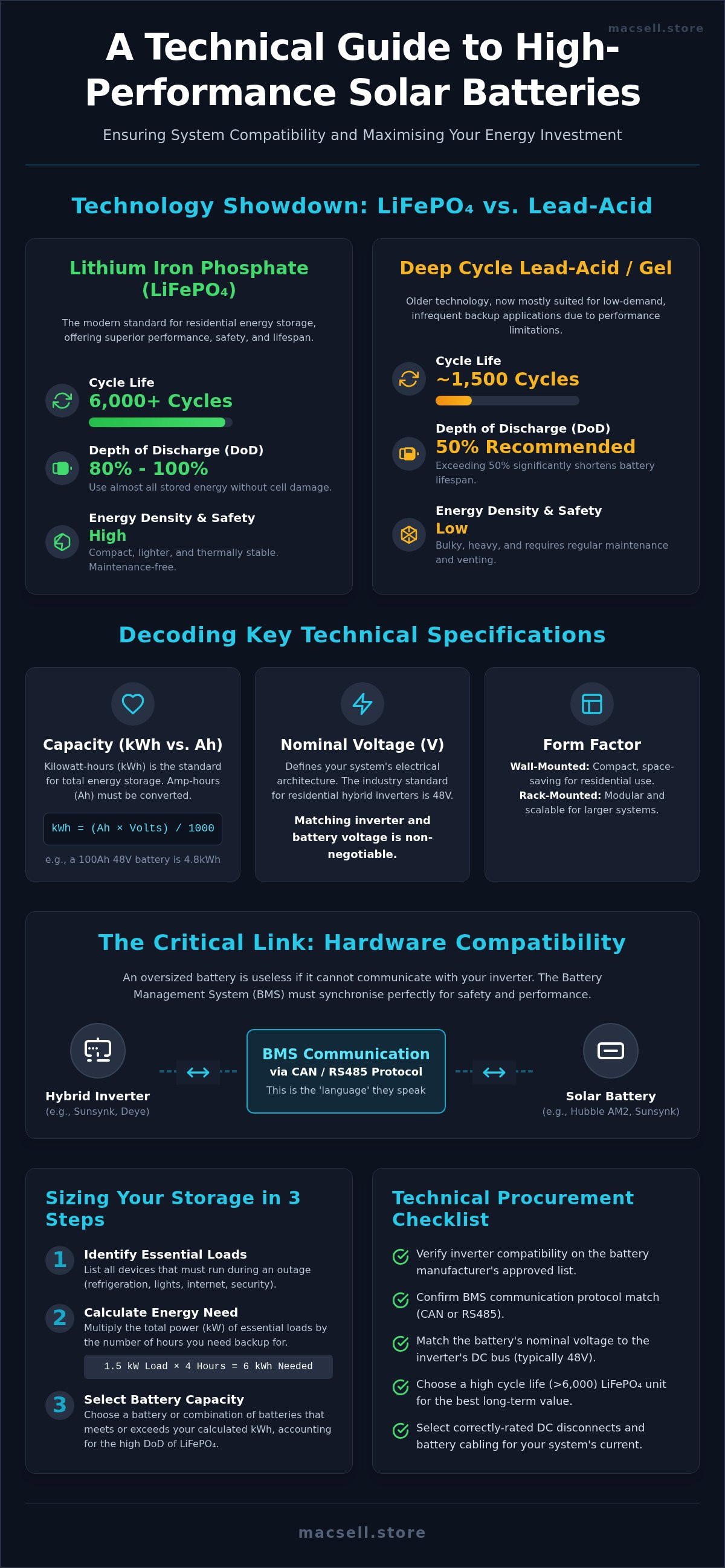
Lithium Iron Phosphate (LiFePO4) has effectively replaced lead-acid and deep cycle gel as the primary storage medium for residential solar. The technical advantages are clear. LiFePO4 units offer significantly higher energy density; allowing for compact, wall-mounted installations that save floor space. Whilst deep cycle gel batteries are still available for low-demand, standby-only applications, they fail to compete on performance. Key differences include:
- Energy Density: Lithium provides more power in a smaller, lighter chassis.
- Thermal Stability: LiFePO4 chemistry is inherently stable amongst various operating temperatures.
- Maintenance: Lithium units are maintenance-free, whereas lead-acid requires venting and regular checks.
LiFePO4 provides a safer profile with a lower risk of thermal runaway compared to older nickel-manganese-cobalt (NMC) lithium variants. It's the safest lithium technology currently available for home energy storage. This chemical stability is vital for indoor installations where temperature fluctuations might occur.
The Importance of Cycle Life in 2026 Systems
Cycle life is the most accurate predictor of your system's return on investment. A "cycle" represents one full discharge and recharge. High-end solar batteries like the Hubble AM-5+ typically offer 6,000 cycles or more at an 80% to 90% Depth of Discharge (DoD). This translates to approximately 15 years of daily operation. Lead-acid alternatives often struggle to exceed 1,500 cycles at a mere 50% DoD. If you discharge a lead-acid battery beyond its recommended limit, you permanently damage its internal chemistry.
Premium lithium hardware allows you to access more of the stored energy you paid for without compromising the unit's lifespan. Investing in high-cycle hardware reduces the total cost per kilowatt-hour over the life of the system. It's a more efficient financial choice than cheaper, low-cycle alternatives that require replacement every three to five years.
There is also a growing trend towards high-voltage (HV) storage in residential applications. Traditional 48V systems remain the standard for small to medium setups, but HV systems reduce current flow; leading to lower heat generation and improved inverter efficiency. This shift ensures that more of your generated solar energy actually reaches your appliances rather than being lost as heat during the conversion process.
Key Technical Specifications to Compare Before Purchase
Technical performance hinges on understanding the relationship between voltage, capacity, and discharge rates. Modern solar batteries are primarily rated in Kilowatt-hours (kWh), representing the total energy available for use. Whilst older deep-cycle units often use Amp-hours (Ah), kWh is the standard metric for lithium hardware. To calculate the energy of an Ah-rated unit, multiply the Amp-hours by the nominal voltage. A 100Ah 48V battery provides 4.8kWh of storage. Selecting the correct capacity ensures your system sustains your critical loads during extended outages.
Nominal voltage defines the electrical architecture of your system. Most residential hybrid inverters, including brands like Sunsynk, Deye, and LuxPower, utilise a 48V DC bus. Using 12V or 24V components in these systems is impossible without complex conversion hardware that reduces efficiency. Physical form factors also dictate your installation environment. Rack-mount units are designed for modularity within standard server cabinets; allowing for easy scaling. Wall-mounted hardware offers a compact footprint, which is often preferable for residential garages with limited floor space.
Calculating Your Required Storage Capacity
Start by identifying your essential load. This includes refrigeration, lighting, security systems, and internet hardware. If your essential load averages 1.5kW, a four-hour load shedding block requires at least 6kWh of usable storage. You must account for the depth of discharge (DoD) to avoid damaging the cells. A battery bank should be sized to match your hybrid inverter output; ensuring the hardware can handle the maximum throughput of the inverter. For those building a new system, reviewing the technical data of lithium batteries can prevent under-sizing your backup capacity.
Discharge Rates and Power Delivery
The C-rating determines the speed at which energy is extracted from the cells. A 5kWh battery with a 0.5C rating provides 2.5kW of continuous power. If you have a 5kW inverter but only one 0.5C battery, you cannot utilise the inverter's full capacity. High-demand appliances like kettles, pumps, or air conditioning units require high discharge rates or multiple batteries in parallel.
- Continuous Discharge: The maximum steady power the battery delivers.
- Peak Surge: The short-term power available for starting motors.
- 0.5C vs 1C: A 1C battery discharges its full capacity in one hour, offering superior performance for heavy loads.
Matching battery output to the 8KVA or 5kW rating of your inverter is essential for system stability. If the load exceeds the battery's discharge limit, the Battery Management System (BMS) will disconnect the power to protect the hardware. This often leads to system blackouts even when the battery is fully charged.
Ensuring Hardware Compatibility with Your Hybrid Inverter
Hardware synchronisation is the most overlooked aspect of energy storage design. Professional solar batteries don't operate in isolation; they require a constant data stream to the hybrid inverter to manage charge parameters. Without this communication, the inverter cannot accurately determine the State of Charge (SOC) or the health of the cells. This lack of data leads to inefficient charging cycles and potential hardware failure. Ensuring your battery and inverter share a compatible communication language is non-negotiable for a reliable system.
BMS Communication Protocols Explained
The Battery Management System (BMS) utilises specific protocols, typically CAN or RS485, to "talk" to the inverter. This digital handshake allows the battery to dictate the maximum charge and discharge current based on real-time cell temperatures and voltages. If you run your system in "voltage mode" without active comms, the inverter relies on imprecise voltage readings to guess the SOC. This is dangerous; it often results in the inverter pulling power from an empty battery or overcharging a full one.
Compatibility varies between brands. For instance, LuxPower and Sunsynk inverters require specific battery firmware to establish a stable link. Modern lithium units often support automatic firmware updates via the inverter's Wi-Fi module, which is essential for maintaining stability as manufacturers release performance patches. Always confirm that your chosen hardware supports the specific protocol required by your inverter brand before finalising your purchase.
Paralleling Batteries for Scalable Storage
Expanding your storage capacity involves paralleling multiple units in a master-slave configuration. This setup requires precise physical addressing, usually via dip switches on the battery chassis. The "master" unit handles all communication with the inverter whilst the "slaves" report their data to the master. Mixing different battery brands or even different models from the same manufacturer in a single bank is a common pitfall. It causes internal resistance mismatches that lead to uneven wear and system instability.
- Master-Slave Setup: Use the manufacturer-provided comms cables to daisy-chain units.
- Cable Sizing: High-current DC connections require heavy-gauge cabling to prevent voltage drop and heat buildup.
- Parallel Limits: Most top-tier brands like Hubble allow up to 15 or 16 units to be paralleled in a single string.
Equal cable lengths are critical when connecting solar batteries to a common DC busbar. If one cable is shorter, it offers less resistance; causing that specific battery to work harder than the others. This imbalance shortens the lifespan of the entire bank. Correct hardware matching and physical installation standards are the only ways to guarantee that your scalable storage performs to its rated specifications.
Standout Solar Battery Hardware at MacSell Solar Outlet
MacSell Solar Outlet operates as a specialised technical distributor for high-end energy storage components. Our inventory focuses on hardware known for reliability, high cycle life, and seamless inverter integration. Selecting the correct solar batteries requires matching your specific capacity requirements with the technical parameters of your hybrid inverter. We prioritise brands that offer transparent technical data and proven performance in the South African climate; including Hubble, Sunsynk, Deye, and LuxPower.
The Hubble AM2 Advantage
The Hubble Lithium AM2 5.5kWh unit is currently considered the industry standard for residential storage. It's a favourite amongst professional installers due to its robust Battery Management System (BMS) and ease of configuration. This 48V unit supports a 1C discharge rate; meaning it can deliver its full capacity to handle heavy motor loads or high-demand appliances without tripping. The AM2 is designed for standard 19-inch rack mounting, which facilitates neat and scalable installations in residential garages or server rooms. For a pre-configured, tested solution, our Sunsynk 8KVA and Hubble AM2 Combo Kit eliminates the risk of hardware communication errors during setup.
Sunsynk and Deye Hardware Synergy
Native integration offers significant performance benefits. Sunsynk-branded storage units are designed for "plug-and-play" operation with Sunsynk hybrid inverters. They utilise a unified CAN bus communication protocol that allows the inverter to monitor individual cell voltages and temperatures with high precision. This synergy ensures that firmware updates are synchronised across the entire system; preventing the software mismatches that often plague mixed-brand installations. Deye lithium units offer similar metrics; maintaining exceptional thermal stability even during the rapid discharge cycles required during frequent load shedding intervals.
For larger commercial applications, Deye provides high-voltage (HV) battery options. These systems operate at higher efficiency levels by reducing the current flow and heat generation within the DC bus. If you're working with a mid-range budget, Shoto and Dyness units serve as reliable alternatives. These rack-mount batteries are compatible with most leading hybrid hardware; including the LuxPower 5kW SNA5000 inverter. They offer a competitive cost-per-kilowatt-hour whilst maintaining the 6000-cycle standard expected of modern lithium technology.
Selecting the right hardware prevents the communication pitfalls and sizing errors discussed in previous sections. You can browse our current inventory of lithium batteries to find the specific technical specifications that match your existing or planned inverter setup.
Procurement Checklist for Your Solar Battery System
Finalising the procurement of energy storage hardware requires a systematic verification of your site's technical readiness. You must ensure that every auxiliary component matches the high performance of your primary lithium cells. A failure in a minor accessory, such as a poorly crimped lug or an undersized fuse, can compromise the entire system's safety and efficiency. This checklist serves as the final technical gate before you commit to a hardware purchase.
Start by confirming the physical installation environment. Whilst LiFePO4 chemistry is thermally stable, the Battery Management System (BMS) and internal electronics still require adequate ventilation to prevent heat soak during rapid discharge cycles. Verify that your chosen location has sufficient clearance for either rack-mount cabinets or wall-mount brackets. Rack-mount configurations are generally preferred for systems exceeding 10kWh as they allow for better airflow and easier cable management amongst multiple units. Ensure the mounting surface can support the significant weight of these high-density units; a single 5.5kWh battery often exceeds 45kg.
Essential Installation Accessories
High-quality DC protection is non-negotiable for modern lithium installations. Lithium batteries can deliver massive amounts of current almost instantaneously during a fault; making fast-acting DC fuses essential to protect your hybrid inverter. Using standard AC breakers or low-quality fuses is a critical safety risk. You must also select the correct battery cabling gauge to handle the inverter's maximum DC current. For a 5kW system, 35mm copper cabling is typically the minimum requirement, whilst 8kVA systems often require 50mm or dual-run cables to prevent voltage drop and excessive heat buildup.
- DC Disconnects: Use a dedicated battery disconnector to allow for safe maintenance and emergency isolation.
- Crimped Lugs: All connections must use professionally crimped lugs; loose or hand-tightened connections cause resistance and eventual terminal melting.
- Communication Cables: Verify that the correct RJ45 pinout is used for CAN or RS485 communication between the battery master and the inverter.
Final Steps Before You Buy
Review the manufacturer warranty terms with a focus on the cycle life guarantee rather than just the calendar years. A 10-year warranty is standard, but it's often limited by a specific total energy throughput or cycle count. Confirm that your inverter brand is explicitly listed on the battery's compatibility matrix to avoid communication errors during commissioning. Given the specialised nature of these components, check the national delivery timelines for your region to ensure your hardware arrives on schedule for the installation date.
Shop Solar Batteries at MacSell Solar Outlet
Industry-leading lithium storage from Hubble, Dyness, and Sunsynk — with national delivery across South Africa.
→ Shop Hubble AM2 5.5kWh Battery
→ Shop Dyness 4.8kWh Battery
→ Browse All Lithium Solar Batteries
→ Shop Matched Inverter & Battery Combos
Optimising Your Energy Storage Strategy
Selecting high-performance energy storage requires more than just comparing capacity figures. You've seen that the integration between your hybrid inverter and the battery's BMS determines the system's actual reliability. Prioritising LiFePO4 chemistry and 48V architecture ensures your setup handles the rigorous demands of frequent load shedding whilst maintaining a 6000-cycle lifespan. Correct cable sizing and DC protection are the final technical requirements to prevent hardware failure and ensure safety.
MacSell Solar Outlet serves as an authorised Sunsynk and Hubble hardware distributor; providing technical expertise in hybrid inverter integration for residential and commercial systems. Our inventory includes high-demand units like the Hubble AM-5+ and Sunsynk lithium range; all available for national delivery across South Africa. Shop the full range of solar batteries at MacSell Solar Outlet to secure the specific hardware needed for your backup system. Investing in correctly matched components is the most efficient way to reduce your grid reliance and ensure consistent power delivery.
Frequently Asked Questions
How long do solar batteries typically last in a residential system?
Modern lithium solar batteries typically last between 10 and 15 years when used in a standard residential setup. This longevity is based on a cycle life of 6,000 cycles at an 80% to 90% depth of discharge. Lead-acid alternatives usually require replacement within three years; making lithium a more durable hardware choice for long-term energy independence.
Can I mix different brands of lithium batteries in one system?
You shouldn't mix different brands of lithium batteries in a single bank. Each manufacturer uses a unique Battery Management System (BMS) and internal cell resistance profile. Mixing brands prevents correct hardware communication with the inverter and leads to uneven wear amongst the units; which significantly reduces the lifespan of the entire storage system.
What is the difference between a 1C and a 0.5C battery rating?
A 1C rating means the battery can discharge its entire capacity in one hour, whereas a 0.5C rating requires two hours for a full discharge. If you have a 5.5kWh battery, a 1C rating allows you to pull 5.5kW of continuous power. A 0.5C unit only provides 2.75kW; which might be insufficient for heavy appliances like kettles or pumps.
Do I need a specific inverter to use a lithium solar battery?
You need a hybrid inverter specifically designed to communicate with lithium battery management systems. Modern hardware from Sunsynk, Deye, or LuxPower includes the necessary CAN and RS485 ports to synchronise with lithium cells. Older inverters designed for lead-acid batteries can't manage the precise charging parameters required for lithium safety and efficiency.
Is it possible to add more batteries to my system later on?
It's possible to expand your storage capacity by adding units later, but you should ideally do so within 12 months of the initial installation. Older batteries have higher internal resistance than new ones. Adding a brand-new unit to an aged bank causes the newer battery to take more of the load; leading to premature degradation of the new hardware.
Why is the Hubble AM2 so popular for South African backup systems?
The Hubble AM-5+ is popular due to its high-performance 1C discharge rate and seamless compatibility with leading hybrid inverters like Sunsynk and Deye. It offers 5.12kWh of usable storage in a standard rack-mount format; making it a versatile choice for South African load shedding requirements. The unit's robust BMS handles frequent cycling without compromising technical stability.
What maintenance is required for lithium-ion solar batteries?
Lithium-ion solar batteries are virtually maintenance-free and don't require the water topping or venting associated with lead-acid cells. You should periodically check that the DC cable terminals remain tight and free from dust. Most technical maintenance is handled automatically through firmware updates provided by the manufacturer via the inverter's monitoring platform.