

Lithium Battery Inverter Compatibility: A Technical Hardware Guide (2026)
A lithium battery is only as efficient as the digital handshake it shares with your inverter. You've likely invested heavily in high-grade lithium cells and a hybrid inverter, expecting peak performance from day one. However, without precise lithium battery inverter compatibility, your system is essentially operating in the dark. It's a common concern that incorrect parameters might degrade expensive cells or trigger terminal faults. You want a system that communicates internally, not one that requires constant manual intervention to stay online.
This technical guide eliminates the guesswork involved in synchronising your hardware for 2026 standards. You'll master the critical differences between CAN-bus and RS485 protocols whilst learning how to establish a robust closed-loop communication system. We'll examine why specific pairings, such as the Sunsynk 8KVA and Hubble AM5+ combo, are considered the gold standard for hardware reliability. We provide the technical clarity needed to select approved hardware, configure charging parameters correctly, and ensure your energy storage system delivers its full rated lifespan without the risks of "dumb" charging modes.
Key Takeaways
- Understand the synchronisation between BMS firmware and inverter settings to ensure precise voltage and temperature management.
- Distinguish between closed-loop and open-loop communication protocols to avoid inaccurate State of Charge (SoC) readings and "dumb" charging.
- Evaluate lithium battery inverter compatibility for major hardware brands including Sunsynk, Deye, and LuxPower.
- Implement a technical checklist to verify that your selected hardware pairing supports active digital handshaking via CAN-bus or RS485 ports.
- Recognise the safety and performance benefits of using pre-tested combo kits to maintain manufacturer warranty standards and matched discharge rates.
What is Lithium Battery Inverter Compatibility?
Lithium battery inverter compatibility is the seamless digital and electrical integration of storage and conversion hardware. It's more than simple wiring. Effective operation requires the Battery Management System (BMS) and inverter firmware to synchronise charging parameters in real-time. This digital handshake maintains safe thermal and electrical boundaries for the entire system.
Precise management is non-negotiable for lithium chemistries. Legacy lead-acid systems rely on basic voltage thresholds; lithium cells require active oversight. Without a verified digital connection, inverters risk overcharging cells or failing to balance internal voltages. These coordination failures lead to accelerated degradation, thermal instability, or total hardware shutdown. Ensuring lithium battery inverter compatibility prevents these risks by allowing the battery to dictate its own charging needs to the inverter.
Electrical vs Communication Compatibility
Physical connectivity is the baseline requirement. Both units must share a common DC bus voltage, typically 48V for residential hybrid systems. Matching the voltage is merely the first step. You must also align the inverter's maximum charge and discharge rates with the battery's specific C-rating. If the inverter pulls more current than the BMS allows, the battery will disconnect to prevent internal damage.
The digital link is the critical differentiator in 2026. Power flows through heavy-gauge DC cables, but critical data travels via CAN-bus or RS485 ports. This stream provides the inverter with the exact State of Charge (SoC), cell temperatures, and health status. Without this link, the inverter guesses battery status based on voltage. This is notoriously inaccurate for lithium iron phosphate (LiFePO4) chemistries, which maintain a very flat discharge curve.
Why Compatibility Matters for Your Warranty
Manufacturers including Sunsynk, Deye, and LuxPower maintain strict approved lists for third-party batteries. Using non-approved pairings is a high-risk strategy. Modern hybrid inverters act as data recorders. They log communication errors and parameter violations. If a cell fails, the manufacturer reviews these logs. Evidence of "dumb" charging or communication gaps often results in voided warranty claims. Maintaining verified lithium battery inverter compatibility is the only way to protect these high-value hardware investments.
Professional installations prioritise pre-tested pairings. The Sunsynk 8KVA and Hubble AM5+ combo kit ensures firmware versions are pre-validated for communication. This eliminates the technical mismatches that shorten equipment life and compromise system safety. Using matched hardware guarantees that the inverter respects the BMS limits at all times.
The Role of the Battery Management System (BMS)
The Battery Management System (BMS) serves as the central processing unit for the lithium storage pack. It is responsible for the continuous monitoring of individual cell voltages, internal temperatures, and the calculated State of Charge (SoC). High-performance hardware, such as Hubble AM5+batteries, utilises advanced BMS logic to organise energy flow and maintain cell health over thousands of cycles. This system doesn't just monitor; it actively dictates system behaviour. By "requesting" specific charge currents and voltage limits, the BMS ensures the inverter never pushes the cells beyond their chemical limits. This active management is a core requirement for lithium battery inverter compatibility.
Communication Ports: CAN-bus vs RS485
Reliable data transmission depends on the physical communication interface. CAN-bus stands as the industry standard for high-speed, robust inverter-to-battery communication. It provides the low-latency feedback loop necessary for real-time adjustments. RS485 is frequently used as a secondary protocol, primarily for parallel battery synchronisation within a larger bank. Identifying the correct pinouts is a critical step during installation. Physical cables must be wired precisely to match the manufacturer's diagram. A mismatch in pin configuration prevents the "handshake" from occurring, often defaulting the system to a less efficient "voltage-based" mode. Selecting compatible lithium batteries with clear port documentation simplifies this technical hurdle.
Dynamic Charging and Safety
Dynamic charging is the primary safety mechanism of a lithium system. The BMS prevents overcharging by communicating real-time cell data to the inverter. When a battery reaches its upper voltage limit, the BMS sends a command to terminate the charge. It also manages the cell balancing cycle. This process requires the inverter to provide a steady, low-current flow whilst the BMS redistributes energy amongst the internal cells. Thermal protection is equally vital. If the BMS detects temperatures exceeding safe operating thresholds whilst discharging, it instructs the inverter to throttle or stop the energy flow. Maintaining lithium battery inverter compatibility ensures these safety protocols execute without delay, protecting both the hardware and the property.
Closed Loop vs Open Loop Communication
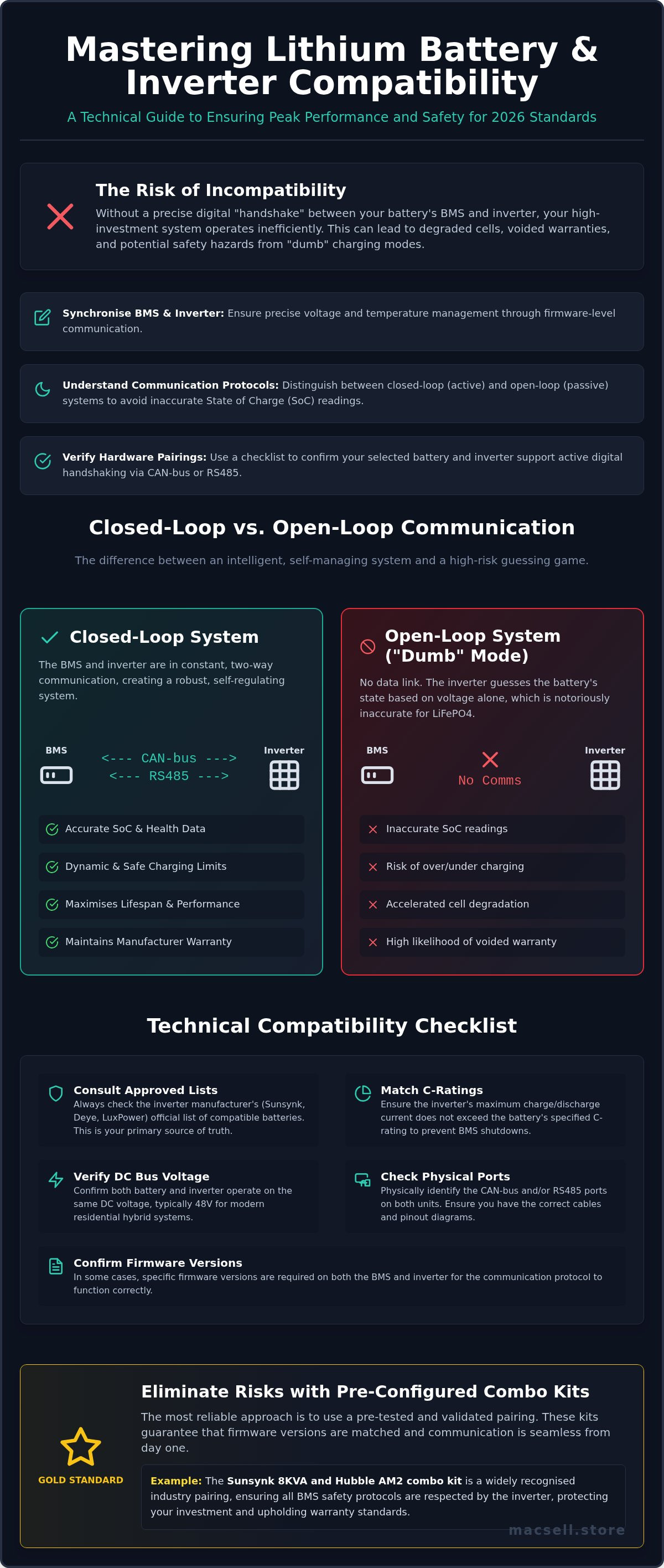
Closed loop communication represents the highest tier of lithium battery inverter compatibility. In this configuration, the inverter and battery maintain a constant, bidirectional data stream. The Battery Management System (BMS) provides the inverter with exact operational data, including cell-level voltage and temperature. This is the mandatory standard for modern lithium ion solar battery systems because it removes the margin for error inherent in manual settings.
Open loop communication, by contrast, operates on a guesswork principle. The inverter is not digitally linked to the BMS. Instead, it monitors the DC bus voltage to estimate the battery's state. Whilst this was acceptable for lead-acid technology, it's poorly suited for lithium chemistries. Lithium iron phosphate (LiFePO4) batteries have a flat discharge curve; the voltage remains nearly constant between 20% and 90% SoC. Consequently, an inverter in open loop mode often fails to report accurate capacity, leading to unexpected system shutdowns.
The Advantages of Closed Loop Integration
Closed loop integration offers precise State of Charge (SoC) monitoring. It eliminates "voltage sag" issues where heavy loads cause a temporary voltage drop that the inverter misinterprets as an empty battery. Systems using this protocol benefit from automatic parameter updates. As cells age or ambient temperatures shift, the BMS adjusts its charge requests, and the inverter follows suit without manual intervention. For approved hardware pairings, this functionality is essentially plug-and-play. Maintaining lithium battery inverter compatibility through a closed loop ensures the inverter respects the real-time limits of the storage cells.
When to Use Open Loop (Voltage Mode)
Open loop or "Voltage Mode" serves primarily as a fallback for emergency scenarios. If a communication cable fails or firmware becomes corrupted, manual settings allow the system to remain functional whilst troubleshooting occurs. It's also the only option for legacy hardware that lacks modern data ports. To use this mode, you must set "User Defined" voltages based on the battery manufacturer's datasheet. However, the risks are significant. Operating in open loop often leads to premature battery degradation because the inverter cannot see internal cell imbalances or high-temperature warnings from the BMS.
Compatibility Checklist for Leading Inverter Brands
Selecting hardware for the South African residential market requires a strict focus on proven interoperability. Reliable hardware pairings are the backbone of a stable energy system. Achieving lithium battery inverter compatibility depends heavily on firmware synchronisation. Before commissioning any system, verify that both the inverter and the battery BMS are running the latest manufacturer-approved software versions. Outdated firmware remains the primary cause of communication "timeouts" and intermittent system tripping. If the versions don't match, the digital handshake will fail, regardless of the physical cable quality.
Sunsynk and Deye Compatibility
Sunsynk and Deye inverters share a core architecture, which means they often utilise identical battery compatibility lists. For many installers, the link between Hubble AM5+ and Sunsynk 8KVA units is the preferred standard for high-demand residential sites. When configuring these units, you must select the "Lithium" battery type in the settings menu. Choosing the correct protocol ID, typically 00 for Hubble Hubble AM5+ Model, is mandatory for enabling closed-loop operation. This specific pairing allows the inverter to read the battery's internal cell data with zero latency. For a deeper dive into specific hardware specifications, consult our 8KVA hybrid inverter South Africa guide.
LuxPower SNA5000 Settings
The LuxPower SNA5000 hybrid inverter requires precise configuration to maintain lithium battery inverter compatibility. As a popular 48V choice, the SNA5000 supports various lithium brands, but the setup process is less automated than high-voltage units. You must manually toggle the battery type to "Lithium" to activate the CAN or RS485 communication ports. Leaving the unit on "Lead-Acid" or "Use-V" settings causes the inverter to ignore the BMS data, forcing it to rely on inaccurate voltage readings. This often leads to the inverter shutting down early because it cannot see the actual State of Charge (SoC) reported by the battery cells.
Parallel battery support is another area where LuxPower requires careful attention. When managing multiple lithium banks, the system designates one battery as the "Master" unit. This master battery aggregates data from all "Slave" units and communicates the total capacity to the inverter. If the dip switches on the battery modules aren't set correctly, the inverter will only see a fraction of the available storage. You can browse our range of pre-tested hybrid inverters to ensure your hardware pairing supports these advanced communication features without the need for complex manual overrides.
Eliminating Risks with Pre-Configured Combo Kits
Procuring individual components from different manufacturers often leads to unforeseen integration delays. A pre-configured Sunsynk Hubble combo kit removes this technical guesswork by providing a verified hardware stack. These kits are engineered with matched charge and discharge rates, ensuring the battery's C-rating aligns perfectly with the inverter's peak current capabilities. This alignment is the practical application of lithium battery inverter compatibility. By sourcing the entire energy storage core from a single supplier, you simplify the procurement process and ensure all internal components are firmware-compatible out of the box.
Buying a matched kit also streamlines the technical support and warranty process. If a communication error occurs, there is no ambiguity regarding which component is at fault. The system is designed as a single functional unit. MacSell Solar Outlet specialises in the supply of these premium hardware pairings. Whilst we provide the technical components and pre-tested kits, all installations must be performed by a qualified professional. This requirement is essential for local compliance and to maintain the validity of your manufacturer warranties. Expert installation ensures the physical wiring matches the digital protocols established in the factory.
The Sunsynk 8KVA & Hubble AM2 Pairing
This specific combination is a favourite amongst South African installers due to its high reliability in demanding environments. The technical synergy between these two brands is significant. Sunsynk firmware is specifically optimised for Hubble protocols, allowing for a seamless digital handshake that requires minimal manual configuration. Scaling your energy storage is also simplified within this ecosystem. You can add more Hubble AM5+ batteries to the existing bank as your load requirements increase, provided the master battery is correctly identified by the Sunsynk unit. This modularity ensures your system remains future-proof without compromising lithium battery inverter compatibility.
Procuring Your Hardware Safely
Consistent stock availability is a primary concern for project timelines. We maintain a steady inventory of hybrid inverters and lithium batteries to prevent project bottlenecks. Buying from an authorised retailer like MacSell ensures you receive genuine hardware backed by manufacturer-approved warranty support. Authorised channels are also the first to receive critical firmware updates, which are necessary for maintaining the digital link between the BMS and the inverter.
Shop Compatible Inverters & Batteries at MacSell
Pre-tested hardware pairings with verified BMS compatibility — national delivery across South Africa.
→ Shop Sunsynk 8KVA + Hubble AM2 Combo Kit
→ Shop Hubble AM2 5.5kWh Battery
→ Shop LuxPower SNA5000 5kW Inverter
→ Browse All Inverter & Battery Combo Kits
Optimising Hardware for Long-Term System Stability
Achieving reliable lithium battery inverter compatibility requires shifting from basic voltage sensing to active digital communication. Prioritising closed-loop protocols ensures your inverter respects the real-time thermal and electrical limits defined by the BMS. This integration protects your investment from premature degradation and maintains warranty compliance through accurate data logging. Selecting hardware from verified approved lists remains the most effective way to avoid communication timeouts and unexpected system shutdowns.
MacSell Solar Outlet serves as an authorised stockist of Sunsynk, Deye, and LuxPower. We focus strictly on technical specifications that prioritise hardware reliability. Our pre-configured kits are engineered to eliminate firmware mismatches, providing a tested foundation for your energy storage core whilst ensuring matched charge and discharge rates. Once you have secured the correct hardware, professional installation ensures your system is commissioned to the highest safety standards.
Browse our range of compatible Lithium Batteries and Inverters to find the exact hardware pairing for your requirements. Investing in verified compatibility today ensures a dependable and efficient power supply for years to come.
Frequently Asked Questions
Can I use any lithium battery with my Sunsynk inverter?
No, Sunsynk inverters only support specific brands for closed-loop communication. Whilst you can technically connect any 48V lithium battery in "Use-V" mode, you lose critical digital oversight. This results in inaccurate State of Charge reporting and potential cell damage. For full lithium battery inverter compatibility, always select a battery from the Sunsynk approved list, such as the Hubble AM5+, to ensure safe operation.
What happens if the BMS communication cable is not connected?
The system defaults to "Open Loop" or "Voltage Mode" operation. Without a digital handshake, the inverter relies on DC bus voltage to estimate the battery status. This is highly inaccurate for lithium iron phosphate chemistries. You risk overcharging the cells or experiencing a sudden system shutdown as the inverter fails to track the flat discharge curve of the battery without BMS data.
Is the LuxPower SNA5000 compatible with Hubble batteries?
Yes, the LuxPower SNA5000 hybrid inverter is fully compatible with Hubble AM5+ batteries. You must manually set the battery type to "Lithium" and select the corresponding protocol ID in the inverter's menu. This enables the CAN-bus or RS485 link, allowing the LuxPower unit to receive real-time temperature and voltage data directly from the Hubble BMS for optimised charging cycles.
How do I update the firmware on my inverter for better battery compatibility?
Firmware updates are generally performed through the manufacturer's online monitoring portal. For Sunsynk or Deye units, you can request a remote update via the technical support desk if the unit is connected to the internet. Some scenarios require a local connection using a specialised RS485-to-USB adapter and the manufacturer's proprietary software to flash the new firmware version manually to the hardware.
Why does my inverter show a "BMS Error" even though the battery is full?
A "BMS Error" typically signals a communication timeout or a pinout mismatch in the data cable. Even if the battery is physically full, the inverter triggers this alarm if it stops receiving data packets from the BMS. Check that the RJ45 cable is wired correctly for your specific hardware. Ensure the protocol ID on the battery dip switches matches the inverter's communication requirement.
Can I mix different brands of lithium batteries in one system?
You shouldn't mix different brands of lithium batteries in the same bank. Every manufacturer uses unique BMS logic and communication protocols. Mixing brands prevents the master battery from aggregating data correctly, leading to charging imbalances and potential system faults. Always use identical modules to ensure the internal logic remains synchronised across the entire storage array for consistent performance.
Does using a non-approved battery void my inverter warranty?
Using a non-approved battery can void your inverter warranty. Most manufacturers log communication data and parameter violations. If a hardware failure occurs, the manufacturer will review these logs. Evidence of "dumb" charging or unverified lithium battery inverter compatibility often leads to rejected claims. Sticking to approved pairings protects your high-value hardware investment and ensures you remain within the manufacturer's terms.
What is the difference between a 1C and 0.5C battery for inverter compatibility?
A 1C rating means the battery can discharge its entire capacity in one hour, whilst a 0.5C battery takes two hours. For lithium battery inverter compatibility, your inverter's maximum discharge current must not exceed the battery's C-rating. If an 8KVA inverter pulls 100A from a battery only rated for 50A, the BMS will trip to prevent internal cell damage and overheating.