

5kW Lithium Battery: Technical Specifications and Hardware Reference Guide (2026)
Selecting a 5kw lithium battery in 2026 involves more than comparing capacity stickers; it requires a precise understanding of discharge protocols and NRS 097-2-1:2024 compliance. With the September 30 SSEG registration deadline approaching and an 8.76% NERSA tariff increase active, hardware that lacks the correct type-testing documentation is no longer a viable option for South African homes. You already know that LiFePO4 technology is the industry standard for safety, yet the real challenge remains ensuring your Battery Management System (BMS) communicates seamlessly with your inverter.
This reference guide provides a technical breakdown of hardware specifications, performance metrics, and inverter compatibility. You'll gain a clear understanding of the difference between peak power and usable energy, alongside criteria for evaluating cycle life in high-demand environments. We examine how to pair units with Sunsynk or LuxPower systems and why specific models like the Hubble AM2 5.5kWh offer a technical edge over standard 5kW alternatives. From C-ratings to communication protocols, this is the hardware data you need to secure your energy independence and ensure your system meets current regulatory requirements.
Key Takeaways
- Identify why LiFePO4 chemistry is the mandatory standard for a 5kw lithium battery to ensure thermal stability and long-term safety.
- Master the relationship between Depth of Discharge (DOD) and cycle life to accurately predict hardware replacement cycles and ROI.
- Verify essential communication protocols, including CANbus and RS485, to ensure your battery and inverter operate as a synchronised system.
- Distinguish between standard units and premium alternatives like the Hubble AM2 5.5kWh for enhanced capacity and performance metrics.
- Learn the technical criteria for pairing lithium hardware with Sunsynk and LuxPower inverters to avoid common integration failures in South African setups.
Understanding 5kW Lithium Battery Hardware and Chemistry
The 5kw lithium battery is the standard storage unit for South African residential solar systems. While the industry uses "5kW" as shorthand, this label typically describes a battery with a nominal capacity of 5.12kWh or 5.5kWh. These units consist of multiple prismatic or cylindrical cells wired in series and parallel to achieve a 48V or 51.2V nominal voltage. The internal hardware is protected by a reinforced steel chassis, usually available in rack-mount or wall-mount configurations. Rack-mount versions are designed for standard 19-inch server cabinets, allowing for modular expansion as energy requirements increase.
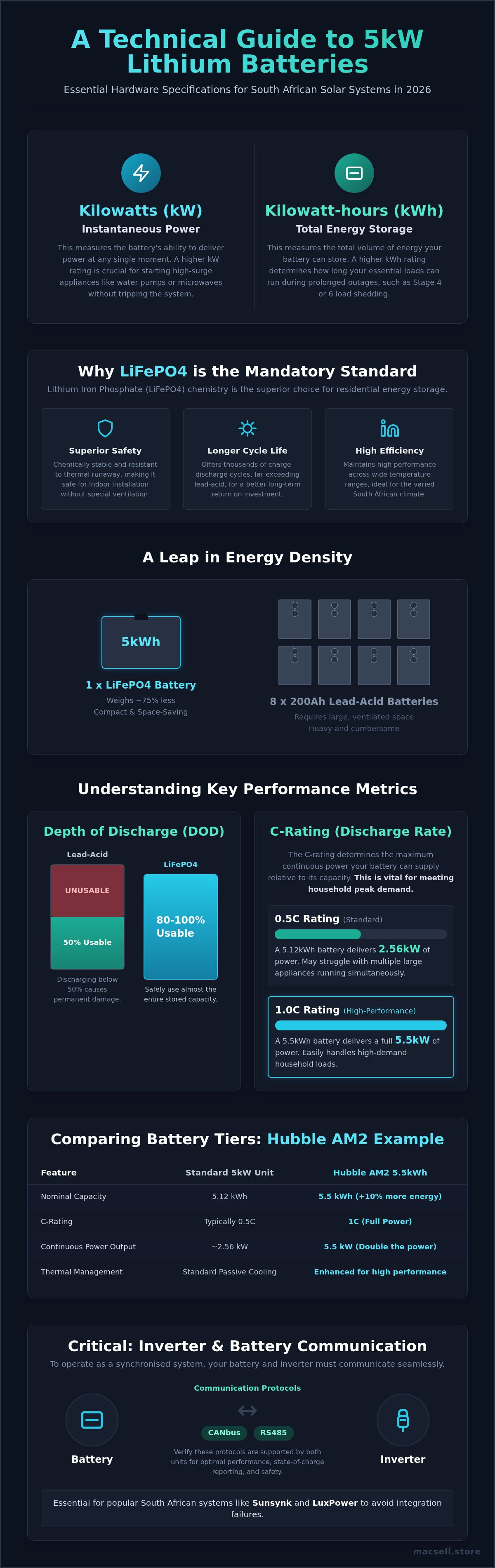
Lithium hardware provides a massive leap in energy density compared to legacy lead-acid systems. A single 5kWh lithium unit offers the same usable energy as eight 200Ah lead-acid batteries. This compact footprint is critical for modern South African homes where space is limited. Moving to lithium also removes the requirement for ventilated battery rooms; these units don't emit hazardous gases during charge or discharge cycles. The physical organisation of cells is managed by internal busbars and mounting brackets that ensure structural integrity during transport and operation.
kW vs kWh: Defining Power and Capacity
Distinguishing between kW and kWh is essential for effective load shedding planning. Kilowatts (kW) represent the instantaneous power output capability. This metric determines if your battery can handle the surge current of a microwave or a water pump. Kilowatt-hours (kWh) define the total energy volume stored; it's the capacity that dictates how long your lights stay on. During Stage 4 or Stage 6 outages, the kWh rating is your primary concern. A standard 5kWh unit provides roughly five hours of runtime for a consistent 1000W load. Understanding this prevents the common mistake of over-discharging a system beyond its technical limits.
The Advantages of LiFePO4 Chemistry
Lithium Iron Phosphate (LiFePO4) is the mandatory industry standard for stationary energy storage. It's a specific branch of lithium-ion battery technology that prioritises thermal stability and safety over the extreme energy density found in mobile phones. LiFePO4 cells are chemically stable and resistant to thermal runaway, making them safe for indoor installation in residential areas. They don't require the aggressive cooling systems needed by other lithium variants.
These cells offer a superior weight-to-power ratio, weighing approximately 75% less than lead-acid equivalents. They are environmentally preferable because they contain no lead or cobalt. High-performance options like the Hubble AM2 5.5kWh use this chemistry to provide a 10% capacity advantage and better thermal management than entry-level models. This phosphate-based hardware maintains high efficiency across wide temperature ranges, which is vital for the South African climate. The absence of "memory effect" means these batteries don't require full discharge cycles to maintain their health.
Performance Metrics: Capacity, Depth of Discharge, and Cycle Life
Performance metrics for a 5kw lithium battery determine the actual utility of the hardware in a load shedding environment. The most critical specification for 2026 hardware is the C-rating. This metric dictates the rate at which energy is extracted relative to total capacity. A 0.5C battery with 5.12kWh capacity supports a 2.56kW continuous discharge. High-performance 1C units, such as the Hubble AM2, support a full 5.5kW output. This distinction is vital; a low C-rating forces the system to pull power from the grid even when the battery is full if the household load exceeds the discharge limit. Users with high-surge appliances like kettles or pumps must verify C-ratings to avoid BMS shutdown during peak demand.
Temperature management remains the primary factor in hardware health. Lithium cells operate optimally between 15°C and 30°C. Operating consistently in South African summer peaks above 35°C can reduce total cycle life by up to 20% if the Battery Management System (BMS) does not actively manage thermal thresholds. Passive cooling through well-ventilated rack-mount cabinets is a basic requirement for maintaining these parameters. High-quality chassis designs facilitate airflow around the internal cells to prevent localised hotspots during high-current discharge cycles.
Depth of Discharge (DOD) Explained
Modern lithium hardware is rated for 80% to 100% DOD. Unlike lead-acid predecessors that failed if discharged below 50%, a lithium system allows for nearly full capacity utilisation. Maintaining a 20% reserve is a proven strategy for prolonging battery life and ensuring emergency power during extended outages. For a deeper technical dive into cell architecture and its impact on capacity, consult our guide on lithium ion solar battery technology.
Cycle Life and Long-Term Value
A cycle is defined as one full discharge and one full recharge. Current 2026 hardware standards specify 6000 cycles at 80% DOD. In a typical South African household with one cycle per day, this translates to a 15-year functional lifespan. Calculating value requires looking beyond the initial price tag to the cost-per-cycle. A 5kw lithium battery with a higher cycle count represents better long-term value than a cheaper, low-cycle alternative. High-cycle reliability is a core feature of the lithium batteries available at MacSell, ensuring the system survives the rigours of frequent grid instability without premature degradation.
Inverter Compatibility and Communication Protocols
Successful energy storage relies on a digital handshake between hardware components. A 5kw lithium battery requires active communication with the hybrid inverter to manage charge cycles and discharge limits effectively. Most modern systems utilise CANbus or RS485 ports to facilitate this data exchange. Without these protocols, the inverter cannot accurately determine the battery's State of Charge (SOC) or internal temperature. This lack of data leads to inefficient energy management and potential hardware damage over time.
Closed-loop communication is the industry standard for 2026. In this setup, the Battery Management System (BMS) dictates the charge parameters to the inverter in real-time. Using "dumb" batteries or open-loop configurations, where the inverter merely monitors voltage, increases the risk of overcharging or deep discharge. This is particularly dangerous in high-demand South African environments where rapid cycling is common due to frequent grid instability. Active communication ensures the system operates within safe technical margins, protecting your investment from premature degradation.
Hybrid Inverter Integration
Integrating a 5kw lithium battery with a LuxPower SNA5000 requires precise voltage matching. These 48V DC systems are designed for modularity, allowing users to connect multiple units in parallel to expand total storage. Hubble batteries, specifically the AM2 model, are prioritised for their native compatibility with Sunsynk and LuxPower firmware. This synergy ensures the inverter receives accurate data regarding cell balancing and health monitoring. It's critical for maintaining warranty conditions, as many manufacturers require logged communication data for claim validation. Paralleling units also requires master-slave configuration via DIP switches to ensure the inverter sees the entire bank as a single logical unit.
BMS Communication Protocols
The BMS acts as the central intelligence of the battery rack. Its primary role is preventing overcharge and managing thermal thresholds across all internal cells. Closed-loop settings allow the battery to command the inverter to stop charging once the target voltage is reached. Troubleshooting common communication errors amongst different brands often involves checking RJ45 pin configurations. Incorrect pinouts are the leading cause of communication failure; always verify the specific cable requirements for Sunsynk or Deye interfaces to ensure a stable link. A failed communication link usually triggers an "F58" or similar error code on the inverter, forcing the system into a protective standby mode until the connection is restored.
Safety Standards and Battery Management Systems (BMS)
A 5kw lithium battery relies on its internal Battery Management System (BMS) to maintain operational safety. The BMS is a dedicated hardware controller that monitors every individual cell within the pack. It serves as the final line of defence against short circuits, over-current, and over-voltage scenarios. If a fault is detected, the BMS triggers an immediate disconnect to prevent hardware damage. This active monitoring is what allows lithium systems to be safely installed inside residential buildings, provided they meet specific structural and ventilation requirements.
Physical installation requires a stable, non-combustible mounting surface. Wall-mount units must be secured with heavy-duty anchors to handle the 45kg to 80kg weight of a standard 5kW-class battery. Ventilation is equally critical. While LiFePO4 chemistry is stable, the electronic components of the BMS generate heat during high-current discharge. Maintaining a 100mm clearance around the chassis ensures adequate airflow and prevents thermal throttling. These physical parameters are as important as the digital ones for ensuring the longevity of your hardware.
Internal Hardware Protection
The BMS manages cell balancing by redistributing charge amongst cells to ensure uniform voltage levels. This process prevents individual cells from reaching critical voltage thresholds that could lead to premature failure or safety risks. High-quality battery hardware includes integrated DC circuit breakers or fuses as secondary protection layers. These physical breakers isolate the battery from the inverter during massive surges or external faults. Monitoring individual cell voltages allows the system to identify a single failing cell before it affects the entire bank, facilitating easier maintenance and long-term stability.
Certifications to Look For
Compliance with international standards like UN38.3 and IEC 62619 is non-negotiable for 2026 energy systems. UN38.3 ensures the battery is safe for transport, whilst IEC 62619 specifically covers the safety of secondary lithium cells in stationary applications. These certifications are essential for meeting South African insurance requirements and municipal SSEG registration standards. Hardware lacking these marks often fails to gain approval for grid-tied systems. For a detailed look at compliant hardware, view our guide on the best lithium battery for solar South Africa.
Ensuring your system meets these safety benchmarks is a prerequisite for reliable energy independence. You can browse certified 5kW lithium batteries at MacSell Solar Outlet to find hardware that matches these rigorous safety specifications.
Procuring 5kW Lithium Batteries for South African Solar Systems
Procuring a 5kw lithium battery requires a transition from general research to specific hardware acquisition. In the South African market, the Hubble AM2 5.5kWh stands out as a high-performance alternative to standard 5kW units. It offers a 10% capacity buffer which is essential for managing the 8.76% NERSA tariff increase. Purchasing from a specialised hardware outlet like MacSell Solar Outlet ensures you receive technical support focused on hardware synergy rather than just a retail transaction. Specialised distributors maintain inventory that's correctly stored and cycled, preventing the cell degradation often found in general retailers who store lithium units in non-temperature-controlled warehouses.
Logistics are a primary consideration during procurement. Standard lithium units weigh between 45kg and 80kg, necessitating specialised courier handling to prevent internal cell misalignment or chassis damage. Buyers should verify that the distributor uses palletised shipping or reinforced packaging for long-distance deliveries within South Africa. It's also vital to confirm that the delivery includes the correct mounting brackets, as wall-mount and rack-mount hardware often require different structural supports that aren't always bundled in generic listings.
Standalone vs Combo Kits
Choosing between standalone hardware and integrated packages depends on your existing infrastructure. The Sunsynk Hubble combo kit is the preferred route for new installations. These kits guarantee hardware synergy, as the communication cables and firmware versions are pre-tested for closed-loop operation. If you're expanding an existing array, ensure the new 5kw lithium battery matches the voltage and chemistry of your current units to maintain balanced charge cycles across the bank. Scalability is a core advantage of these 48V systems, but adding units from different manufacturing batches may require a manual BMS update to ensure all cells balance at the same rate.
Hardware Procurement Checklist
A technical procurement checklist prevents integration delays. First, verify that the battery firmware is compatible with your specific inverter model; older LuxPower or Sunsynk units may require a firmware bridge. Second, ensure the package includes the specific CANbus or RS485 communication cables required for your inverter's pinout. Finally, perform a physical hardware inspection upon delivery. Check the DC terminals for any signs of transit stress and verify that the digital SOC display or LED indicators initialise correctly during the first power-on test. Verifying these technical details at the point of procurement ensures the system meets the NRS 097-2-1:2024 standards mentioned earlier in this guide.
Optimising Your Energy Storage Strategy
Building a resilient power system requires more than high capacity; it demands hardware that communicates effectively and meets the safety standards of the 2026 South African energy market. Selecting a 5kw lithium battery with a high C-rating and LiFePO4 chemistry ensures your system handles peak loads whilst maintaining a functional lifespan of over 15 years. Prioritising closed-loop communication between your BMS and inverter is the only reliable way to protect your cells from premature degradation during frequent grid outages.
Compliance with NRS 097-2-1:2024 and international safety certifications remains the benchmark for any professional installation. By focusing on high-cycle hardware like the Hubble AM2, you secure better long-term value and higher energy density. As an authorised stockist of Hubble, Sunsynk, and Deye hardware, we provide the technical components necessary for a high-performance solar array. View our range of 5kW Lithium Batteries and Combo Kits to secure your energy independence today. We provide national delivery across South Africa to get your hardware on-site efficiently. Your transition to a reliable, decentralised energy system starts with the right hardware specifications.
Frequently Asked Questions
What is the actual capacity of a 5kW lithium battery?
A standard 5kw lithium battery typically offers a nominal capacity of 5.12kWh or 5.5kWh, depending on the specific cell configuration. This rating represents the total energy stored, whilst the "5kW" label often refers to the unit's power class. For example, the Hubble AM2 provides 5.5kWh, giving you a 10% capacity advantage over entry-level 5kWh models. Always check the usable capacity rating, which is usually 90% to 100% of the nominal value.
Can I expand my system by adding another 5kW battery later?
You can expand your storage by adding additional units in parallel to your existing 48V busbar. Most modern 5kW lithium batteries support parallel configurations of up to 15 units, significantly increasing total household capacity. It's best practice to use batteries of the same brand and model to ensure the Battery Management System (BMS) balances cells correctly across the entire bank. Always verify that your inverter firmware supports the expanded logical battery size.
How long will a 5kW lithium battery last during load shedding?
Runtime depends entirely on your instantaneous power draw. A 5kWh battery provides approximately five hours of power for a constant 1000W load or ten hours for a 500W load. This duration decreases if you use high-surge appliances like kettles or heaters. To maximise runtime during Stage 4 or Stage 6 load shedding, prioritise essential circuits such as lighting, refrigeration, and internet routers whilst avoiding heavy heating elements.
Is a 5kW lithium battery compatible with my existing inverter?
Compatibility depends on the inverter's DC voltage and communication protocols. Most residential lithium units are 48V DC systems designed for hybrid inverters like Sunsynk, Deye, or LuxPower. The battery must "talk" to the inverter via CANbus or RS485 ports to manage charging safely. If your inverter only supports lead-acid settings (voltage-based charging), you can still use lithium hardware in "open-loop" mode, though "closed-loop" communication is the preferred standard for 2026.
What is the difference between a 1C and a 0.5C discharge rate?
These ratings define the speed at which the battery can be discharged. A 1C rating means a 5.5kWh battery can deliver a full 5.5kW of power continuously, whereas a 0.5C rating limits the output to 2.75kW. High-performance units with 1C ratings are better suited for South African households that need to run multiple appliances simultaneously without the battery tripping its internal circuit breaker due to over-current.
Do I need to register my 5kW battery with the local municipality?
Registration is mandatory for all Small-Scale Embedded Generation (SSEG) systems connected to the grid in South Africa. This includes any 5kw lithium battery integrated with a grid-tied or hybrid inverter. Municipalities require this for safety and grid stability monitoring. The fee waiver for this registration ends on September 30, 2026. Failure to register your system can result in penalties ranging from R6,000 to R30,000 depending on your local municipal bylaws.
How many cycles can I expect from a high-quality LiFePO4 battery?
Modern LiFePO4 hardware typically offers 6000 cycles or more at an 80% Depth of Discharge (DOD). In a standard residential environment with one full cycle per day, this hardware should remain functional for approximately 15 years. High-quality cells maintain roughly 80% of their original capacity even after reaching this cycle count. Factors such as operating temperature and discharge rates will influence the actual longevity of the internal chemistry.
What happens if the BMS fails in my 5kW lithium battery?
If the Battery Management System (BMS) fails, the internal protection circuit will typically isolate the battery cells by opening the DC breaker or fuse. This prevents unsafe operation such as overcharging or thermal runaway. The inverter will display a communication error and stop drawing power from the unit. Because the BMS is integrated into the battery chassis, a failure usually requires a hardware repair or replacement by the manufacturer's authorised service centre.