

48V Lithium Battery Price South Africa: 2026 Hardware Comparison Guide
Missing the March 31, 2026, registration deadline for your solar system results in a R 6,052 fine and immediate disconnection. It's a steep penalty for hardware that might not even be communicating correctly with your inverter. You've likely found that tracking the 48v lithium battery price South Africa market is only half the battle. The real frustration comes from technical specifications that don't match actual performance or batteries that refuse to talk to your existing Sunsynk or Deye unit.
This 2026 hardware comparison guide simplifies your procurement process by providing a transparent breakdown of technical specifications and hardware compatibility. You'll discover the latest pricing factors for premium units like the Hubble AM2 and Sunsynk 5.12kW models. We examine cycle life data and warranty terms to ensure your investment delivers long-term reliability. This overview provides the clarity needed to choose a high-performance battery with confidence and identifies a dependable hardware supplier for national delivery.
Key Takeaways
- Identify why 48V LiFePO4 technology is the definitive standard for South African residential and commercial hybrid inverters.
- Analyse how usable capacity and C-ratings directly influence the 48v lithium battery price South Africa retailers offer in 2026.
- Compare the performance of the Hubble AM2 5.5kWh against proprietary Deye and Sunsynk hardware ecosystems for better integration.
- Ensure hardware longevity by mastering the BMS-to-inverter communication "handshake" required for system health.
- Streamline procurement by selecting pre-configured solar combo kits designed for guaranteed hardware compatibility and national delivery.
Why 48V Lithium Batteries are the Standard for South African Solar
The 48V architecture is the definitive hardware standard for South African residential and commercial hybrid inverters. Most modern 5kW and 8kVA systems from manufacturers like Sunsynk and Deye require this specific voltage to operate. While older backup systems relied on 12V or 24V lead-acid configurations, the transition to 48V lithium iron phosphate (LiFePO4) has redefined performance benchmarks. It's the technical baseline for any reliable solar installation today.
Managing high-demand appliances like kettles, pumps, or microwave ovens during load shedding requires significant power output. A 48V system handles these loads more effectively than lower-voltage alternatives. By doubling the voltage from 24V to 48V, the system halves the current required to deliver the same power. This reduction in current allows for thinner, more manageable cabling and significantly decreases heat dissipation within the hardware. It's a critical factor when calculating the total 48v lithium battery price South Africa consumers face; lower heat translates to longer component lifespans and better round-trip efficiency.
The Chemistry of 48V LiFePO4 Hardware
Lithium Iron Phosphate is the preferred chemistry for stationary energy storage due to its exceptional thermal stability and safety profile. Unlike standard Lithium-ion battery technology used in mobile electronics, LiFePO4 does not suffer from thermal runaway at typical operating temperatures. These packs provide a stable voltage curve, maintaining consistent output even as the state of charge drops. While marketed as 48V, most hardware actually operates at a nominal 51.2V, consisting of 16 cells in series. This configuration eliminates the "voltage sag" common in lead-acid batteries, ensuring your inverter doesn't trip under heavy surge loads.
Efficiency Gains in High-Voltage Residential Systems
Using 48V architecture minimises energy loss during discharge through reduced electrical resistance. This efficiency is vital for scaling system capacity. Most 48V units allow for parallel connection, enabling users to expand from 5kWh to over 100kWh without changing the core inverter hardware. Modern lithium ion solar battery systems also utilise 48V to facilitate high-speed charging. This allows batteries to reach full capacity rapidly between load shedding stages, which is a non-negotiable requirement given the current grid instability in South Africa. The 48v lithium battery price South Africa installers quote reflects this superior power density and rapid-cycle capability.
Factors Influencing 48V Lithium Battery Price in 2026
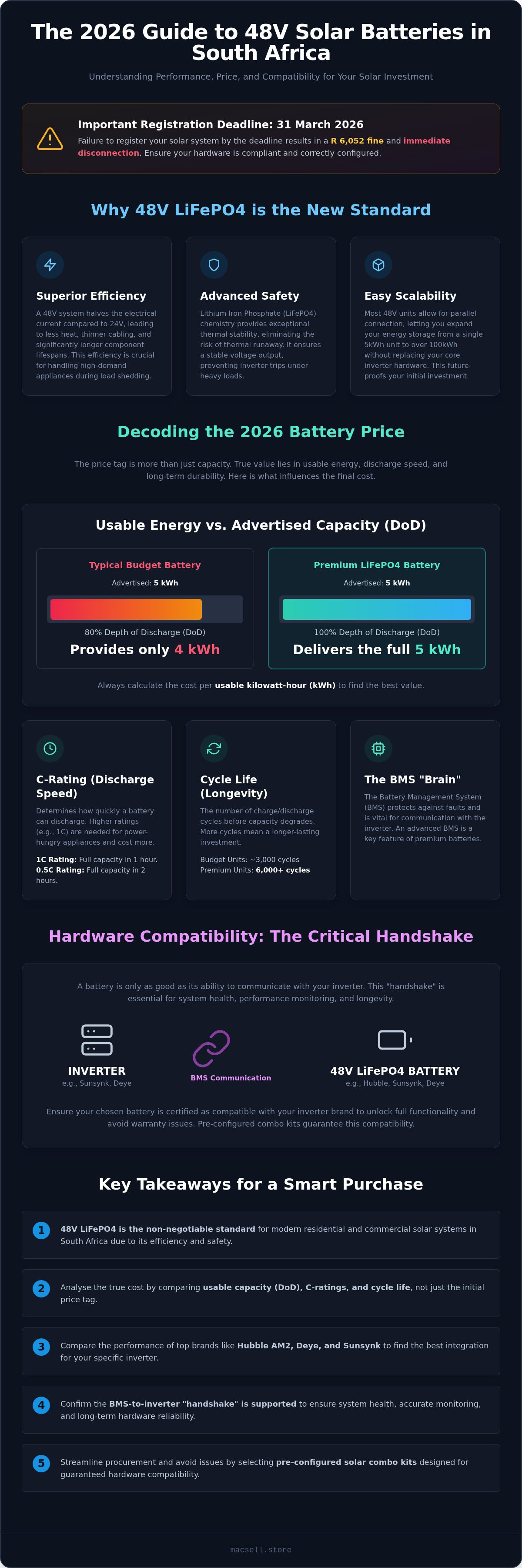
Calculating the 48v lithium battery price South Africa homeowners pay requires looking beyond the initial sticker cost. Hardware complexity and internal component quality drive these variations. As the South Africa Battery Market size continues to expand, manufacturers are differentiating products based on discharge performance and management intelligence. A battery's "C-Rating" defines its discharge speed. A 1C-rated battery can discharge its full capacity in one hour, whereas a 0.5C battery takes two. High-drain appliances require higher C-ratings, which increases the manufacturing cost. Additionally, the Battery Management System (BMS) acts as the brain of the unit. High-end BMS hardware protects against over-voltage, short circuits, and thermal issues, ensuring the hardware doesn't fail prematurely. This intelligence allows for better communication with your inverter, which is a key price differentiator in the current market.
Usable Energy and Depth of Discharge (DoD)
Depth of Discharge is the percentage of the battery that can be used relative to its total capacity. While a unit might be labelled as 5kWh, the usable energy depends on its DoD rating. A budget battery with an 80% DoD only provides 4kWh of actual power, whereas a premium unit with 100% DoD offers the full 5kWh. When comparing the 48v lithium battery price South Africa suppliers offer, always calculate the cost per usable kWh. Choosing a unit with 100% DoD often proves more economical than a cheaper alternative that restricts energy access to prevent cell damage. You can browse premium lithium options to find hardware that delivers maximum usable energy for your specific load profile.
The Impact of Cycle Life on Long-Term Value
Cycle life determines how many times a battery can be charged and discharged before its capacity drops below a specific threshold, usually 80%. Budget units typically offer 3000 cycles, which may last five to seven years under standard load shedding conditions. In contrast, premium hardware like the Hubble AM2 provides 6000 cycles or more, often backed by 10-year warranties. Some 2026 models now feature "unlimited cycles" warranties within the 10-year period, reflecting high confidence in cell longevity. Investing in higher-cycle hardware reduces the long-term cost-per-cycle, making it a superior financial choice for permanent solar installations. These warranty terms directly correlate with the initial purchase price, as higher-grade cells and more robust manufacturing processes are required to meet 10-year performance guarantees.
Comparing Top 48V Battery Brands: Hubble, Deye, and Sunsynk
Brand selection is a critical variable in the 48v lithium battery price South Africa market. While technical specifications often look similar on paper, the hardware's ability to integrate with specific inverters varies significantly. Hubble, Deye, and Sunsynk dominate the local landscape due to their robust communication protocols and established local support networks. Choosing a brand with a strong presence in South Africa ensures access to firmware updates and technical assistance, which are vital for maintaining system health over a ten-year lifespan.
Hubble AM2 5.5kWh: Technical Specifications
The Hubble AM2 5.5kWh remains a favourite for South African residential installations due to its high power-to-weight ratio and wall-mount versatility. It features a high-performance BMS that supports CAN-bus and RS485 communication, allowing it to "talk" to almost any leading inverter brand on the market. This compatibility reduces installation complexity and prevents the common "communication fault" errors that plague generic hardware. For those tracking current market positioning, reviewing a detailed Hubble AM2 battery price roundup helps in understanding how this unit competes against modular alternatives. Its 1C rating and 100% Depth of Discharge make it a technically superior choice for heavy-load environments.
Sunsynk and Deye Ecosystem Batteries
Using Sunsynk or Deye proprietary batteries with their respective inverters offers a "plug-and-play" advantage. These same-brand ecosystems ensure perfect BMS-to-inverter synchronisation without manual configuration. Premium Deye lithium hardware often provides 1C discharge capabilities, meaning a 5kWh battery can deliver a continuous 5kW of power. This is a significant advantage over budget brands that limit discharge to 0.5C. Many manufacturers also offer extended warranties when their batteries and inverters are purchased as a complete kit, as the hardware is designed to operate within pre-defined safety parameters that protect the lithium cells from stress.
Secondary brands like Pylontech, Dyness, and Freedom Won provide alternative price-to-performance ratios. Freedom Won, specifically, is highly regarded for its local South African manufacturing and robust technical support centres. While the 48v lithium battery price South Africa retailers offer for these brands may vary, the inclusion of local service centres is a mandatory requirement for any long-term energy investment. Ensuring access to local technicians for hardware assessment across the country is far more valuable than a marginal saving on a generic import that lacks local representation.
Inverter Compatibility: Matching 48V Batteries to Your Hardware
The "handshake" between a lithium battery and a hybrid inverter is the most critical technical requirement for system longevity. This digital communication, usually facilitated via CAN-bus or RS485 protocols, allows the Battery Management System (BMS) to dictate charging parameters directly to the inverter. Without this link, the inverter relies on voltage-based estimations. These are notoriously inaccurate for lithium chemistry and can lead to over-discharging or inefficient charging cycles. When evaluating the 48v lithium battery price South Africa suppliers quote, ensure the hardware includes compatible communication firmware for your specific inverter brand.
Matching discharge rates is equally vital. An 8kVA inverter has a maximum continuous discharge capability that can exceed 150A. If you pair this with a single 0.5C-rated 100Ah battery, the battery will likely trip under heavy loads like geysers or air conditioners. You must size your 48V bank to match or exceed the inverter's peak demand. Expanding a 48V bank is straightforward through parallel connections, but mixing different lithium brands or capacities in one bank is a significant pitfall. Variations in internal resistance cause uneven current distribution. This leads to premature cell degradation in the weaker units and voids most manufacturer warranties.
Sunsynk 8KVA and Hubble AM2 Synergy
The Sunsynk Hubble combo kit represents a top-tier choice for South African residential backup systems. The Sunsynk 8KVA inverter's high-speed processing allows it to manage multiple Hubble AM2 units as a single logical power source. This pairing requires specific RJ45 communication cables pinned for the Sunsynk CAN port to ensure the inverter receives real-time data on cell temperature and state of charge. This level of integration allows the system to prioritise essential loads whilst protecting the battery hardware during extended outages. It is the most reliable way to ensure your hardware investment survives the rigours of Stage 6 load shedding.
LuxPower SNA5000 and Budget-Friendly 48V Options
For those seeking a versatile entry point, the LuxPower SNA5000 is a robust choice. It pairs effectively with standard 100Ah 48V batteries to deliver 5kW of continuous performance. Whilst the SNA5000 supports many BMS protocols, some budget batteries may require manual configuration. In cases where BMS communication is unavailable, installers must set precise charge and float voltages to prevent cell damage. You can purchase 48V lithium hardware directly to ensure your inverter and battery pairing meets these technical requirements. The total 48v lithium battery price South Africa buyers pay is often more economical when purchasing these matched components as a pre-configured kit.
Procuring 48V Lithium Batteries from MacSell Solar Outlet
MacSell Solar Outlet operates as a specialised technical distributor for the South African market. The focus remains strictly on high-performance hardware procurement and direct-to-consumer sales. By avoiding installation services, the business ensures maximum stock availability and expert product knowledge for every unit sold. This direct model allows for a competitive 48v lithium battery price South Africa buyers can rely on for professional-grade energy setups. National delivery logistics are structured for speed and safety, ensuring that heavy 48V hardware arrives at any location in optimal condition.
One of the most efficient ways to secure a reliable system is through a solar combo kit South Africa retailers offer. These pre-configured packages, such as the Sunsynk 8KVA and 2X Hubble AM2 5.5 KWh Combo Kit, eliminate the risk of hardware mismatch. They provide a verified solution where the inverter and battery communication protocols are already synchronised. This approach reduces the technical burden on the buyer and ensures the system operates within manufacturer-approved parameters from the moment of activation.
Hardware Availability and Variety
The inventory features a curated selection of Sunsynk, Deye, and Hubble products designed for diverse installation requirements. Buyers can choose between rack-mount configurations, which are often preferred for high-capacity Deye systems, or the wall-mount versatility found in the Hubble AM2 range. To complement these 48V storage units, MacSell stocks high-wattage solar panels and LuxPower SNA5000 hybrid inverters. This enables users to build a complete, high-efficiency energy ecosystem from a single, reliable hardware source.
Streamlined Transactional Experience
MacSell prioritises a no-nonsense, functional approach to solar retail. The online store functions as a technical catalog where specifications are the primary focus. This allows industry professionals and informed homeowners to make data-driven decisions for their 2026 energy requirements without unnecessary marketing fluff. Every product listing provides the essential technical parameters, from C-ratings to cycle life, to ensure the 48v lithium battery price South Africa consumers pay translates into a compatible and efficient power solution. This methodical process moves the buyer rapidly from a technical need to a specific hardware solution.
View the latest 48V Lithium Battery range at MacSell Solar Outlet
Securing Your 2026 Energy Independence
Selecting the right hardware requires balancing technical parameters with long-term reliability. A competitive 48v lithium battery price South Africa consumers find today must account for 100% Depth of Discharge and robust BMS communication protocols. As the March 31, 2026, registration deadline approaches, ensuring your system meets SANS 10142 standards with authorised hardware is essential for regulatory compliance and operational safety. High-performance units like the Hubble AM2 provide the cycle life necessary to withstand frequent grid instability whilst maintaining voltage stability.
MacSell Solar Outlet serves as your specialised technical partner, providing direct access to premium brands like Hubble, Sunsynk, and Deye. We prioritise product excellence and transparent, direct-to-consumer pricing to streamline your procurement process. Whether you require a standalone Hubble AM2 unit or a pre-configured 8KVA combo kit, our national delivery network ensures your hardware arrives safely at any location across the country. You can trust our expert-curated inventory to provide the exact specifications needed for a high-efficiency solar installation.
Browse our 48V Lithium Battery inventory for national South African delivery and take the next step in securing a reliable, future-proof power solution for your home or business.
Frequently Asked Questions
What is the average price of a 5kWh 48V lithium battery in South Africa in 2026?
The market 48v lithium battery price South Africa consumers encounter for 5kWh units generally ranges from R13,500 to R20,000 depending on brand and technical specifications. Premium units with higher C-ratings or advanced communication features typically sit at the upper end of this bracket. These costs are influenced by cell grade, warranty duration, and the quality of the integrated Battery Management System. Always verify the usable capacity to ensure accurate value comparison.
Can I use a 48V lithium battery with a 5kW hybrid inverter?
Yes, a 48V lithium battery is the industry standard for 5kW hybrid inverters like the LuxPower SNA5000 or Sunsynk models. These inverters are specifically designed to operate within the 42V to 58V DC range provided by lithium packs. You must ensure that the battery's continuous discharge current matches the inverter's maximum input requirements. A single 100Ah battery is usually sufficient for a 5kW load if it has a 1C discharge rating.
How long will a 48V 100Ah lithium battery last during load shedding?
A 48V 100Ah battery provides approximately 4.8kWh to 5.1kWh of energy. If your average household load is 1kW, running a fridge, lights, and television, the battery will last roughly 4.5 to 5 hours. Increasing the load to 2kW by adding a microwave or pump will reduce the runtime to approximately 2 hours. Runtime is directly proportional to the continuous wattage consumed by your connected appliances during the outage.
Is it better to buy one 10kWh battery or two 5kWh batteries in parallel?
Choosing two 5kWh batteries in parallel is often superior for redundancy and system scalability. If one unit fails, the second remains operational to provide essential backup power. This configuration also doubles the continuous discharge current, which is beneficial for high-surge appliances. Whilst a single 100Ah unit is more compact, the 48v lithium battery price South Africa retailers offer for parallel setups provides better long-term flexibility as your energy requirements grow.
Will a Hubble AM2 battery work with a Deye or Sunsynk inverter?
The Hubble AM2 is fully compatible with both Deye and Sunsynk inverters through CAN-bus or RS485 communication protocols. It is essential to use the correct RJ45 cable pinout for the specific inverter brand to ensure the digital "handshake" is successful. Once connected, the inverter automatically receives real-time data from the battery's BMS. This ensures optimal charging and prevents the hardware from operating outside safe voltage or temperature limits.
What is the difference between a 48V and a 51.2V lithium battery?
There is no functional difference in application; 48V is the nominal category name, whilst 51.2V is the actual nominal voltage of a 16-cell LiFePO4 pack. Most modern lithium hardware marketed as 48V operates at 51.2V to provide better compatibility with hybrid inverters. This higher nominal voltage helps reduce current flow and heat within the system. Both terms refer to the same hardware standard used in residential solar installations across South Africa.
Do 48V lithium batteries require maintenance like lead-acid batteries?
Lithium batteries are entirely maintenance-free and do not require water top-ups or equalisation charges like traditional lead-acid units. The internal Battery Management System (BMS) automatically balances the cells and protects the hardware from overcharging. You only need to ensure that the terminals remain tight and the environment stays clean and well-ventilated. This lack of maintenance is a primary driver for the transition to lithium technology in South African homes.
What does a 1C discharge rate mean for my 48V battery price?
A 1C discharge rate means the battery can discharge its full capacity in one hour, which usually commands a higher price than 0.5C units. For a 100Ah battery, a 1C rating allows for a 100A continuous output, roughly 5kW. Cheaper 0.5C units only allow 50A, or 2.5kW. Investing in a 1C-rated battery ensures your hardware can handle heavy appliance surges without tripping the BMS or causing long-term cell damage.