

Best Lithium Battery for Solar South Africa: 2026 Hardware Comparison
With the mandatory 31 March 2026 registration deadline approaching, an uncertified solar setup now carries a R6,052 fine and the threat of grid disconnection. You've likely invested in solar to escape the unpredictability of load shedding, yet the technical reality of choosing the best lithium battery for solar South Africa remains complex. Hardware mismatches between the Battery Management System and your inverter can lead to system failure and high replacement costs before your investment pays off.
We agree that energy independence should be permanent, not a temporary fix plagued by compatibility errors. This comparison evaluates the top lithium storage brands to identify the most durable hardware for your specific requirements. We focus on technical specifications, 10-year cycle performance, and seamless integration with hybrid inverters like Sunsynk and LuxPower. This guide provides the data needed to secure a reliable storage solution that ensures your system remains compliant and operational through 2026 and beyond.
Key Takeaways
- Identify why Lithium Iron Phosphate (LiFePO4) is the 2026 industry standard for safety and thermal stability in South African conditions.
- Define the relationship between Depth of Discharge (DOD) and cycle life to ensure your storage hardware lasts a full decade.
- Evaluate technical specifications of top brands to find the best lithium battery for solar South Africa for your specific inverter pairing.
- Recognise the importance of the BMS-to-inverter communication protocol to avoid integration failures and warranty voids.
- Calculate essential load and autonomy requirements using a structured approach to avoid over-spending on unnecessary capacity.
The 2026 South African Solar Battery Landscape
South Africa's energy strategy has evolved rapidly. Solar installations are no longer viewed as temporary backup measures but as permanent infrastructure for total energy independence. By mid-2026, the preference for high-performance hardware has solidified, moving away from cheaper, short-term fixes that fail under heavy usage. Finding the best lithium battery for solar South Africa now requires a focus on specific chemical compositions and integration capabilities that can withstand the rigours of the local grid. This transition is driven by the need for hardware that remains compliant with the Electricity Regulation Amendment Act and the mandatory system registration deadlines.
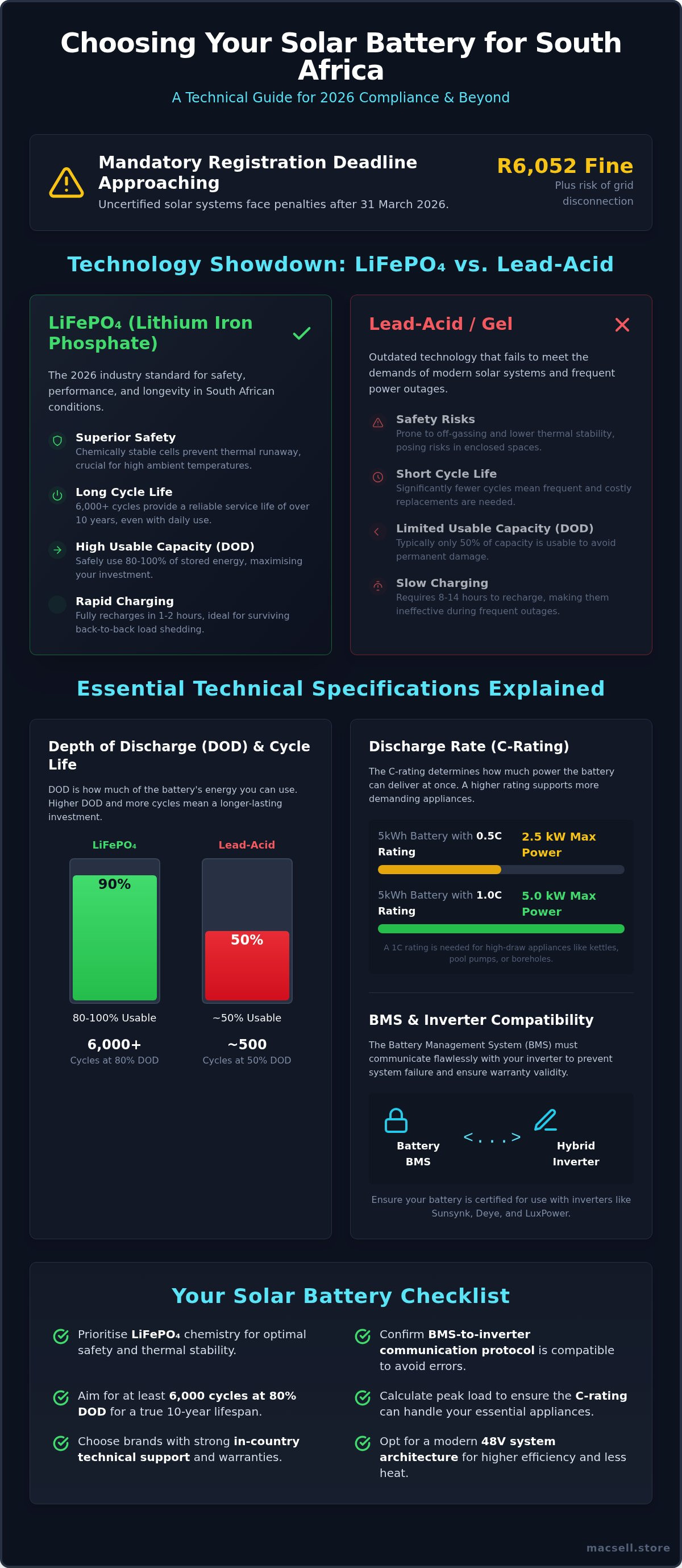
Lithium Iron Phosphate (LiFePO4) is the current industry benchmark. It outperforms lead-acid and gel alternatives in every technical category, particularly energy density and usable capacity. Lead-acid units typically offer a 50% depth of discharge, whereas modern lithium units allow for 80% to 100% without immediate degradation. For a comprehensive technical overview of lithium-ion battery technology and its various sub-types, technical documentation highlights the shift toward phosphate-based cells for residential safety and longevity.
Why LiFePO4 Dominates the Market
Safety is the primary driver for LiFePO4 adoption. Unlike standard Lithium-ion (NMC) batteries found in mobile phones, LiFePO4 cells are chemically stable and do not suffer from thermal runaway. This is critical in the South African climate, where high ambient temperatures in regions like Gauteng or the Northern Cape can stress electrical components. LiFePO4 technology typically delivers 6,000 cycles at 80% Depth of Discharge, providing a reliable 10-year service life in residential applications. This chemistry ensures the battery remains functional even after thousands of rapid discharge cycles.
The Impact of Load Shedding on Battery Selection
Frequent load shedding cycles demand rapid replenishment. Lead-acid batteries often require 8 to 14 hours to charge fully, making them useless during back-to-back outages. High-end lithium units support 0.5C to 1C charging rates, which means they can reach full capacity in approximately two hours of grid availability. Selecting the best lithium battery for solar South Africa involves evaluating how many cycles the unit can handle during Stage 6 load shedding without losing capacity.
Most residential systems have transitioned from 12V or 24V configurations to 48V high-voltage architectures. These 48V systems, compatible with Sunsynk and Deye inverters, reduce current flow and heat generation. This improves overall system efficiency and hardware longevity. Local support is also a non-negotiable factor. Brands like Hubble and Sunsynk provide in-country technical assistance for warranty claims and firmware updates, ensuring your investment is protected against technical glitches or hardware failures.
Essential Technical Specifications to Compare
Evaluating hardware based on sticker capacity alone is a common error. To identify the best lithium battery for solar South Africa, you must distinguish between nominal capacity and useable energy. While a battery might be labelled as 5kWh, its actual performance depends on the Depth of Discharge (DOD) and the efficiency of its internal Battery Management System (BMS). High-quality lithium iron phosphate units allow for deeper cycling than older technologies, but the hardware's ability to sustain high-current loads remains the critical differentiator for residential reliability.
Depth of Discharge and Cycle Life
Depth of Discharge (DOD) refers to the percentage of the battery that can be used before the BMS requires a recharge. Most 2026 lithium standards cite 6,000 cycles at 80% DOD. If you discharge 80% of your capacity daily, the battery should maintain 80% of its original health for approximately 16 years. However, running a 100% DOD profile increases stress on the cells. In South Africa, where Stage 4 or 6 load shedding might require two or three discharge cycles per day, the real-world lifespan may reduce to 8 or 10 years. For a technical breakdown of how these cycles function, consult our guide on Lithium Ion Solar Battery Technology.
Discharge Rates and Peak Loads
The C-rating of a battery defines how quickly it can release its stored energy. A 0.5C rating means a 5kWh battery can provide 2.5kW of continuous power. Conversely, a 1C rating allows that same battery to discharge 5kW. This is vital when operating high-draw appliances like boreholes, pool pumps, or kettles during a power outage. If your household demand exceeds the battery's discharge limit, the BMS will trigger a safety shutdown to prevent cell damage. The specific C-rating of your hardware directly determines the minimum number of battery units required to support high-draw appliances without triggering a system shutdown. If you require consistent power for heavy loads, you can browse our lithium battery inventory to find units with higher discharge capabilities.
The BMS serves as the brain of the storage system, monitoring cell voltage, temperature, and current flow in real time. A sophisticated BMS doesn't just protect the hardware; it facilitates a "handshake" protocol with your inverter. This communication ensures the inverter uses precise SOC (State of Charge) data rather than relying on voltage-based estimations. This precision prevents over-discharging and ensures your solar system operates at peak efficiency during extended outages.
Top Lithium Battery Brands in South Africa Compared
The 2026 solar market is dominated by a few key players that have established reliable supply chains and technical support within South Africa. Selecting the best lithium battery for solar South Africa involves looking beyond the price per kWh. It requires an analysis of local warranty fulfilment, firmware stability, and physical durability. Brands like Hubble, Sunsynk, Deye, and Pylontech lead the market because they offer verified integration with the most popular hybrid inverters. MacSell Solar Outlet stocks these specific brands to ensure customers receive hardware that meets current SANS 10142 standards and mandatory registration requirements.
Hubble AM Series Technical Review
Hubble Lithium remains a top choice due to its high-performance cells and robust local presence. The AM2 and AM5+ models are engineered specifically for the South African grid environment. The Hubble AM2 5.5kWh Battery offers a 5.5kWh capacity with a 1C discharge rating, making it suitable for high-demand residential loads. Local support is a critical advantage; warranty claims and technical troubleshooting are handled by South African technicians rather than international call centres. For a detailed breakdown of integration, read our Hubble AM2 5.5 KWh Hardware Overview.
Sunsynk and Deye Performance Comparison
Sunsynk and Deye provide vertically integrated solutions where the battery and inverter share a native communication protocol. The Sunsynk 5.32kWh wall-mounted battery is designed to pair perfectly with Sunsynk inverters, simplifying the "handshake" process. Deye's SE-G5.1 offers similar modularity but often appeals to those using high-voltage configurations in larger estates. Both brands utilise lithium iron phosphate technology to ensure thermal stability during the high ambient temperatures common in Pretoria and surrounding regions.
In 2026, warranty standards have shifted. While many brands offer a standard 10-year warranty, some have introduced "unlimited cycle" clauses, provided the battery is kept within specific temperature and DOD parameters. Sunsynk typically offers a 5-year standard warranty that extends to 10 years when paired with their own inverters. Deye maintains a competitive 10-year outlook on their lithium iron phosphate cells. Organising these systems is straightforward because both brands utilise standard CAN and RS485 communication ports for seamless BMS integration.
Pylontech remains the modular pioneer in the industry. Its US3000C and US5000 models are ideal for users who wish to start small and expand their storage capacity over time. Whilst newer wall-mounted options are sleeker, Pylontech's rack-mount design offers unmatched flexibility for custom solar rooms. This modularity allows for precise scaling as household energy demands increase or as new Virtual Power Plant (VPP) initiatives allow homeowners to monetise their excess storage.
Matching Your Battery to Your Hybrid Inverter
The communication protocol, often called the "handshake", is the most critical technical factor in system stability. Whilst many lithium batteries can physically connect to any 48V inverter, the absence of active data exchange leads to inefficient charging and reduced hardware lifespan. A functional "handshake" allows the Battery Management System (BMS) to dictate charge and discharge parameters based on real-time cell temperature and voltage. Without this, the inverter relies on voltage-based estimations, which are notoriously inaccurate for lithium iron phosphate chemistries. Selecting the best lithium battery for solar South Africa requires verifying that your inverter's firmware supports the specific CAN or RS485 protocol of your battery.
The Sunsynk-Hubble Synergy
The Sunsynk 8KVA and Hubble AM2 combo is a market leader because of its high-speed integration and shared communication standards. This pairing allows the Sunsynk inverter to monitor individual cell health within the Hubble units. Users gain access to the Sunsynk cloud platform, providing a centralised interface for monitoring state of charge (SOC), power flow, and battery temperature. This level of visibility is essential for managing energy independence during extended outages. For a complete technical breakdown of this hardware pairing, see our Sunsynk Hubble Combo Kit Guide.
Universal Compatibility Options
The LuxPower SNA5000 remains a popular choice for modular systems due to its flexible communication settings. It integrates effectively with Pylontech and Hubble batteries, provided the correct dip-switch settings are applied during setup. Deye inverters offer similar versatility, supporting a wide range of third-party lithium protocols. However, a common mistake is configuring these hybrid systems in "Lead-Acid" mode to bypass communication errors. This mode forces the inverter to use fixed voltage points, which prevents the battery from reaching a true 100% state of charge and often leads to premature cell balancing issues. Poor BMS integration will void your battery warranty if the inverter settings exceed the manufacturer's maximum charge voltage.
Hardware mismatches often result in "BMS Communication Loss" errors, which can shut down your entire solar array. To avoid these technical hurdles, you should procure hybrid inverters and lithium batteries that are pre-verified for compatibility. Mixing brands without a confirmed firmware handshake increases the risk of system downtime and hardware degradation. Ensuring your storage solution and inverter are synchronised is the only way to achieve maximum energy independence and 10-year hardware reliability.
Hardware Procurement: How to Choose Your System
Procuring high-end hardware directly allows homeowners and independent contractors to bypass the markups often associated with turnkey installation services. To identify the best lithium battery for solar South Africa for your specific property, you must follow a methodical selection process based on technical requirements rather than brand popularity alone. This ensures the hardware you purchase provides the necessary autonomy during extended grid failures.
The first step involves calculating your essential load. This is the total wattage of appliances that must remain operational during load shedding, such as refrigeration, security systems, and internet routers. Once this figure is established, determine your required autonomy. If you need four hours of backup for a 1kW load, a 5kWh battery at 80% Depth of Discharge is the minimum requirement. You must also verify your inverter's maximum charging current. If your inverter is limited to 50A, it can't charge a large battery bank quickly enough between frequent power outages. Finally, confirm the physical mounting requirements, as wall-mounted units like the Sunsynk 5.32kWh require specific structural support compared to floor-standing rack units.
Sizing Your Battery Bank
The 5.12kWh capacity has become the 2026 entry-level standard for South African households. Whilst one battery is often sufficient for basic backup, moving to a 10kWh or 15kWh array is necessary for those seeking full energy independence or operating high-draw appliances. Scalability is a key advantage of modern lithium systems. Most brands allow you to add more batteries later, provided the new units share the same firmware version and voltage specifications as the existing bank. It's vital to check that your inverter can manage the increased capacity without firmware conflicts.
Buying Solar Hardware Directly
Purchasing your own hardware gives you control over component quality and warranty terms. In the 2026 market, a retail warranty should offer at least 10 years of coverage on the cells and local technical support for the BMS. Procuring from an authorised retailer ensures you receive genuine stock with the latest firmware updates pre-installed. This approach is ideal for DIY-savvy buyers or those working with their own certified electricians to meet SANS 10142 compliance. You can view our curated range of Lithium Batteries to find the specific capacity and C-rating required for your system architecture.
Securing Your 10-Year Energy Investment
Technical compatibility between the BMS and inverter remains the primary factor in system reliability. Selecting the best lithium battery for solar South Africa involves evaluating cycle life, C-ratings, and the availability of local technical support to ensure long-term ROI. High-end LiFePO4 hardware ensures your system meets the 2026 registration standards whilst providing a durable storage solution that can withstand frequent load shedding cycles. This technical alignment prevents premature cell degradation and ensures your warranty remains valid through the full service life of the unit.
Direct hardware procurement empowers you to select components that match your specific autonomy and load requirements. As an authorised retailer of Sunsynk and Hubble, MacSell Solar Outlet provides technical expertise and efficient national delivery across South Africa. This approach ensures your installation is built on a foundation of guaranteed compatibility and verified performance standards. You can now build a resilient system that delivers maximum energy independence and operational stability.
Browse the Best Lithium Batteries for Solar at MacSell to secure your energy independence with professional grade hardware today.
Shop Lithium Batteries at MacSell
Find LiFePO4 batteries from Hubble, Sunsynk, Felicity Solar, and more — all compatible with leading hybrid inverters, with national delivery.
→ Shop Lithium Ion Solar Batteries
→ Shop Inverter & Battery Combo Kits
Frequently Asked Questions
What is the best lithium battery brand in South Africa for 2026?
Hubble and Sunsynk are widely considered the best lithium battery for solar South Africa due to their robust local support and seamless inverter integration. Hubble's AM series offers high discharge rates and proven durability in local conditions, whilst Sunsynk batteries provide native communication with their own market-leading hybrid inverters. Your choice should depend on your specific inverter brand and the required discharge current for your household loads.
How long does a 5kWh lithium battery last during load shedding?
A 5kWh battery typically lasts between 4 and 6 hours during load shedding if you limit the load to essential appliances like lights, routers, and refrigeration. If you increase the demand to include high-draw appliances like kettles or pumps, the runtime will drop to under two hours. Calculating your average hourly wattage is vital to ensure your battery capacity matches your required autonomy during power outages.
Can I mix different brands of lithium batteries in one solar system?
You shouldn't mix different lithium battery brands or models within a single bank. Different manufacturers utilise unique Battery Management Systems (BMS) and firmware protocols that cannot communicate effectively with one another. Mixing brands usually leads to charging imbalances, communication errors between the battery and inverter, and will almost certainly void your hardware warranties.
Is it better to buy a wall-mounted or rack-mounted lithium battery?
Wall-mounted batteries are ideal for space-saving and aesthetic residential installations where floor space is limited. Rack-mounted units offer superior scalability and cooling for larger systems that require multiple batteries. If you plan to expand your storage capacity in the future, a rack-mount configuration allows you to add multiple units into a modular cabinet with ease.
Do I need a specific inverter for a lithium battery?
Yes, you require a hybrid or off-grid inverter that specifically supports lithium iron phosphate (LiFePO4) charging profiles. The inverter must feature a compatible communication port, such as CAN or RS485, to "handshake" with the battery's BMS. Using a standard lead-acid inverter without these communication features will reduce battery lifespan and prevent accurate state-of-charge monitoring.
What is the difference between 0.5C and 1C lithium batteries?
The C-rating indicates the battery's discharge capability relative to its capacity. A 0.5C battery can discharge half its total capacity in one hour, whilst a 1C battery can discharge its full capacity in the same timeframe. For heavy loads like borehole pumps or electric kettles, a 1C battery is often necessary to prevent the BMS from triggering a safety shutdown during high-draw events.
How do I claim a warranty on a lithium battery in South Africa?
Warranty claims in South Africa are processed through the authorised retailer from whom you purchased the hardware. You must provide the original invoice, the unit's serial number, and a valid Certificate of Compliance (CoC) from a registered electrician. Brands like Hubble and Sunsynk have local service centres to facilitate technical repairs and replacements without the need for international shipping.
Can I install a lithium battery myself if I buy the hardware?
Whilst you can procure the hardware directly to save on costs, you shouldn't perform the electrical installation yourself. A registered electrician must install the system to issue a mandatory Certificate of Compliance (CoC) as per SANS 10142 standards. Without this certificate, your household insurance will be invalid, and manufacturers will likely reject any warranty claims if the hardware fails.