

Lithium Ion Battery for Inverter Systems: 2026 Hardware Roundup
In 2026, the performance of your backup power system is defined by hardware communication rather than raw capacity. A high-capacity cell is ineffective if its management system fails to synchronise with your hybrid inverter during high-demand cycles. Selecting the correct lithium ion battery for inverter setups requires more than just matching voltage; it demands a precise understanding of protocol compatibility and discharge limits.
Evaluating the technical shift from 24V to 48V architectures often creates unnecessary confusion, especially when trying to pair specific brands like Hubble or Deye. You're likely concerned about buying components that don't talk to each other or failing to meet the C-rating requirements of your household load. This hardware roundup eliminates that uncertainty by providing the technical configurations needed to build a resilient, high-performance system.
We'll break down the essential rules for battery-to-inverter sizing and highlight the hardware combos currently setting the 2026 standard. You'll also find a definitive procurement checklist to ensure your equipment choices are technically sound and future-proof.
Key Takeaways
- Understand why LiFePO4 technology is the 2026 benchmark, providing 6,000 cycles for superior long-term reliability over traditional lead-acid units.
- Match system voltages and C-ratings accurately to ensure your lithium ion battery for inverter setup maintains stability during high-demand discharge cycles.
- Review high-performance hardware pairings like the Hubble AM2 and Sunsynk 8KVA to guarantee seamless communication between the BMS and the inverter.
- Calculate the essential 2:1 battery-to-inverter ratio needed to prevent hardware strain and maximise the depth of discharge without compromising safety.
- Identify technical requirements for 24V and 48V architectures to avoid common compatibility errors during the procurement process.
Understanding Lithium-Ion Technology for Inverter Systems
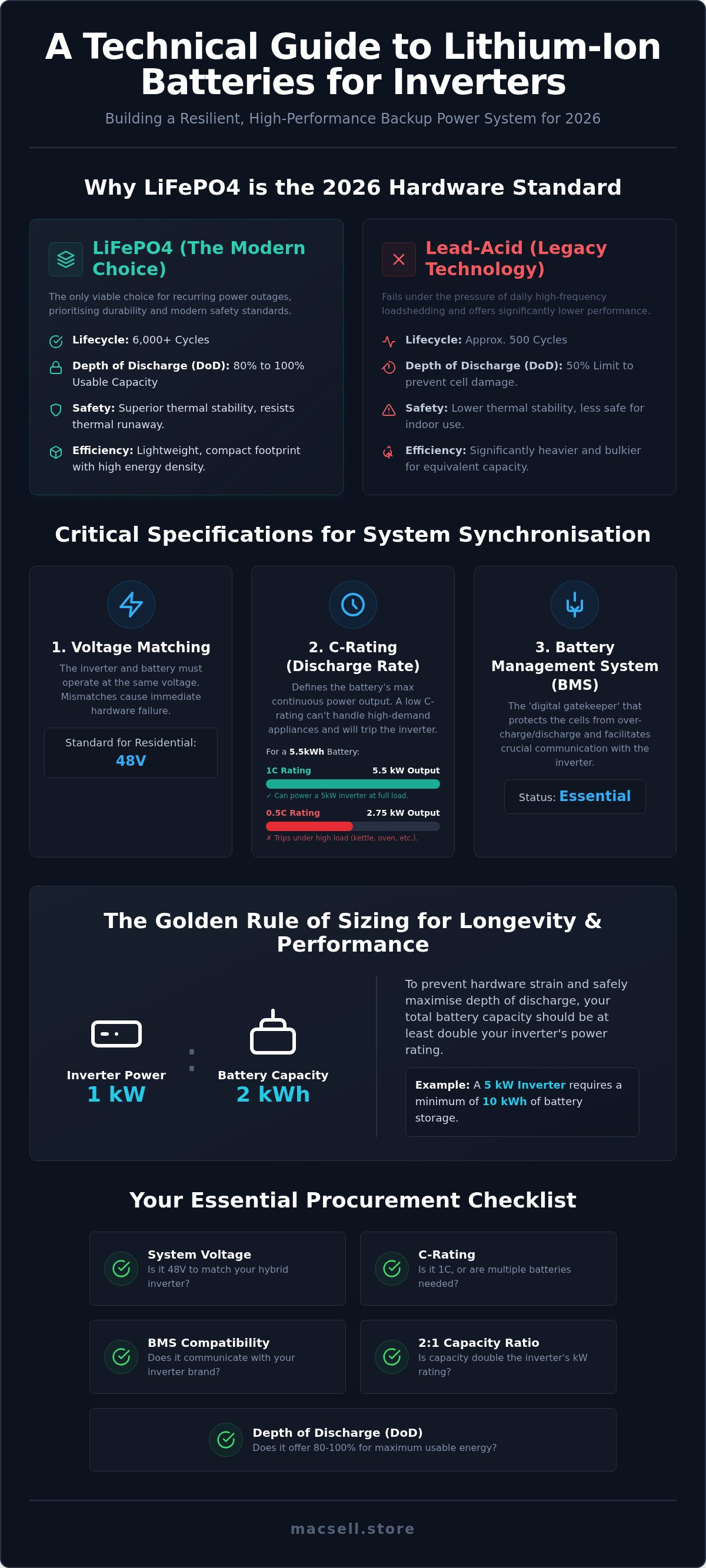
Lithium Iron Phosphate (LiFePO4) is the established hardware standard for 2026 energy storage. Traditional lead-acid batteries fail under the pressure of daily high-frequency loadshedding. A standard lead-acid unit provides roughly 500 cycles at 50% depth of discharge. In contrast, a modern lithium ion battery for inverter systems delivers 6,000 cycles or more. This longevity makes lithium the only viable choice for recurring power outages. It's a technical shift that prioritises durability over low initial purchase costs.
The Superiority of LiFePO4 Chemistry
LiFePO4 offers superior thermal stability compared to older cobalt-based lithium variants. It resists thermal runaway, making it safer for indoor residential installations amongst other sensitive environments. The chemistry is non-toxic and more easily recycled than lead-based alternatives. Key benefits include:
- High Safety Profile: Enhanced resistance to high temperatures and physical damage.
- Weight Efficiency: A 5kWh lithium battery weighs significantly less than a lead-acid bank of equivalent capacity.
- Compact Footprint: Smaller dimensions allow for secure wall-mounted installations in confined spaces whilst maintaining high energy density.
Depth of Discharge (DoD) Explained
Depth of Discharge refers to the percentage of the battery's total capacity used before recharging. Lead-acid batteries require a 50% limit to prevent permanent cell damage. Modern lithium hardware supports an 80% to 100% DoD. This allows for smaller, more efficient battery banks because nearly all stored energy is accessible. You don't need to over-size the bank just to protect the hardware.
Distinguish between nominal capacity and usable capacity during procurement. A 5.5kWh unit with a 90% DoD provides 4.95kWh of actual energy. High DoD ratings directly influence the total lifecycle of your solar investment by maximising utility without degrading the cells prematurely. Smaller footprints with higher usable energy represent the primary shift in 2026 hardware design.
Every high-performance lithium ion battery for inverter integration includes an internal Battery Management System (BMS). The BMS acts as a digital gatekeeper. It monitors cell voltage, current, and temperature in real-time. This protects the hardware from overcharging or deep discharge. It also facilitates communication with hybrid inverters, ensuring the entire system operates within safe technical parameters. Without a robust BMS, the battery cannot synchronise with modern hybrid units, leading to system inefficiencies or hardware failure.
Key Technical Specifications for Inverter-Compatible Batteries
Selecting a lithium ion battery for inverter systems requires precise alignment with the inverter's DC input range. Modern hybrid units typically operate on 48V architectures, whilst entry-level or mobile systems might still utilise 24V. Mismatched voltages result in immediate hardware failure or permanent damage to the inverter's internal circuitry. Beyond simple voltage, technical parameters like C-ratings and parallel communication dictate how the system handles real-world household loads.
Voltage Matching and System Architecture
Most residential hybrid inverters, including the Sunsynk and Deye 5kW models, require a 48V nominal input. High-voltage (HV) series are also emerging for larger 3-phase installations, but standard server-rack batteries remain the 2026 benchmark for domestic use. Transitioning from legacy 12V portable units to 48V residential storage allows for lower current draw and reduced heat generation in the cabling. This efficiency is vital for maintaining system longevity during extended loadshedding cycles. Ensure your chosen hardware supports the specific DC voltage range of your inverter, as even a 1V discrepancy can trigger safety shut-offs.
Discharge Rates and Peak Power Performance
The C-rating is a critical specification that defines the continuous discharge current relative to the battery's capacity. A 1C rating on a 5.5kWh battery allows it to output 5.5kW of power. Many budget-friendly options only offer a 0.5C rating. This means a 5.5kWh unit with a 0.5C rating can only provide 2.75kW of continuous power. If you attempt to run a geyser, oven, or kettle, a single 0.5C battery will likely trip the inverter due to over-current protection. To meet the peak demand of a 5kW hybrid inverter, you must either select a 1C rated battery or parallel multiple 0.5C units to share the load across the bank.
Energy density and parallel capability are essential for scalable energy storage. Standard server-rack batteries are designed for 19-inch cabinets, allowing you to stack multiple units to increase both capacity and discharge potential. Parallel capability ensures the BMS of each unit communicates to balance the state of charge across the entire bank. This modularity allows you to start with a single unit and expand as your energy requirements grow. You can verify technical compatibility by browsing our range of 48V lithium batteries designed for high-demand residential systems.
Hardware integration also relies on communication protocols. Most 2026 lithium units use CAN or RS485 ports to talk to the inverter. This communication allows the inverter to see the exact state of charge and cell temperature, rather than guessing based on voltage alone. This data-driven approach prevents the common "voltage sag" issues found in older battery technologies, ensuring your backup power remains stable until the final percentage of usable capacity is reached.
Top Lithium-Ion Battery Configurations for South African Inverters
In 2026, the South African energy market focuses on hardware that withstands 2 to 4 daily discharge cycles. A lithium ion battery for inverter setup must offer more than raw storage; it requires a robust BMS that talks directly to the inverter's control logic. Whilst many brands exist, only a few provide the technical synergy required for high-availability systems. Choosing the right configuration depends on your specific inverter model and the peak demand of your household loads.
The Hubble AM2 5.5kWh Advantage
The Hubble AM2 5.5kWh is widely regarded as the benchmark for 48V systems. It features high-quality LiFePO4 cells and a sophisticated BMS designed to integrate natively with Sunsynk and Deye hardware. This level of integration ensures that the inverter receives accurate data regarding cell temperature and voltage balance. Precise monitoring prevents the premature "cut-off" issues common in generic battery brands. It's a reliable choice for those prioritising data accuracy and long-term cell health. For a complete breakdown of this hardware, view the Hubble AM2 battery price and specs.
Scalable Rack-Mounted Solutions
Hardware form factors are split between wall-mount and rack-mount designs. Rack-mount units are superior for scalability. They fit into standard 19-inch cabinets, which helps organise the high-current DC cabling and maintains consistent airflow amongst the units. Proper ventilation is critical when discharging multiple batteries at high C-ratings, as heat build-up can trigger safety derating in the BMS. Ensure all interconnecting busbars or cables are rated for the maximum continuous current of the entire bank to avoid resistive heating and voltage drops.
For large-scale residential projects, the Deye Lithium High-Voltage series offers a specialised solution for 3-phase hybrid inverters. These systems operate at higher voltages to reduce current-related losses in large cable runs. If your requirements are less intensive, Dyness and Greenrich offer cost-effective alternatives. Greenrich units are notable for their high discharge capabilities, making them suitable for households with high-peak appliances like kettles or pumps. Dyness remains a favourite for standard backup due to its modular design and broad compatibility with LuxPower inverters. Both brands provide reliable LiFePO4 performance for secondary backup circuits where budget-conscious procurement is a priority.
The decision between these configurations often comes down to the communication protocol. Brands like Hubble and Deye are prioritised because their firmware is frequently updated to match the latest inverter software. This reduces the risk of "BMS Communication Loss" errors that can plague older or generic hardware combinations. When selecting a lithium ion battery for inverter integration, always verify that the manufacturer provides a dedicated communication cable for your specific inverter brand.
Hardware Integration: Balancing Load and Capacity
Integrating a lithium ion battery for inverter systems requires more than a simple physical connection. It demands a balanced ratio between the inverter's maximum output and the battery bank's total capacity. A 2:1 ratio is the recommended technical standard for 5kW hybrid systems. This means pairing a 5kW inverter with at least 10kWh of storage. This configuration prevents the battery from reaching its maximum discharge limit too quickly, which preserves the internal cell chemistry and ensures the system handles household surges without tripping.
BMS Communication: CAN vs RS485
Closed-loop communication is now a mandatory requirement for most 2026 hardware warranties. This digital handshake occurs via CAN or RS485 protocols, allowing the inverter to see the exact state of charge (SoC) and individual cell voltages. When the BMS talks directly to a Sunsynk or Deye unit, the inverter can adjust its charging profile in real-time based on actual battery health. Without this link, the system operates in "voltage-based" mode, which is far less accurate and can lead to over-discharge. Common communication errors amongst different brands are usually caused by mismatched pinouts in the RJ45 data cables, requiring specific crossover configurations to establish a stable link.
Calculating Runtime for Loadshedding Stages
Runtime calculations must match your kWh capacity to your average hourly household consumption whilst accounting for the intensity of local power cuts. During Stage 4 or Stage 6 loadshedding, the intervals between outages are short. Your system needs enough capacity to last the 2.5 to 4.5-hour blocks whilst retaining enough "headroom" for the inverter to fast-charge the cells before the next outage. Planning for these cycles is essential to avoid "battery depletion" errors during back-to-back outages. You can find pre-configured hardware pairings in our home inverter and battery combo guide.
Managing environmental factors is the final step in hardware integration. High-performance lithium storage areas should be kept at stable temperatures to avoid thermal derating. Consider these site requirements:
- Ventilation: Ensure at least 100mm of clearance around rack-mounted units for passive cooling.
- Temperature Control: Maintain an ambient temperature below 30 degrees Celsius to prevent the BMS from limiting discharge current.
- Cable Sizing: Use 35mm or 50mm DC cables for high-current paths to reduce resistive heat and voltage drop.
Correct hardware sizing ensures that your lithium ion battery for inverter setup lasts for its full 10-year design life. Overloading a small battery bank with a large inverter is the leading cause of premature BMS failure. To ensure your system is technically sound, you can browse our range of inverter-compatible lithium batteries designed for high-availability residential use.
Procuring Reliable Solar Hardware from MacSell
MacSell Solar Outlet operates as a technical warehouse for high-capacity energy components. Selecting a lithium ion battery for inverter systems requires a procurement partner who understands hardware synergy. We specialise in supplying Sunsynk, Deye, and LuxPower inverters paired with Hubble lithium units. This focus ensures that the hardware you receive is designed to work as a unified system rather than a collection of mismatched parts. Hardware quality remains the primary factor in system lifespan; budget components often fail under the thermal stress of South African loadshedding cycles.
High-Performance Combo Kits
Our Sunsynk 8KVA & 2X Hubble AM2 5.5 KWh Combo Kit is the primary choice for residential loadshedding resilience. This pairing provides 11kWh of total capacity, allowing for significant depth of discharge whilst maintaining the 2:1 battery-to-inverter ratio discussed earlier. Pre-configured kits remove the technical guesswork from the procurement process. The closed-loop communication between the Hubble BMS and the Sunsynk inverter is verified for 2026 standards, ensuring precise state-of-charge monitoring. For a deeper look at these specifications, read our Lithium ion solar battery technology guide.
Expert Hardware Supply
Our inventory is strictly limited to high-performance brands such as Deye, Sunsynk, and LuxPower. This includes the LuxPower 5kW Inverter – SNA5000 Hybrid Inverter, a unit favoured for its robust performance in off-grid and hybrid configurations. We prioritise technical accuracy in every hardware order, verifying that the chosen lithium ion battery for inverter setup matches the DC input requirements of the specific inverter model. This meticulous approach to procurement prevents common hardware failures associated with mismatched voltage architectures or incompatible BMS firmware. We don't just sell components; we provide the specific hardware configurations required for long-term solar independence.
National delivery across South Africa is managed through a streamlined logistics network. This allows for the secure transport of sensitive lithium cells and large-scale hybrid inverters directly to your project site. MacSell acts as a specialised warehouse manager, ensuring that every component, from the Sunsynk 8KVA units to the Hubble AM2 cells, is available for immediate dispatch. We focus on providing the hardware that industry professionals and informed consumers require to achieve energy autonomy with 2026-standard technology. By focusing on premium brands, we ensure your investment is protected by established warranty standards and proven hardware reliability.
Optimising Your 2026 Solar Infrastructure
Successful backup power depends on the technical handshake between your BMS and inverter. Ensuring a 2:1 capacity-to-load ratio and verifying closed-loop communication protocols prevents hardware failure during Stage 6 cycles. High-performance LiFePO4 cells remain the industry benchmark for durability, providing the 6,000-cycle lifespan required for modern residential demands. Selecting the correct lithium ion battery for inverter integration is a technical decision that determines the 10-year reliability of your backup system.
MacSell Solar Outlet specialises in high-end Sunsynk and Hubble hardware configurations, including the 8KVA and 5.5kWh units required for heavy household loads. Our national South African delivery network ensures these premium components reach your project site securely and efficiently. We focus on technical accuracy to ensure every hardware combo delivers maximum performance from the first discharge cycle. You can build a resilient energy system by choosing pre-verified hardware that meets the latest communication standards.
Take control of your energy security with hardware designed for high-frequency use. View our range of lithium batteries for inverters to find the correct technical match for your system. Your path to solar independence starts with reliable, expert-curated components.
Frequently Asked Questions
How long does a lithium ion battery last for an inverter system?
A high-quality LiFePO4 battery typically lasts between 10 and 15 years in a residential environment. Most 2026 units are rated for 6,000 cycles at an 80% depth of discharge. If you cycle the battery once daily, it remains operational for over 16 years. However, high-frequency loadshedding with multiple daily cycles will reduce this lifespan to approximately 7 or 8 years.
Can I use a 12V lithium battery with a 5kW hybrid inverter?
No, you cannot use a 12V battery with a standard 5kW hybrid inverter like the Sunsynk or Deye models. These units require a 48V nominal DC input to operate within their technical parameters. A 12V unit won't meet the minimum startup voltage required by the inverter's battery terminals. Always match your battery bank voltage to the inverter's specific hardware requirements to avoid system failure.
What is the difference between 0.5C and 1C discharge rates?
The C-rating defines the continuous power output relative to the battery's total capacity. A 1C rated lithium ion battery for inverter systems can discharge its full capacity in one hour; for example, a 5kWh battery provides 5kW of power. A 0.5C rating limits that same battery to a 2.5kW output. Higher C-ratings are essential if you intend to run heavy appliances like kettles or pumps during an outage.
Do I need a specific brand of battery for my Sunsynk inverter?
You don't strictly need the same brand, but you must use a battery that supports Sunsynk's communication protocols. Brands like Hubble and Deye are pre-verified for seamless integration with Sunsynk hardware. Using a generic battery without a compatible BMS handshake forces the inverter into a less accurate voltage-based mode. This often reduces system efficiency and can complicate warranty claims if the hardware isn't on the approved list.
Is it possible to add more lithium batteries to my system later?
Yes, you can expand your storage capacity by adding more units in parallel. It's best to add batteries of the same brand and model to ensure the internal resistance and voltage remain balanced. Most 2026 hardware allows for up to 15 units in a single bank. If your existing batteries are over two years old, the BMS might struggle to balance the state of charge with newer cells.
Why is the BMS communication cable so important for my inverter?
The BMS cable enables "closed-loop" communication between the lithium ion battery for inverter and the hybrid control unit. This data link provides real-time updates on cell temperature, voltage, and the exact state of charge. Without this connection, the inverter cannot adjust its charging profile to protect the cells from stress. This lack of communication is a leading cause of inefficient charging and premature hardware degradation.
What is the ideal temperature for storing lithium-ion solar batteries?
The optimal ambient temperature for lithium storage is between 15 and 25 degrees Celsius. Whilst LiFePO4 chemistry is thermally stable, temperatures exceeding 30 degrees Celsius can cause the BMS to reduce the discharge current to protect the cells. Storing batteries in a cool, well-ventilated area is essential for maintaining performance. Avoid installing hardware in confined spaces where heat from the inverter can accumulate and trigger safety derating.
How does depth of discharge (DoD) affect my battery warranty?
Most manufacturers specify a maximum DoD, usually 80% or 90%, to maintain the validity of the 10-year warranty. Discharging the battery to 0% consistently accelerates cell wear and reduces the total cycle life. Modern inverters allow you to programme a specific shutdown percentage to ensure the battery remains within these warranted limits. Always check the technical datasheet for your specific Hubble or Deye battery before adjusting your inverter's discharge settings.