

Hybrid Solar Inverters: 2026 SA Buying Guide
South Africa's rooftop solar capacity surpassed 8.3 GW in June 2026. This rapid growth aligns with the 9.01% municipal electricity tariff hike, making solar self-consumption a priority for household cost management. Many homeowners encounter technical friction when selecting hardware, specifically regarding the distinction between KVA and KW ratings. Incompatibility between hybrid solar inverters and specific lithium battery BMS protocols often leads to system inefficiency and avoidable downtime during load shedding periods.
This guide provides the technical data required to select an inverter that matches your specific energy requirements. You'll learn how to compare performance ratings and hardware specifications whilst avoiding common integration errors. We examine the core functional attributes of units from Sunsynk, Deye, and LuxPower to ensure your system remains future-proof. By the end of this article, you'll have the technical insight to procure a reliable backup power supply that effectively lowers your monthly electricity bills through optimised solar usage and efficient load management.
Key Takeaways
- Identify the operational differences between hybrid solar inverters and standard units to maximise your energy independence from the national grid.
- Master the technical nuances of KVA versus KW ratings and battery voltage requirements to avoid common system configuration errors.
- Review performance benchmarks for industry-standard hardware from Sunsynk, Deye, and LuxPower to ensure seamless lithium battery compatibility.
- Learn to calculate your peak household load accurately to select an inverter capacity that handles simultaneous appliance demands without tripping.
- Explore specific high-capacity options like the Conderenergy 10.2 KVA hybrid inverter for large-scale residential power requirements.
What is a Hybrid Solar Inverter and How Does it Work?
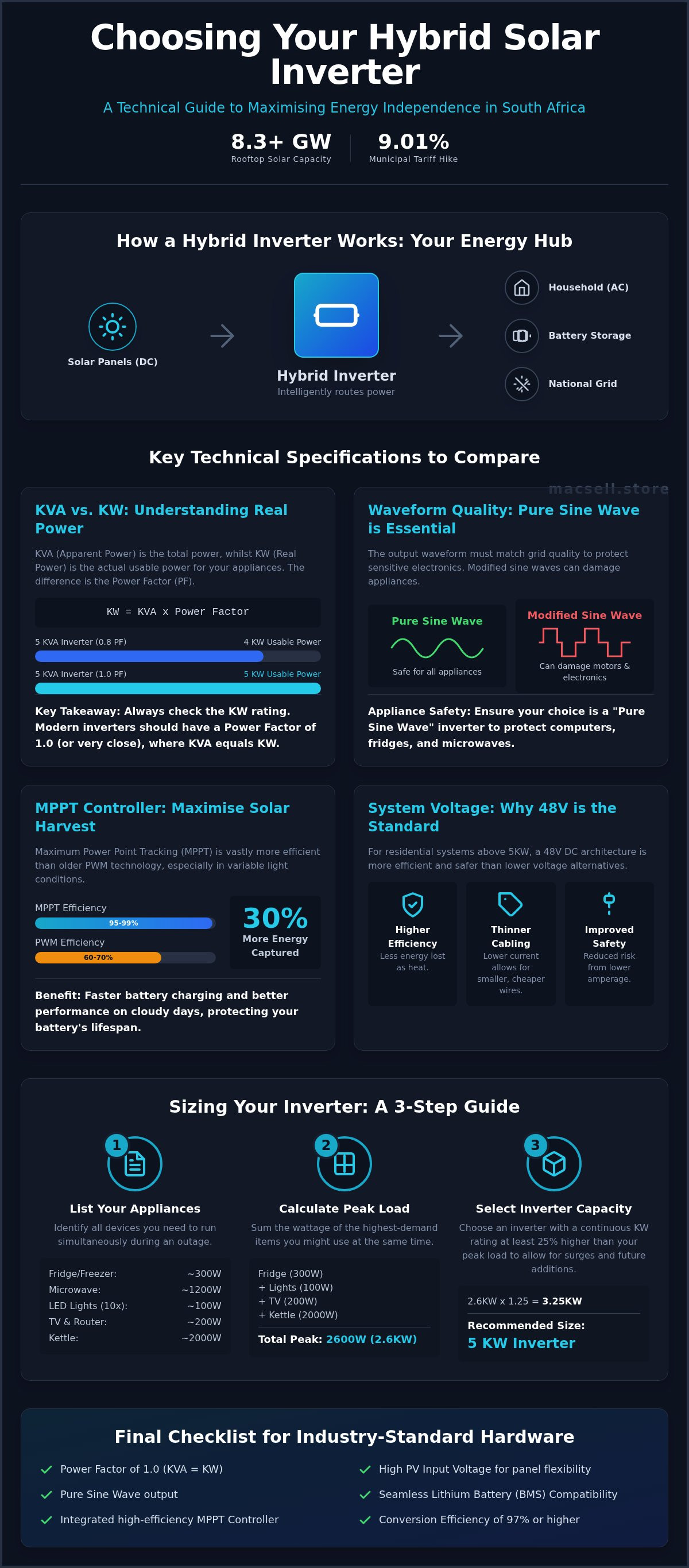
A What is a Solar Inverter? is a power electronics device that converts the direct current (DC) generated by solar panels into the alternating current (AC) required by household appliances. Hybrid solar inverters represent the next generation of this technology by integrating a solar controller, a battery charger, and a grid-management interface into a single chassis. This hardware acts as the central processor for your energy system, intelligently routing power from three distinct sources: PV panels, lithium battery storage, and the Eskom grid. The system prioritises solar energy for immediate consumption, directs any excess to the battery bank, and only draws from the utility grid when local resources are insufficient.
In the South African market, these systems are the preferred choice for long-term energy security. Grid-tied systems are cheaper but offer no protection during load shedding because they must deactivate when the grid goes down for safety. Off-grid systems operate independently but lack the ability to use the grid as a backup during periods of low solar production. Hybrid units provide a versatile middle ground. They maintain power during outages whilst allowing for grid-assisted battery charging when necessary. This functionality is essential for mitigating the impact of the 9.01% municipal electricity tariff increases scheduled for mid-2026.
The Role of the MPPT Charge Controller
Modern hybrid solar inverters utilise Maximum Power Point Tracking (MPPT) to maximise energy harvest from your solar array. An MPPT controller constantly monitors the voltage and current output of the panels to find the optimal point where the most power is produced. This technology is significantly more efficient than older Pulse Width Modulation (PWM) hardware, which often fails to capture up to 30% of available solar energy. By using MPPT, the system ensures that batteries replenish faster during limited daylight hours and protects the cells from voltage fluctuations. This level of precision is vital for preserving the operational lifespan of expensive lithium battery banks.
Pure Sine Wave vs Modified Sine Wave
Pure sine wave output is a non-negotiable technical requirement for any residential energy system. This waveform provides a clean, stable current that matches the quality of utility power, making it safe for all sensitive electronics. Modified sine wave inverters are more affordable but produce a "blocky" electrical signal that can cause significant interference. Components in fridges, microwave ovens, and desktop computers often overheat or suffer internal circuit damage when running on modified waves. Specifying a high-frequency pure sine wave unit, such as the LuxPower SNA5000, ensures that your appliances operate at peak efficiency without the risk of premature failure.
Key Technical Specifications to Compare Before Buying
Selecting hybrid solar inverters requires a strict focus on technical parameters rather than price alone. The most common error in system design is confusing KVA with KW ratings. KVA (kilovolt-amperes) represents the total apparent power, whilst KW (kilowatts) represents the actual real power the unit can output. For example, an inverter with a 5KVA rating and a 0.8 power factor only delivers 4KW of usable power. Modern high-end hardware typically features a 1.0 power factor, meaning 5KVA equals 5KW. Always verify the KW rating to ensure the unit can handle your peak appliance demand without entering overload protection mode.
Battery voltage is another critical hardware configuration. Most residential systems above 5KW utilise a 48V DC architecture. This higher voltage is more efficient than 24V alternatives as it reduces the current (amperage) required, allowing for thinner cabling and lower heat generation. Integrating an inverter with a solar-plus-storage system requires precise matching of these voltage parameters. Additionally, check the maximum PV input voltage and current limits. A higher maximum PV voltage allows you to string more solar panels together in series, which simplifies installation and improves MPPT efficiency during low-light conditions. Look for efficiency ratings of 97% or higher to minimise energy loss during the DC-to-AC conversion process.
Single Phase vs Three Phase Inverters
Most South African households operate on a single-phase electrical supply. Units like the Deye 5KW or Sunsynk 8KW are designed for these standard environments. However, larger properties or commercial sites often use a three-phase supply to distribute heavy loads more evenly. You must identify your property's phase configuration before procurement. Installing a single-phase inverter on a three-phase system requires complex phase-balancing hardware, whereas a dedicated three-phase hybrid inverter provides a more streamlined, industrial-grade solution.
Intelligent Load Management Features
Effective energy management depends on how the hardware handles different circuit types. Many hybrid solar inverters now feature dual outputs. This allows you to separate essential loads (lights, internet, security) from non-essential heavy appliances (geysers, pool pumps). During load shedding, the inverter automatically disconnects the non-essential side to preserve battery life. Hardware like the LuxPower SNA5000 also includes auto-restart functions. When the grid recovers or solar production begins, the system resumes operation without manual intervention. Review our full range of hybrid solar inverters to find a unit that matches your specific voltage and phase requirements.
Sunsynk, Deye, or LuxPower: Choosing the Right Brand
Brand selection is a primary technical decision when procuring hybrid solar inverters. Sunsynk and Deye currently lead the South African market with an estimated combined market share of 75%. Sunsynk is frequently positioned as the premium hardware option due to its sophisticated monitoring software and robust local technical support. Deye offers nearly identical hardware specifications at a more competitive price point, making it a high-value alternative for residential installations. For those seeking cost-effective entry-level or mid-range setups, LuxPower provides reliable performance without the premium price tag associated with top-tier brands.
Trusted manufacturers like Mecer and Growatt continue to serve the off-grid and multifunctional market segments. The Growatt SPF series is particularly effective for installations where grid stability is low and a versatile power management system is required. Each of these brands maintains specific technical advantages regarding lithium battery communication protocols and surge handling capabilities. Selecting the right manufacturer depends on your specific requirements for system longevity, ease of use, and local warranty support.
The Sunsynk Advantage for Self-Consumption
Sunsynk hardware is engineered to improve self-consumption ratios, often reaching efficiency levels up to 80% by prioritising solar and battery usage over grid power. Understanding how hybrid inverters work in different modes is essential for maximising these gains. The Sunsynk 5.5kW model is a favourite amongst South African households for standard three-bedroom homes. For larger properties with high simultaneous loads, the Sunsynk 8.8kW Hybrid Inverter provides the necessary capacity to manage heavy appliances whilst maintaining a reliable backup reserve.
LuxPower and Deye: Reliability and Value
LuxPower has established a strong reputation with the SNA5000 5kW hybrid inverter, which is a staple for reliable backup power during load shedding. For high-demand energy storage requirements, the Luxpower LXP 10kWh unit offers significant density for larger battery banks. Deye hardware is highly regarded for its seamless lithium battery compatibility and its modular scalability. A single Deye 8kW Single Phase unit can be installed initially, with the option for parallel operation as energy demands grow. This flexibility makes Deye an excellent choice for future-proofing a residential energy system without a massive upfront investment.
Sizing Your Hybrid Inverter for Your Household Load
Calculating peak load is the primary requirement when procuring hybrid solar inverters. You must sum the wattage of all appliances intended to run simultaneously to determine the required kilowatt (KW) rating. For example, running a kettle (2000W), a microwave (1200W), and a fridge (200W) at the same time requires 3.4KW of continuous power. Whilst inverters feature surge ratings to handle the initial startup current of motors, sustained overloads will trigger internal protection and shut down the system. Accurate load profiling prevents these interruptions and ensures your energy system remains stable during load shedding.
Inverter capacity must also align with your daily energy consumption patterns and battery storage limits. The inverter size dictates the maximum rate at which you can discharge your battery bank. A 5KW unit can only pull 5KW from the batteries regardless of whether you have 10kWh or 20kWh of total storage. For a comprehensive look at matching storage to your inverter, refer to our Lithium Ion Solar Battery Guide. Choosing a unit with parallel capability is a strategic move for future-proofing; it allows you to add a second inverter later if your household energy demands increase.
Small Homes and Backup Essentials (3KVA - 5KVA)
These smaller units are engineered for essential circuit protection. They provide sufficient power for lighting, Wi-Fi, television, and laptop charging during power outages. The 3.5 Kva Hybrid Inverter 24v Ecco is a practical, cost-effective choice for compact setups that do not require heavy appliance support. For small apartments or garden flats, the ESENER 3kva MPPT unit offers reliable performance with an integrated charge controller. These 24V hardware configurations are ideal for users who prioritise a reliable backup for electronics over high-capacity power generation.
Medium to Large Households (6KVA - 10KVA)
Larger residences with multiple fridges, pool pumps, and extensive entertainment systems require significantly more throughput. A 6.2 KVA Conderenergy unit provides the necessary headroom to manage these simultaneous loads without compromising system health. For heavy-duty residential needs or small home offices, the 10.2 KVA Vito SH10.2K48 delivers industrial-grade capacity. This allows for the operation of high-draw appliances whilst maintaining a dedicated backup reserve for overnight use. Browse our full inventory of hybrid solar inverters to find the specific capacity required for your household load requirements.
Standout Hybrid Inverters at MacSell Solar Outlet
Procuring hybrid solar inverters through a specialised distributor ensures access to hardware that meets South African grid requirements and safety standards. The inventory at MacSell Solar Outlet focuses on technical accuracy and immediate availability for residential and commercial energy projects. The Conderenergy S-2100 10.2 KVA Hybrid On/Off Grid Inverter is a primary choice for high-capacity installations. It provides versatile power management by operating in both grid-parallel and standalone modes. For mid-range setups, the Sun Solar 6KVA Hybrid Inverter includes a Wi-Fi dongle as standard, allowing for real-time performance tracking and system diagnostics via mobile applications.
Entry-level requirements are effectively met by the Luxpower 3.6Kw Hybrid Geta model. This unit offers significant value for users prioritising essential backup over high-draw appliance support. For those utilising established 48V battery architectures, the Mecer Axpert 5.6K MKS IV remains a robust and trusted solution. It features a high-voltage MPPT range that simplifies string design and improves overall solar harvest efficiency. Each unit in our inventory is selected for its ability to handle the specific electrical stresses of frequent load shedding cycles without compromising component longevity.
High-Capacity Solutions for Energy Independence
Large-scale residential backup requires hardware that can manage heavy simultaneous loads without tripping. The 8.2KVA 8200W Hybrid Inverter MPPT Vito is engineered for this purpose, providing enough headroom for multiple appliances and entertainment systems. For properties with complex roof orientations, the Conderenergy 10.2 KVA unit features 2 X MPPT trackers. This allows for two independent solar arrays, ensuring maximum power generation even when one string is partially shaded. You can explore these high-performance options in our Hybrid Solar Inverters Collection.
Pre-configured Hardware Kits
Buying pre-configured kits eliminates the risk of technical incompatibility between inverters and lithium battery management systems. The Sunsynk 8KVA and Hubble AM2 Combo is a technically matched solution designed for seamless communication and optimal discharge cycles. For a more modular approach, the Home Inverter and Battery Combo provides a simplified procurement path for standard households. MacSell Solar Outlet facilitates national hardware delivery across South Africa, ensuring that professional-grade energy components are accessible for all regional installations.
Optimise Your Energy Independence for 2026
Selecting the correct hardware requires a precise understanding of your household's peak power demands and battery voltage requirements. By prioritising KW ratings over price and ensuring seamless lithium battery communication, you protect your system's long-term efficiency. Implementing hybrid solar inverters from established manufacturers like Sunsynk, Deye, or LuxPower provides the necessary flexibility to manage rising utility costs whilst maintaining a reliable backup supply during load shedding.
MacSell Solar Outlet maintains an extensive inventory with over 100 hybrid inverter models in stock, including industrial-grade units from Mecer and high-capacity Vito hardware. We facilitate national delivery across South Africa, ensuring that professional-grade components reach your installation site promptly. Our pre-configured kits simplify procurement by matching inverters with compatible storage solutions to ensure peak performance.
Shop our full range of Hybrid Solar Inverters to secure the precise hardware needed for a future-proof energy system. Taking control of your power requirements today ensures a stable and cost-effective energy future for your property.
Frequently Asked Questions
Do hybrid inverters need to be connected to solar panels to work?
No, hybrid inverters do not require solar panels to operate. They can function as high-capacity battery backup systems by charging from the Eskom grid during normal periods. This setup provides immediate protection against load shedding even before you install PV panels. However, adding solar later is recommended to reduce monthly electricity costs and achieve true energy independence through self-consumption.
What is the difference between KVA and KW in solar inverters?
KW represents the actual real power used by appliances, while KVA is the total apparent power in the system. In technical terms, KW is KVA multiplied by the power factor. A 5KVA inverter with a 1.0 power factor provides 5KW of usable power. Always check the manufacturer's specification sheet for the KW rating to ensure the hardware can sustain your specific household load without tripping.
Can I use a hybrid inverter without a battery?
Yes, most modern hybrid solar inverters can operate without a battery bank in a grid-tied configuration. In this mode, the unit uses solar energy to power loads during the day and exports excess to the grid if permitted. You will not have any backup power during load shedding without a battery. Adding a lithium storage unit later is a standard way to future-proof the system.
Which hybrid inverter brand is best for the South African climate?
Sunsynk and Deye are currently the most reliable brands for South African conditions. These manufacturers provide robust hardware that handles high ambient temperatures and frequent switching cycles caused by load shedding. Sunsynk is particularly favoured for its extensive local repair centres and technical support network. LuxPower also offers excellent value for residential users seeking a balance between performance and entry-level pricing.
How many solar panels can I connect to a 5kW hybrid inverter?
A standard 5kW hybrid inverter typically supports between 5500W and 6500W of total PV input. The exact number of panels depends on the maximum DC voltage and current limits of the MPPT trackers. For instance, you could install ten 550W panels to reach a 5.5kW peak. Always ensure the total string voltage does not exceed the inverter's maximum DC input limit to avoid internal circuit damage.
Is a 48V inverter better than a 24V inverter for home use?
A 48V architecture is superior for most residential installations exceeding 3kW. Higher voltage systems are more efficient because they require lower current to deliver the same power; this reduces heat generation and allows for thinner, more cost-effective cabling. While 24V systems are suitable for small apartments or mobile setups, 48V hardware provides the stability and scalability needed for comprehensive home energy management.
What happens to my hybrid inverter during a power cut?
Your inverter will automatically switch to battery mode within approximately 10 to 20 milliseconds during a power cut. This transition is fast enough to keep computers, Wi-Fi routers, and televisions running without interruption. The device disconnects from the grid to prevent back-feeding and uses stored energy to maintain your essential circuits. Once the grid recovers, the unit synchronises and resumes normal operation whilst recharging the batteries.
Can I parallel different brands of hybrid inverters together?
No, you cannot parallel different brands of hybrid solar inverters together. Parallel operation requires identical firmware and matching communication protocols to synchronise voltage and frequency across units. Mixing a Sunsynk with a Deye or a LuxPower will cause communication failures and potential hardware damage. If you plan to expand your system later, you must procure an identical model from the same manufacturer to ensure compatibility.