

LuxPower vs Sunsynk Inverter: 2026 Hardware Comparison Guide
Choosing the wrong inverter for a South African solar project usually leads to expensive communication failures between the hardware and the lithium battery bank. The debate regarding a LuxPower vs Sunsynk inverter isn't merely a matter of price; it's a fundamental technical choice between "True Hybrid" grid interaction and "Off-Grid Hybrid" backup functionality. You've likely felt the frustration of trying to decipher whether a specific model is NRS 097-2-1 compliant for legal grid connection or if it will actually talk to your Hubble AM2 battery.
We understand that you need precise specifications rather than marketing fluff. This 2026 hardware comparison strips away the jargon to provide a direct look at how these units handle specific load profiles. You'll gain a clear understanding of which hardware fits your energy requirements, how to guarantee battery-to-inverter communication, and the technical justification for your investment. We're examining the LuxPower SNA5000's value against the Sunsynk 8KVA's advanced load-splitting capabilities to ensure your system remains stable, efficient, and legal.
Key Takeaways
- Distinguish between LuxPower’s off-grid hybrid architecture and Sunsynk’s true hybrid functionality to ensure NRS 097-2-1 compliance for legal grid connection.
- Evaluate the LuxPower vs Sunsynk inverter debate by analysing how each brand manages essential versus non-essential load splitting on a standard South African distribution board.
- Compare surge capacities and rated power outputs to identify which hardware can reliably start heavy inductive loads like borehole pumps and air conditioners.
- Verify the importance of seamless BMS communication with the Hubble AM2 5.5 KWh battery to maintain lithium cell health and longevity.
- Determine whether the cost-effective LuxPower SNA5000 or the high-performance Sunsynk 8KVA kit provides the best technical ROI for your specific load profile.
LuxPower vs Sunsynk: Understanding the Hardware Philosophy
The South African energy landscape is split between pure backup requirements and comprehensive solar independence. Selecting a solar inverter involves more than comparing peak output; it requires a technical analysis of how the unit interfaces with the national grid. The LuxPower vs Sunsynk inverter debate centres on two distinct engineering philosophies: cost-optimised off-grid architecture versus premium bi-directional hybrid systems. Whilst both brands provide reliable power, their market positioning serves different project goals and budget profiles.
| Feature | LuxPower SNA5000 | Sunsynk 8KVA |
|---|---|---|
| Hardware Type | Off-Grid Hybrid | True Hybrid |
| IP Rating | IP20 (Indoor Only) | IP65 (Outdoor Rated) |
| Warranty | 2 Years Standard | 5 Years Standard |
| Grid Interaction | Non-Exporting | Bi-directional / Export Capable |
The LuxPower SNA5000 Value Proposition
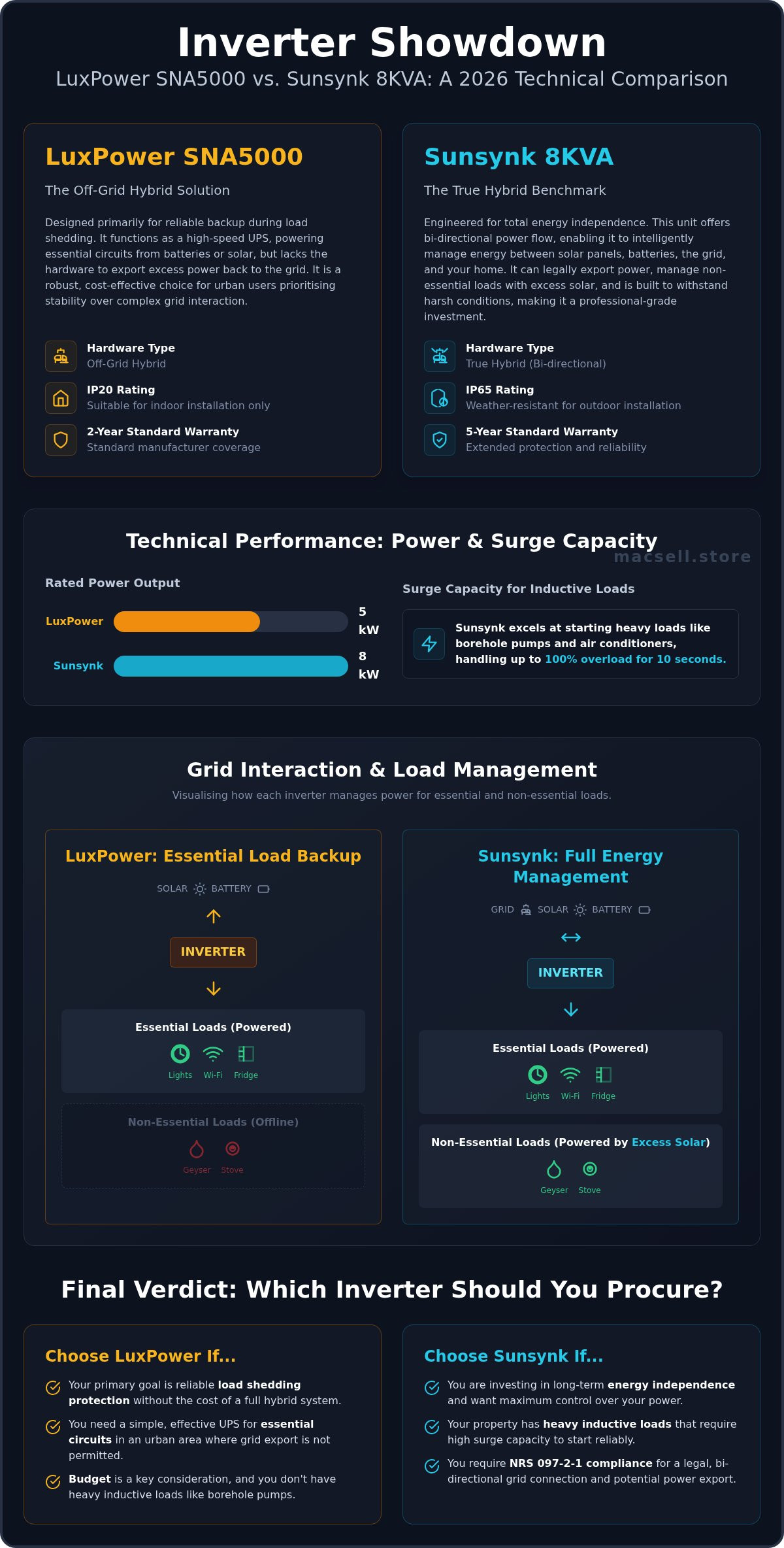
The SNA5000 is the primary choice for users prioritising load shedding protection over complex grid interaction. It functions as an "Off-Grid Hybrid" unit. This means it can use utility power to charge batteries or supplement loads, but it lacks the hardware to export power back to the grid. It's a robust solution for urban areas where grid feedback isn't permitted or required. Even without solar panels installed, the SNA5000 operates as a high-speed UPS, keeping essential circuits active during stage 6 outages. It's a functional, transactional piece of hardware designed for reliability without the premium price tag of a true hybrid system.
The Sunsynk Hybrid Engineering Standard
Sunsynk is the benchmark for "True Hybrid" engineering in South Africa. The Sunsynk 8KVA model offers bi-directional power flow, allowing it to manage energy between panels, batteries, the grid, and the home with high precision. Its hardware is designed to survive aggressive load shedding cycles whilst offering advanced load management. Unlike basic units, Sunsynk can power "non-essential" loads, such as geysers, using excess solar energy without drawing from the batteries. This bi-directional capability ensures maximum utility of every watt produced. It's a professional-grade tool for those seeking long-term energy independence and sophisticated control over their power consumption.
Technical Performance and Power Specifications
Raw power delivery determines whether a system handles daily routines or collapses under the strain of heavy appliances. The LuxPower vs Sunsynk inverter comparison reveals a significant gap in available hardware scales. Whilst the LuxPower SNA5000 is a dedicated 5kW unit, the Sunsynk range offers 5kW, 8kW, and 12kW variants. This variety allows for more precise matching of hardware to load profiles. For instance, a household with multiple air conditioners and a borehole pump will exceed the 5kW limit of a single LuxPower unit almost immediately upon start-up.
Surge capacity is the critical metric for starting inductive loads. Inductive motors, found in pumps and compressors, can pull up to three times their rated current during the first few seconds of operation. Sunsynk inverters are engineered for high-surge environments, typically allowing for a 100% overload for up to 10 seconds. The LuxPower SNA5000 provides reliable surge protection but remains physically constrained by its internal transformer architecture. If your project involves high-torque machinery, the Sunsynk 8KVA or 12KVA models offer the necessary headroom to prevent nuisance tripping.
Thermal management also differs between these brands. The LuxPower SNA5000 uses active fan cooling within an IP20 chassis, making it audible in quiet indoor spaces. In contrast, the Sunsynk 8KVA utilises a massive external heat sink combined with internal fans. Its IP65 rating means the sensitive electronics are sealed from dust and moisture, which improves heat dissipation efficiency in high-temperature environments. This hardware durability is why many professionals choose to buy Sunsynk hardware for installations in garages or semi-outdoor areas.
Efficiency and MPPT Performance
When evaluating the LuxPower vs Sunsynk inverter performance, PV input limits are a deciding factor. Both units feature dual MPPT controllers to manage separate solar panel strings. The LuxPower SNA5000 has a maximum PV input voltage of 480VDC, whilst the Sunsynk 8KVA supports up to 500VDC, allowing for longer panel strings. Both brands maintain approximately 97.5% MPPT efficiency and 93% battery-to-AC conversion efficiency in 2026. This high efficiency ensures that minimal energy is lost as heat during the conversion process, directly lowering your long-term electricity costs.
Parallel Capability and Scalability
Scalability is a core feature for both brands. You can link up to 16 LuxPower SNA5000 units in parallel to create a massive 80kW off-grid bank. This requires specific hardware components to function correctly:
- Dedicated parallel communication cables between each inverter.
- Correct dip-switch positioning to define the master unit.
- Synchronised battery banks or a shared busbar for DC input.
Sunsynk also supports up to 16 units in parallel, but the setup is largely software-driven through the touch-screen interface. For large-scale residential projects, Sunsynk’s parallel logic is often considered more intuitive for technicians to organise and maintain. Sunsynk's 2026 lineup, including the Lifelynk XL series, further simplifies this by offering all-in-one systems that integrate the inverter and battery into a single, scalable unit.
Grid Interaction and Load Management Capabilities
Legal grid connection in South Africa requires strict adherence to NRS-097-2-1 standards. Sunsynk inverters are fully certified for grid-tied operation, allowing for legal bi-directional energy flow. This means you can safely export excess power if your local municipality permits it. In contrast, the LuxPower SNA5000 is an off-grid hybrid. It doesn't feed power back into the utility grid, which simplifies some legal aspects but limits your ability to use solar power for appliances located "upstream" of the inverter's output.
The primary technical advantage in the LuxPower vs Sunsynk inverter comparison is how the hardware manages different circuit types. A standard South African distribution board (DB) is typically split into essential and non-essential loads. Essential loads, like lights, routers, and security systems, stay on during load shedding. Non-essential loads, such as geysers or swimming pool pumps, are usually cut off to protect the battery bank. Sunsynk uses a CT (Current Transformer) clamp to monitor the total household demand, allowing it to supplement non-essential loads with solar power whilst the grid is active.
Essential and Non-Essential Load Splitting
Sunsynk hardware excels here due to its versatile "Aux" port. This port can be configured to power heavy appliances like geysers or ovens only when solar production is high and batteries are full. This prevents the system from tripping during a grid failure whilst ensuring you don't waste free energy. If you're calculating the technical ROI of these features, consult our Hybrid Inverter Price South Africa guide for detailed hardware costs. LuxPower units generally require external contactors or manual timers to achieve similar results, which adds complexity to the physical hardware stack.
Monitoring and Smart System Control
Remote management is handled by dedicated hardware modules. The Sunsynk Logger connects via Wi-Fi or LAN, providing deep telemetry through the Sunsynk or Solarman platforms. It allows for remote firmware updates and technical diagnostics without physical access to the unit. LuxPower utilises a plug-and-play WiFi Dongle linked to the LuxCloud 2.0 platform, which was updated in January 2026 for improved stability. Whilst both apps offer real-time data on battery SOC (State of Charge) and PV yields, Sunsynk’s interface provides more granular control over time-of-use settings. This is vital for managing electricity costs when utility rates vary throughout the day.
Battery Compatibility and Hubble Integration
BMS communication is the foundation of a stable solar system. In the LuxPower vs Sunsynk inverter comparison, both brands support CAN-bus and RS485 protocols to interface with lithium batteries. This digital handshake allows the battery to dictate charging currents and voltages based on real-time cell health. Without it, you risk overcharging or deep-discharge cycles that shorten hardware lifespan. The Hubble AM2 5.5 KWh battery has emerged as the preferred pairing for both manufacturers due to its high discharge capability and established communication profiles.
Hubble AM2 and Sunsynk Synergy
Pairing a Sunsynk inverter with Hubble batteries creates a highly resilient energy stack. The Sunsynk 8KVA model is frequently bundled with two Hubble AM2 units to provide 11kWh of storage. This configuration supports a 1C discharge rate, meaning the batteries can deliver their full capacity quickly to handle high-demand appliances. For a deeper dive into this pairing, read our Sunsynk Hubble combo kit technical review. This combination is favoured because the Sunsynk firmware includes pre-configured presets for Hubble BMS protocols, which reduces setup errors during commissioning.
LuxPower Battery Pairing Options
The LuxPower SNA5000 is highly flexible regarding battery chemistry. Whilst it excels with the Hubble AM2, it also supports a wide range of other lithium brands and even traditional lead-acid banks. When using lithium, you must select the "LI" battery type and ensure the correct communication cable pinout is used. For those building a budget-friendly backup system, check the LuxPower SNA5000 price guide for information on compatible battery bundles. Selecting the right battery pairing determines the overall efficiency of your LuxPower vs Sunsynk inverter installation.
Troubleshooting common communication issues usually involves verifying dip-switch settings on the battery or checking the RJ45 cable pinout. Sunsynk typically uses CAN-bus as the primary channel, whilst LuxPower setups frequently utilise RS485 for certain battery models. Ensuring your firmware is current on both the inverter and the battery BMS is essential for long-term stability. If you're ready to secure your hardware, you can browse our range of lithium batteries and inverters to find the right match for your project.
Final Verdict: Which Inverter Should You Procure?
The procurement decision in the LuxPower vs Sunsynk inverter debate follows a clear technical logic based on your 10-year energy strategy. LuxPower represents the primary choice for budget-optimised backup, providing a functional solution for those focused on surviving load shedding with minimal upfront investment. Sunsynk remains the benchmark for high-performance solar independence, offering the hardware necessary for sophisticated energy management and legal grid interaction. Both brands maintain a strong presence in South Africa, ensuring that spare parts and technical support are accessible for local projects.
Choose LuxPower If...
- Your primary goal is load shedding backup on a restricted hardware budget.
- You have a simple distribution board setup without the need for complex essential and non-essential load splitting.
- You prioritise low upfront costs and don't require the ability to export power back to the utility grid.
- Your installation environment is indoors, protected from dust and moisture, suited for an IP20-rated chassis.
Choose Sunsynk If...
- You're investing in a full solar array and want to maximise ROI through advanced load management.
- You require a "True Hybrid" system that is fully NRS-097-2-1 compliant for legal grid-tie functionality.
- You need advanced control over heavy appliances via a dedicated Aux port or CT clamp monitoring.
- You prefer the premium reliability of an IP65-rated unit with a standard 5-year warranty.
Analyse the long-term financial horizon before making a final selection. A LuxPower SNA5000 system has a lower initial price point but lacks the hardware to supplement non-essential loads with solar power whilst the grid is active. Over a decade, a Sunsynk 8KVA can offer superior technical ROI by reducing total utility dependency through its bi-directional power flow. The Sunsynk 8KVA & 2X Hubble AM2 5.5 KWh Combo Kit remains the benchmark for those seeking a pre-configured, high-reliability solution that balances storage capacity with advanced inverter logic.
Hardware availability is currently stable for both manufacturers. Local retailers consistently stock the LuxPower 5kW SNA5000 and various Sunsynk power ratings as standard inventory. Technical support for both brands is well-established in the local market, though Sunsynk’s extensive documentation and software interface often make it the preferred choice for complex residential projects. Ultimately, your choice should align with your specific load profile and the degree of energy independence you intend to achieve.
Securing Your Energy Infrastructure for 2026
Determining the victor in the LuxPower vs Sunsynk inverter comparison depends entirely on your project's technical scope. If your priority is a cost-effective, off-grid backup system for load shedding, the LuxPower SNA5000 is a reliable and functional choice. For those requiring a true hybrid system with bi-directional grid interaction and advanced load management, the Sunsynk 8KVA remains the industry standard. Both options provide verified compatibility with the Hubble AM2 5.5 KWh battery, ensuring your lithium bank operates within safe parameters.
As technical hardware specialists, we keep Sunsynk 8KVA and Hubble AM2 combo kits in stock for rapid deployment. We offer national delivery across South Africa, ensuring your hardware arrives on-site without delay. Choosing the correct inverter ensures long-term system stability and legal compliance. Browse our Sunsynk and LuxPower hardware range to find the exact components for your next solar project. Your path to energy independence starts with selecting the right hardware.
Frequently Asked Questions
Is LuxPower a true hybrid inverter?
The LuxPower SNA5000 is classified as an "Off-Grid Hybrid" rather than a true hybrid inverter. When evaluating a LuxPower vs Sunsynk inverter, note that the SNA5000 lacks the bi-directional hardware required to export energy back to the grid. This makes it a functional solution for backup without the complexity of grid-tie regulations. True hybrid units like Sunsynk offer more advanced interaction with both essential and non-essential loads for complex residential solar projects.
Can I use Sunsynk inverters with Hubble lithium batteries?
Yes, Sunsynk inverters are fully compatible with Hubble lithium batteries, specifically the Hubble AM2 5.5 KWh model. This combination is a top-selling hardware kit because both manufacturers share established BMS communication protocols. The Sunsynk firmware includes dedicated presets for Hubble batteries, ensuring the inverter receives accurate telemetry regarding cell temperature and state of charge. This digital handshake is essential for maintaining battery health during aggressive discharge cycles and ensuring the longevity of your lithium cells.
Which inverter is better for handling frequent load shedding?
The best choice in the LuxPower vs Sunsynk inverter debate depends on your specific load profile. LuxPower is excellent for budget-conscious backup of essential circuits like lights and routers. However, Sunsynk is superior for frequent, high-stage load shedding because it manages both essential and non-essential loads through its CT clamp and Aux port. This allows you to power heavier appliances using solar energy whilst the grid is active without draining your battery bank prematurely.
Do I need an NRS-approved inverter for my home in South Africa?
Yes, an NRS-097-2-1 approved inverter is required for any legal grid-tied installation in South Africa. This certification ensures the hardware safely disconnects from the grid during an outage to prevent "islanding," which protects utility workers. Sunsynk inverters carry this certification as standard. Whilst the LuxPower SNA5000 is often used in off-grid configurations, choosing NRS-approved hardware ensures your system complies with municipal bylaws and future-proofs your investment for legal grid interaction and potential feed-in tariffs.
What is the main difference between LuxPower SNA5000 and Sunsynk 5kW?
The primary difference lies in their grid interaction and environmental protection. The LuxPower SNA5000 is an off-grid hybrid with an IP20 rating, meaning it must be installed indoors and cannot export power. The Sunsynk 5kW is a true hybrid with an IP65 rating, allowing for outdoor installation and bi-directional power flow. Sunsynk also offers more sophisticated load management, whereas LuxPower focuses on providing a cost-effective, high-capacity backup solution for standard residential essential circuits without complex grid interaction.
Can I parallel a LuxPower inverter with a Sunsynk inverter?
No, you cannot parallel a LuxPower inverter with a Sunsynk inverter. Parallel operation requires identical hardware and synchronised firmware to manage the AC output and DC battery bus accurately. Mixing brands will lead to communication failures and potentially catastrophic hardware damage. If you intend to scale your system, you must stick to the same brand and model range. Both LuxPower and Sunsynk support paralleling up to 16 of their own units to create larger, more resilient energy systems.
How much does a Sunsynk 8KVA price differ from a LuxPower 5kW?
The Sunsynk 8KVA represents a higher tier of hardware investment compared to the LuxPower 5kW SNA5000. This difference in value reflects the Sunsynk’s increased output capacity, bi-directional grid interaction, and advanced IP65-rated chassis. Whilst the LuxPower unit offers exceptional value for basic backup requirements, the Sunsynk 8KVA provides the necessary headroom for running heavy appliances and managing complex solar arrays. Your choice should depend on whether you prioritise low upfront costs or long-term energy independence.
Does the LuxPower SNA5000 support grid-feedback?
No, the LuxPower SNA5000 does not support grid-feedback. It is designed as an off-grid hybrid unit that uses utility power only as a secondary source for charging batteries or supplementing loads when solar production is insufficient. It lacks the internal hardware and NRS certification required to export excess solar energy back to the national grid. For users who want to feed power back into their distribution board's non-essential side, a true hybrid like Sunsynk is the necessary hardware choice.