

Deye vs LuxPower Hybrid Inverter: 2026 Hardware Comparison Guide
Selecting the wrong hardware today could leave your system non-compliant by the September 30, 2026, registration deadline. With the updated NRS 097-2-1:2024 standards in effect, the Deye vs LuxPower hybrid inverter debate is no longer just about initial cost. It's about technical longevity and grid-tie legality within the South African distribution network. You likely feel overwhelmed by conflicting spec sheets and the fear of buying an inverter that won't communicate correctly with Hubble lithium batteries. We understand that you need a functional, high-performance solution that prioritises precision over marketing hype.
This guide provides a direct, technical side-by-side analysis of these two market leaders to help you secure a reliable energy setup. We'll compare the industrial-grade robustness of Deye's 5kW to 16kW range against the cost-effective performance of LuxPower's SNA5000 and 12kW models. You'll gain a clear understanding of hardware compatibility, 2026 regulatory requirements, and the specific performance metrics that define long-term investment value. We strip away the uncertainty to provide an expert-curated inventory of facts for your procurement process.
Key Takeaways
- Understand the mandatory NRS 097-2-1:2024 compliance requirements and the critical September 2026 registration deadline for all grid-tied systems.
- Compare technical efficiency ratings between transformer-less and traditional designs to determine which hardware suits your specific daily energy cycles.
- Evaluate the performance metrics of the Deye vs LuxPower hybrid inverter to correctly match 5kW or 8kW models to your household peak demand.
- Confirm seamless hardware integration between these inverter brands and lithium batteries, specifically the Hubble AM2 series, to ensure system stability.
- Identify how pre-configured hardware kits and premium alternatives like Sunsynk can streamline procurement whilst improving overall system reliability.
The Hybrid Inverter Landscape in South Africa: 2026 Overview
Hybrid inverters serve as the primary control centre for modern South African energy systems. These units manage the complex power flow between the national grid, solar photovoltaic arrays, and lithium battery storage. Deye and LuxPower represent the two most prominent hardware choices in the current market, each catering to specific performance requirements and budget constraints. In 2026, the criteria for selecting hardware have evolved. Buyers now prioritise technical longevity and regulatory compliance over simple brand recognition or aggressive marketing claims.
The 2026 hardware landscape is defined by the updated NRS 097-2-1:2024 standards. These regulations dictate how generation equipment interacts with the distribution network. A Deye vs LuxPower hybrid inverter comparison must begin with these technical parameters. Selecting hardware that lacks the necessary certifications can result in system registration failure, especially with the September 30, 2026, deadline for existing grid-tied systems approaching. Efficiency and hardware robustness are now the primary metrics for determining long-term investment value.
Hybrid vs Off-Grid: Why Hardware Choice Matters
Technical distinctions between true hybrid and off-grid models are critical for system legality. A true hybrid inverter is grid-interactive, meaning it can synchronise with the utility grid to supplement load or export excess power. High-voltage off-grid models are often physically similar but lack the internal protection and synchronisation hardware required for grid-tie compliance. The choice between Deye and LuxPower often depends on this distinction. Deye units are frequently utilised in grid-tied environments due to their robust compliance history. Conversely, models like the LuxPower SNA5000 are highly effective for backup-only or off-grid scenarios where grid feedback is not required. Hardware durability is also a factor; units must survive the thermal stress caused by multiple daily load-shedding cycles. High-quality internal components and efficient cooling systems are non-negotiable for maintaining performance during peak summer temperatures.
Current Market Availability and Hardware Trends
The hybrid inverter price South Africa landscape reflects a significant shift toward higher-capacity hardware. While 5kW units remain standard for small apartments, residential homeowners are moving toward 8kVA and 10kVA units to manage larger household loads during grid outages. This trend is driven by the need for higher surge capacities to start pumps, air conditioners, and geysers. Lithium battery integration has also become more sophisticated. Hardware-level communication between the inverter and batteries, such as the Hubble AM2 series, is essential for accurate state-of-charge reporting. Without precise CAN bus or RS485 protocol integration, the system cannot optimise charge cycles, which leads to premature battery degradation. Reliable procurement now focuses on pre-configured hardware kits that guarantee component compatibility from the start.
Deye Hybrid Inverter: Technical Strengths and Specifications
Deye hybrid inverters are engineered with an industrial focus, utilising robust aluminium enclosures and advanced thermal management systems. Unlike purely residential-grade alternatives, Deye hardware employs forced-air cooling to maintain stability during high-demand periods. This is a critical factor in the Deye vs LuxPower hybrid inverter comparison; Deye's ability to handle sustained thermal stress makes it a preferred choice for harsh South African environments. The MPPT (Maximum Power Point Tracking) efficiency is equally high, featuring wide input voltage ranges that accommodate diverse solar panel configurations.
Future-proofing is a core design element. Deye units support paralleling for up to 16 units, allowing users to scale from a single residential setup to a large-scale three-phase industrial system. This modularity ensures that initial investments remain relevant as energy requirements grow. For a detailed breakdown of current costs and specific model variations, consult our guide on Deye solar inverter price ZA parameters.
Deye Performance Parameters
The hardware is built for heavy load handling, providing a surge capacity of twice the rated power for up to 10 seconds. This capability is essential for starting inductive loads like borehole pumps or large refrigeration units. The user interface features a high-resolution LCD touch screen for direct hardware interaction, whilst remote monitoring is facilitated through WiFi or GPRS data loggers. These tools provide real-time data on battery state-of-charge and solar yield. Hardware longevity is supported by an IP65 ingress protection rating, ensuring the internal electronics are shielded from dust and moisture.
Grid-Tie Compliance and Safety
Safety and regulatory adherence are non-negotiable for 2026 installations. Deye models are fully certified under the NRS 097-2-1:2024 standard, ensuring legal connection to municipal and Eskom grids. This certification is a major deciding factor when evaluating a Deye vs LuxPower hybrid inverter for urban residential use. The hardware includes integrated DC disconnect switches, surge protection devices, and anti-islanding protection as standard. These features reduce the need for external protection components, simplifying the physical hardware footprint. The Deye 8kW efficiency rating is 97.6%. This high conversion rate minimises energy loss during the DC-to-AC inversion process. If you're ready to upgrade, you can view our Deye inventory to find the right model for your site.
LuxPower SNA5000 vs Deye: A Side-by-Side Hardware Analysis
Hardware architecture represents the primary divergence in the Deye vs LuxPower hybrid inverter comparison. The LuxPower SNA5000 utilises a high-frequency transformer-less design, which significantly reduces the physical weight and footprint of the unit compared to Deye's more industrial builds. Whilst Deye prioritises heavy-duty filtering and IP65-rated enclosures for outdoor resilience, LuxPower focuses on high-efficiency performance within indoor residential centres. Efficiency ratings for the SNA5000 peak at approximately 93%, providing reliable daily cycle performance for standard household backup requirements. Both brands have prioritised battery communication protocols, ensuring seamless integration with Hubble and Pylontech lithium systems through dedicated CAN bus and RS485 ports.
The LuxPower SNA5000 Advantage
The SNA5000 is a specialist solution for users prioritising hardware stability in off-grid or backup-only configurations. It remains a favourite in the South African market due to its dual MPPT trackers and the ability to handle up to 6400W of solar array input. For many residential owners, the LuxPower SNA5000 price offers a more accessible entry point into high-capacity energy storage without sacrificing essential monitoring features. However, technical limitations exist when compared to Deye hybrid counterparts. The SNA5000 is an IP20-rated device, meaning it must be installed in a dust-free, indoor environment. It also lacks the specific NRS 097-2-1 grid-export certifications found in Deye units, making it better suited for "zero-export" or pure backup applications where grid synchronisation for feed-in is not required.
Key Technical Specification Table
Comparing these units requires a direct look at the hardware parameters that govern daily operation. The following data points highlight the functional differences between a standard 5kW Deye Hybrid and the LuxPower SNA5000:
- Max PV Input: Deye 5kW (6500W) vs LuxPower SNA5000 (6400W via 2 x 3200W MPPTs).
- Peak Efficiency: Deye (97.6%) vs LuxPower (93.0%).
- Battery Charging Current: Both units support high-current charging, typically up to 120A or 140A depending on specific firmware revisions.
- Hardware Weight: Deye 5kW (20kg+) vs LuxPower SNA5000 (14.5kg).
- Ingress Protection: Deye (IP65 - Outdoor) vs LuxPower (IP20 - Indoor only).
- Battery Voltage: Both systems utilise a 48V nominal battery bank, ensuring compatibility with standard 100Ah lithium modules.
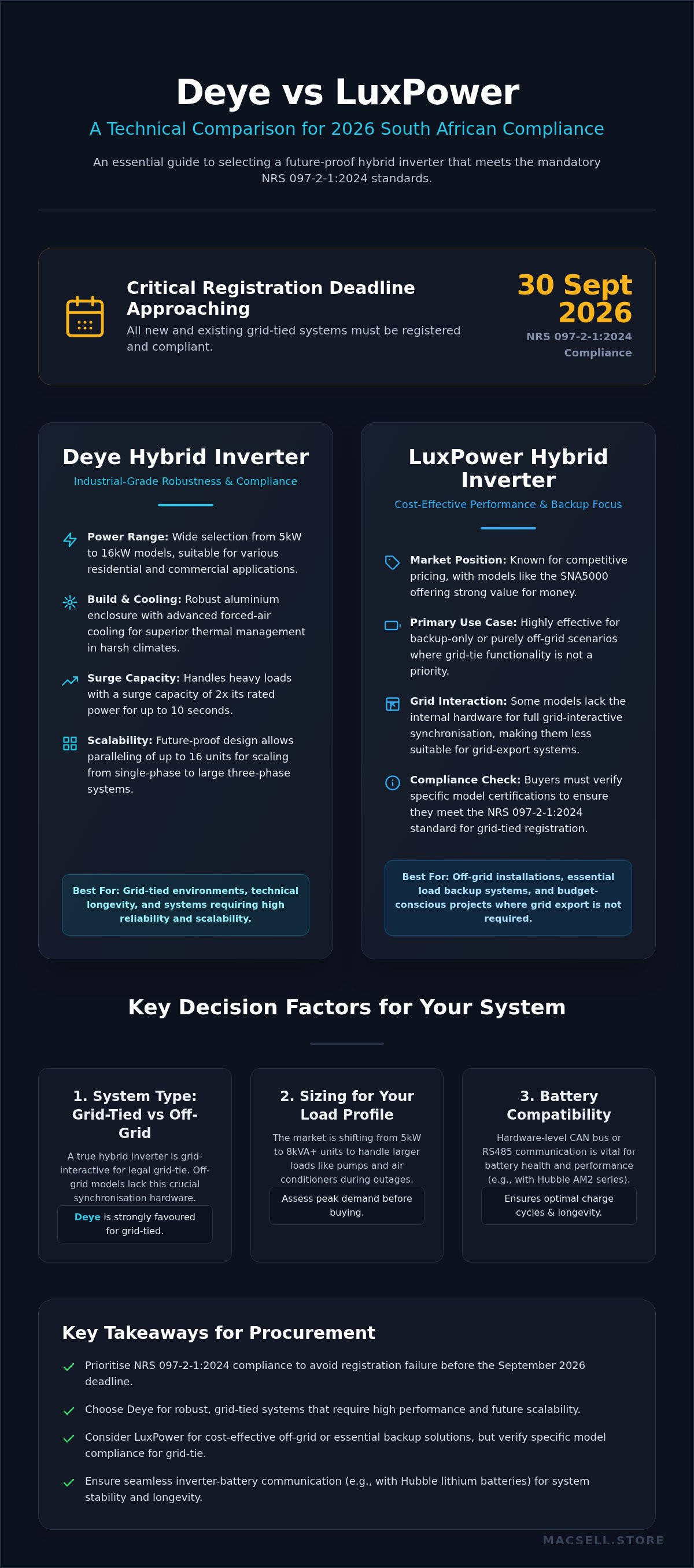
These specifications demonstrate that while the Deye offers superior conversion efficiency and environmental protection, the LuxPower provides a lightweight, modular alternative for internal installations. Choosing between them depends on whether your site requires an outdoor-rated, grid-interactive system or a cost-effective, indoor backup solution.
Selection Guide: Matching Hardware to Your Load Profile
Selecting the correct capacity is more critical than brand preference alone. You must calculate your peak simultaneous demand by summing the wattage of every appliance required during a grid failure. A 5kW unit is sufficient for basic residential circuits, including lights, routers, and refrigeration. If your load profile includes high-draw items like borehole pumps or geysers, the 8kW Deye or 12kW LuxPower models provide the necessary surge overhead. The Deye vs LuxPower hybrid inverter choice ultimately hinges on whether your priority is grid-interactive savings or pure backup reliability.
Budgeting for a complete system must extend beyond the inverter unit. A functional installation requires a compatible battery bank, solar panels, and a protection distribution board containing DC surge arrestors and AC breakers. Long-term ROI is driven by conversion efficiency. Deye’s higher efficiency rating translates to more usable energy over a 10-year lifespan, whereas LuxPower offers a faster initial payback period due to a lower hardware entry price. MPPT compatibility is also a vital factor; Deye's wide voltage window allows for longer panel strings, whilst the LuxPower dual MPPT design is better suited for split-roof orientations.
Scenario A: High-End Grid-Interactive Systems
Deye hardware is the logical choice for urban residential sites where grid-tie functionality and NRS compliance are mandatory. These systems are designed for energy arbitrage, allowing you to sell excess power back to the grid or use it to offset peak-rate consumption. High-capacity installations benefit from integrating a premium lithium ion solar battery to maintain stable discharge rates under heavy load. Deye's smart-load ports also allow you to automate non-essential appliances, ensuring the inverter does not trip when the battery reaches a specific state-of-charge.
Scenario B: Cost-Effective Backup and Off-Grid
LuxPower remains the superior choice for dedicated backup and off-grid environments where grid export is not required. The SNA5000 is a modular hardware platform, allowing you to start with a single inverter and battery and expand the system as your budget permits. This flexibility is ideal for smaller residential circuits that need immediate protection from load-shedding without the complexity of grid-tie registration. Ensure your solar array is correctly sized for the dual MPPT inputs to maximise winter yield. You can browse our certified hardware inventory to compare specific model availability for your project.
Procurement and Compatibility: Building Your System with MacSell
Building a solar system requires exact component matching to avoid operational failures. Procurement through pre-configured hardware kits eliminates the risk of communication errors between different hardware brands. While the Deye vs LuxPower hybrid inverter choice remains central to your system design, many users opt for validated bundles to ensure immediate stability. MacSell specialises in hardware-only distribution, focusing on technical accuracy and national delivery across South Africa. We prioritise the availability of components that are known to work together under high-stress conditions.
For those seeking a premium alternative with similar architecture to Deye, the Sunsynk Hubble combo kit provides a high-performance solution. This kit is pre-configured to handle 8kVA loads whilst maintaining full compatibility with Hubble lithium technology. These bundles reduce the complexity of the procurement process by grouping essential hardware into a single, verified transaction.
Lithium Battery Integration
Communication protocols are the backbone of a reliable hybrid system. Hubble AM2 batteries use CAN bus communication for seamless inverter integration. This hardware-level handshake allows the inverter to monitor cell voltages and internal temperatures in real-time. Without this link, the inverter relies on less precise voltage-based charging, which often leads to reduced battery lifespans. Proper setup involves selecting the correct lithium protocol in the inverter's battery management menu to ensure the hardware accurately tracks the state-of-charge.
Your Hardware Checklist
A complete installation requires more than just the primary unit. To finalise your Deye vs LuxPower hybrid inverter setup, you must source high-wattage monocrystalline solar panels to maximise your MPPT harvest. Your hardware checklist should include the following essential components:
- Hybrid Inverter: Deye, LuxPower, or Sunsynk units.
- Lithium Storage: Hubble AM2 or equivalent 48V modules.
- DC Protection: Distribution boards with 600V or 1000V surge arrestors.
- AC Isolation: Changeover switches and dedicated breakers for backup circuits.
- Solar PV: Monocrystalline panels sized for your specific MPPT voltage window.
MacSell facilitates national South African delivery for all solar hardware. Orders are processed with a focus on speed and technical accuracy, ensuring you receive the exact SKUs required for your energy profile. You can proceed with your purchase through our online store to secure your hardware for the 2026 registration window.
Securing Your 2026 Energy Infrastructure
The 2026 energy landscape requires precise hardware selection to meet NRS compliance and load-shedding demands. Choosing a Deye vs LuxPower hybrid inverter isn't just about brand preference; it's about technical longevity and grid legality. Deye provides the industrial robustness needed for high-demand, grid-interactive systems. LuxPower offers a streamlined, cost-effective solution for indoor residential backup and off-grid configurations. Both brands ensure reliability when integrated with advanced lithium storage through verified communication protocols.
Building a future-proof system starts with sourcing the correct components from a trusted distributor. You must prioritise hardware that supports the latest safety standards and provides long-term investment value. We maintain an expertly curated solar hardware inventory with national South African delivery on all inverters. Our specialised high-performance Hubble and Deye combo kits are available to simplify your procurement process.
Browse the Full Range of Deye and LuxPower Hybrid Inverters at MacSell to secure your hardware before the upcoming registration deadlines. Your path to energy independence is built on verified technical accuracy.
Frequently Asked Questions
Is Deye better than LuxPower for grid-tie systems?
Yes, Deye is specifically engineered for grid-interactive operation and carries the mandatory NRS 097-2-1:2024 certifications for South African municipal grids. While LuxPower offers hybrid models, the popular SNA5000 isn't designed for grid-export. Deye allows for seamless energy export and tariff arbitrage, making it the superior choice for urban residential systems that must integrate directly with the utility network for legal compliance.
Can I use Hubble lithium batteries with both Deye and LuxPower inverters?
Yes, both brands support Hubble lithium batteries through dedicated CAN bus and RS485 communication ports. The Deye vs LuxPower hybrid inverter selection ensures that your Hubble AM2 or AM5 modules can communicate state-of-charge data directly to the inverter's management system. This integration is essential for optimising charge cycles and protecting the battery cells from over-discharge, which extends the overall lifespan of your energy storage hardware.
What is the hardware warranty on a LuxPower SNA5000 in 2026?
The LuxPower SNA5000 hardware warranty period depends on the specific retailer and the inclusion of approved protection equipment during installation. Standard terms in the South African market often range from two to five years. You must verify the registration requirements with your distributor, as some warranties require a certified installation report. Always check the serial number against the manufacturer's database to confirm the support period for your unit.
Does Deye require specific WiFi hardware for remote monitoring?
Yes, Deye inverters require an external plug-in data logger, usually a WiFi or GPRS dongle, to enable remote monitoring via the Solarman platform. This hardware connects to the dedicated port on the underside of the inverter. Once configured, you can track solar yield, battery health, and load consumption through a mobile application. Most Deye units are sold with the WiFi logger included as part of the standard hardware package.
Which inverter handles load shedding cycles more effectively?
Deye is generally more effective for frequent load shedding cycles due to its industrial-grade cooling and higher conversion efficiency. The hardware manages rapid transitions between grid and battery power without significant thermal stress. In the Deye vs LuxPower hybrid inverter comparison, Deye's robust build quality and 97.6% efficiency rating make it better suited for environments where the system must cycle multiple times daily under heavy residential loads.
Are Deye inverters NRS 097-2-1 approved for South African municipalities?
Yes, most Deye hybrid models are fully NRS 097-2-1:2024 approved and appear on the authorised equipment lists for the City of Cape Town, Johannesburg, and other municipalities. This certification is mandatory for any grid-tied solar installation. It ensures the hardware meets safety standards for anti-islanding and grid protection. You must confirm the specific model number on the municipal database before starting your registration process for the September 2026 deadline.
Can I parallel LuxPower SNA5000 inverters for more power?
Yes, the LuxPower SNA5000 supports paralleling for up to 16 units in a single-phase or three-phase configuration. This modularity allows you to scale your system from 5kW to 80kW as your energy requirements increase. Paralleling requires specific communication cables between the units and a synchronised battery bank. It's an effective way to future-proof a residential system without replacing the original hardware when adding more solar panels.
What is the main hardware difference between LuxPower and Sunsynk?
The main difference lies in the software architecture and grid-tie hardware capabilities. Sunsynk uses the same hardware platform as Deye, featuring a robust hybrid design with full NRS certification for grid export. The LuxPower SNA5000 is a high-frequency off-grid unit that lacks these grid-interactive features. If your site requires grid-tie registration, LuxPower isn't the correct choice, whereas it suits pure backup or off-grid sites.