
Deye Solar Inverter Price ZA: 2026 Hardware and Specification Guide
The most expensive solar investment you'll make isn't the hardware itself, but the cost of choosing the wrong inverter version for your battery bank. Understanding the current Deye solar inverter price ZA is the first step in moving from temporary load-shedding relief to a robust, long-term energy strategy. You've likely felt the frustration of frequent power outages prematurely aging your battery cycles or struggled to distinguish between single-phase and three-phase hardware requirements. It's a common hurdle when technical specifications aren't clearly defined for the local market.
This guide provides a precise technical breakdown of Deye hybrid inverters to help you select the exact hardware for your specific load profile. We'll examine the technical justification for price differences, help you categorise various models, and clarify the uncertainty surrounding V2 versus V3 hardware versions. You'll gain a clear understanding of hardware tiers, verify lithium battery compatibility, and identify the specific hardware capabilities required for the South African grid in 2026.
Key Takeaways
- Identify the critical technical differences between V2 and V3 hardware generations to ensure your system remains compatible with 2026 grid standards.
- Evaluate the Deye solar inverter price ZA based on specific hardware features like IP65 ingress protection and dual MPPT trackers for complex roof layouts.
- Select the appropriate inverter capacity by matching model outputs, from 5kW to 12kW, with your essential household or commercial load requirements.
- Understand how currency fluctuations and extended warranty terms influence the total cost of ownership for imported power electronics.
- Ensure hardware synergy by verifying the compatibility of Deye hybrid inverters with leading lithium battery brands like Hubble and Dyness.
Deye Solar Inverter Price Trends in South Africa for 2026
Deye has established itself as a primary hardware provider within the South African energy sector, particularly for hybrid systems requiring grid-tied and off-grid flexibility. The Deye solar inverter price ZA is influenced by several technical factors, including hardware generation and voltage architecture. As load-shedding persists, many property owners are moving away from all-in-one installation contracts. Instead, there's a clear trend towards direct hardware procurement. This allows buyers to secure specific components, like the Deye 8kW or 12kW units, without the inflated markups often found in bundled service packages.
The distinction between high-voltage (HV) and low-voltage (LV) systems is a major cost driver in 2026. While LV systems remain popular for standard 5kW residential backups, HV systems are gaining traction for larger estates requiring faster discharge rates and higher efficiency. Understanding how solar inverters work in these different configurations is essential for accurate budgeting and long-term system scalability.
Market Positioning of Deye Hardware
Deye hardware occupies a strategic middle ground. It offers nearly identical technical specifications to Sunsynk, as both originate from the same manufacturing lineage, yet it typically carries a more competitive price point. This makes it a preferred choice for budget-conscious professionals who prioritise performance over brand-specific support ecosystems. In the secondary market, Deye units maintain strong value retention. Their reliability during South Africa's frequent grid switching cycles ensures they remain a liquid asset for those looking to upgrade their capacity later.
Understanding Hardware Generations
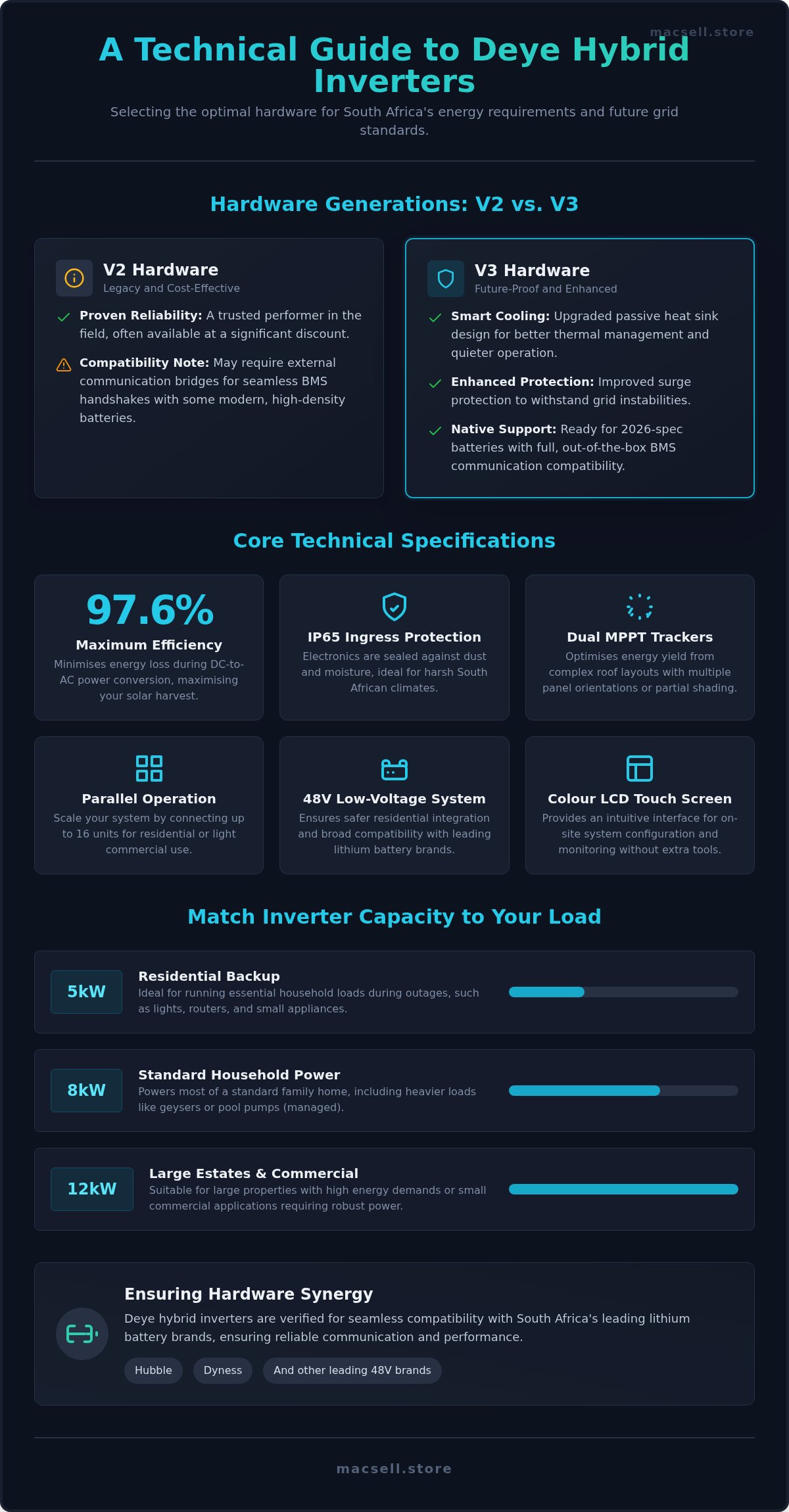
The transition from V2 to V3 hardware has significantly impacted the Deye solar inverter price ZA. The V3 series features an upgraded cooling mechanism efficiency that utilises a more robust heat sink design to manage thermal loads during peak summer temperatures. The V3 cooling architecture utilises a passive heat-dissipation design that maintains optimal thermal efficiency without the constant high-decibel fan operation found in older generations. Compatibility is the main concern here. While V3 units are backwards compatible with most 48V lithium banks, using older V2 hardware with 2026-spec batteries can sometimes lead to BMS (Battery Management System) handshake issues.
- V2 Hardware: Reliable, often available at a discount, but may require external communication bridges for certain modern batteries.
- V3 Hardware: Integrated smart cooling, enhanced surge protection, and native support for high-density lithium storage.
Technical Specifications and Hybrid Feature Breakdown
Deye hybrid hardware is engineered for durability within the diverse South African climate. The IP65 ingress protection rating ensures that the internal electronics remain sealed against fine dust and moisture, making these units suitable for outdoor installation in coastal or high-altitude regions. The Deye solar inverter price ZA reflects this high-spec engineering, particularly when evaluating the dual MPPT (Maximum Power Point Tracking) trackers. These trackers allow for independent string management, which is essential for complex roof orientations where panels face different directions. By isolating the performance of each string, the system maximises energy harvest even during partial shading.
Scalability is a core feature of the Deye ecosystem. These inverters support parallel operation for up to 16 units, allowing a seamless transition from residential backup to light commercial power plants. The integrated colour touch LCD screen provides an intuitive interface for on-site configuration, eliminating the need for external programming tools. For those focused on standalone hardware procurement, these built-in features reduce the complexity of the initial setup.
Efficiency and Power Conversion
Deye inverters achieve a maximum efficiency rating of 97.6%, ensuring minimal energy loss during the DC-to-AC conversion process. This high performance is supported by high-frequency switching technology, which allows for a more compact chassis and reduced operational noise. The use of a 48V low-voltage battery system simplifies residential integration. It's a safer, more standard architecture that matches the majority of lithium storage options available in South Africa. This voltage choice ensures that the system remains compatible with a wide range of battery brands without requiring expensive high-voltage string controllers.
Smart Energy Management
Advanced energy management is critical under South Africa's Renewable Energy Masterplan, which prioritises efficient decentralised power. Deye hardware includes sophisticated Time-of-Use (TOU) settings, allowing users to categorise six different time periods for battery charging and discharging. This helps owners avoid high peak-tariff costs by prioritising solar or battery power when grid prices are highest. The "Zero Export" function is another vital feature for grid-tied systems in municipalities where feeding power back into the grid isn't yet permitted. Remote monitoring is handled via plug-and-play Wi-Fi or GPRS modules, providing real-time data on system health and yield through a dedicated mobile application. When comparing the Deye solar inverter price ZA, the inclusion of these smart modules adds significant value compared to brands that charge extra for monitoring hardware.
Comparing Deye Inverter Models: 5kW to 12kW
Selecting the correct inverter capacity is a balance between technical requirements and the Deye solar inverter price ZA. Over-speccing hardware leads to unnecessary capital expenditure. Under-speccing results in frequent system trips during peak demand. Calculate your loads carefully. You must determine your base load and your peak load before selecting a specific model for your property.
The 5kW hybrid model serves as a functional entry point for small households or apartments. It effectively manages basic backup loads like lighting, refrigeration, and home office electronics. It's often the preferred choice for those starting with a single 5kWh lithium battery. For most medium-sized South African homes, the 8kW model is the recognised industry standard. It provides sufficient headroom to run essential appliances alongside high-draw items like a dishwasher or washing machine. This model offers the best value-to-performance ratio for the average residential user.
Properties with larger energy footprints, such as expansive estates or light commercial sites, require the 12kW three-phase model. This unit is designed for environments where power demand is distributed across multiple circuits, offering a robust solution for high-consumption hardware. It's built for those who won't compromise on energy independence during extended outages.
Single-Phase vs Three-Phase Hardware
Identifying your distribution board configuration is mandatory before purchasing hardware. Most residential properties in South Africa use single-phase power. Larger homes and commercial buildings often feature three-phase supplies. System balance is critical. Three-phase inverters carry a higher price premium due to the complexity of their internal switching and the requirement to balance loads across all three phases. A 12kW Deye system allows for precise load management. This ensures no single phase is overloaded whilst others remain underutilised, maintaining system balance and protecting your electrical infrastructure.
Load Capacity and Surge Performance
Calculating peak loads is essential for appliances like boreholes, pool pumps, and geysers. These inductive loads require high initial current to start their motors. Deye hardware handles these spikes more effectively than entry-level backup inverters. Entry-level units often trip when a pump starts whilst the kettle is boiling. The units feature a 2x rated power surge capability, meaning an 8kW inverter can momentarily handle a 16kW surge to start heavy machinery without shutting down. This technical headroom ensures system stability during simultaneous activation of multiple high-draw appliances, providing peace of mind during grid transitions.
Factors Influencing the Deye Solar Inverter Price in ZA
The Deye solar inverter price ZA is fundamentally tied to international trade dynamics and currency health. Because these high-end power electronics are imported, the exchange rate between the South African Rand and the US Dollar or Chinese Yuan dictates the final retail cost. Sudden shifts in the Rand's value can lead to price adjustments even within a single shipping cycle. Beyond the base unit cost, buyers must account for mandatory compliance hardware. A legal, safe installation requires DC and AC isolators, surge protection devices (SPDs), and specific fuse ratings. These components are essential for protecting the inverter's internal circuitry from grid-borne surges and lightning strikes.
Bundle discounts offer a strategic way to manage total system expenditure. Procuring a "combo kit" that includes the inverter and compatible lithium storage, such as the Hubble AM2, often results in a lower per-unit cost compared to buying components individually. For those ready to upgrade, you can browse current Deye hardware and combo kits to find the most efficient configuration for your budget.
Warranty and After-Sales Support
Deye hardware in South Africa typically carries a standard 5-year warranty, though many retail outlets offer 10-year extensions. This extension carries a price premium but provides long-term security for your energy investment. To ensure your hardware is eligible for manufacturer support, it's vital to purchase through an established ZA retail outlet that handles official imports. Grey market units might appear cheaper initially, but they often lack the necessary local firmware updates and technical recourse if a component fails. A local warranty ensures that technical issues are resolved through official repair centres rather than leaving the owner with an unserviceable unit.
Essential Hardware Accessories
The base Deye solar inverter price ZA often excludes the smaller but critical accessories required for a functional system. Monitoring hardware, such as Wi-Fi or GPRS dongles, is necessary for remote system management and firmware updates. Communication is another factor; a dedicated BMS (Battery Management System) cable is mandatory to ensure the inverter accurately reads the state of charge from lithium batteries like Hubble or Dyness. Without this data link, the inverter cannot optimise battery cycles, which leads to reduced hardware lifespan. Finally, investment in proper racking and ventilated enclosures is a non-negotiable cost to prevent thermal throttling and physical damage to the hardware.
Procuring Deye Hardware: System Integration and Best Practices
Direct procurement allows project owners to bypass the significant markups often applied by installation-heavy solar companies. By managing your own Deye solar inverter price ZA through a specialist retailer, you maintain control over your project timeline and hardware quality. Securing the hardware first ensures that your system components are on-site and ready for integration when your chosen professional arrives for the final connection. MacSell Solar Outlet serves as a dedicated hardware specialist; we focus on the direct retail of high-end inverters and batteries with national South African shipping coverage.
Safety remains the priority during the final integration phase. Whilst you can manage procurement and delivery, the final AC and DC connections must be performed by a certified electrician. A valid Certificate of Compliance (CoC) is required for insurance purposes and to maintain the manufacturer's warranty. This approach combines the cost-efficiency of direct retail with the safety of professional trade skills. MacSell Solar Outlet facilitates this process by providing the exact technical specifications and hardware required for a compliant South African installation.
Lithium Battery Compatibility
The synergy between a Deye inverter and a modern lithium ion solar battery is a primary factor in system longevity. Achieving a reliable handshake between these components requires setting up CAN or RS485 communication protocols. This data link allows the inverter to receive precise voltage and temperature data from the battery's BMS. When pairing Deye units with Hubble or Dyness storage, correct port configuration is mandatory to avoid "Communication Fault" alarms. This technical integration allows you to optimise discharge depths, typically set to 80% or 90%, which protects your hardware investment from the stress of deep cycling during prolonged load-shedding.
Direct Retail Benefits
Choosing a direct retail model eliminates the opaque pricing structures of traditional solar contractors. You gain transparency regarding the Deye solar inverter price ZA and can allocate your budget more effectively across other system components. Securing your own hardware also protects you from the stock shortages that frequently affect the installation market. This method allows you to organise your own hardware delivery according to your specific site requirements. For a broader perspective on market valuations and hardware tiers, refer to our Hybrid Inverter Price South Africa pillar.
Optimising Your 2026 Solar Hardware Investment
Selecting the right hybrid hardware requires a balance of technical precision and market awareness. You've seen how hardware generations and load capacities dictate the Deye solar inverter price ZA, making it essential to match your inverter choice with your specific energy profile. By prioritising direct retail procurement, you avoid unnecessary service markups and maintain control over your system's integration timeline. This approach ensures that you invest in high-spec components rather than inflated service fees.
MacSell Solar Outlet remains a trusted specialist in Sunsynk and Deye hardware, providing national South African delivery for all standalone units and high-performance lithium battery stock. Whether you're upgrading a single-phase residential backup or scaling to a three-phase commercial site, securing reliable components is the foundation of your energy independence. Our inventory is curated to meet the demands of the 2026 energy landscape, ensuring compatibility with the latest lithium storage technologies.
Browse our Deye Hybrid Inverter Range to secure your hardware today and build a resilient power solution for the years ahead.
Frequently Asked Questions
What is the current average price range for a Deye 5kW hybrid inverter in ZA?
The market price for a 5kW Deye hybrid unit typically ranges between R16,000 and R20,000 depending on the specific retail outlet and stock availability. This price point reflects the entry-level hardware tier suitable for smaller residential backup systems. When calculating your total expenditure, remember that this excludes the cost of lithium storage, protection hardware, and cabling required for a compliant South African installation. Always verify current stock levels before procurement.
Is the Deye inverter compatible with all lithium battery brands?
Deye inverters are compatible with most major lithium battery brands that support CAN or RS485 communication protocols. This includes high-performance options like Hubble, Dyness, and Pylontech. However, they aren't universally compatible with every battery on the market. You must verify that the battery's Management System (BMS) can successfully handshake with the Deye firmware to ensure accurate state-of-charge readings and optimal hardware protection during frequent load-shedding cycles.
Does the Deye inverter price include the Wi-Fi monitoring dongle?
Most reputable distributors include the Wi-Fi monitoring dongle in the standard Deye solar inverter price ZA. This module allows for remote system management and real-time data tracking through the Solarman or Deye Cloud applications. You should always confirm the inclusion of this hardware before finalising your purchase, as some grey-market units or budget kits might exclude it to reduce the initial sticker price. Monitoring is essential for firmware updates and troubleshooting.
What is the difference between Deye V2 and V3 hardware?
The primary difference lies in the cooling architecture and surge management. The V3 hardware features an improved passive cooling design with a more substantial heat sink, reducing the reliance on high-decibel internal fans. V3 units often include enhanced surge protection and better native support for high-voltage battery banks. These technical upgrades ensure the hardware remains efficient during the sustained high temperatures common in the South African summer and improve overall component longevity.
Can I use a Deye inverter without solar panels initially?
You can operate a Deye hybrid inverter as a standalone battery backup system without installing solar panels immediately. In this configuration, the unit functions as a high-speed UPS (Uninterruptible Power Supply), charging the lithium batteries from the grid during available windows. This allows you to secure your backup power first and scale your system with solar panels later as your budget or energy requirements evolve. It is a common strategy for phased system deployment.
How long is the standard manufacturer warranty on Deye inverters in South Africa?
The standard manufacturer warranty for Deye hardware in South Africa is 5 years. Many local distributors offer an optional extension to 10 years, which usually requires the inverter to be paired with a specific brand of lithium battery. To maintain this warranty, the system must be installed by a qualified professional and protected by the correct DC and AC surge protection devices. Failure to provide a Certificate of Compliance can void these terms.
Which is better for a South African home: Deye or Sunsynk?
Both brands are manufactured in the same facility and share nearly identical technical specifications. Sunsynk is often perceived as having a more established local support network for technical troubleshooting. Deye is typically positioned as the more budget-friendly option for those focused on the Deye solar inverter price ZA. The best choice depends on whether you prioritise a lower initial hardware cost or the perceived convenience of a specific brand's local repair and support ecosystem.
Does the Deye 12kW inverter support three-phase power?
The Deye 12kW hybrid model is specifically designed for three-phase electrical systems commonly found in large estates and commercial properties. It allows for balanced load management across all three phases, preventing the system from tripping due to phase imbalance. This model is a robust solution for high-consumption environments where single-phase hardware cannot meet the total power demand. It ensures that heavy machinery or large HVAC systems receive stable, continuous power during grid outages.