

Solar Combo Kit South Africa: 2026 Hardware Procurement and Buying Guide
Why do so many high-capacity solar installations fail to deliver consistent power during stage six load shedding despite impressive technical data sheets? The answer usually lies in mismatched hardware or insufficient discharge rates that cannot handle peak residential surges. Selecting a solar combo kit South Africa requires a precision-focused approach to ensure your inverter and lithium storage work in total synchronisation. You need a system that offers seamless transitions between grid-tied and off-grid modes without the risk of hardware incompatibility.
We understand the frustration of navigating complex battery specifications and the fear of purchasing expensive components that don't talk to each other. This guide provides a definitive hardware procurement roadmap for 2026. You'll learn how to identify the most reliable configurations to achieve total energy independence whilst meeting the rigorous technical demands of the South African electrical landscape. We'll break down high-performance pairings like the Sunsynk 8KVA and Hubble AM5+ combo kit, LuxPower SNA5000 hybrid units, and Deye hardware to ensure your backup power supply is efficient, reliable, and future-proof.
Key Takeaways
- Understand how pre-configured hardware bundles ensure seamless technical compatibility between hybrid inverters and lithium storage components.
- Identify whether a 5kW essential backup or an 8kVA high-capacity solar combo kit South Africa best suits your specific residential energy load.
- Master the technical requirements of CAN/RS485 communication protocols to ensure optimal charging and system longevity.
- Learn to calculate daily kilowatt-hour consumption accurately to size your battery bank for long-term energy independence.
- Evaluate premium hardware options from Sunsynk, Deye, and LuxPower to build a future-proof and reliable backup power configuration.
Defining the Solar Combo Kit in the South African Market
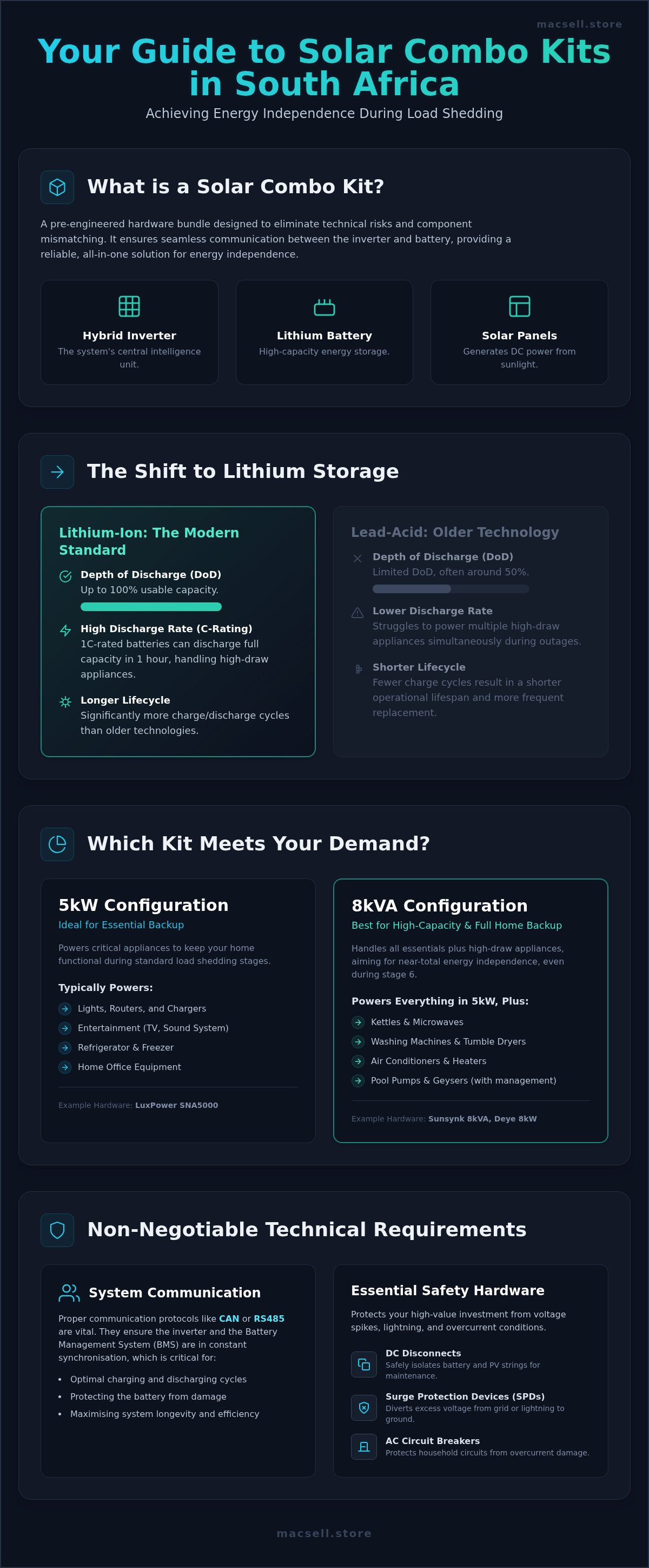
A solar combo kit South Africa is a pre-engineered hardware bundle. It integrates three primary components: a hybrid inverter, lithium battery storage, and high-efficiency solar panels. Installers favour these pre-configured kits because they eliminate the technical risk of component mismatching. They ensure that the Battery Management System (BMS) communicates correctly with the inverter via CAN or RS485 protocols. This technical synchronisation prevents common BMS communication errors that often plague DIY or piecemeal systems. Procurement becomes a streamlined process when all necessary hardware arrives as a single, verified unit.
The hybrid inverter serves as the central intelligence unit. It manages the flow of electricity between the erratic national grid, the solar array, and the battery bank. In the South African context, this management is vital for survival. The inverter must react instantly to grid failures, switching to battery power in less than 20 milliseconds to keep sensitive electronics running. Selecting a pre-selected solar combo kit South Africa ensures the inverter's firmware is already optimised for the specific battery chemistry provided. This level of hardware-level integration is the most reliable way to achieve long-term energy independence.
The Shift from Lead-Acid to Lithium Storage
Lithium-ion technology is the current industry standard for backup power. Older lead-acid or gel batteries suffer from short lifecycles and limited depth of discharge (DoD). Modern lithium units, such as the Hubble AM5+ 5.12kWh found in the Sunsynk Hubble combo kit, offer a DoD of up to 100% with unlimited cycle life. High discharge rates, or C-ratings, are essential amongst leading South African battery brands. A 1C-rated battery can discharge its full capacity in one hour, providing the surge power necessary for handling high-draw appliances during outages. This capability determines the overall longevity and performance of the hardware configuration.
Grid-Tied vs Off-Grid Configurations
Hybrid inverters provide the best of both worlds. They remain grid-tied for municipal compliance and cost-saving whilst offering off-grid capabilities during load shedding. Hardware from Sunsynk, Deye, and LuxPower is frequently found on municipal approved lists. This compliance is mandatory for legal grid connection in many South African metros. Balancing solar panel output with storage capacity is critical. A kit with too many panels and too little storage wastes energy; conversely, insufficient panels lead to chronic battery undercharging. Successful configurations match the daily kilowatt-hour (kWh) yield of the panels to the total capacity of the battery bank.
Core Components: Hybrid Inverters and Lithium Batteries
The hybrid inverter functions as the central management system for every solar combo kit South Africa. It directs DC energy from the solar panels to the battery bank whilst simultaneously converting it to AC power for household consumption. When the grid fails, the inverter isolates the home system to prevent back-feeding, ensuring a safe and continuous power supply. High-efficiency photovoltaic (PV) panels, typically monocrystalline for better low-light performance, serve as the primary generator. These panels harvest solar radiation to maintain the battery state-of-charge (SoC) during daylight hours, reducing reliance on expensive municipal power.
System durability depends heavily on protection hardware. Every solar combo kit South Africa must include specific safety components on both the AC and DC sides. These safeguard the inverter and battery from voltage spikes common during grid restoration and atmospheric lightning. Essential protection includes:
- DC Disconnects: Allows for safe isolation of the battery and PV strings during maintenance.
- Surge Protection Devices (SPDs): Diverts excess voltage to the ground to prevent terminal damage to electronics.
- AC Circuit Breakers: Protects the household circuits and the inverter from overcurrent conditions.
Without these safety measures, the high-value electronics within the kit remain vulnerable to terminal damage. Proper fuse ratings and circuit breakers are non-negotiable for insurance compliance and operational safety.
Sunsynk and LuxPower: Market Leaders in Inverter Tech
Choosing a LuxPower SNA5000 provides a robust 5kW output, making it a favourite for essential residential backup. It's a versatile unit that supports off-grid functionality and integrates well with various battery brands. For households with higher peak demands or commercial needs, Sunsynk and Deye inverters provide superior power management and sophisticated monitoring interfaces. Both brands support parallel configurations. This means you can stack multiple inverters to increase your total power output as your energy needs grow. You can browse the latest hybrid inverter hardware to find a technical match for your specific load requirements.
Hubble AM5+: High-Performance Storage
Lithium storage is the most critical investment for night-time energy availability. The Hubble AM5+ 5.12kWh unit is a standout component in modern kits. It features high energy density and unlimited cycle life with LiFePO4 chemistry. Integrating these lithium-ion solar batteries ensures the system remains operational through frequent daily load shedding cycles. For a technical breakdown of storage chemistry and performance metrics, refer to our Lithium Ion Solar Battery Technology Guide. This level of technical specificity ensures your chosen battery bank can handle the high-discharge requirements of South African appliances without premature degradation.
5kW vs 8kVA Configurations: Which Kit Meets Your Demand?
Selecting a solar combo kit South Africa requires a precise understanding of the difference between peak load and continuous load. Continuous load refers to the total power consumed by appliances running simultaneously for extended periods. Peak load, or surge power, occurs when high-draw motors or heating elements start up. A 5kW inverter may handle continuous light loads easily but will trip if a kettle and microwave are used whilst the geyser is active. Correct sizing ensures the hardware operates within its efficiency curve, preventing premature wear on the inverter's internal switching components.
The Essential 5kW Backup Solution
This tier is the industry standard for apartments and small residential units. A 5kW solar combo kit South Africa is commonly paired with a single 5.12kWh lithium battery. This configuration provides a reliable hardware foundation for essential services:
- Wi-Fi routers, fibre ONT units, and home security systems.
- LED lighting circuits across the entire property.
- Standard refrigeration and freezing units.
- Television, gaming consoles, and home office equipment.
It remains a cost-effective choice for users prioritising load shedding resilience over full off-grid living. The primary limitation is the inability to run heavy heating appliances. Using a hair dryer, kettle, or air fryer on a 5kW system often reaches the maximum discharge limit of a single battery, causing the system to shut down to protect the lithium cells.
The High-Performance 8kVA Tier
For users seeking total energy independence, the 8KVA hybrid inverter is the preferred hardware choice. This capacity allows for the inclusion of high-surge appliances that an entry-level kit cannot manage. It's suitable for larger households running borehole pumps, pool motors, and electric fencing. To maximise this configuration, we recommend pairing 8kVA inverters with dual battery banks using the Hubble AM5+. This setup provides the necessary discharge current to handle high-surge loads without stressing the individual battery management systems.
Sustaining an 8kVA system through a South African winter requires a robust solar array. Shorter daylight hours and lower irradiation levels mean you need more photovoltaic capacity to recharge your batteries fully before sunset. A typical 8kVA kit should be paired with 10 to 14 high-wattage panels (550W+) to ensure the system remains self-sufficient. This array size provides enough headroom to charge the battery bank whilst simultaneously powering the daytime household load, even during overcast conditions in the Western Cape or cold fronts in Gauteng.
Technical Compatibility and Load Assessment for Combo Kits
To ensure a solar combo kit South Africa operates at peak efficiency, hardware synergy is non-negotiable. An improperly configured system leads to rapid battery degradation or inverter failure. You must calculate your daily kilowatt-hour (kWh) consumption by auditing every appliance's wattage and runtime. This data dictates the required battery bank size and the solar array's recharging capacity. High ambient temperatures in regions like the Northern Cape or Limpopo can reduce lithium battery performance and panel efficiency. Selecting hardware with a low temperature coefficient ensures better performance when roof temperatures exceed 40 degrees Celsius.
BMS Communication and Hardware Synergy
Lithium battery inverter compatibility is the most critical factor in kit selection. Without a digital link, the inverter operates on 'voltage-based' charging, which is imprecise for lithium chemistries. High-end kits use CAN or RS485 communication ports to share real-time data between the Battery Management System (BMS) and the inverter. BMS communication is the digital handshake that prevents overcharging and cell damage. Using 'dumb' batteries with smart hybrid inverters risks thermal runaway or voiding hardware warranties. This technical integration allows the inverter to adjust charge current based on individual cell temperatures and voltages.
Sizing Your Solar Array
Matching panel output to the inverter's Maximum Power Point Tracking (MPPT) range is vital for maximum yield. Modern 550W panels offer faster charge times compared to older 450W units, especially during the limited peak sun hours found in South African winters. You should organise panels into strings that stay within the inverter's voltage limits whilst exceeding the 'start-up' voltage. Proper stringing ensures the system begins harvesting energy earlier in the morning and continues later into the afternoon. Assessing roof space is critical; a 550W panel is physically larger than a 450W unit, requiring more mounting rail and structural support.
To size your battery bank correctly, multiply the total wattage of essential loads by the hours of backup required. For a typical South African home, a 5Kwh Battery provides roughly 4kWh of usable energy at an 80% depth of discharge. If your evening load is 1kW, you have four hours of runtime. If you need to power a double-storey house or commercial office, you'll need to parallel multiple batteries to meet the discharge demand. You can procure compatible lithium batteries directly to ensure your system handles these loads without technical friction or communication errors.
Sourcing Premium Solar Hardware Bundles in South Africa
Procuring a solar combo kit South Africa requires a focus on hardware synergy and logistics. MacSell Solar Outlet operates as a specialised national retailer focusing on Sunsynk, Deye, and LuxPower hardware. These brands are chosen for their proven performance in the South African climate and their adherence to local grid regulations. Because solar components are heavy and fragile, procurement involves coordinated national delivery of palletised panels and high-density lithium batteries. This hardware-only model is designed for customers who have already secured a qualified electrician but require a reliable source for high-performance equipment.
Warranty validity is a critical consideration during the procurement process. Whilst MacSell provides the technical hardware, a professional installation by a registered electrician is mandatory to maintain manufacturer warranties. You must ensure your installer provides a Certificate of Compliance (CoC) after the system is commissioned. This document is essential for insurance purposes and municipal registration. Without it, the sophisticated protection circuits within your hybrid inverter and lithium batteries may not be recognised by the manufacturer in the event of a hardware failure.
The Sunsynk 8KVA & Hubble AM5+ Combo
The Sunsynk Hubble combo kit remains the flagship choice for 2026 residential projects. This high-capacity pairing is popular amongst homeowners who require enough power to run multiple high-draw appliances simultaneously. The Sunsynk 8KVA inverter provides a sophisticated user interface and excellent parallel capabilities. If your energy needs grow, you can easily expand the system by adding more Hubble AM5+ units to the battery bank. This modularity ensures your initial hardware investment remains future-proof as you move closer to total grid independence.
Procurement Checklist for Solar Hardware
Before finalising your purchase, run through this technical checklist to ensure the hardware meets your specific site requirements:
- Municipal Approval: Verify that your chosen Sunsynk or Deye inverter appears on your local municipality's approved hardware list.
- Discharge Rates: Confirm the Hubble AM5+ battery bank's continuous discharge rate can handle the peak surge of your borehole pump or air conditioning units.
- Mounting Hardware: Ensure the kit includes the correct mounting rails and clamps for your specific roof type, whether it's corrugated iron, tile, or IBR.
- Cabling and Switchgear: Double-check that the kit includes the necessary DC cables and protection boxes to meet SANS 10142-1-2 standards.
Matching these technical parameters to your load assessment prevents common installation delays and ensures the solar combo kit South Africa delivers the expected energy yield from day one.
Shop Solar Combo Kits at MacSell Solar Outlet
Pre-verified inverter and battery bundles with national delivery across South Africa.
→ Shop Sunsynk 8KVA & Hubble AM5+ Combo Kit
→ Shop Hubble AM5+ 5.12kWh Battery
→ Shop LuxPower SNA5000 5kW Inverter
→ Browse All Solar Combo Kits
Future-Proofing Your Energy Independence
Achieving energy independence requires more than just purchasing individual components. It demands a synchronised approach where the hybrid inverter and lithium storage communicate via a verified digital handshake. By selecting a pre-configured solar combo kit South Africa, you eliminate the technical risks associated with mismatched hardware and communication errors. Whether you choose an essential 5kW setup or a high-capacity 8kVA configuration, your priority remains technical synergy and municipal compliance. Matching your battery discharge rates to your peak household load is the only way to ensure reliable backup power during extended outages.
MacSell Solar Outlet provides specialised Sunsynk 8KVA hardware bundles and acts as an authoritative distributor for LuxPower SNA5000 and Deye inverters. We facilitate national South African delivery to ensure your high-performance equipment arrives securely at your location. Pair your hardware with a professional installation to maintain warranty validity and system safety. View our premium Solar Combo Kits to secure a reliable power solution for 2026. You're now equipped to build a robust system that delivers long-term cost reductions and total grid resilience.
Frequently Asked Questions
Can I start with a small solar combo kit and expand it later?
Yes, modular expansion is possible provided your inverter supports parallel configurations. Sunsynk and Deye inverters are specifically designed for this, allowing you to add more Hubble AM5+ batteries or solar panels as your energy load increases. You should ensure the initial cabling and protection hardware are sized correctly to accommodate future growth without requiring a complete system overhaul.
Is a lithium battery better than a gel battery for a South African solar kit?
Lithium-ion technology is the industry standard for reliable backup power. Unlike gel batteries, lithium units like the Hubble AM5+ offer unlimited cycle life and 100% depth of discharge. This makes a lithium-based solar combo kit South Africa a more durable investment for navigating frequent load shedding than traditional lead-acid or gel-based alternatives which degrade rapidly under heavy use.
How many solar panels do I need for an 8kVA hybrid inverter?
To effectively utilise an 8kVA inverter, you should install between 10 and 14 panels rated at 550W or higher. This array provides sufficient DC energy to recharge your lithium storage whilst simultaneously powering daytime household loads. Smaller arrays may fail to reach a 100% state-of-charge during overcast conditions or during the shorter daylight hours of the winter season.
What is the lifespan of a Hubble AM5+ lithium battery in a combo kit?
The Hubble AM5+ is rated for unlimited cycles with LiFePO4 chemistry, making it one of the most durable residential storage options available. Maintaining the hardware in a well-ventilated area with stable temperatures will maximise its operational lifespan by preventing thermal stress on the cells during high-discharge periods.
Do solar combo kits include installation services in South Africa?
No, we don't provide installation services as part of our hardware bundles. MacSell focuses exclusively on the procurement and national delivery of high-quality solar hardware. You're responsible for hiring a registered electrician to perform the installation. A professional sign-off is mandatory to ensure municipal grid compliance and to keep your manufacturer hardware warranties intact.
Is the LuxPower SNA5000 inverter compatible with Hubble batteries?
The LuxPower SNA5000 is technically compatible with the Hubble AM5+ and supports the necessary communication protocols to link with the Hubble BMS. This digital handshake ensures the inverter manages charge and discharge rates based on real-time battery health data. This synchronisation is essential for preventing cell damage and ensuring the longevity of your solar combo kit South Africa.
What happens to my solar kit during a grid outage or load shedding?
Your system will instantly switch to "island mode" when the grid fails. The hybrid inverter detects the outage and draws power from the battery bank or solar panels to maintain your electrical supply. This transition occurs in less than 20 milliseconds, meaning sensitive electronics like computers and routers won't reboot or lose power during the switch from grid to battery.
Can an 8kVA solar kit run my entire house, including the geyser?
An 8kVA kit is capable of running a geyser alongside other household loads, provided you manage your peak demand. We suggest scheduling geyser heating for midday when solar yield is at its highest. This reduces the strain on your battery bank and ensures the inverter doesn't reach its maximum current limit during periods of high simultaneous electricity draw.