

Backup Power Kit South Africa: 2026 Hardware Procurement Guide
By September 2026, a non-compliant inverter isn't just a technical oversight; it's a legal liability that could disconnect your home from the grid entirely. You've likely realised that a generic backup power kit South Africa retailers often push isn't enough to withstand Stage 4 outages or meet the latest Eskom SSEG registration standards. It's frustrating to invest in hardware only to find the battery doesn't communicate with the inverter or the discharge capacity fails during extended blackouts. You need a system that offers precision and reliability without the guesswork.
This guide provides a technical roadmap for procuring high-performance hardware that ensures long-term energy independence. You'll learn how to match Sunsynk and LuxPower hybrid inverters with high-C-rate lithium batteries like the Hubble AM2 to build a scalable, durable system. We'll break down the 2026 procurement landscape, focusing on NERSA-compliant specifications and the critical metrics that separate professional-grade kits from temporary fixes. We'll also examine why specific pairings, such as the Sunsynk 8KVA and Hubble AM2 combo, remain the industry standard for South African conditions.
Key Takeaways
- Understand the 2026 transition from basic UPS units to high-capacity hybrid systems required for grid compliance and sustained energy independence.
- Identify the ideal backup power kit South Africa has available by comparing technical specifications across Sunsynk, Deye, and LuxPower hardware.
- Evaluate the performance metrics of the Sunsynk 8KVA and Hubble AM2 pairing to determine its suitability for medium-to-large residential loads.
- Master a precise calculation method to size your essential loads and prevent system failure during extended outages.
- Streamline hardware procurement by utilising pre-configured combo kits that guarantee seamless communication between lithium batteries and hybrid inverters.
Evaluating Backup Power Kit Requirements for South African Households
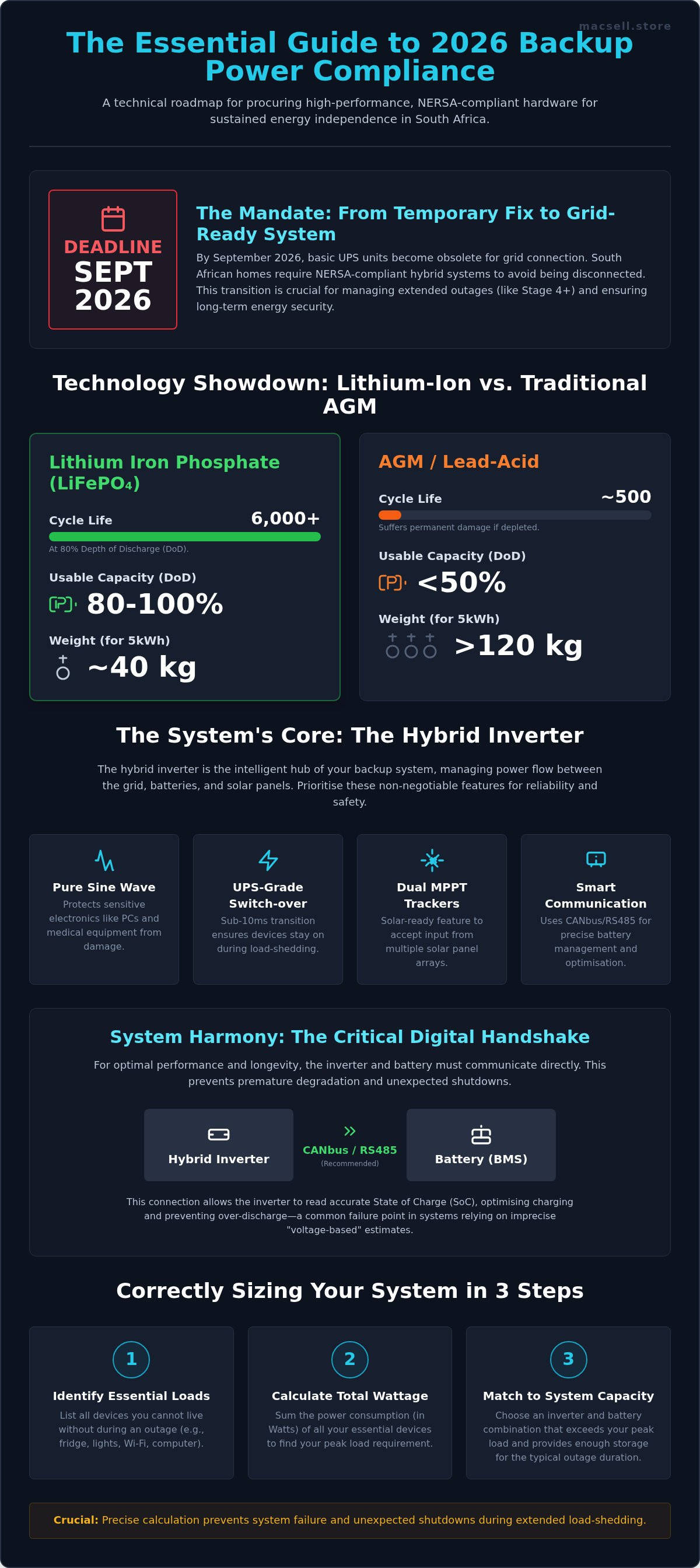
A standard backup power kit South Africa homeowners rely on comprises three critical components: a hybrid inverter, lithium battery storage, and specialised AC/DC protection gear. In 2026, the shift from basic Uninterruptible Power Supplies (UPS) to high-capacity hybrid systems is driven by the need for sustained energy independence. While a UPS might bridge a 20-minute gap, hybrid systems manage multi-hour outages by integrating with the broader Renewable energy landscape in South Africa. This evolution ensures that hardware remains compliant with updated NERSA grid-tie regulations whilst providing a platform for future solar expansion.
Procuring hardware for a backup power kit South Africa requires distinguishing between backup-only and solar-ready configurations. Backup-only setups use the grid to charge batteries; solar-ready systems include Maximum Power Point Tracking (MPPT) controllers to accept photovoltaic input. During multi-day outages, the Depth of Discharge (DoD) becomes a vital metric. High-end lithium units allow for 80% to 100% DoD without immediate degradation, a feat impossible for older lead-acid technologies that suffer permanent damage if depleted below 50%.
The Role of the Hybrid Inverter in Modern Backup
Hybrid inverters act as the central intelligence of the system. They coordinate power flow between the Eskom grid, battery banks, and solar panels simultaneously. For sensitive electronics like high-end PCs or medical equipment, pure sine wave output is non-negotiable to prevent circuit damage. Modern units offer UPS-grade switch-over times of less than 10 milliseconds. This ensures home offices remain online during sudden load-shedding transitions without equipment restarts or data loss.
Lithium vs AGM: Why Lithium-Ion Dominates in 2026
The hardware market has moved decisively toward lithium-ion, specifically Lithium Iron Phosphate (LiFePO4) chemistry. The primary differentiator is cycle life. A premium Hubble AM2 battery offers 6000+ cycles at 80% DoD, whereas traditional AGM or Gel batteries typically fail after 500 cycles. Lithium hardware provides several advantages for residential use:
- Space Efficiency: Higher energy density allows for wall-mounted installations in compact residential spaces.
- Discharge Performance: Lithium units maintain voltage stability even as the capacity drops, ensuring consistent power delivery.
- Long-term Value: The cost-per-cycle is drastically lower because the hardware doesn't require replacement every 18 months.
Weight is another factor. A 5kWh lithium battery weighs approximately 40kg, whereas an equivalent AGM bank requires four 100Ah batteries weighing over 120kg in total. This efficiency makes lithium the only viable choice for scalable, modern backup systems.
Essential Hardware: Hybrid Inverters and Lithium-Ion Storage
The rapid expansion of the Renewable Energy Market in South Africa has established Sunsynk as a primary benchmark for reliability. Sunsynk hybrid inverters are engineered to withstand the thermal stress of frequent switching during high-stage load-shedding. Deye has emerged as a versatile, high-specification alternative, sharing similar hardware architecture whilst offering competitive feature sets for residential kits. Both brands prioritise system intelligence, allowing for granular control over power prioritisation and grid feedback. Selecting a high-performance backup power kit South Africa depends on the seamless integration of these inverters with premium storage solutions like Hubble Lithium batteries.
Hardware compatibility is dictated by communication protocols. Modern systems utilise CANbus or RS485 ports to facilitate real-time data exchange between the Battery Management System (BMS) and the inverter. This communication ensures the inverter receives accurate State of Charge (SoC) data, preventing over-discharge and optimising charging profiles. Without this digital handshake, the system operates on "voltage-based" parameters, which are significantly less precise and can lead to premature battery degradation or unexpected shutdowns during peak loads.
Hybrid Inverter Specifications to Prioritise
Modern hybrid units must include dual MPPT (Maximum Power Point Tracking) trackers. This allows for solar arrays to be installed on two different roof orientations, such as East and West, to maximise energy harvest throughout the day. Parallel capability is another essential feature; it enables the addition of multiple inverters to the same system as household demand increases. For installations in coastal or dusty environments, an IP65 rating is mandatory. This ingress protection ensures the internal power electronics remain shielded from moisture and particulate matter, extending the hardware's operational lifespan.
Lithium Battery Performance Metrics
Hubble Lithium batteries are frequently paired with high-end inverters due to their robust operating voltage ranges and high discharge capabilities. A critical metric is the 1C discharge rate. This indicates the battery can discharge its entire rated capacity in one hour, providing the high current necessary to start heavy appliances like borehole pumps or air conditioners without tripping. Depth of Discharge is the percentage of battery capacity that can be safely used without causing damage. Unlike lead-acid alternatives, premium lithium cells maintain a flat discharge curve. This ensures the nominal voltage remains stable even as the battery nears the end of its cycle, protecting sensitive electronics from voltage sag.
Hardware Roundup: Comparing Sunsynk, Deye, and LuxPower Kits
Selecting a permanent backup power kit South Africa requires a comparison of high-capacity hybrid hardware rather than portable power stations. While portable units serve small loads, fixed systems from Sunsynk, Deye, and LuxPower offer the scalability needed for full energy independence. These brands dominate the 2026 market due to their ability to handle the rigorous duty cycles imposed by the national grid's instability.
Sunsynk 8KVA: Performance and Load Capacity
The Sunsynk 8KVA hybrid inverter remains the preferred hardware for medium-to-large households. It manages peak surges from inductive loads like borehole pumps and air conditioners effectively. The integrated user interface provides real-time data, whilst Wi-Fi dongles allow for remote monitoring and parameter adjustments via a dedicated app. For a deeper dive into hardware specifications, refer to the Sunsynk 8KVA and Hubble AM2 combo kit technical review.
Pairing the Sunsynk 8KVA with two Hubble AM2 5.5kWh batteries creates a system widely regarded as the "Gold Standard" for residential backup. This configuration provides 11kWh of storage, sufficient to sustain essential loads and high-draw appliances through Stage 6 load-shedding cycles. The communication between the Hubble BMS and the Sunsynk inverter is exceptionally stable; it allows the system to manage discharge rates precisely based on real-time temperature and cell health data.
LuxPower SNA5000 Technical Data
The LuxPower SNA5000 is a robust, cost-effective solution specifically designed for essential load backup and off-grid applications. It's a favourite for kits where solar integration isn't the immediate priority but lithium compatibility is essential. This unit communicates effectively with various lithium brands, including Hubble and Volta. You can find detailed procurement information by checking the LuxPower SNA5000 price and specs guide.
Deye 5kW and 8kW inverters offer a versatile middle ground for modern households. They provide the same robust hardware architecture as Sunsynk but utilise a different monitoring ecosystem. Built-in protection features remain a mandatory requirement for any reliable backup power kit South Africa. Sunsynk and Deye units typically feature integrated DC switches and surge protection devices. These components safeguard the inverter against high-voltage transients from the grid, ensuring the hardware survives the frequent power cycling associated with South Africa's current energy challenges.
Calculating Load Capacity: How to Size Your Backup Power Supply
Sizing a backup power kit South Africa households can rely on requires a methodical approach to electrical demand. It's not about the total number of rooms in a house, but rather the cumulative wattage of active circuits during a blackout. Accurate sizing prevents the two most common failure points: inverter overload and premature battery depletion.
- Step 1: Identify Essential Loads. Categorise high-priority items such as LED lights (10W each), Wi-Fi routers (15W-30W), refrigerators (150W-250W), and security systems (50W).
- Step 2: Calculate Total Wattage. Sum the wattage of these items running simultaneously to determine your baseload. A typical essential circuit for a three-bedroom home often sits between 400W and 800W.
- Step 3: Determine Battery Runtime. Match your capacity to load-shedding stages. For a Stage 4 outage lasting 4.5 hours, a 500W load requires 2.25kWh of usable energy.
- Step 4: Factor in Efficiency Loss. Inverters generally experience an efficiency loss of 5-10% during DC-to-AC conversion. Multiply your required kWh by 1.1 to ensure a safe buffer.
Understanding Watt-Hours vs Amp-Hours
Modern lithium hardware utilises Kilowatt-hours (kWh) as the primary metric for usable energy storage. Older lead-acid or gel battery specifications often cite Amp-hours (Ah), which can be misleading because energy capacity changes based on system voltage. You calculate kWh by multiplying Amp-hours by Voltage and dividing by 1000. Relying on kWh provides a universal standard for comparing different backup power kit South Africa options regardless of their 24V or 48V architecture.
Managing High-Draw Appliances
Geysers, ovens, and tumble dryers are usually excluded from standard backup power kits because their resistive heating elements draw massive amounts of current. A single 3000W geyser would exhaust a standard 5kWh battery in less than 90 minutes. Motors found in borehole pumps and fridges present a different challenge known as "Inrush Current". These devices require a momentary surge of up to seven times their running wattage to start, which can trip an undersized inverter. Balancing these loads is essential for system stability. For technical strategies on load-shedding management, check the home inverter and battery combo guide. To secure hardware that handles these surges effectively, browse our lithium and inverter combos for professional-grade reliability.
Procuring Your Solar Hardware from MacSell Solar Outlet
MacSell Solar Outlet operates as a specialised distributor of premium energy hardware. We don't provide installation or financing. This hardware-only focus empowers customers to maintain full control over their energy projects whilst avoiding the hidden costs associated with turnkey service providers. Every backup power kit South Africa households purchase through our platform is selected for its ability to meet NERSA requirements and withstand local grid conditions. By excluding service-based markups, we ensure customers receive high-performance hardware at transactional pricing. We act as a technical warehouse for those who prioritise component quality and availability.
Choosing a pre-configured combo kit eliminates the risk of component mismatch. We specialise in pairing hybrid inverters with compatible lithium storage, such as the Sunsynk 8KVA and Hubble AM2 combo. These kits are verified for digital communication stability through CANbus protocols. National delivery logistics are managed strictly to ensure that sensitive power electronics and heavy lithium banks arrive securely at your site. Our dispatch process is designed for speed and reliability, catering to both DIY enthusiasts and independent professional installers across the country.
The MacSell Advantage: Curated Technical Inventory
Our inventory is restricted to brands with proven track records: Sunsynk, Deye, LuxPower, and Hubble. This curation ensures that every SKU meets the technical demands of the South African market. Buying hardware directly allows you to bypass the "installer markup" often found in all-inclusive quotes. This transparency is vital for accurate project budgeting and long-term ROI calculations. For a detailed analysis of component pricing, view our Solar system hardware cost breakdown South Africa. We provide the tools; you provide the local expertise for the final connection.
Next Steps for Your Energy Independence
Before purchasing, review your distribution board. You'll need to split your circuits into essential and non-essential loads to prevent system trips during outages. Once your load profile is established, you can order your backup power kit South Africa online for national dispatch. Secure your hardware first; this allows you to present the exact technical specifications to your preferred local electrician for a compliant installation. Preparing your site with the correct hardware ensures the final setup meets the high standards required for 2026 energy independence. Focus on the hardware specifications today to ensure grid compliance tomorrow.
Securing Your Energy Independence with Professional Hardware
Achieving energy independence in 2026 requires more than just a temporary fix. It demands a technically sound backup power kit South Africa homeowners can trust during high-stage outages. By prioritising NERSA-compliant hybrid inverters like the LuxPower SNA5000 or the Sunsynk 8KVA, you ensure your system remains grid-compliant whilst delivering pure sine wave stability. Pairing these with high-cycle lithium storage like the Hubble AM2 guarantees a durable power supply that survives thousands of discharge cycles without performance loss. Accurate load sizing remains the final piece of the puzzle; it prevents inverter overload and ensures your essential circuits stay powered when the grid fails.
MacSell Solar Outlet provides the technical expertise and inventory depth needed to build a professional system. As official stockists of Sunsynk, Deye, and Hubble, we offer specialised hardware-only retail expertise with national delivery across South Africa. This direct-to-consumer model allows you to secure premium components without unnecessary service markups. View our range of Sunsynk and Hubble backup power kits to begin your procurement process. Building a reliable system is a methodical investment in your household's operational continuity.
Frequently Asked Questions
What is the best backup power kit for a standard 3-bedroom home in South Africa?
A Sunsynk 8KVA or Deye 8kW hybrid inverter paired with 11kWh of lithium storage is ideal for a standard 3-bedroom home. This capacity handles the higher inrush currents of fridges and borehole pumps whilst providing enough runtime for essential circuits. For a reliable backup power kit South Africa households can depend on, the Sunsynk 8KVA and Hubble AM2 combo kit offers the best balance of peak load handling and storage duration during Stage 6 cycles.
Can I add solar panels to my backup power kit at a later stage?
You can integrate solar panels later if you select a hybrid inverter with built-in MPPT trackers. Models like the LuxPower SNA5000 or Sunsynk 8KVA are designed for this modular approach. Starting with a battery-only backup kit allows for immediate load-shedding relief whilst keeping the system open for photovoltaic expansion. Ensure your initial inverter sizing accounts for the total solar array you plan to install in the future to avoid costly hardware replacement later on.
How long will a 5.5kWh lithium battery run my essential appliances during load-shedding?
A 5.5kWh lithium battery, such as the Hubble AM2, will typically power a 500W baseload for approximately 9 to 10 hours at 90% depth of discharge. If your load includes only lights, Wi-Fi, and a fridge, this capacity comfortably covers Stage 6 load-shedding cycles. However, adding high-draw appliances like kettles or microwaves will drastically reduce this runtime. Constant monitoring of your inverter's real-time discharge rate is essential for managing your energy budget effectively during blackouts.
Is a 5kW or 8kW hybrid inverter better for a residential backup system?
An 8kW hybrid inverter is generally better for households requiring simultaneous use of several appliances or those with high-start-up inductive loads. While a 5kW unit like the LuxPower SNA5000 is sufficient for essential lighting and electronics, it may trip if a microwave and fridge compressor activate at the same time. Investing in an 8kW Sunsynk or Deye unit provides a 60% increase in throughput capacity, offering better long-term scalability as your household power needs grow.
Do I need a special certificate (CoC) after installing a backup power kit?
A valid Certificate of Compliance (CoC) is a legal requirement for every backup power kit South Africa installation. This document proves the electrical work meets national safety standards and is necessary for insurance claims or property sales. Additionally, if you're connecting a grid-tied system, you must ensure the inverter is NERSA-approved and registered with your local municipality. Always use a qualified electrician to perform the final connection to your home's distribution board safely.
What is the difference between a hybrid inverter and an off-grid inverter for backup?
Hybrid inverters manage power from the grid, solar panels, and batteries simultaneously whilst allowing for grid feedback where permitted. In contrast, off-grid inverters typically treat the grid as a backup source only and cannot push power back or blend sources as efficiently. For most residential applications, a hybrid unit is the superior choice because it offers greater flexibility in energy prioritisation and meets the strict compliance standards required for modern South African grid connections.
How do I ensure my lithium battery is compatible with my Sunsynk inverter?
Compatibility is ensured by verified BMS communication protocols, specifically via CANbus or RS485 ports. When pairing a Sunsynk inverter with a Hubble battery, the hardware uses a digital handshake to exchange real-time data on voltage and temperature. This communication allows the inverter to manage the charging profile precisely. Always check the manufacturer's compatibility list to confirm that the specific firmware versions of both the inverter and the lithium battery are supported for closed-loop communication.
Why should I choose a Hubble lithium battery over cheaper alternatives?
Hubble lithium batteries offer a superior 1C discharge rate and a high cycle life of up to 6000 cycles, which cheaper alternatives often lack. A 1C rating means the battery can discharge its full capacity in one hour, supporting heavy loads without unexpected shutdowns. Cheaper batteries often have lower 0.5C ratings, limiting their performance during peak demand. Hubble provides robust technical specifications and local hardware reliability that ensures your backup system remains functional for over a decade.