

Solar Power Hardware Checklist: Essential Equipment for South Africa (2026)
Your solar system's performance depends entirely on hardware compatibility. Buying an inverter and battery that don't communicate properly makes energy independence impossible. You've likely spent hours comparing brands but still feel uncertain about the specific components required for a legal, robust installation. This guide provides a definitive solar equipment checklist South Africa for 2026 to help you avoid the frustration of a system that underperforms during peak load shedding or fails to meet updated safety standards.
You'll gain a technical understanding of how to procure high-spec hardware that ensures long-term reliability. We'll focus on industry-standard options like Sunsynk and Deye hybrid inverters paired with Hubble lithium batteries. We also detail the essential protection components and switchgear needed for a valid Certificate of Compliance. You'll find a breakdown of critical hardware requirements, from panel specifications to the modular components that keep your system safe and legal. This information provides the foundation for permanent power security and technical confidence.
Key Takeaways
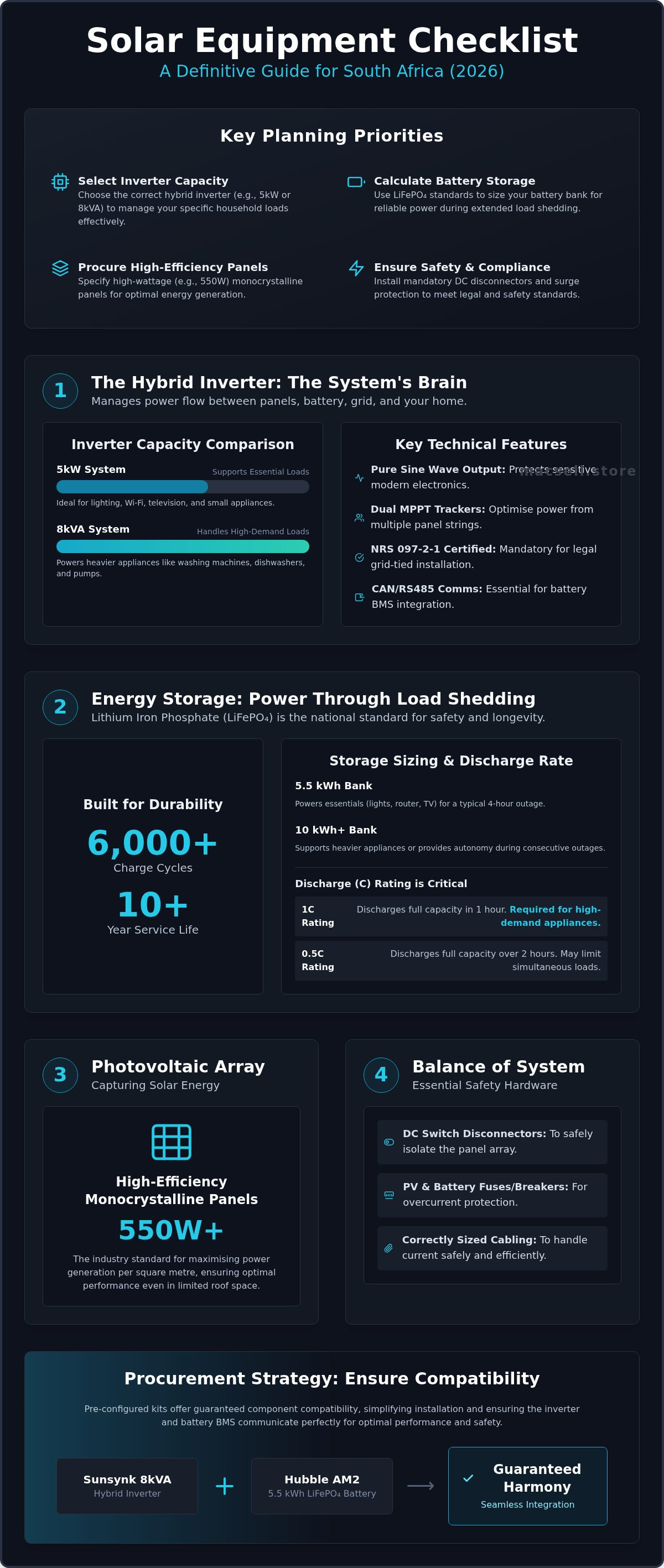
- Identify why selecting the correct hybrid inverter capacity, such as 5kW or 8KVA, is the critical first step for managing South African household loads.
- Learn how to calculate battery storage requirements using lithium iron phosphate (LiFePO4) standards to ensure reliable power during extended load shedding.
- Utilise this detailed solar equipment checklist South Africa to procure high-efficiency 550W monocrystalline panels and mandatory balance-of-system hardware.
- Understand the technical necessity of DC switch disconnectors and surge protection devices to ensure your installation is safe and compliant.
- Discover the advantages of pre-matched hardware kits, such as the Sunsynk 8KVA and Hubble AM2 combo, for guaranteed component compatibility.
The Core Component: Hybrid Inverter Selection
The hybrid inverter functions as the central intelligence of any Photovoltaic (PV) system. It manages the complex distribution of electricity between solar panels, battery storage, the national grid, and your household circuits. Choosing a high-spec unit is the most critical step on your solar equipment checklist South Africa. These devices convert DC power from panels into the clean AC power required by home appliances whilst simultaneously managing battery charging cycles to ensure longevity.
Capacity choice depends on your specific load profile and peak demand requirements. A 5kW system generally supports essential circuits like lighting, Wi-Fi, and television. However, South African households often require more power for appliances with high initial draw. An 8KVA inverter provides the necessary capacity to run a washing machine or dishwasher without exceeding the system's thermal limits. Essential technical features include dual MPPT trackers for multi-string panel configurations and pure sine wave output to prevent damage to sensitive microprocessors in modern electronics.
High-Capacity Inverters for Load Shedding
An 8KVA hybrid inverter is the preferred choice for larger residential properties. This hardware offers superior surge capacity, which is essential for starting inductive loads such as boreholes, pool pumps, or large refrigerators. These motors require a momentary burst of energy significantly higher than their running wattage. Without sufficient surge capability, the system will shut down during high-demand events. You can find specific market rates for these units in our Hybrid Inverter Price South Africa: 2026 Hardware Buying Guide.
Brand Compatibility and Technical Standards
All hardware must meet strict South African grid codes. The NRS 097-2-1 certification is mandatory for any grid-tied installation to ensure safety and legal compliance. The inverter must also support CAN or RS485 communication protocols to interface with lithium battery management systems (BMS). This ensures the inverter receives real-time data on battery health, voltage, and temperature. The LuxPower SNA5000 is a versatile hybrid option for off-grid and grid-tied use. Leading brands like Sunsynk and Deye offer integrated software that simplifies these technical requirements for a more reliable installation.
Energy Storage: Lithium Battery Hardware Requirements
Reliable energy storage is the second pillar of a robust solar equipment checklist South Africa. Lithium iron phosphate (LiFePO4) has emerged as the national standard for residential and commercial storage. This chemistry offers superior safety profiles compared to older lithium-ion variants; it is significantly less prone to thermal runaway. Hardware longevity is a primary factor. LiFePO4 batteries typically provide 6,000 cycles at 80% depth of discharge, ensuring a service life exceeding ten years under standard load shedding conditions.
Sizing your storage requires an analysis of essential load duration. A 5.5 KWh battery generally provides sufficient capacity for essential electronics and lighting during a four-hour load shedding slot. Expanding to a 10 KWh bank allows for the operation of heavier appliances or extended autonomy during consecutive outages. It's useful to consult an IEA solar energy guide to understand how storage integrates into broader energy security strategies. Pay close attention to technical discharge rates:
- 1C Rating: Allows the battery to discharge its full capacity in one hour, supporting high-draw appliances.
- 0.5C Rating: Discharges full capacity over two hours, which may limit the number of simultaneous loads.
High-demand households should prioritise 1C ratings to prevent inverter tripping during peak usage. Integration between the Battery Management System (BMS) and the inverter is mandatory. This digital handshake allows the inverter to manage charge voltages accurately based on real-time cell data.
The Hubble AM2 Advantage
The Hubble AM2 5.5 KWh lithium battery is a high-performance choice for South African systems. It features a 1C discharge rate and high-density cells designed for heavy-cycle applications. Integration is seamless via the Hubble Cloudlink, which provides remote hardware monitoring and real-time telemetry. This level of data visibility is vital for maintaining system health. For a deeper technical breakdown, refer to our Lithium Ion Solar Battery Technology: The Complete 2026 Hardware Guide.
Battery Bank Scaling
Scalability is a core requirement for future-proofing. Most modern lithium units allow for parallel configuration to increase total capacity. Ensure your hardware matches the inverter's DC voltage, which is typically 48V for residential hybrid systems. Proper installation requires dedicated battery cabinets to organise cabling and provide necessary ventilation. Excessive heat reduces cell life; therefore, maintaining an ambient temperature between 20°C and 25°C is recommended. You can browse our range of lithium batteries to find compatible storage for your specific inverter model.
Photovoltaic Array: Solar Panel Procurement
The photovoltaic array serves as the primary generation engine for your system. In 2026, high-performance installations prioritise panels within the 450W to 550W range. These higher-wattage modules offer better roof space efficiency and reduced balance-of-system costs per watt. Monocrystalline technology is the hardware standard because it offers superior efficiency and lower temperature coefficients compared to polycrystalline options. It's vital in South Africa, where high ambient temperatures can otherwise lead to significant power derating during peak sunlight hours.
String configuration must strictly match the MPPT (Maximum Power Point Tracking) voltage parameters of your chosen inverter. Calculating the total open-circuit voltage (Voc) for your specific string length is a non-negotiable part of your solar equipment checklist South Africa. Incorrect voltage levels can either prevent system startup or cause catastrophic hardware failure. For those looking to maximise value, a bulk procurement strategy is recommended. Purchasing full pallets of panels usually yields a lower unit price than buying individual modules, which is helpful for larger residential or commercial projects.
Panel Efficiency and Hardware Quality
Selecting panels from Tier 1 manufacturers ensures long-term reliability and warranty security. These manufacturers utilise advanced production techniques that include Anti-PID (Potential Induced Degradation) features, protecting the cells from voltage-induced power loss over time. High-quality modules maintain their output levels even after decades of exposure to harsh UV radiation. You can find detailed cost breakdowns for these high-spec modules in our Solar Panel for Home Price: 2026 South Africa Hardware Procurement Guide.
Mounting Hardware and Structural Integrity
Structural stability depends on using the correct mounting hardware for your roof type. Whether your property features concrete tiles, IBR, or corrugated sheeting, the mounting kit must be substrate-specific to ensure a waterproof and secure fit. Professionals utilise anodised aluminium rails and stainless steel fasteners to resist corrosion in coastal and inland environments. Mounting hardware must be wind-load rated for South African conditions to prevent structural failure during storms. A complete hardware list for mounting includes:
- Substrate-specific roof hooks or hangers.
- Anodised aluminium mounting rails.
- Universal or size-specific mid and end clamps.
- EPDM flashing or rubber seals for leak prevention.
Balance of System (BOS): The Essential Hardware Checklist
The Balance of System (BOS) consists of the ancillary hardware that secures, connects, and protects the primary components. This solar equipment checklist South Africa focuses on the technical specifications for high-current wiring and safety switchgear. DC cabling is a primary consideration; use 4mm or 6mm UV-resistant solar cables paired with high-quality MC4 connectors. For energy storage, battery cables must have a sufficient gauge, such as 35mm or 50mm, to prevent voltage drop and thermal stress during high-discharge events.
Protection hardware is non-negotiable for system longevity. DC switch disconnectors are mandatory for isolating the photovoltaic array during maintenance or emergencies. Surge Protection Devices (SPD) must be installed on both the AC and DC sides to safeguard the inverter from grid spikes and lightning surges. You can procure all these essential components when you buy solar hardware online from our specialised warehouse.
Electrical Protection and Compliance Hardware
An AC changeover switch is required to manage the transition between the national grid and the inverter output. This can be manual or automatic depending on your specific requirements. The distribution board must house earth leakage units and circuit breakers sized to the specific amperage of the inverter. Proper system grounding is essential for safety. This requires dedicated earth spikes and bonding conductors to ensure the entire installation is potential-equalised and meets the standards for a Certificate of Compliance.
Monitoring and Communication Cables
Data integrity depends on RS485 or CAN bus cables for communication between the lithium battery and the inverter. These cables allow the Battery Management System (BMS) to dictate charge parameters based on real-time cell health. Wi-Fi dongles are necessary hardware for remote monitoring and firmware updates via the manufacturer's portal. All external wiring should be protected within UV-stabilised conduit or trunking to ensure the installation remains tidy and resistant to environmental wear. This level of detail in procurement prevents expensive technical delays during the final commissioning phase.
Procurement Strategy: Pre-Configured Solar Combo Kits
Buying solar hardware as individual components often leads to technical mismatches during commissioning. Pre-configured kits solve this by providing a verified Bill of Materials where the inverter, batteries, and protection gear are already tested for compatibility. This approach is the most efficient way to complete a solar equipment checklist South Africa. Procurement through a specialised national hardware outlet ensures that all units feature the latest 2026 firmware updates, which are necessary for compliance with evolving municipal grid standards and battery communication protocols.
Kits simplify the logistics of national delivery by consolidating all essential hardware into a single shipment. This ensures that your project is not delayed by a missing communication cable or an undersized circuit breaker. By choosing a pre-matched system, you eliminate the technical guesswork that often leads to hardware failure or voided warranties. This strategy allows you to focus on the technical requirements of the installation rather than the complexities of component sourcing.
The Sunsynk-Hubble Synergy
The Sunsynk 8KVA inverter and Hubble AM2 battery pairing is the gold standard for high-performance residential backup. This hardware combination is designed for intensive use during frequent load shedding cycles. The Sunsynk 8KVA & 2X Hubble AM2 5.5 KWh Combo Kit provides 11 KWh of total storage with a 1C discharge rate. This allows users to run heavy appliances without thermal shutdown or battery stress. This synergy ensures the inverter receives accurate state-of-charge data, which is vital for maintaining the health of the lithium cells. Technical details are available in our Sunsynk 8KVA and Hubble AM2 Combo Kit: Technical Review and Hardware Guide (2026).
Securing Your Hardware Investment
Finalising your procurement requires a strict audit of all delivered components. Every item must have its specific warranty documentation verified before the installation process begins. Conduct a full inventory to ensure all balance-of-system hardware, such as DC isolators and surge protection devices, matches the project specifications. This preparation allows your chosen electrician to proceed without technical delays. Use the following points to cross-reference your purchase:
- Verify that the inverter carries the NRS 097-2-1 certification for grid compliance.
- Ensure battery communication cables (CAN or RS485) are included and undamaged.
- Check that all solar panels are from the same production batch to ensure uniform electrical output.
- Confirm the gauge of battery cables supports the peak inverter current to prevent voltage drop.
Our national distribution network coordinates delivery for these kits, allowing you to own your equipment outright without the complexities of financing. This hardware-only model provides the most cost-effective route to long-term energy security. Once your hardware list is finalised, you can proceed with confidence that your system is built on a foundation of compatible, high-spec equipment.
Securing Your Energy Independence with High-Spec Hardware
Achieving energy independence in 2026 requires more than just panels. It demands a technically sound solar equipment checklist South Africa. You've learned that matching a Sunsynk 8KVA inverter with high-performance Hubble lithium batteries provides the necessary surge capacity and cycle life for heavy residential loads. Proper balance-of-system hardware, including surge protection and correctly gauged cabling, ensures your installation remains safe and compliant. Procurement through pre-configured kits eliminates the risk of component mismatch and technical delays during commissioning.
As an authorised Sunsynk and Deye hardware retailer and specialised Hubble lithium battery stockist, we provide high-end components for professional builds. We serve South Africa nationally, focusing on a hardware-only model for customers who want to own their equipment outright. Browse our range of Sunsynk and Hubble hardware kits to finalise your procurement with components that meet the latest technical standards. You're now equipped with the knowledge to build a robust, future-proof power solution that delivers long-term reliability.
Frequently Asked Questions
What is the most important piece of hardware in a solar system?
The hybrid inverter is the most critical component because it manages power distribution between the grid, panels, and battery storage. It functions as the system's central brain, converting DC energy into usable AC power whilst maintaining battery health through precise charging cycles. Selecting high-quality units from Sunsynk or Deye ensures long-term reliability. Without a robust inverter, even the best solar panels can't provide consistent energy during load shedding.
Can I mix different brands of solar panels and inverters?
You can mix brands as long as the electrical specifications match the inverter's MPPT input range. Panels must have compatible voltage and amperage ratings to ensure efficient energy harvest. However, mixing different panel wattages or brands on the same string isn't recommended as it reduces overall efficiency. Always verify that the total string voltage remains within the inverter's maximum operating parameters to prevent catastrophic hardware damage.
Does the Hubble AM2 battery work with a Sunsynk inverter?
The Hubble AM2 lithium battery is fully compatible with Sunsynk inverters. This pairing is a primary feature of any comprehensive solar equipment checklist South Africa. They communicate via a CAN bus or RS485 port, allowing the inverter to monitor the battery's state of charge and temperature in real-time. This digital integration ensures optimal charging cycles and extends the lifespan of the lithium cells compared to non-communicating types.
What thickness of cable is required for a 5kW solar system?
A 5kW system typically requires 4mm or 6mm UV-resistant DC cabling for the photovoltaic array. For the battery connection, 35mm or 50mm flexible copper cables are necessary to handle high-current discharge without excessive voltage drop or heat buildup. Using the correct cable gauge is vital for both safety and peak performance. Undersized wiring leads to thermal stress, reduced efficiency, and potential fire hazards during periods of high demand.
Is surge protection mandatory for solar hardware in South Africa?
Surge protection is mandatory for both the AC and DC sides of a solar installation to meet South African safety standards. These devices protect sensitive inverter electronics from lightning strikes and grid-switching spikes common in local infrastructure. A valid Certificate of Compliance (CoC) can't be issued without proper surge protection. Installing Type 1 and Type 2 Surge Protection Devices (SPDs) is a critical step in safeguarding your hardware investment.
What hardware is included in a Sunsynk 8KVA combo kit?
A standard Sunsynk 8KVA combo kit includes the 8KVA hybrid inverter and two Hubble AM2 5.5 KWh lithium batteries. These kits are pre-configured to ensure immediate communication between the Battery Management System and the inverter. They often include the necessary communication cables and feature pre-wired protection boxes. This hardware combination provides 11 KWh of total storage, making it suitable for larger residential households requiring reliable backup during outages.
Can I add more lithium batteries to my system later?
Most modern lithium batteries, including Hubble AM2 units, are modular and allow for parallel scaling. You can increase your storage capacity by adding identical batteries to the existing bank. It's essential to ensure that the firmware versions match and that the cabling is sized to handle the increased current. Adding storage later is a cost-effective way to expand your system's autonomy as your energy requirements grow or load shedding duration increases.
What is the difference between a hybrid and an off-grid inverter?
A hybrid inverter can interact with the national grid, allowing for battery charging from Eskom and selling excess power back where municipal regulations permit. Off-grid inverters operate independently and can't feed power back or synchronise with external AC sources. Hybrid units are the preferred choice for a solar equipment checklist South Africa because they offer the flexibility to use grid power whilst providing seamless backup during load shedding events.