

Solar Panels for 8kVA Inverter: South Africa 2026 Guide
Installing exactly 8,000 watts of solar power for an 8kVA inverter is a technical mistake that costs you energy every single day. Most users believe a one-to-one ratio is ideal, but this fails to account for South Africa's specific solar conditions and the technical limits of modern hybrid systems. You've likely felt the confusion of balancing kVA ratings against real-world kW output while trying to avoid the "clipping" that wastes your hardware's potential. It's difficult to determine exactly how many solar panels for 8kva inverter south africa installations are needed when transitioning from simple load shedding backup to a full off-grid configuration.
This guide clarifies the exact number of 550W to 670W panels required to maximise your system's efficiency. You'll learn the optimal DC-to-AC ratio to ensure your 5Kwh Lithium Batteries stay charged even during winter's shorter daylight hours. We provide a hardware-first procurement list that covers MPPT string configurations and the specific panel counts used in high-performance Sunsynk and Deye setups. By the end of this technical breakdown, you'll have a definitive list of components for a reliable 2026 solar array.
Key Takeaways
- Define the critical distinction between kVA and kW ratings to avoid under-sizing your solar array and wasting inverter capacity.
- Calculate exactly how many solar panels for 8kva inverter south africa setups are required when using modern 550W to 650W high-efficiency modules.
- Master MPPT voltage constraints and string configurations to protect your hardware whilst maximising energy harvest throughout the day.
- Optimise panel counts for the specific demands of South African winter solar yields and consistent 10kWh battery charging cycles.
- Streamline procurement by matching the Sunsynk 8KVA inverter with high-performance Hubble AM5+ lithium batteries for a technically balanced system.
Understanding 8kVA Inverter Capacity and DC Input Limits
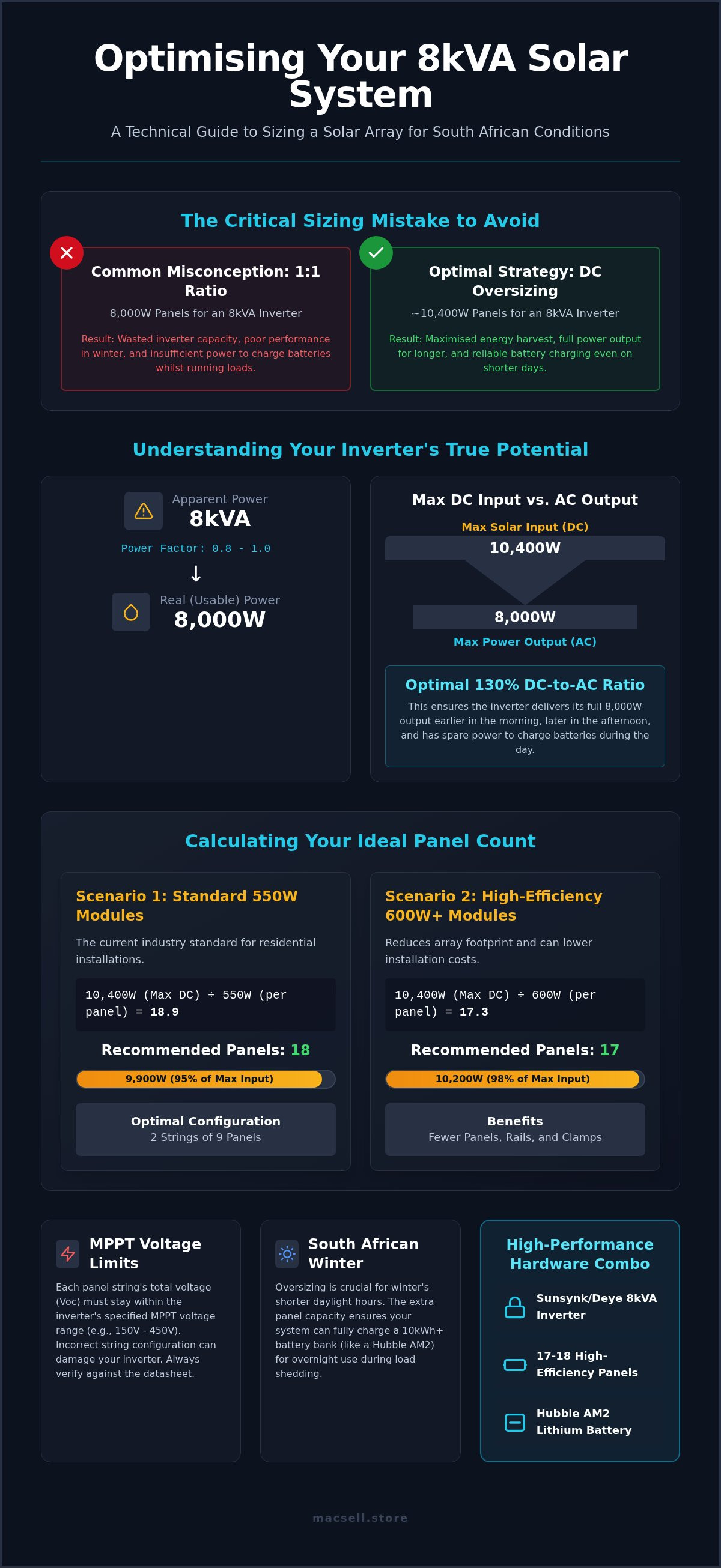
Selecting the correct hardware for a residential energy system requires a firm grasp of technical specifications beyond the headline rating. An 8kVA inverter is a high-capacity unit capable of running heavy loads like geysers, borehole pumps, and multiple kitchen appliances simultaneously. However, the label "8kVA" refers specifically to the inverter's output capacity, not its solar intake potential. To determine how many solar panels for 8kva inverter south africa installations require, you must first look at the Maximum DC Input. For industry-standard units like the Sunsynk 8KVA or Deye models, this limit is typically 10,400W. This headroom allows for a significant DC-to-AC oversizing ratio, which is essential for maintaining power during South Africa's frequent load shedding cycles.
The Difference Between kVA and kW
In electrical engineering, kVA represents apparent power, whilst kW represents real power. Modern hybrid inverters typically operate with a power factor between 0.8 and 1.0, effectively translating 8kVA of apparent power into 8,000 watts of usable energy. This capacity is considered the "sweet spot" for medium-to-large South African households. It provides enough surge current to start inductive loads, such as air conditioning compressors, without tripping the system. Understanding this ratio is the first step in hardware procurement, as it dictates the total load you can safely pull from your lithium batteries during a grid failure.
Max DC Input vs AC Output
Designing a photovoltaic (PV) system requires matching the solar array to the inverter's maximum DC input limit rather than its AC output rating. Most premium 8kVA inverters allow for a 130% DC-to-AC ratio. This means you can install up to 10.4kW of solar panels on an 8kW machine. This oversizing is intentional. It ensures the inverter reaches its full 8kW output earlier in the morning and maintains it later into the afternoon. It also provides the excess current needed to charge a high-performance Hubble AM5+ battery bank whilst simultaneously powering the home. Without this extra solar capacity, your system will struggle to recover battery state-of-charge between load shedding stages, especially during overcast periods or the shorter days of winter.
Exceeding the 10,400W limit results in "clipping," where the inverter discards excess energy it cannot process. Whilst minor clipping at midday is acceptable, massive over-provisioning is a waste of capital. The goal is a balanced configuration that provides enough current for 24-hour autonomy without overspending on redundant glass.
Calculating the Number of Panels Based on 2026 Wattage Standards
Determining how many solar panels for 8kva inverter south africa homeowners require depends on the Maximum PV Input of the inverter. For a Sunsynk 8KVA unit, this is confirmed at 10,400W. Use this four-step process for a precise hardware list:
- Verify the max PV input on your inverter datasheet.
- Select high-efficiency modules (550W to 650W).
- Divide the total capacity by the panel wattage.
- Group panels into strings that match the inverter's voltage range.
Panel Count for 550W Modules
Using 550W modules is the current standard for residential arrays in 2026. The math is direct: 10,400W divided by 550W equals 18.9 panels. You should install 18 panels to maintain a safe margin and ensure symmetry in your wiring. This configuration allows for a balanced 2-string setup with 9 panels per string. In South African conditions, an 18-panel array of 550W modules yields approximately 9,900W of peak DC power. This provides ample current for charging lithium batteries whilst simultaneously powering household loads during peak sun hours. It's a reliable configuration for those using the Sunsynk 8KVA and Hubble AM5+ combo.
Panel Count for 600W+ High-Efficiency Modules
Transitioning to 600W or 650W panels reduces the total footprint of the array. For 600W panels, a 17-panel configuration reaches 10,200W, which is near the 8kVA inverter's limit. Higher wattage panels are more efficient in terms of installation labour. You'll need fewer mounting rails, mid-clamps, and end-clamps. It's a strategic way to lower total system costs without sacrificing yield. Check the latest solar panel for home price data to compare the cost-per-watt between 550W and 600W options. If you're ready to build your system, you can browse high-wattage modules at our outlet to find a match for your roof space. Always verify that the combined open-circuit voltage of these larger panels doesn't exceed the inverter's 500V limit per MPPT.
The Impact of MPPT Strings and Voltage Constraints
An MPPT, or Maximum Power Point Tracker, is a high-frequency DC-to-DC converter that optimises the electrical match between the solar array and the battery bank. Most 8kVA hybrid inverters, including the Sunsynk and Deye models, are equipped with two MPPTs. This dual-tracker design allows for two independent strings of panels, which is vital for South African homes with complex rooflines or multiple orientations. By splitting the array, you can ensure that shading on one side of the house doesn't degrade the performance of the entire system.
Understanding Maximum Open Circuit Voltage (VOC) is the most critical safety factor in system design. VOC is the maximum voltage a panel produces under no-load conditions. In South Africa, winter temperatures can cause voltage spikes because solar cells become more efficient in the cold. If your total string voltage exceeds the inverter's 500V limit on a cold July morning, the internal circuitry will likely suffer catastrophic failure. Always apply a 10-15% safety margin to your calculations to account for these environmental fluctuations.
Stringing Math for Sunsynk and Deye 8kVA Units
Efficiency depends on keeping the string voltage within the inverter's "sweet spot," typically between 125V and 425V. When determining how many solar panels for 8kva inverter south africa installations require, you must decide between series and parallel wiring. Wiring in series increases voltage, whilst parallel wiring increases amperage. For a standard 18-panel array of 550W modules, the most effective configuration is two strings of 9 panels. This keeps the voltage high enough for peak efficiency without risking an over-voltage event that could trigger a system shutdown.
Inverter Protection and Warranty Compliance
Incorrect panel counts or poor stringing configurations are leading causes of voided hardware warranties. Manufacturers require strict adherence to voltage and current limits to ensure long-term reliability. The start-up voltage is just as important as the max voltage because it determines when your system begins generating power in low-light conditions. If your string voltage is too low, the inverter won't "wake up" until midday. Integrating robust DC surge protection is also a non-negotiable requirement for high-panel-count systems, as it protects your investment from lightning-induced surges and grid instability.
Optimising Your 8kVA System for South African Conditions
System performance in South Africa is dictated by seasonal variance and the intensity of the national grid's instability. Whilst summer provides peak generation, winter yields typically drop by 30% to 40% due to shorter days and lower solar angles. To maintain 24-hour autonomy, you must size your array for these "worst-case" winter scenarios. When calculating how many solar panels for 8kva inverter south africa requires, the objective isn't just to cover your daytime load but to generate enough surplus to replenish your energy storage during narrow windows of grid availability.
Sizing for Load Shedding Cycles
During Stage 4 or Stage 6 load shedding, the time between outages is drastically reduced. An 8kVA system owner must distinguish between "Load Power" (energy used by the home) and "Charge Power" (energy sent to the batteries). To charge a 10kWh bank, such as the Sunsynk 8KVA and 2x Hubble AM5+ combo kit, you need significant DC headroom. If your household pulls a constant 3kW load, an array generating only 5kW will only leave 2kW for the batteries. This would take over five hours to fully charge your bank. By maximising the DC input to 10.4kW, you can fast-charge your lithium ion solar battery at its maximum C-rating whilst simultaneously running heavy appliances. This synergy between high-wattage panels and Hubble AM5+ lithium integration is what defines a resilient 2026 installation.
Orientation and Tilt Efficiency in SA
In the Southern Hemisphere, North-facing arrays provide the highest total daily yield. However, many 8kVA users benefit from an East/West split across the two MPPT trackers. This configuration flattens the generation curve, providing more power in the early morning and late afternoon when household demand is usually at its peak. You must also account for environmental factors like dust accumulation and heat degradation, which can reduce panel efficiency by 5% to 10% in high-temperature regions. Oversizing the array to the inverter's full DC capacity acts as an insurance policy. It ensures that even on cloudy days or when panels are less than perfectly clean, the system still produces enough current to keep the lights on. Browse our 8kVA hybrid hardware combos to ensure energy autonomy before the next grid cycle.
Procuring the Right 8kVA Solar Hardware Combo
Sourcing hardware directly from a specialised distributor is the most effective method for reducing total project costs whilst ensuring technical compatibility. When you procure your own components, you bypass the inflated margins often found in turnkey service packages. A pre-configured hardware bundle simplifies the engineering phase by providing a tested baseline for your array. It answers the complex question of how many solar panels for 8kva inverter south africa installations need by matching the inverter's maximum DC input to a specific number of high-wattage modules. This direct retail path allows you to allocate your budget toward higher-quality glass and lithium storage rather than administrative overheads.
The Sunsynk 8KVA & Hubble AM5+ Combo Advantage
The Sunsynk 8KVA and Hubble AM5+ combo kit represents the industry benchmark for residential energy independence. This pairing is a deliberate technical match; the Hubble AM5+ lithium batteries utilise a Battery Management System (BMS) that communicates natively with the Sunsynk inverter. This integration allows for precise monitoring of state-of-charge (SoC) and ensures the batteries charge at optimal rates to extend their lifespan. It's a plug-and-play solution that eliminates the communication errors common in mismatched hardware sets.
Scaling this system is straightforward. The 8kVA inverter's dual MPPT trackers allow you to start with a smaller array and expand to the full 10,400W limit as your budget allows. This modular approach ensures that your initial investment remains relevant as your energy requirements grow or as you add more storage capacity.
Final Hardware Checklist for 8kVA Systems
A complete 8kVA installation requires more than just panels and an inverter. Your procurement list must include:
- Hybrid Inverter: A Sunsynk or Deye 8kVA unit with dual MPPT trackers.
- Energy Storage: At least two Hubble AM5+ 5.12kWh lithium batteries for 10.24kWh of total capacity.
- Solar Array: 18 to 20 panels of 550W+ to maximise the 10,400W DC input.
- Protection Gear: DC combiner boxes, surge protection devices, and high-quality circuit breakers.
Whilst Sunsynk and Deye are the primary choices for 8kVA requirements due to their high DC input limits, LuxPower remains a competitive option for smaller 5kW systems. For a standard 2026 setup, we recommend a minimum of 18 panels (550W) to ensure your system can recover from Stage 6 load shedding whilst powering a modern home.
Shop 8kVA Solar Hardware at MacSell Solar Outlet
Pre-matched inverter, battery, and panel kits with national delivery across South Africa.
→ Shop Sunsynk 8KVA & Hubble AM5+ Combo Kit
→ Shop Sunsynk 8kW Lynks Hybrid Inverter
→ Shop Hubble AM5+ 5.12kWh Battery
→ Browse Solar Panels & Accessories
Securing Your 2026 Energy Independence
Maximising a high-capacity energy system requires moving beyond basic power ratings to understand the technical limits of your hardware. By utilising the full 10,400W DC input limit of an 8kVA hybrid inverter, you ensure rapid battery recovery and consistent household performance during the shorter days of a South African winter. Determining how many solar panels for 8kva inverter south africa installations need depends on balancing your chosen 550W+ modules with specific MPPT voltage constraints to protect your hardware investment.
The technical synergy between Sunsynk or Deye inverters and Hubble AM5+ lithium batteries provides a reliable, scalable foundation for any residential project. As an authorised retailer, MacSell Solar Outlet offers national shipping on pre-configured hardware packages designed for maximum efficiency. Browse 8kVA Inverter and Hubble Battery Combo Kits to secure the exact components required for your high-performance array.
Frequently Asked Questions
Can I put 20 panels on an 8kVA Sunsynk inverter?
Yes, provided the total wattage doesn't exceed the 10,400W DC input limit. If using 500W panels, 20 units reach exactly 10kW, which is within the safety margin. However, if using 550W panels, 20 units would total 11,000W, exceeding the rated capacity. Always check the individual panel wattage against the inverter's specific datasheet to ensure the array remains within the 10.4kW maximum processing capability.
What is the maximum DC input voltage for an 8kVA Deye inverter?
The maximum DC input voltage for an 8kVA Deye hybrid inverter is typically 500V. It's vital to maintain an operating voltage between 125V and 425V for optimal MPPT performance. When designing your array, you must calculate the Open Circuit Voltage (VOC) of your panels and include a 10% safety margin for cold weather spikes. Exceeding the 500V limit will cause permanent damage to the inverter's internal switching components.
Do I need more panels if I add a second Hubble AM5+ battery?
Adding a second Hubble AM5+ battery increases your storage capacity to 10.24kWh, which often necessitates additional solar power for efficient recharging. Whilst the inverter can handle the load, you must ensure you have enough surplus generation to charge both batteries during the limited sunlight hours between load shedding stages. Increasing your panel count towards the 10,400W limit ensures your bank reaches a full state-of-charge even during overcast conditions.
Will too many solar panels damage my 8kVA hybrid inverter?
Excessive voltage will damage the inverter, but over-panelling the wattage is generally safe if the voltage remains within limits. If the array's potential power exceeds the 10,400W DC input, the inverter will simply clip the excess energy. However, if the combined VOC of the panels exceeds the 500V maximum, it'll likely destroy the MPPT controllers. Accurate stringing is the only way to prevent hardware failure from over-provisioning.
How many solar panels do I need to run a geyser on an 8kVA system?
A standard residential geyser requires approximately 3kW of power, so you should have at least 4kW to 5kW of dedicated solar generation to run it without draining batteries. When determining how many solar panels for 8kva inverter south africa geyser applications require, an array of 14 to 18 panels (550W) is recommended. This provides enough current to power the element whilst simultaneously maintaining the household base load and keeping your lithium batteries charged.
What happens if my solar panels produce more than 8kW of power?
If your array produces more than 8kW, the inverter uses the surplus to charge your batteries or exports it to the grid if permitted. The 8kVA rating refers to the AC output limit for household loads. Premium inverters like Sunsynk and Deye can process up to 10.4kW of DC power. This allows the system to provide a full 8kW to your home whilst simultaneously sending 2.4kW to your energy storage.
Is it better to have one long string or two shorter strings of panels?
Two shorter strings are almost always better for 8kVA inverters because they utilise both MPPT trackers. Splitting 18 panels into two strings of 9 keeps the voltage within the efficient 300V to 400V range. A single long string of 18 panels would likely exceed the 500V maximum VOC limit, especially in winter. Using both MPPTs also provides redundancy and better performance if one section of the roof experiences shading.
How many 550W panels are needed for an off-grid 8kVA setup?
For a full off-grid setup, you should install 18 to 19 panels of 550W to reach the inverter's maximum 10,400W DC input. Deciding how many solar panels for 8kva inverter south africa off-grid users require involves sizing for winter autonomy. An 18-panel array provides roughly 9.9kW of peak power, which is essential for recharging large battery banks during the limited daylight hours of the South African winter season.