

Solar Panel for Home Price: 2026 South Africa Hardware Procurement Guide
Is the markup on your "all-in-one" solar quote hiding the true market value of your hardware? In 2026, the solar panel for home price in South Africa is no longer a mystery reserved for contractors. You need transparency regarding the specific costs of Tier 1 monocrystalline modules and high-performance hybrid inverters. Finding the balance between upfront investment and long-term energy security requires a granular look at component specifications rather than vague bundle pricing.
We understand the frustration caused by opaque pricing structures and the technical complexity of matching N-type panels with specific lithium battery voltages. This guide delivers a comprehensive breakdown of hardware-only procurement strategies to help you optimise your return on investment. You'll gain technical confidence in component compatibility and a clear understanding of current market rates. We preview Sunsynk and Hubble combo kits, LuxPower SNA5000 hybrid inverters, and the critical implications of the SANS 10142-1:2026 (Edition 3.3) standards on your equipment choices.
Key Takeaways
- Understand how the solar panel for home price is influenced by wattage and Tier 1 certification to ensure long-term system reliability.
- Learn to match high-output N-type solar cells with the MPPT trackers of hybrid inverters like the Sunsynk 8KVA for maximum energy harvest.
- Discover the financial advantages of direct hardware procurement and how pallet pricing reduces the cost-per-watt compared to individual retail units.
- Identify why solar modules only represent a fraction of your total budget and how to effectively balance costs with Hubble AM5+ lithium batteries.
- Familiarise yourself with the SANS 10142-1:2026 (Edition 3.3) standards to ensure your hardware selection complies with the latest South African safety regulations.
The 2026 Solar Hardware Landscape in South Africa
The South African energy sector has undergone a significant technical transition. In 2026, the solar panel for home price is primarily influenced by the mass adoption of N-type monocrystalline technology. These cells have replaced older P-type variants due to their superior temperature coefficients and lower annual degradation rates. This shift in solar panel technology means that modern residential systems are more efficient in high-heat conditions, providing a better long-term return on investment for local households.
Homeowners are increasingly moving towards direct hardware procurement to bypass the substantial markups often found in turnkey installation quotes. By sourcing components like Deye hybrid inverters or high-capacity lithium batteries independently, consumers gain total transparency over the solar panel for home price. This transactional model ensures that the budget is spent on high-performance hardware rather than service overheads. It's a practical choice for those who want to ensure their system uses specific, high-end components rather than whatever an installer happens to have in stock.
Market Trends: Why Hardware Prices are Fluctuating
Raw material costs remain a decisive factor in 2026 pricing structures. While the cost of industrial silicon has stabilised, the demand for silver in high-efficiency N-type cells continues to create minor price fluctuations. Additionally, the ZAR exchange rate against the USD and CNY impacts the landed cost of imported brands like Deye and Sunsynk. Residential standards have also shifted; the 550W to 660W module is now the baseline for home installations, offering a higher power density that requires fewer mounting rails and less cabling per kilowatt peak.
Direct Procurement vs. Full-Service Installation Kits
The hardware-only model offers significant cost benefits for savvy consumers. Purchasing a Sunsynk 8KVA and 2x Hubble AM5+ Combo Kit directly allows for immediate savings compared to bundled service packages. This approach requires a clear understanding of component compatibility, particularly when matching the MPPT voltage range of an inverter to a specific panel array. Choosing a pre-validated combo kit reduces technical risk, as the communication protocols between the Hubble AM5+ battery management system and the Sunsynk inverter are already synchronised. This method empowers the homeowner to act as the project manager, hiring a certified electrician only for the final connection and the mandatory Certificate of Compliance.
Decoding Solar Panel Prices: Wattage, Efficiency, and Tier 1 Quality
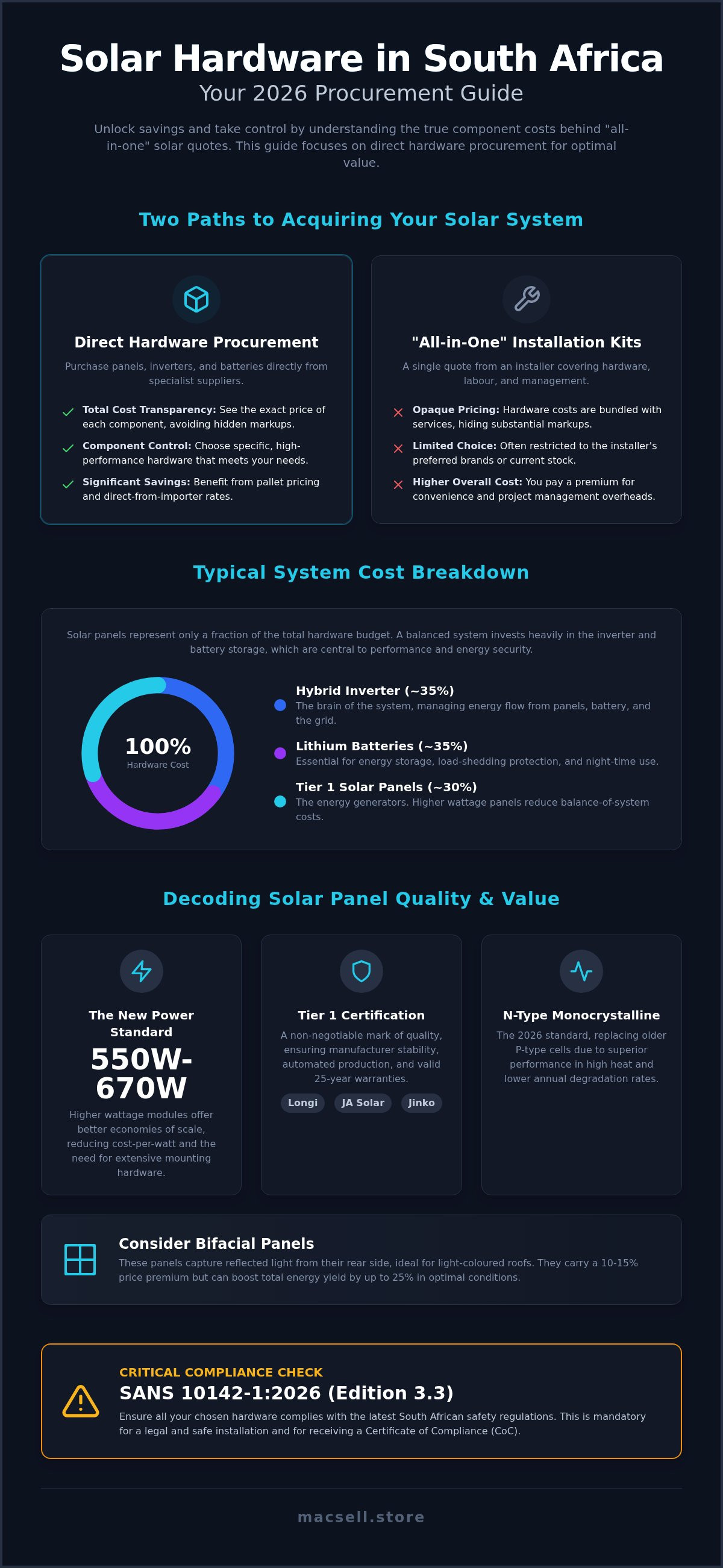
The primary metric for evaluating a solar panel for home price is the cost-per-watt. In the 2026 South African market, high-wattage modules ranging from 550W to 670W typically offer the best economies of scale. While the initial unit cost is higher for a 600W+ panel compared to a 450W module, the price-per-watt is often lower. This efficiency extends beyond the hardware itself; higher wattage reduces balance-of-system costs. You require fewer mounting rails, fewer mid-clamps, and less DC cabling to achieve the same total kilowatt peak (kWp) output.
Tier 1 certification is a non-negotiable requirement for residential procurement. This designation indicates that the manufacturer is vertically integrated, utilises automated production lines, and possesses the financial stability to honour 25-year linear power warranties. Brands such as Longi, JA Solar, and Jinko Solar dominate this space. Selecting the right module requires balancing roof space with budget. You can browse our current inventory of Tier 1 solar panels to compare technical specifications and current availability.
Bifacial monocrystalline panels now carry a 10 to 15 percent price premium over standard monofacial options. These modules feature a glass-on-glass design that captures reflected light from the rear side. In South African conditions, where high albedo surfaces like light-coloured metal roofs or concrete are common, bifacial panels can increase total energy yield by up to 25 percent. Real-world value is also dictated by the temperature coefficient. For every degree above 25°C, panel efficiency drops. High-end N-type cells maintain better performance in the South African heat, often featuring coefficients as low as -0.29%/°C.
The 450W Standard: Efficiency and Dimensions
The 450W module remains the preferred choice for complex residential roofs with limited contiguous space. These panels typically measure approximately 1.9 metres by 1.1 metres, making them easier to handle and position around chimneys or vents. They offer a practical compromise between power density and physical footprint. While 600W+ panels are more efficient for large, flat surfaces, the 450W standard provides the flexibility needed for intricate roof layouts without sacrificing Tier 1 reliability.
Monocrystalline vs. Polycrystalline: The 2026 Verdict
Polycrystalline technology has effectively vanished from the high-end residential market. The solar panel for home price for modern monocrystalline cells has dropped significantly, rendering the lower efficiency of polycrystalline obsolete. Monocrystalline panels offer superior low-light performance and a higher efficiency rating, typically exceeding 22 percent in 2026. This technical advantage ensures that your system generates power earlier in the morning and later into the evening, directly improving your daily self-consumption rates.
Component Cost Analysis: Balancing Panels with Inverters and Batteries
A common misconception in the procurement process is that the solar panel for home price represents the majority of the total system cost. In a modern 2026 residential setup, photovoltaic modules typically account for only 25 to 35 percent of the total hardware budget. The remaining expenditure is distributed across the hybrid inverter, lithium storage, and the balance of system components such as DC protection boxes and mounting structures. Understanding this ratio is essential for accurate budget allocation, especially when prioritising high-performance storage over peak generation capacity.
Technical synergy between components is the primary driver of system efficiency. For instance, the Sunsynk 8KVA hybrid inverter features dual MPPT trackers that require careful string sizing to maximise yield. You must ensure that the total open-circuit voltage (Voc) of your panel array remains within the inverter's operating window whilst providing enough current to trigger the trackers in low-light conditions. For those focused on mid-range performance, the LuxPower SNA5000 hybrid inverter provides a robust alternative for 5kW systems. You can find more detail on these specific hardware costs in our guide to hybrid inverter prices in South Africa.
The Sunsynk 8KVA and Hubble AM5+ Combo Advantage
The pairing of Sunsynk inverters with Hubble AM5+ 5.12kWh lithium batteries has become a residential standard in South Africa. This popularity stems from the seamless BMS-to-inverter communication, which allows for precise monitoring of State of Charge (SoC) and discharge parameters. Opting for a pre-configured hardware kit often results in better cost-efficiency than sourcing individual components from disparate suppliers. These kits ensure that the solar panel for home price is balanced against a storage solution that won't bottleneck your system's performance. For a full technical breakdown, view our Sunsynk Hubble combo kit review.
Sizing Your System: 5kW vs. 8kW Hardware Costs
A standard 5kW backup system, often built around LuxPower components, is designed to power essential circuits during load shedding. This configuration requires a smaller panel array and usually a single 5kWh lithium battery. Stepping up to an 8KVA system involves more than just a larger inverter; it necessitates a significant increase in panel wattage and battery capacity to handle heavier loads like geysers or air conditioning. Medium to large homes should anticipate a hardware list that includes at least 10 to 14 high-wattage panels to ensure the batteries reach full charge during winter months. This direct procurement approach ensures you pay for hardware capability rather than inflated service markups.
Factors Influencing the Total Procurement Price
Procurement costs extend beyond the base solar panel for home price. Total expenditure is influenced by logistical requirements and the necessary protective hardware required for a compliant installation. Solar panels are fragile, large-format glass modules that require specialist handling and reinforced packaging during transit. National shipping across South Africa involves specific courier surcharges to mitigate the risk of micro-cracks, which can occur if modules are transported incorrectly. These logistical costs are a critical variable in your total hardware budget.
Hardware compatibility also dictates the final price. Ensuring your lithium battery BMS communicates effectively with your hybrid inverter prevents operational failures and warranty disputes. Using high-end brands like Sunsynk, Deye, or Hubble ensures that communication protocols are standardised. Additionally, you must budget for DC protection. This includes DC combiner boxes, high-voltage fuses, and surge protection devices. These components are mandatory under South African safety regulations and add a necessary layer of cost to the initial procurement list.
Bulk Solar Panels: Procurement and Pallet Discounts
Buying in bulk is the most effective way to reduce the per-unit solar panel for home price. Most Tier 1 manufacturers package panels in pallets of 31 to 36 units. For large residential projects or multi-phase installations, purchasing a full pallet significantly reduces the cost-per-watt compared to individual retail units. This approach is common amongst property developers and homeowners with high energy demands. You can find detailed technical insights on this strategy in our guide to bulk solar panels South Africa. Proper storage is essential if you don't intend to install the entire pallet immediately; modules must be kept upright in a dry, secure environment to prevent structural damage.
Technical Standards and Warranty Impact on Price
The 2026 regulatory landscape in South Africa is defined by the SANS 10142-1:2026 (Edition 3.3) standards. Compliance is a legal requirement for your Certificate of Compliance (CoC) and is essential for insurance validity. Hardware that meets these stricter safety requirements often carries a higher price tag but offers superior reliability. Linear performance warranties are also a price driver. Tier 1 modules typically guarantee that power output won't drop below 80 percent over 25 years. Cheap, unbranded alternatives lack this long-term security and often fail within the first five years, leading to higher replacement costs. You can view our full hardware inventory to calculate your specific component requirements based on these technical standards.
Sourcing Your Hardware: The Specialist Outlet Advantage
Buying from a generalist retailer often results in a lack of technical support for complex electrical systems. A specialist outlet focuses on the technical parameters of the hardware, ensuring that the solar panel for home price you pay translates into a high-performance system. We prioritise stock availability for industry-leading brands like Deye, Sunsynk, and Hubble. This availability is crucial in the 2026 market, where specific component models are required to meet the latest SANS safety standards. Relying on a dedicated distributor ensures that you aren't forced to use mismatched components due to local stock shortages.
To finalise your procurement strategy, you should utilise a solar system hardware cost breakdown. This resource allows you to cross-reference component costs and ensure your budget is correctly weighted between generation and storage. It provides a clear view of the current market landscape, helping you avoid inflated retail prices and ensuring your ROI calculations are based on accurate hardware data.
The MacSell Approach: High-End Hardware Focus
Our model provides direct access to premium solar hardware without the "middleman" markups typically added by full-service installation companies. We act as a specialised warehouse manager, providing technically accurate product descriptions that respect the reader's need for precision. Whether you're looking for a LuxPower SNA5000 5kW Hybrid Inverter or a Sunsynk 8KVA & 2x Hubble AM5+ Combo Kit, our inventory is curated for compatibility and reliability. This variety ensures that you don't have to settle for sub-optimal components based on what a specific installer happens to stock.
Next Steps: Finalising Your Hardware List
Before making a purchase, organise your component list into a structured format for your chosen contractor. This list should include specific model numbers, wattage ratings, and battery capacities. Verify the compatibility between your chosen panels and your lithium storage BMS once more. A professional electrician will appreciate a detailed hardware manifest, as it simplifies the process of obtaining a Certificate of Compliance. Taking this initiative ensures that the solar panel for home price and the associated inverter costs are fully transparent from the start.
Final procurement checklist for 2026:
- Confirm Tier 1 status of all solar modules.
- Verify inverter MPPT voltage ranges against your panel string design.
- Ensure lithium batteries use compatible communication protocols with the inverter.
- Include mandatory DC protection hardware in your final budget.
Shop Solar Hardware at MacSell Solar Outlet
Tier 1 panels, inverters, and battery kits with national delivery across South Africa.
→ Browse Solar Panels & Accessories
→ Shop Sunsynk 8KVA & Hubble AM5+ Combo Kit
→ Shop LuxPower SNA5000 5kW Inverter
→ Browse All Inverter & Battery Combos
Optimising Your 2026 Solar Investment
Direct procurement of high-performance hardware remains the most effective strategy for managing the solar panel for home price in South Africa. By focusing on Tier 1 N-type monocrystalline modules and specialised combo kits, you eliminate unnecessary markups whilst ensuring technical compatibility. Reliability in 2026 is defined by the synergy between your hybrid inverter and lithium battery storage. Adhering to the latest SANS 10142-1:2026 standards ensures your system is both legal and efficient for the next two decades.
MacSell Solar Outlet serves as an authoritative distributor of Sunsynk, Deye, and Hubble lithium. We provide no-nonsense technical hardware specifications and offer national South African delivery on all premium components. Our inventory is curated for professionals and homeowners who prioritise variety and stock availability. Browse our 2026 Solar Hardware catalogue to secure your components today. Take control of your energy future with hardware designed for the South African climate.
Frequently Asked Questions
What is the average price of a 450W solar panel in South Africa for 2026?
Pricing for a 450W module varies based on manufacturer specifications and current import duties. Monocrystalline modules from Tier 1 brands typically represent the mid-range of the market. You should evaluate the price-per-watt rather than the unit cost to determine the best value. Factors like temperature coefficients and linear warranties influence the final retail price. It's advisable to check our live inventory for the most accurate daily rates for these specific components.
How many solar panels do I need to power a standard 3-bedroom home?
A standard 3-bedroom home usually requires between 8 and 14 panels depending on the daily kilowatt-hour consumption. For a medium hybrid system, 2.2kWp of generation is often the baseline, whilst larger households with geysers and air conditioning require closer to 4.4kWp or 8.8kWp. The total count depends on individual panel wattage. Higher wattage modules reduce the physical footprint on the roof whilst meeting the same energy production targets for the household. See our solar panel sizing guide for a full step-by-step calculation.
Is it cheaper to buy solar panels in bulk or individually?
Bulk procurement is significantly more cost-effective than individual retail purchases. Purchasing a full pallet, which typically contains 31 to 36 modules, reduces the per-unit shipping costs and allows for volume discounts. This approach is ideal for large residential projects or multi-phase installations. Individual panels often carry a retail markup and higher logistical fees due to the specialist packaging required for fragile, single-unit shipments across South Africa. Read our bulk solar panels guide for full procurement detail.
Does the price of a solar panel include the mounting hardware?
The base price of a solar panel does not include mounting hardware, cabling, or protection components. These items must be budgeted for separately to ensure a compliant installation. Mounting structures vary based on roof type, such as tiled, corrugated iron, or flat concrete. You require specific rails, mid-clamps, and end-clamps to secure the modules. Always verify the hardware manifest to ensure all balance-of-system components are accounted for before starting the procurement process.
What is the price difference between monocrystalline and bifacial panels?
Bifacial panels generally carry a 10% to 15% price premium over standard monofacial monocrystalline modules. This additional cost is justified by the glass-on-glass construction and the ability to capture reflected light from the rear surface. In South African residential applications with light-coloured roofs, the yield increase can range from 5% to 25%. This efficiency boost often results in a faster payback period despite the higher initial solar panel for home price investment required at the start.
Are there government rebates available for solar hardware in 2026?
No residential tax rebates are available for households in the 2026 tax year as the Section 6C incentive has expired. However, registered businesses can still claim a 100% upfront deduction on the cost of solar PV systems under Section 12B. This applies to hardware like hybrid inverters and lithium batteries used for income generation. Homeowners should focus on the 2 to 5 year payback period driven by rising municipal electricity tariffs instead of relying on direct government incentives.
How do I know if a solar panel is Tier 1 certified?
Tier 1 status is verified through quarterly reports from reputable financial analysts. This designation confirms that a manufacturer is bankable, vertically integrated, and uses automated production processes. You can identify these brands by checking the manufacturer's financial history and the length of their linear power warranties. Most premium hardware outlets only stock Tier 1 modules to ensure long-term reliability and support for residential customers. This certification is a non-negotiable standard for high-performance solar procurement in South Africa.
Can I mix different brands of solar panels in one system?
Mixing different brands of solar panels in a single string is not recommended due to differences in electrical characteristics. Varying voltage and current ratings can cause mismatch losses, reducing the efficiency of the entire array. If you must expand a system, it is better to use a separate MPPT tracker on the inverter for the new panels. This ensures that your hardware investment is protected by maintaining optimal performance across the total system without bottlenecking the output of individual modules.