

Off-Grid Solar Kit South Africa: The 2026 Hardware Reference Guide
Why do most residential solar installations fail when the grid stays down for more than 48 hours? It is rarely a lack of sun; it is almost always a hardware mismatch. Selecting a high-performance off-grid solar kit South Africa requires for genuine energy independence involves more than just buying a battery. You probably know the frustration of distinguishing between a simple backup solution and a robust, standalone power plant. This guide eliminates that confusion by providing the technical hardware reference for 2026.
You will master the specific configurations needed to achieve total autonomy. We provide a clear breakdown of essential hardware, including high-discharge Hubble lithium batteries and the technical synergy between Sunsynk, Deye, and LuxPower inverters. We also cover 2026 regulatory shifts, such as the simplified Department of Employment and Labour sign-off requirements. This ensures you can choose between a 5kW or 8kW system with total technical confidence. The following sections detail the exact components and brand compatibility standards for a reliable, high-performance installation.
Key Takeaways
- Define the technical boundary between basic backup power and total energy independence to ensure your system meets true off-grid requirements.
- Identify the core components of a professional off-grid solar kit South Africa households need, specifically the integration of hybrid inverters and lithium iron phosphate batteries.
- Evaluate the technical specifications and brand compatibility of top-tier hardware including Sunsynk, Deye, and LuxPower.
- Calculate your specific system requirements by analysing daily kWh usage and peak KVA demand to select the correct inverter capacity.
- Streamline procurement with pre-configured hardware kits, such as the Sunsynk 8KVA and Hubble AM2 combo, to guarantee component synergy and stability.
Off-Grid vs. Grid-Tied: Defining Energy Independence in South Africa
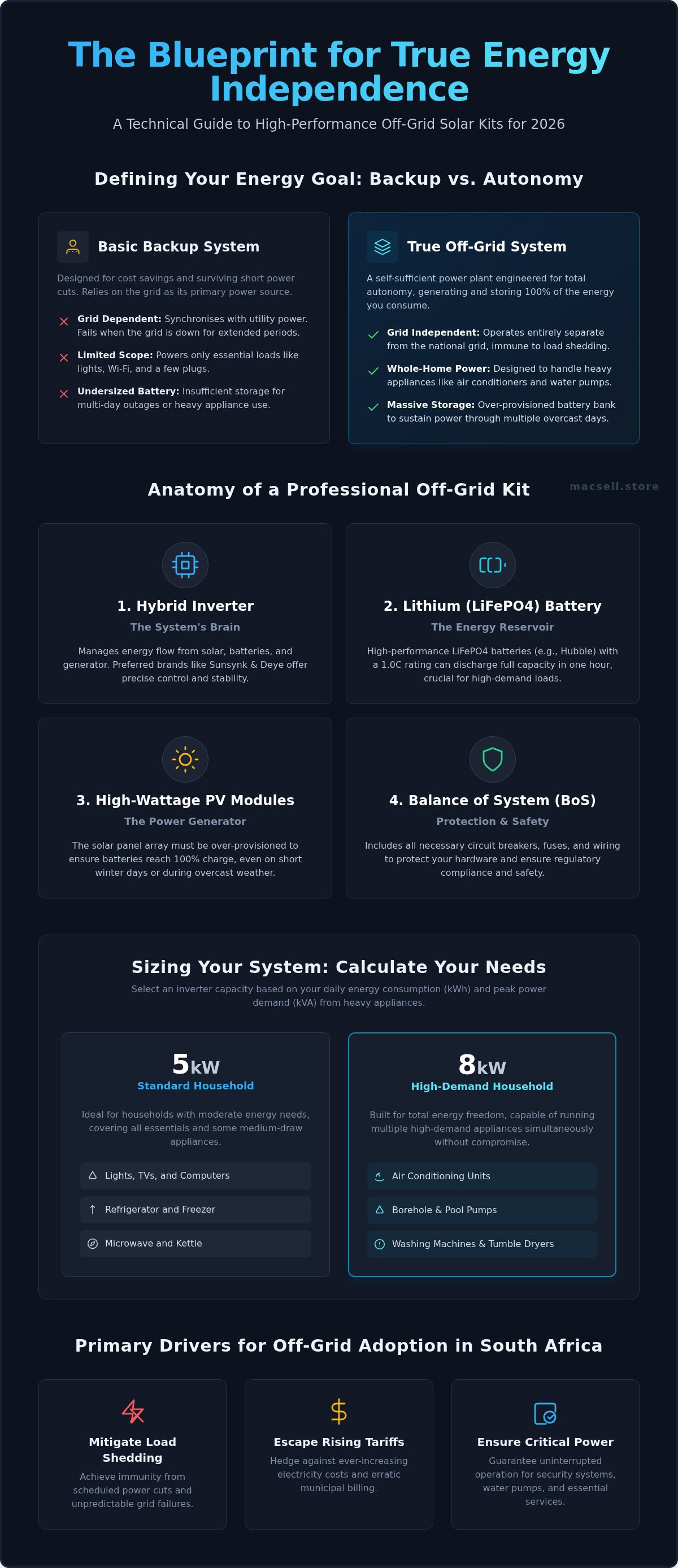
An off-grid solar system is a stand-alone power system that operates entirely independently of the national electricity grid. Unlike grid-tied systems, which synchronise with utility power and draw from it when solar production ceases, a true off-grid solar kit South Africa residents rely on must generate and store every kilowatt-hour consumed. This distinction is critical. Grid-tied setups are often designed for cost savings or basic backup during outages. Off-grid systems are engineered for total self-sufficiency.
True energy independence requires a massive hardware shift. Whilst a grid-tied system might use the utility as a virtual battery at night, an off-grid configuration necessitates a significantly larger battery bank. You cannot rely on the grid to bridge the gap during three days of rain. Hybrid inverters, such as those from Sunsynk or Deye, act as the central processor for these systems. They manage complex energy flows between the photovoltaic (PV) array, the lithium battery storage, and the household load with technical precision.
Why South Africans are Choosing Off-Grid Kits
The primary driver is the mitigation of persistent load shedding and systemic infrastructure failure. Relying on a grid that can disappear for hours daily is no longer viable for high-demand households. Beyond reliability, escaping rising electricity tariffs and erratic municipal billing provides a long-term financial hedge. For properties requiring constant power for security systems or water pumps, an off-grid solar kit South Africa provides a level of autonomy that grid-dependent systems cannot match. It ensures that essential services remain operational regardless of utility status.
The Hardware Gap: Backup vs. Full Independence
A standard backup kit is often undersized for a true off-grid scenario. Most backup systems focus on essential loads like lights and routers. A full off-grid system must handle heavy appliances and motor starts consistently.
- Over-provisioning: You must over-size your solar panel array to ensure batteries reach 100% charge even during short winter days.
- Surge Capacity: Starting heavy motors for air conditioning or borehole pumps requires high peak demand (KVA) capacity from the inverter.
- Battery Depth: Professional kits use high-capacity lithium iron phosphate (LiFePO4) batteries to sustain multiple cycles without voltage drop or damage.
Failing to account for these technical requirements leads to system shutdowns when the grid is unavailable. Genuine independence demands hardware that exceeds your average daily consumption to account for environmental variables. This level of over-engineering is what separates a professional installation from a basic backup solution.
Core Components of a Professional Off-Grid Solar Kit
Building a reliable off-grid solar kit South Africa requires a modular approach to hardware selection. Each component must be chosen based on technical synergy rather than just individual specifications. A professional system comprises four main categories: the hybrid inverter, lithium storage, high-wattage PV modules, and the Balance of System (BoS) protection hardware. This equipment must operate within the strategic framework of the South African Renewable Energy Masterplan, which prioritises local energy security through decentralised generation.
The Role of the Hybrid Inverter
The hybrid inverter is the central processing unit of your energy system. It manages the Maximum Power Point Tracking (MPPT) to ensure the solar array operates at peak efficiency regardless of environmental variables. Sunsynk and Deye inverters are the preferred choice for South African off-grid applications. Their firmware allows for complex parallel configurations and precise battery communication. These units ensure a seamless transition between solar, battery, and generator inputs, preventing equipment resets during high-demand periods. They effectively act as the "brain" that balances generation against consumption.
Lithium Battery Storage and Discharge Rates
Energy storage has shifted entirely toward Lithium Iron Phosphate (LiFePO4) chemistry. Unlike legacy lead-acid batteries, LiFePO4 supports deep discharge cycles and maintains a stable voltage curve throughout the discharge cycle. The C-rating of a battery is a critical technical metric for off-grid stability. A 1.0C rated battery, like many Hubble lithium units, can discharge its full capacity in one hour. This is essential for handling peak loads such as borehole pumps or heavy kitchen appliances. In contrast, 0.5C batteries may trigger inverter shutdowns if the load exceeds half the battery's rated capacity during a surge. Hubble batteries are specifically engineered to handle these high-demand South African environments.
Efficiency also depends on the PV array and protection hardware. Modern installations utilise 450W+ solar panels to maximise the energy harvested per square metre. High-wattage modules reduce the number of mounting rails and DC connectors required. The BoS hardware, including DC circuit breakers, fuses, and surge protection devices, safeguards the inverter from atmospheric surges and short circuits. For those seeking pre-configured reliability, you can browse professional solar hardware kits that include matched inverters and batteries for guaranteed brand compatibility.
Comparing Top Hybrid Inverter Brands: Sunsynk, Deye, and LuxPower
Selecting the correct inverter brand is the most critical decision when assembling an off-grid solar kit South Africa. Sunsynk, Deye, and LuxPower dominate the current hardware landscape. These brands provide the necessary intelligence to manage complex energy flows between PV arrays and lithium storage. While they share some technical similarities; their firmware, monitoring capabilities, and expansion options cater to different system requirements.
Sunsynk and Deye: The High-End Choice
Sunsynk and Deye are often considered the industry standard for high-performance off-grid projects. Deye manufactures the hardware for both brands, resulting in shared technical architecture and robust cooling systems. However, Sunsynk utilises a distinct firmware set that is highly regarded for its intuitive user interface and precise battery management. Both brands offer exceptional paralleling capabilities. This allows you to expand your system by adding multiple inverters in the future as your energy demand grows.
These inverters support customisable discharge profiles. You can set specific parameters for battery usage based on the time of day or the state of charge. For a pre-configured high-performance solution, the Sunsynk Hubble combo kit remains the gold standard for South African households. It pairs the 8KVA hybrid inverter with high-discharge Hubble AM2 units to ensure maximum stability under heavy loads.
LuxPower SNA5000: Practical Performance
The LuxPower SNA5000 is a favourite for residential off-grid setups that require reliable performance without the premium cost of high-end industrial units. It is specifically engineered for off-grid applications. A standout feature is its dual MPPT (Maximum Power Point Tracking) inputs. These inputs allow you to manage two different roof orientations, such as an east-west split, without sacrificing total solar harvest. This flexibility is vital for properties with complex roof structures.
The SNA5000 is known for its wide-ranging compatibility with various lithium battery brands. It provides a stable platform for modular hardware procurement. While it lacks some of the industrial-scale paralleling features of Sunsynk, it delivers consistent power for standard household requirements. It is a robust entry point for those building an off-grid solar kit South Africa for the first time.
Monitoring is handled via proprietary apps like Sunsynk Connect or Solarman for Deye users. These platforms provide real-time data on PV production and battery health. Remote management features allow for firmware updates and technical adjustments without physical access to the hardware. This digital oversight is essential for maintaining system longevity in an off-grid environment.
Sizing Your Off-Grid Kit: 5kW vs. 8kW vs. 12kW
Determining the correct scale for an off-grid solar kit South Africa requires a precise audit of energy consumption. Your monthly utility bill provides the starting point. Divide the total monthly kilowatt-hours (kWh) by 30 to find your average daily consumption. However, off-grid sizing must account for peak demand (KVA) rather than just averages. This is the maximum power required when several high-draw appliances run simultaneously. If your peak load exceeds the inverter's rating, the system will trip regardless of the energy stored in your batteries.
Battery sizing introduces the concept of "autonomy days". This refers to the number of days your system can power the home without any solar input. In South Africa, a minimum of 1.5 to 2 days of autonomy is recommended to bridge cloudy periods. It's often more cost-effective to over-specify your solar panel array than to add additional lithium batteries later. Extra panels ensure batteries reach full charge even during low-light winter days, reducing the depth of discharge and extending hardware lifespan.
The 5kW Entry-Level Off-Grid Solution
A 5kW system is ideal for small households, apartments, or cottages that utilise gas for cooking and water heating. This configuration typically requires one 5kW inverter and a minimum of 5.5kWh lithium battery storage. It provides enough capacity for lighting, refrigeration, and entertainment systems. You can find detailed specifications in our guide for an inverter and battery combo for home use. This tier serves as an efficient entry point for those with modest energy requirements.
The 8KVA Standard for Family Homes
The 8KVA tier is the standard for most South African family homes. It supports multiple high-draw appliances, home offices, and security systems. The Sunsynk 8KVA hybrid inverter is the most popular choice in this category due to its high surge capacity and robust management of parallel battery banks. For this tier, we recommend a minimum of 10kWh to 15kWh of storage. This ensures sufficient capacity for overnight use and provides the necessary discharge current for heavy loads.
If you're ready to secure your energy independence, you can purchase pre-configured off-grid kits designed for national delivery.
Procuring Professional Solar Hardware from MacSell
Procuring a reliable off-grid solar kit South Africa requires a supplier that understands hardware synergy. MacSell Solar Outlet operates as a specialised retail-focused distributor, providing high-end components to both individual consumers and industry professionals. We focus on the technical accuracy of every order. Whilst individual components like hybrid inverters, lithium batteries, and high-wattage panels are available, the primary advantage lies in our pre-configured hardware kits. These bundles are engineered to ensure that all communication protocols between the inverter and the battery management system (BMS) are fully compatible before delivery.
National delivery is available for all hardware, ensuring that professional-grade equipment is accessible regardless of your location. By sourcing pre-configured kits, you eliminate the risk of purchasing mismatched components that fail to communicate via CAN-bus or RS485 ports. This transactional efficiency allows you to move from procurement to installation with total technical certainty.
The Sunsynk and Hubble Advantage
The technical synergy between Sunsynk inverters and Hubble lithium batteries is widely regarded as the gold standard for high-demand environments. The Sunsynk 8KVA & 2X Hubble AM2 5.5 KWh Combo Kit is specifically designed to handle the rigorous discharge requirements of South African households. Hubble AM2 batteries support high discharge rates, allowing the system to sustain heavy loads without triggering safety shutdowns. This combination ensures that the inverter receives accurate real-time data from the battery cells, optimising charging cycles and extending the lifespan of the hardware. If your requirements are focused more on resiliency during outages, you can review our backup power kit South Africa procurement guide for alternative configurations.
Final Hardware Procurement Checklist
Before completing your hardware order, you must verify the physical and electrical constraints of your site. Confirm that your roof space can accommodate the total dimensions of the required 450W+ solar panels. You also need to ensure that the Balance of System hardware is included to meet safety standards. A professional order should include:
- DC protection boxes with appropriate fuses and surge arrestors.
- AC changeover switches and circuit breakers.
- Correct gauge battery cables to handle peak current flow.
- Mounting structures compatible with your specific roof type.
Ensuring these items are present in your initial order prevents delays. For a comprehensive breakdown of every necessary component, refer to our solar equipment checklist South Africa. This ensures your off-grid project is supported by the correct protective switchgear and mounting hardware from day one.
Securing Your Energy Independence with Professional Hardware
Achieving total autonomy from the national grid requires more than just high-capacity panels. It demands a technically sound integration of hybrid inverters and high-discharge lithium storage. By prioritising hardware synergy and over-specifying your PV array for winter months, you can maintain essential services regardless of utility infrastructure failures. Selecting a professional off-grid solar kit South Africa depends on matching your peak KVA demand with robust brands like Sunsynk, Deye, or LuxPower. This technical precision ensures your system remains stable during extended outages and high-demand periods.
MacSell Solar Outlet is an official retailer of Sunsynk and Hubble Lithium. We specialise in pre-configured hardware combos that guarantee component compatibility and operational performance. With national shipping available across South Africa, you can procure the exact tools needed for a standalone power system without the risk of brand mismatch. Browse the full range of off-grid solar kits at MacSell Solar Outlet to secure your energy future with reliable, high-end hardware. Building a resilient power system is a vital investment in long-term technical stability and personal energy security.
Frequently Asked Questions
What is the difference between an off-grid and a hybrid solar kit?
An off-grid solar kit South Africa residents use is entirely independent of the national utility, whereas a hybrid system remains grid-connected to supplement solar power at night. Off-grid systems require significantly larger battery banks and PV arrays to ensure energy security during consecutive cloudy days. Hybrid systems often prioritise backup during load shedding, whilst true off-grid setups must manage 100% of the household load 24 hours a day without grid assistance.
Can I start with a small off-grid kit and expand it later?
Expansion is possible if you select an inverter with paralleling capabilities, such as the Sunsynk 8KVA or Deye hybrid models. You can add more lithium batteries or solar panels to your off-grid solar kit South Africa project as your energy demand increases. It is critical to ensure that additional batteries match the existing units' voltage and chemistry. Most professional systems allow for up to 16 inverters to be connected in parallel for industrial-scale growth.
How many solar panels do I need for a full off-grid system in South Africa?
The number of panels depends on your average daily kWh consumption and the peak solar hours available in your specific region. For a standard South African family home consuming 25kWh per day, you typically require between 14 and 18 high-wattage panels (450W+). This over-provisioning ensures that your battery bank reaches a full state of charge even during winter months when daylight hours are shorter and solar intensity is lower.
Which lithium battery brand is best for a Sunsynk inverter?
Hubble lithium batteries are considered the most compatible and high-performance option for Sunsynk inverters. The Hubble AM2 and AM5 series utilise advanced BMS communication protocols that integrate seamlessly with Sunsynk firmware. This synergy allows the inverter to receive precise cell-level data, ensuring optimal charging cycles and high discharge performance during peak loads. Using matched hardware components prevents communication errors and maximises the functional lifespan of the entire storage system.
Does an off-grid solar kit require a backup generator?
A backup generator is not strictly required but is highly recommended for long-term off-grid reliability. During extended periods of poor weather, solar generation may fall below your daily consumption. A generator connected to the inverter's "Gen" port acts as a secondary power source to charge the batteries and support the household load. This prevents deep battery discharge and ensures that essential services remain operational regardless of environmental variables.
How long do lithium solar batteries last in an off-grid environment?
Modern lithium iron phosphate (LiFePO4) batteries typically last between 10 and 15 years in a correctly managed off-grid environment. Most professional brands, such as Hubble, are rated for 6,000 cycles at an 80% depth of discharge. To maximise this lifespan, you should avoid exposing the batteries to extreme temperatures and ensure the inverter's charge settings match the manufacturer's technical specifications. Regular firmware updates also help maintain battery efficiency over time.
Is it legal to go completely off-grid in South Africa?
It is legal to go completely off-grid, but you must still comply with NERSA regulations regarding the registration of embedded generation facilities. As of February 2026, registration requirements depend on the connection point and installed capacity. Eskom has extended the waiver of registration fees for systems up to 50 kVA until September 30, 2026. You should always ensure a Department of Employment and Labour registered person performs the final technical sign-off.
What maintenance does an off-grid solar kit require?
Off-grid solar kits require minimal but essential maintenance to maintain peak performance. You must clean the solar panels at least twice a year to remove dust and debris that can reduce efficiency by up to 25%. Technical maintenance involves checking DC and AC connections for tightness and inspecting protection boxes for signs of wear. You should also monitor the inverter's digital interface via apps like Sunsynk Connect to ensure firmware is current.