
Solar Power for Loadshedding South Africa: The 2026 Hardware Procurement Checklist
Most homeowners believe solar panels are the most important part of an installation, but the real power lies in the synchronisation of high-discharge lithium storage and intelligent hybrid inversion. When sourcing solar power for loadshedding South Africa, the hardware you choose determines whether you achieve true independence or remain tethered to an unreliable grid. You've likely experienced the disruption of a work-from-home setup failing during an outage or felt the fear of buying a battery that isn't compatible with your inverter. It's a technical landscape that requires a precise, no-nonsense approach to procurement.
You need a system that works without constant troubleshooting or manual intervention. This article provides the technical requirements for a loadshedding-proof home through our comprehensive 2026 hardware checklist. We'll examine the gold standard components, including Sunsynk 8KVA hybrid inverters and Hubble AM2 lithium batteries, to give you a clear list of what to purchase. You'll gain the confidence to build a future-proof setup that prioritises performance, compatibility, and maximum energy autonomy from the national grid.
Key Takeaways
- Understand the critical hardware specifications for solar power for loadshedding South Africa to ensure your system provides true energy independence.
- Discover why LiFePO4 battery technology and intelligent hybrid inverters form the necessary foundation for a high-performance residential power supply.
- Evaluate the technical advantages of premium brands like Sunsynk and LuxPower to ensure component compatibility and future-proof scalability.
- Master the load auditing process to correctly size your inverter's peak surge capacity for essential household appliances and security systems.
- Learn how to configure precise charge and discharge parameters to maximise hardware longevity and maintain battery efficiency.
Understanding the Loadshedding Landscape in 2026
The South African energy crisis has shifted the residential power market from a hobbyist niche to a technical necessity. Whilst grid performance varies, the persistence of rotational cuts means that solar power for loadshedding South Africa must be built on robust, industrial-grade hardware. Energy independence is no longer about just surviving a two-hour blackout; it's the ability to sustain a high-demand household indefinitely without grid intervention. By 2026, the technology has matured significantly, making lithium storage the standard for any reliable installation.
Modern systems have moved beyond simple emergency backup. We're seeing a total shift toward full hybrid integration where the hardware manages multiple power sources simultaneously. This transition is driven by the declining cost-to-performance ratio of LiFePO4 batteries and the increased intelligence of hybrid inverters. These units don't just switch on when the power fails; they actively optimise energy flow to reduce grid reliance and protect your hardware investment from the instability of the national infrastructure.
Stages of Loadshedding and Hardware Demands
Higher stages of loadshedding, specifically Stage 4 and above, place immense strain on battery storage. When power cuts occur multiple times a day, the time available for recharging becomes critically short. You need hardware with high-current charging capabilities to ensure batteries reach full capacity between outages. A standard 0.5C discharge rate might suffice for lower stages, but Stage 6 requires batteries like the Hubble AM2 that can handle rapid cycling without degrading.
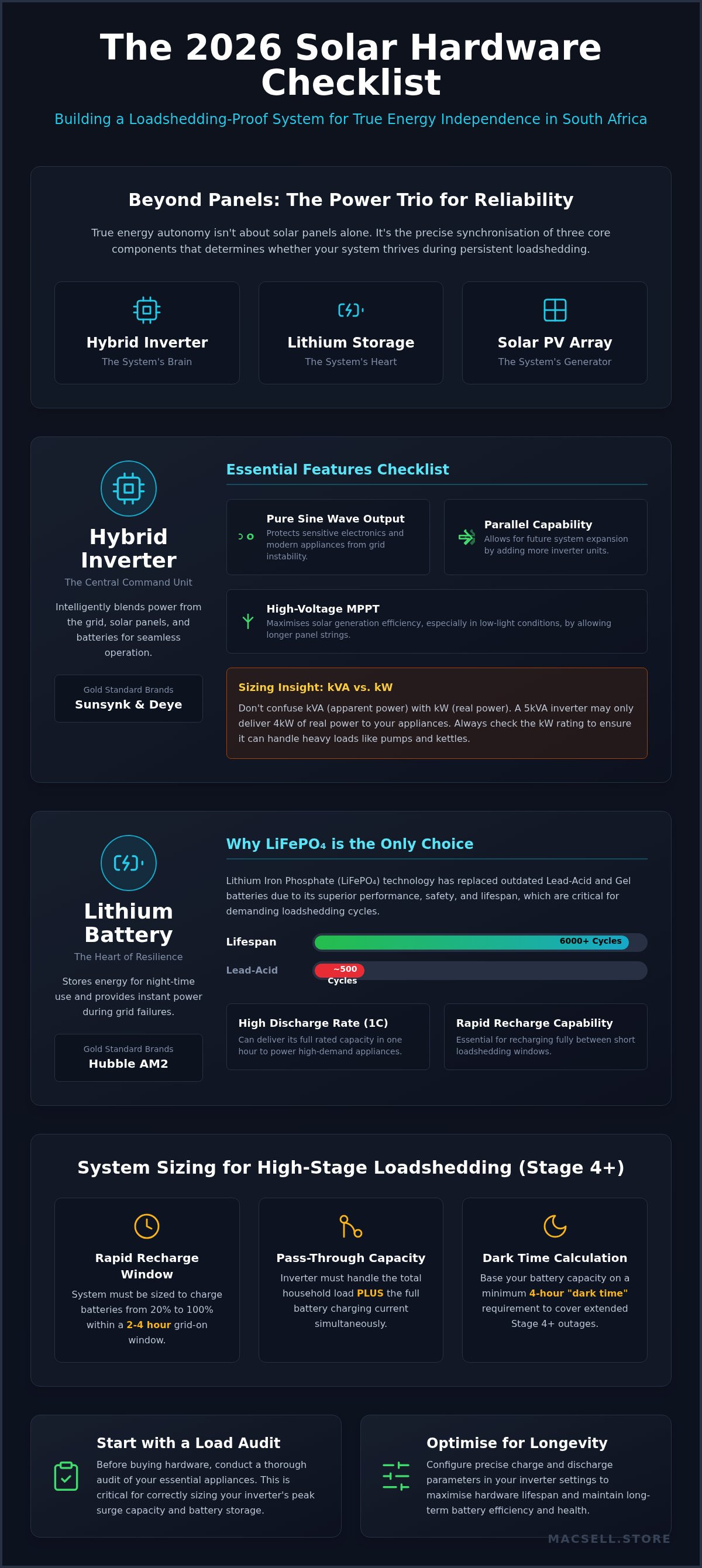
- Recharge Windows: Systems must be sized to charge from 20% to 100% within a 2-to-4-hour window.
- Pass-Through Capacity: Your inverter must manage the total household load plus the battery charging current when the grid returns.
- Dark Time Calculation: Base your procurement on a minimum 4-hour "dark time" requirement to cover extended Stage 4 slots.
Grid Stability vs. Hardware Sensitivity
Grid instability often leads to damaging voltage surges when power is restored. Protecting sensitive electronics requires a pure sine wave inverter to provide clean, stable electricity. Modified sine wave units are unsuitable for modern appliances like inverter-based fridges or high-end workstations. Additionally, hardware featuring high-voltage MPPTs (Maximum Power Point Trackers) is essential. These components allow for longer panel strings and better efficiency during low-light conditions, ensuring your system generates maximum solar power for loadshedding South Africa even during overcast periods.
The Hardware Trifecta: Inverters, Batteries, and Panels
A successful installation of solar power for loadshedding South Africa relies on three core components: the inverter, the battery, and the PV array. These must be technically matched to ensure system stability. South Africa's solar boom has led to a flood of hardware options, making specific procurement critical for long-term reliability. While panels generate the energy, the inverter manages the flow, and the battery stores it for the dark hours. Overlooking secondary components like DC breakers, surge protection devices, and correctly rated cabling compromises the entire hardware investment. High-quality switchgear is essential for system safety and compliance with NERSA regulations.
Hybrid Inverters: The Central Command
Hybrid inverters are the intelligent brain of a modern system. Unlike standard off-grid units, a hybrid inverter can blend power from the grid, panels, and batteries simultaneously. This is essential for urban environments where grid-tie functionality allows for seamless transitions during outages. The Deye inverter range is a primary choice due to its robust load management and parallel capabilities. When sizing, distinguish between KVA and Kilowatts (kW). KVA is the apparent power, while kW is the actual real power the unit can deliver. A 5kVA inverter might only deliver 4kW if the power factor is 0.8; always check the specific kW rating for heavy loads like pumps or kettles.
Lithium Storage: Beyond the Amp-Hour
The lithium ion solar battery is the heart of loadshedding resilience. Older lead-acid and gel technologies are obsolete for high-frequency cycling. Lithium Iron Phosphate (LiFePO4) chemistry offers superior thermal stability and a higher cycle life. For Stage 6 loadshedding, Depth of Discharge (DoD) is the most critical metric. High-quality lithium units allow for 80% to 100% DoD without immediate damage, whereas lead-acid batteries fail if discharged past 50%. Hubble hardware incorporates an advanced Battery Management System (BMS) that communicates directly with the inverter. This ensures voltage balancing and temperature monitoring, preventing cells from overheating during rapid 2026 recharge cycles.
To ensure your system recovers fully between shedding slots, size your panel array to provide at least 1.5 times your daily consumption. This headroom accounts for low-light days and ensures batteries are topped up before the next outage. You can browse our specialised inventory to find pre-configured hardware kits that simplify this procurement process.
Comparing Top Hardware Brands for the South African Market
Selecting the correct manufacturer is a critical step in securing solar power for loadshedding South Africa. The market is currently led by Sunsynk and Deye; these brands offer robust parallel capabilities for expanding systems. Sunsynk is particularly favoured for its intuitive colour touch-screen interface and extensive local technical support. Deye provides similar internal architecture but often appeals to those running complex solar arrays with high-voltage strings. For mid-range residential applications, LuxPower has established itself as a high-value alternative that balances cost with performance.
Sunsynk vs. LuxPower: A Functional Analysis
The LuxPower SNA5000 is a frequent choice for entry-level hybrid systems. Whilst it lacks the advanced touch interface of a Sunsynk 5kW model, its off-grid and hybrid blending capabilities are reliable. Sunsynk’s monitoring app remains the industry benchmark for data granularity. It allows users to track individual string performance and battery health in real-time. Reliability across both brands is high, provided they are operated within their rated thermal limits and not overloaded during peak shedding slots.
The Hubble Advantage in Loadshedding
The Hubble AM2 5.5 KWh lithium battery is engineered specifically for the high-frequency cycling required by the local grid. Unlike generic lithium imports, the AM2 features a high-discharge rate that supports heavy start-up loads. This makes it the preferred partner for Sunsynk and Deye inverters. Compatibility is managed via a dedicated CAN-bus port; this allows the inverter to receive precise data from the battery's internal management system. With an expected cycle life exceeding 6,000 cycles at 80% Depth of Discharge, these units provide a decade of service even when facing daily loadshedding. Integrating a Sunsynk 8KVA with two Hubble AM2 units creates a balanced system capable of running essential circuits and high-draw appliances simultaneously. Sourcing these components through a specialised retail outlet ensures you receive authorised hardware with valid local warranties.
The Ultimate Solar Hardware Procurement Checklist
Procuring solar power for loadshedding South Africa requires a methodical approach to hardware selection. Failure to match component specifications leads to system inefficiency or hardware failure. Use this technical checklist to ensure every part of your installation is compatible and correctly rated for the local grid environment. Focus on high-performance standards rather than entry-level specifications that cannot handle Stage 6 cycling.
- Step 1: Audit essential loads. Calculate the total wattage of critical appliances. Include fridges, lights, Wi-Fi routers, and security systems. Distinguish between continuous draw and peak start-up current.
- Step 2: Select an inverter with sufficient peak surge capacity. Modern hybrid units must handle the inductive loads of pumps or compressors without tripping.
- Step 3: Match battery capacity to discharge requirements. Use LiFePO4 batteries like the Hubble AM2 to ensure the system survives daily discharge cycles.
- Step 4: Source compatible solar panels and mounting hardware. Verify that the PV array voltage fits within the inverter's MPPT operating window. Purchase aluminium mounting rails and stainless steel fasteners to prevent corrosion.
- Step 5: Verify switchgear and protection components. DC circuit breakers, fuses, and surge protection devices are mandatory for safety and insurance compliance.
Sizing Your System Correctly
Determining if an 8KVA system is necessary depends on your peak load. If you intend to run geysers, kettles, or air conditioning during an outage, the 8KVA Sunsynk is the industrial standard. For basic backup, a 5kW unit suffices. Calculate your battery runtime using this formula: (Total kWh x Depth of Discharge) / Average Load in kW. For example, a 5.5kWh Hubble AM2 at 80% DoD providing a 0.5kW load will last approximately 8.8 hours. Plan for expansion by selecting an inverter that supports parallel battery stacking; this allows you to add storage capacity as your budget permits.
Compatibility and Integration
Hardware synergy is non-negotiable. Ensure your backup power kit components communicate via CAN bus or RS485 protocols. This allows the Battery Management System (BMS) to dictate charging parameters to the inverter, preventing overcharging. Buying a pre-configured combo kit reduces technical friction and ensures that firmware versions for Sunsynk and Hubble hardware are already synchronised. Always verify that your chosen components carry local warranties and technical support. You can source our authorised solar hardware inventory directly to ensure you receive genuine, high-performance components for your installation.
Optimising Your System for Maximum Lifespan
Hardware longevity isn't just a result of brand choice; it's a product of precise operational parameters. When managing solar power for loadshedding South Africa, thermal management is non-negotiable. Heat is the primary cause of premature capacity loss in lithium cells and component failure in inverters. Organise your hardware room with adequate ventilation and keep equipment away from direct sunlight. Inverters should be mounted at eye level with at least 200mm of clearance on all sides to allow for natural convection and fan-assisted cooling. High-ambient temperatures during summer months can force inverters to derate their output, reducing the power available to your home.
Firmware updates are another critical maintenance requirement. Manufacturers like Sunsynk and Deye frequently release software patches that improve MPPT efficiency, battery communication protocols, and safety features. Keeping your inverter intelligent ensures it can handle the evolving requirements of the South African grid. Remote monitoring through Wi-Fi dongles allows you to track real-time performance and catch hardware faults, such as high-voltage surges or battery imbalances, before they lead to system downtime.
Battery Health Management
Back-to-back loadshedding slots, common during Stage 4 and Stage 6, create "Battery Stress." This happens when lithium cells don't have sufficient time to reach thermal equilibrium between rapid discharge and high-current recharge cycles. The Hubble Cloudlink is a vital tool for managing this. It provides granular data to the Hubble portal, enabling remote diagnostics and ensuring the Battery Management System (BMS) is operating within safe limits. Whilst high-quality LiFePO4 chemistry is robust, you should avoid 100% Depth of Discharge (DoD) on a daily basis. Setting a 15% to 20% reserve capacity significantly extends the total cycle life of your Hubble AM2 units compared to running them to empty.
Procuring Quality Hardware from MacSell
MacSell Solar Outlet operates as a specialised retail warehouse rather than a service provider. This hardware-only approach allows for better component selection without the pressure of proprietary service bundles. You source the exact technical specifications you need, such as the Sunsynk 8KVA and Hubble AM2 combo kit, and provide them to your preferred technical team. This combination remains the gold standard for solar power for loadshedding South Africa because it balances high peak surge capacity with industrial-grade storage. We provide national delivery across the country for all stocked items, including Deye and LuxPower hardware. Ordering directly from a specialised outlet ensures you receive authorised hardware with full local warranties, giving you total control over your energy independence strategy.
Secure Your Energy Independence for 2026
Achieving true energy independence requires moving beyond basic backup and investing in a technically integrated hardware ecosystem. Success depends on matching the high peak surge capacity of hybrid inverters with the rapid-cycling durability of LiFePO4 storage. By following a structured procurement checklist, you eliminate compatibility risks and ensure your system survives the specific demands of the local grid. Correct parameter configuration and thermal management further protect your hardware investment for the decade ahead. It's about building a system that functions autonomously whilst maintaining peak efficiency.
Selecting high-performance solar power for loadshedding South Africa is a long-term investment in household stability. As an authorised Sunsynk and Deye distributor and specialist in Hubble lithium technology, MacSell Solar Outlet provides the industrial-grade components necessary for residential resilience. We offer national hardware delivery to ensure you have access to premium stock regardless of your location. Our pre-configured combo kits are designed to remove the technical friction of hardware matching, providing a streamlined path to grid independence.
View our Sunsynk and Hubble Combo Kits for 2026 Loadshedding Relief to start building your system today. You now have the technical foundation required to secure your home against power interruptions with absolute confidence.
Frequently Asked Questions
Is solar power enough to run a house during Stage 6 loadshedding?
Yes, provided the hardware is sized correctly for your peak load and storage requirements. Stage 6 involve frequent 4-hour slots; a system with high-discharge lithium batteries and sufficient solar panels can sustain essential circuits indefinitely. You must ensure the battery capacity in kWh exceeds your consumption for the dark time and the PV array is large enough to recharge the units fully during the short grid-on windows.
Can I start with just an inverter and battery and add solar panels later?
You can install an inverter and battery as a standalone backup system and add panels as your budget allows. This configuration functions like a large UPS, charging from the grid when power is available. It is a common entry point for solar power for loadshedding South Africa. However, remember that without panels, you remain dependent on grid availability for recharging, which becomes difficult during higher stages with limited uptime.
What is the difference between a 5kW and an 8KVA hybrid inverter?
The primary difference lies in the real power output and surge capacity. A 5kW inverter provides 5,000 watts of continuous power, whereas an 8KVA unit typically provides around 8,000 watts, depending on the specific power factor. The 8KVA model is better suited for households running heavy inductive loads such as air conditioners, geysers, or borehole pumps. Choosing the larger unit provides more headroom for future expansion and higher peak demand.
How long does a lithium solar battery like the Hubble AM2 last?
A high-quality LiFePO4 battery like the Hubble AM2 is rated for approximately 6,000 cycles at an 80% Depth of Discharge. In a typical residential setup with daily cycling, this equates to a lifespan of 10 to 15 years. Longevity depends heavily on maintaining correct charge and discharge parameters. Using a compatible Battery Management System (BMS) ensures the cells stay balanced and protected from thermal stress, preserving their capacity over time.
Do I need a special permit to install solar hardware in South Africa?
Grid-tied and hybrid systems must be registered with your local municipality or Eskom as part of Small-Scale Embedded Generation (SSEG) regulations. As of 2026, NERSA requires all grid-connected facilities under 100kW to be registered on a national database. Off-grid systems are generally exempt, but any system that can feed power back into the grid or uses a grid-tied inverter requires a formal application and a Certificate of Compliance from a qualified electrician.
Why should I choose a hybrid inverter over an off-grid inverter for loadshedding?
Hybrid inverters offer superior versatility by blending power from the grid, solar panels, and batteries simultaneously. An off-grid inverter typically switches between sources, which can cause minor interruptions. Hybrids also allow for grid-tie functionality, enabling you to use solar energy to offset your daytime consumption whilst keeping batteries full for outages. This makes them the most efficient choice for urban environments where grid access is available but unreliable.
Can I mix different brands of lithium batteries in one system?
Mixing different battery brands is strongly discouraged due to communication and voltage differences. Lithium batteries rely on a Battery Management System to communicate with the inverter via CAN-bus or RS485 protocols. Different brands use proprietary logic that won't synchronise correctly, leading to imbalances, charging errors, or system shutdowns. For stability, always use identical models, such as two Hubble AM2 units, when expanding your storage capacity in a parallel configuration.
What maintenance does a Sunsynk inverter require?
Sunsynk inverters are solid-state devices with minimal moving parts, requiring very little physical maintenance. You should regularly clear dust from the cooling fans and heatsinks to prevent overheating. Beyond physical cleaning, the most important maintenance is keeping the firmware updated to the latest version. This ensures the inverter remains compatible with new battery technologies and continues to operate with the most efficient charging algorithms and safety protocols available for solar power for loadshedding South Africa.