
Choosing Solar Panels for South African Homes: 2026 Guide
Buying the highest wattage panel you can find is often the fastest way to throttle your solar system's performance. In 2026, the real challenge of how to choose solar panels for home South Africa isn't merely finding stock; it's ensuring your panels don't exceed the strict operating voltage limits of your Sunsynk or Deye inverter. You've likely felt the frustration of comparing monofacial and bifacial specifications without a clear answer on which hardware justifies its premium on a standard tiled roof. It's a common concern, especially when you're trying to protect a significant investment against South African hail and long-term cell degradation.
This guide masters the technical nuances of panel procurement so your home remains powered through any grid instability. You'll learn how to match string voltages to your specific hybrid hardware and why the potential energy gains of bifacial technology might not apply to your property. We'll examine the latest 2026 efficiency ratings and hardware compatibility standards to ensure your system delivers maximum yield. From navigating the September 2026 SSEG registration deadline to selecting high-impact glass, this is the definitive technical manual for local homeowners focused on hardware performance.
Key Takeaways
- Distinguish between monofacial and bifacial technology to ensure you invest in the specific panel type that suits your roof's reflectivity and mounting style.
- Master how to choose solar panels for home South Africa by precisely matching panel string voltages with the MPPT input ranges of Sunsynk and Deye inverters.
- Determine your ideal array size through a systematic audit of essential loads and regional peak sun hour averages.
- Use technical datasheet metrics, including Temperature Coefficient and Tier 1 ratings, to verify hardware durability against local climate conditions.
- Maximise winter energy production by understanding the strategic benefits of 'over-clocking' your PV array within safe inverter parameters.
Monofacial vs Bifacial: Choosing the Right Solar Panel Technology
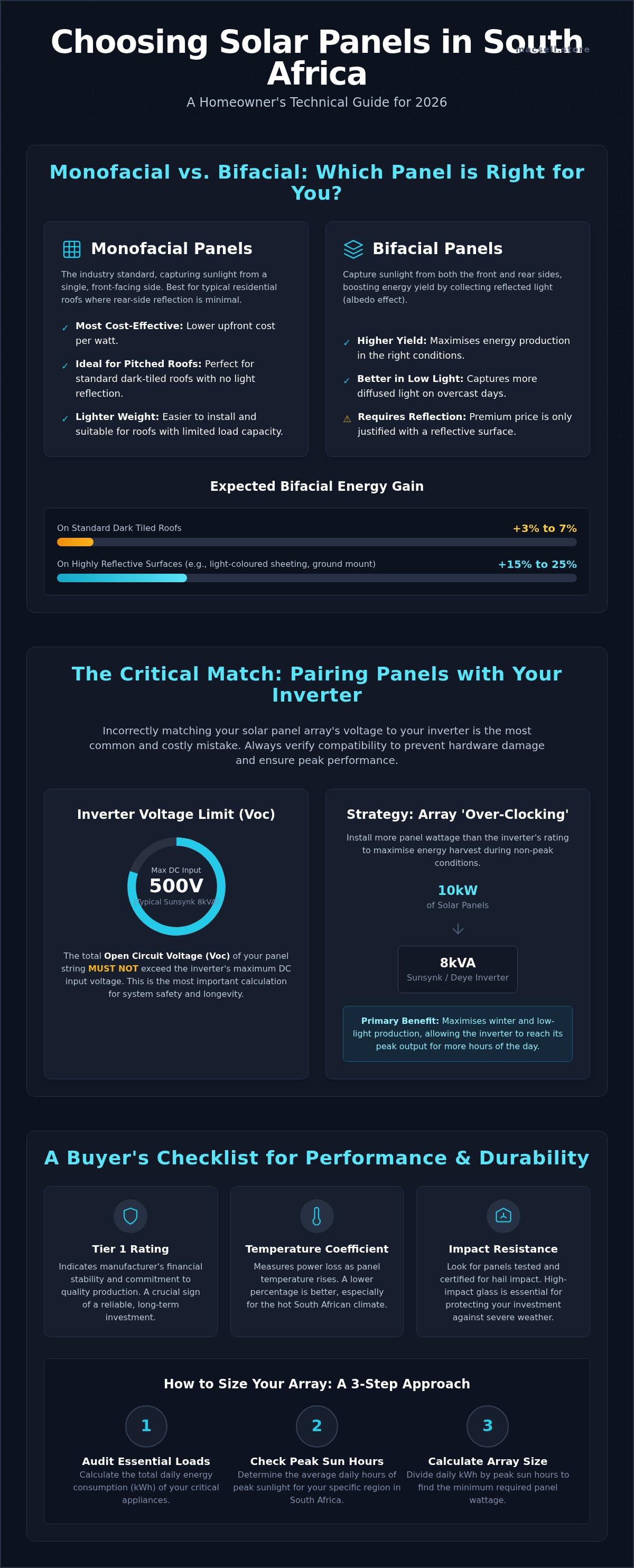
The core distinction in modern solar panel technology lies in the light-harvesting surface area. Monofacial panels capture photons on the front-facing side only, utilising an opaque backsheet. Bifacial modules use dual-glass or transparent backsheets to harvest light from both the front and the rear. This rear-side generation relies on the albedo effect, where sunlight reflects off the roof or ground surface back into the panel. When considering how to choose solar panels for home South Africa, your specific roof type dictates which technology offers the best return on investment.
Bifacial panels have become the baseline for flat-roof installations across South Africa. These environments allow for higher mounting angles and greater light reflection. In ground-mounted arrays or on light-coloured industrial roofs, bifacial hardware can increase energy yield by 15% to 25%. For typical residential installations on dark-tiled pitched roofs, this gain is significantly lower, often ranging between 3% and 7%. The price premium for bifacial modules is only justified if the installation environment supports high reflectivity.
Monofacial Panels: The Reliable Standard
Monofacial modules remain the industry standard for traditional pitched tile roofs. Because these surfaces provide negligible rear-side light, the technical advantages of bifacial cells are largely nullified. These panels feature a lighter weight profile, making them easier to organise for residential roof structures with limited load-bearing capacity. They represent the most cost-effective solution per watt for homeowners focused on basic load-shedding mitigation. Reliability and predictable performance make them the preferred hardware for standard grid-tied or hybrid systems.
Bifacial Panels: Maximising Yield in High-Light Environments
Bifacial technology delivers peak performance when paired with reflective surfaces like white gravel or light-coloured iron sheeting. These high-albedo environments significantly boost rear-side production. This technology is also advantageous during overcast or low-light conditions common in summer rainfall regions. Dual-sided cells capture more diffused light than monofacial equivalents. To maximise bifacial gain, mounting height is a critical variable; panels must be positioned far enough from the surface to allow reflected light to reach the rear cells effectively. This is a vital technical factor when deciding how to choose solar panels for home South Africa to ensure hardware investment is not wasted on inefficient configurations.
Inverter Compatibility: Matching Panels with Sunsynk and Deye Systems
Precise matching of PV arrays to inverter specifications is the most critical step in hardware procurement. Sunsynk and Deye hybrid inverters share similar architectures, yet their Maximum Power Point Tracking (MPPT) voltage ranges define the boundaries of your system's performance. Selecting panels without cross-referencing their Open Circuit Voltage (Voc) against the inverter's DC input limit can lead to hardware failure or inefficient energy harvesting. Understanding how to choose solar panels for home South Africa requires a focus on these electrical parameters rather than just peak wattage.
In 2026, many South African users are opting for 'over-clocking' or 'over-sizing' their PV arrays. This involves installing a total solar panel wattage that exceeds the inverter's nominal output rating, such as 10kW of panels on an 8kVA Sunsynk. This strategy ensures the system reaches its maximum output earlier in the morning and maintains it longer during low-irradiation winter months. It maximises the utility of the inverter's internal components without exceeding safe current limits.
Wiring configuration also dictates efficiency. Series wiring increases voltage, whilst parallel wiring increases amperage. High-performance hybrid inverters generally prefer higher voltages to stay within the peak efficiency window of the MPPT. However, you must ensure the total amperage of parallel strings doesn't exceed the inverter's maximum input current, typically 13A to 26A depending on the specific model.
Voltage and Amperage: The Technical Handshake
Calculating the total string voltage for a Sunsynk 8KVA inverter requires strict adherence to its maximum DC input voltage, usually 500V. Each panel's Voc must be summed in series. It's vital to account for cold-weather performance; as temperatures drop, panel voltage increases. Exceeding the 500V threshold on a cold Gauteng morning will trigger a high-voltage alarm or permanent damage. Always leave a 10% to 15% safety margin when calculating your maximum string voltage.
Optimising for LuxPower and Deye Hardware
The LuxPower SNA5000 hybrid inverter operates with a specific efficiency curve. To ensure the MPPT starts early, your string voltage must exceed the minimum startup threshold, often around 100V. Organising your strings correctly allows for a faster transition from grid or battery power to solar. This ensures your lithium ion solar battery receives a steady charge throughout the day. For those building a new system, selecting a compatible hardware kit simplifies the matching process and eliminates compatibility risks.
Sizing Your Array: How Many Panels Does a South African Home Need?
Determining the precise number of modules required is a function of daily energy consumption and regional solar irradiance. When researching how to choose solar panels for home South Africa, homeowners must distinguish between essential loads, such as security systems and lighting, and high-draw appliances like geysers and pool pumps. A typical 5kW hybrid system generally suits a small to medium-sized home, whilst an 8kW system provides the necessary capacity for larger households seeking significant energy independence. Accurate sizing ensures your battery reaches a full state of charge before the evening peak without wasting capital on redundant hardware.
South Africa averages between 4.5 and 6 peak sun hours daily. Inland provinces like the Northern Cape and Gauteng sit at the higher end of this spectrum, whilst coastal regions may experience lower averages due to seasonal cloud cover. This geographical variance directly affects the physical footprint of your array. It's technically prudent to leave additional space on your mounting rails for future-proofing; as energy tariffs rise, adding two or three extra panels is a cost-effective way to scale your system. Balancing your total panel count with hybrid inverter price market trends is a critical step in hardware procurement.
Calculating Daily Kilowatt-Hour Requirements
To calculate your daily target, divide your monthly kWh consumption from your municipal bill by 30. For a household consuming 900kWh monthly, the daily target is 30kWh. You must add a 20% to 30% buffer to this figure to account for DC-to-AC conversion losses and environmental factors like dust or heat. Household behaviour also dictates array size; shifting high-draw activities like laundry to the middle of the day allows you to utilise direct PV generation, potentially reducing the required battery capacity and panel count.
Roof Orientation and Shading Factors
In the Southern Hemisphere, a North-facing orientation is the primary driver of return on investment. Deviating from this "North-facing rule" can result in a yield loss of 15% to 20%, necessitating a larger array to meet the same energy goals. For roofs with partial shading from chimneys or neighbouring structures, selecting high-wattage panels with better low-light performance is often more efficient than installing individual optimisers. Always verify the structural limits of your roof before procurement. A standard 12-panel array adds roughly 300kg of dead load to the structure, requiring secure anchoring to the rafters rather than just the battens.
Standout Solar Hardware: Top Picks from the MacSell Collection
MacSell Solar Outlet maintains a curated inventory of solar panel products, specifically selected for the South African climate. Our collection prioritises Tier 1 manufacturers to ensure long-term performance and warranty security. Understanding how to choose solar panels for home South Africa involves more than just selecting the highest wattage; it requires balancing module dimensions with rail availability and inverter input limits. From high-yield bifacial modules to compact monofacial units, our hardware selection supports diverse residential requirements.
High-Performance Panels for Large Households
For medium to large households, 550W+ panels represent the current efficiency peak. These modules utilise larger cell sizes and multi-busbar technology to reduce internal resistance. Whilst higher wattage is attractive, these panels have a larger physical footprint, typically exceeding 2.2 metres in length. This requires specific spacing of mounting rails to ensure structural integrity during high-wind events. Our high-performance range features reinforced glass with high hail resistance ratings and anti-PID technology to prevent power loss over time. These modules are specifically optimised for use within the Sunsynk Hubble combo kit, ensuring seamless electrical integration from day one.
Compact and Efficient Panels for Smaller Systems
Townhouses and smaller residential units often face roof space constraints. In these scenarios, 400W to 450W panels offer a superior power-to-size ratio. These modules are easier to handle and organise on complex roof shapes with multiple valleys or hips. They provide the necessary voltage to trigger MPPT startup thresholds without requiring an extensive array. These panels are frequently paired with entry-level systems; consult our Deye inverter guide to understand the total hardware cost for a 3kW or 5kW build. Integrating these panels with existing battery banks requires careful attention to the charge controller's amperage limits.
A complete solar installation requires specialised accessories to maintain safety standards. We stock UV-stabilised solar cables, genuine MC4 connectors, and anodised aluminium mounting rails designed for the local environment. Using substandard connectors is a leading cause of DC arc faults; therefore, we only supply hardware that meets international safety certifications. You can browse our full range of high-yield modules and procure your solar hardware directly from our warehouse for nationwide delivery.
Procurement and Quality Control: A Buyer's Checklist for 2026
Successful hardware acquisition concludes with rigorous quality control and technical verification. When evaluating how to choose solar panels for home South Africa, buyers must look beyond marketing brochures and scrutinise the technical datasheet. A Tier 1 manufacturer rating is a primary indicator of bankability and long-term warranty support. Technical metrics like the Temperature Coefficient are equally vital; this figure dictates how much power the panel loses for every degree above 25°C. In the high-heat environments of the South African interior, a lower coefficient ensures better afternoon yield.
Efficiency ratings in 2026 typically range between 21% and 23.8% for high-end monocrystalline modules. Whilst higher efficiency allows for a smaller physical footprint, it often carries a price premium. For large-scale residential projects, managing the logistics of bulk solar panels South Africa requires a coordinated delivery strategy to prevent hardware damage. Inspecting your modules immediately upon arrival is non-negotiable. Look for frame misalignment, glass scratches, or "snail trails" which may indicate internal micro-cracks caused by improper handling during transit.
The Essential Technical Checklist
- Serial Number Verification: Cross-reference the serial numbers on the panel frames with the manufacturer's database to ensure legitimate warranty coverage and registration.
- MC4 Connector Compatibility: Verify that the pre-installed connectors match your existing cable runs. Using mismatched brands can lead to high-resistance connections or water ingress.
- Wind and Snow Load Ratings: Confirm the module's structural rating meets the requirements for your region. High-wind coastal areas require panels with higher Pascal (Pa) ratings to prevent mechanical failure during storms.
Finalising Your Order
Procuring your hardware in bulk significantly reduces the per-unit shipping cost, especially for nationwide delivery. Ensure your order includes the specific mounting hardware for your roof type, whether it be corrugated iron, IBR, or concrete tile. Using the correct bracketry prevents roof leaks and maintains the structural integrity of the array. Once you've verified your inverter compatibility and calculated your daily kWh needs, you're ready to secure your energy future. Shop our full range of Solar Panels & Accessories for reliable nationwide delivery across South Africa.
Shop Solar Panels & Complete Kits at MacSell Solar Outlet
Tier 1 panels, matched inverter & battery combos, and accessories with national delivery across South Africa.
→ Browse Solar Panels & Accessories
→ Shop Sunsynk 8KVA & Hubble AM5+ Combo Kit
→ Shop LuxPower SNA5000 5kW Inverter
→ Browse All Inverter & Battery Combos
Maximising Your 2026 Solar Investment
Mastering how to choose solar panels for home South Africa requires a strict focus on technical compatibility and environmental suitability. You've learned that aligning string voltages with the MPPT ranges of your Sunsynk or Deye inverter is the only way to protect your hardware from failure. Simultaneously, selecting between monofacial and bifacial modules must be a data-driven choice based on your specific roof orientation and surface reflectivity. These decisions directly impact your system's yield and the speed of your return on investment.
MacSell Solar Outlet serves as your specialised hardware partner, stocking Tier 1 brands and essential accessories designed for the unique South African climate. We provide nationwide delivery on all solar components, ensuring you have access to high-performance technology regardless of your location. Secure your energy independence — shop our Solar Panels & Accessories collection now. Building a robust, efficient power system is within your reach.
Frequently Asked Questions
What is the most reliable solar panel brand available in South Africa?
Tier 1 manufacturers represent the most reliable solar panel brands available locally. These manufacturers are vertically integrated, utilise automated production lines, and possess the financial stability to honour 25-year linear power warranties. When deciding how to choose solar panels for home South Africa, look for brands that appear on the BloombergNEF Tier 1 list. These modules offer high resistance to Potential Induced Degradation (PID), ensuring long-term yield in harsh local conditions.
How many solar panels do I need to run a standard 3-bedroom home?
A standard 3-bedroom home typically requires between 8 and 12 high-wattage panels to achieve meaningful energy independence. This configuration usually pairs with a 5kW or 8kW hybrid inverter. If your daily consumption is approximately 30kWh, a 5.5kWp to 6.6kWp array is necessary to cover essential loads and charge battery storage. Regional peak sun hours, which average 4.5 to 6 hours in South Africa, directly dictate the final panel count for your property.
Can I mix different brands or wattages of solar panels on the same inverter?
Mixing different brands or wattages on a single MPPT string is technically discouraged. The inverter throttles the entire string to the lowest performing panel's current, causing significant energy loss. You can use different panels on separate MPPT trackers if your inverter supports multiple inputs. For a healthy hybrid system, maintaining uniform voltage and amperage across each string prevents electrical bottlenecks and maximises the efficiency of your Sunsynk or Deye hardware within the system.
Are bifacial solar panels worth the extra cost for a residential roof?
Bifacial solar panels are generally not worth the price premium for standard pitched tile roofs. These modules require rear-side light reflection to generate extra power, which is negligible on dark, close-mounted tiles. They are highly effective for ground-mounted systems or flat commercial roofs with light-coloured surfaces. For most residential properties, high-efficiency monofacial panels provide a better return on investment by delivering consistent yield at a lower upfront hardware cost per watt.
How long do Tier 1 solar panels typically last in the South African climate?
Tier 1 solar panels are engineered to last between 25 and 30 years in the field. Most manufacturers provide a linear performance warranty ensuring the modules still produce at least 80% of their original rated output after 25 years. In the South African climate, high UV exposure and temperature fluctuations are the primary stressors. Selecting hardware with a low temperature coefficient and robust frame construction is essential to mitigate long-term degradation and mechanical fatigue over time.
Do solar panels still work during load shedding if I don't have a battery?
Standard grid-tied solar panels won't function during load shedding without a battery or a specialised off-grid inverter. This is due to anti-islanding safety regulations, which require the system to shut down when the grid fails to prevent back-feeding power. To maintain power during outages, you must integrate your array with a hybrid inverter and lithium-ion storage. This setup allows the system to create an independent micro-grid for your essential household loads whilst the grid is down.
What maintenance is required to keep solar panels at peak efficiency?
Maintenance is primarily focused on keeping the glass surface free from dust, bird droppings, and industrial soot. In dry South African regions, cleaning your panels every three to four months can improve energy yield by 5% to 10%. Use deionised water and a soft brush to avoid scratching the anti-reflective coating. Additionally, an annual visual inspection of the MC4 connectors and mounting rails ensures that thermal expansion hasn't loosened any critical electrical or structural components.
Is it better to buy a solar combo kit or individual components?
Buying a solar combo kit is generally superior for ensuring 100% hardware compatibility. Kits like the Sunsynk 8KVA and Hubble AM5+ combo are pre-configured to work within specific electrical parameters. This eliminates the risk of selecting panels with voltages that don't match the inverter's MPPT range. For those learning how to choose solar panels for home South Africa, a kit provides a simplified procurement path with verified performance standards and streamlined warranty support across all components.