

Residential Solar Kit South Africa: 2026 Hardware Buying Guide
Paying for a monthly solar subscription is often a permanent liability, whereas direct hardware ownership is a high-yield asset. Finding the right residential solar kit South Africa requires a strict focus on technical compatibility rather than vague marketing promises. You've likely experienced the frustration of Stage 6 load shedding and the paralysis of choosing between incompatible components. It's a technical minefield where a single communication error between a battery and an inverter can compromise your entire backup strategy.
This 2026 hardware buying guide provides the technical specifications needed for genuine energy independence. You'll learn the precise requirements to eliminate the impact of grid instability through proper system sizing and component selection. We've curated a reliable list of compatible hardware, focusing on industry leaders like Sunsynk and Hubble. This guide prioritises utility and performance, moving you away from hidden markups and towards a robust, owner-managed power solution. Expect a direct, no-nonsense breakdown of the hardware that actually works in the local market.
Key Takeaways
- Understand the critical technical compatibility requirements between hybrid inverters and lithium storage to ensure long-term system reliability.
- Identify the specific residential solar kit South Africa needs to eliminate load shedding based on your household's unique base load and peak demand.
- Evaluate the performance specifications of tier-one hardware brands like Sunsynk, Deye, and LuxPower for 2026 energy independence.
- Determine whether a portable plug-and-play power system or a fixed wall-mounted installation best suits your property type and mobility requirements.
- Master the calculation of appliance wattages to correctly size your hardware and avoid the common pitfalls of underpowered systems.
Navigating the 2026 Residential Solar Landscape in South Africa
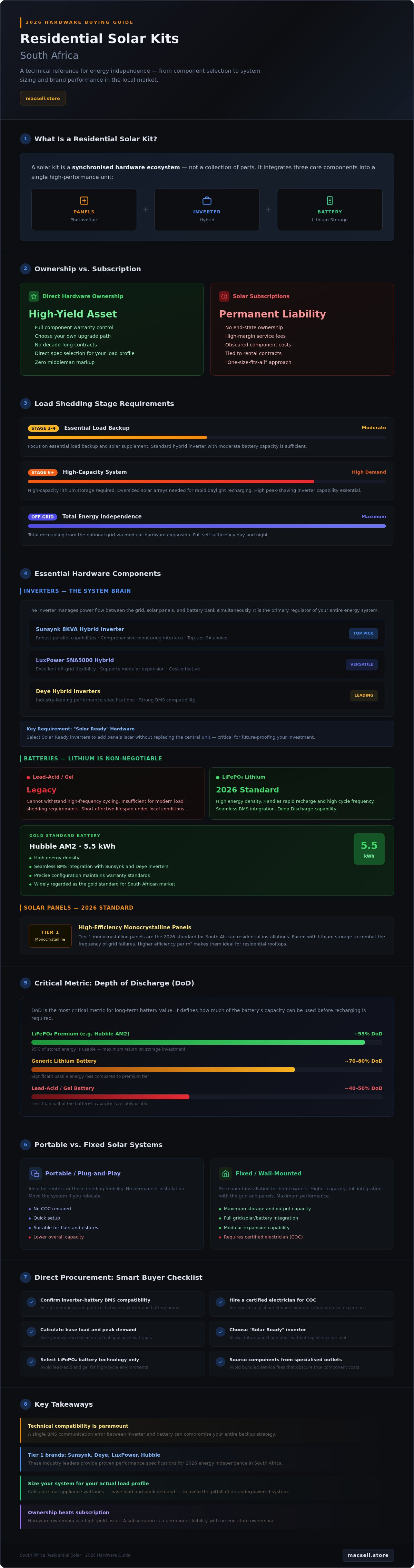
A residential solar kit South Africa is a synchronised hardware ecosystem. It isn't just a collection of parts. A functional kit integrates photovoltaic panels, a hybrid inverter, and lithium storage into a single high-performance unit. In 2026, the objective has shifted. We're moving from simple backup during outages to total energy independence. Grid instability is now a permanent factor. This reality dictates hardware requirements. You need components capable of handling high cycle frequencies and rapid recharge rates. The financial logic is clear. Hardware ownership is a high-yield asset. Solar subscriptions are often a permanent liability with no end-state ownership.
The Evolution of Home Power Systems
Early residential systems were basic UPS units. They kept small electronics running. Modern configurations use integrated hybrid systems that manage grid, solar, and battery power simultaneously. Load shedding stages now dictate your hardware choices. Higher stages require larger battery banks and inverters with high peak-shaving capabilities. A hybrid inverter serves as the central brain of a residential energy system, directing power flow between the grid, panels, and battery bank. This intelligent management ensures you prioritise solar consumption whilst maintaining a reserve for night-time outages.
- Stage 2-4 Requirements: Focus on essential load backup and solar supplement.
- Stage 6+ Requirements: High-capacity lithium storage and oversized solar arrays for rapid daylight charging.
- Off-Grid Transition: Total decoupling from the national grid through modular hardware expansion.
Direct Procurement: The Smart Buyer’s Path
Buying hardware directly from a specialised outlet provides immediate transparency. You avoid the heavy markups common with full-service installation companies. Many providers bundle hardware with high-margin service fees that obscure the actual component costs. By sourcing your own Sunsynk or Deye components, you retain control over the asset. You aren't tied to a decade-long rental contract that costs more than the equipment's value. Ownership means you control the warranty and the upgrade path.
Organising your own installation involves hiring a certified electrician for the Certificate of Compliance (COC). Ask about their experience with specific lithium communication protocols. Premium components like Hubble batteries require precise configuration to maintain warranty standards. Direct procurement allows you to select the exact specifications for your load profile. It eliminates the "one-size-fits-all" approach of subscription models. You get the performance you pay for without middleman interference.
Essential Hardware Components: Inverters, Batteries, and Panels
A high-performance residential solar kit South Africa relies on the technical handshake between the inverter and the battery bank. If these components don't communicate effectively via a Battery Management System (BMS), you risk inefficient charging cycles and a significantly reduced hardware lifespan. In 2026, the standard has shifted toward high-efficiency monocrystalline panels paired with Tier 1 lithium storage to combat the frequency of grid failures.
Inverter Technology: Choosing the Right Engine
The inverter acts as the primary regulator of your entire energy system. The Sunsynk 8KVA hybrid inverter remains a top-tier choice for South African households due to its robust parallel capabilities and comprehensive monitoring interface. For those seeking a versatile and cost-effective solution, the LuxPower SNA5000 Hybrid Inverter provides excellent off-grid flexibility and supports modular expansion as your power needs grow. Selecting "Solar Ready" hardware is essential for future-proofing, allowing you to add panels at a later stage without replacing the central unit. For a breakdown of current market rates, consult our hybrid inverter price South Africa guide.
The Lithium Revolution in Storage
Lead-acid and gel batteries are legacy technologies that generally cannot withstand the high-frequency cycling required in the local market. Lithium Iron Phosphate (LiFePO4) is the non-negotiable standard for 2026. The Hubble AM2 5.5kWh battery is widely regarded as the gold standard because of its high energy density and seamless BMS integration with Sunsynk and Deye inverters.
Depth of Discharge (DoD) is the most critical metric for long-term value. Whilst generic batteries often suffer internal damage if discharged beyond 50%, a premium lithium ion solar battery like the Hubble AM2 supports a 100% DoD. This allows you to utilise the full capacity of the energy you've stored. Managing this discharge correctly ensures your system remains operational through extended Stage 6 outages without degrading the cells.
Solar Panels and Technical Synergy
Modern South African roof installations require high-wattage monocrystalline panels, typically ranging from 450W to over 550W. Efficiency ratings are vital; higher efficiency panels convert more sunlight into usable current within limited roof spaces. However, the hardware only performs as well as its weakest link. You must ensure your inverter and battery use compatible communication protocols, such as CAN or RS485, to avoid "dumb" charging. This occurs when the inverter cannot see the battery's specific state of charge, leading to inefficient power management. If you aren't ready for a fixed roof installation, you might consider modular portable power systems that offer similar hardware quality in a mobile, plug-and-play format.
Portable Power Systems vs. Fixed Solar Kits: Which is Right for You?
Choosing a residential solar kit South Africa often depends on property ownership and immediate power requirements. Whilst fixed systems offer high capacity, portable plug-and-play systems fill a critical gap for apartment dwellers and renters who cannot modify their distribution boards (DB). These units are self-contained ecosystems. They house an inverter, battery, and charge controller within a mobile chassis. The distinction lies in how the power is delivered and the scale of the loads they can support.
The Plug-and-Play Advantage
A primary benefit is the elimination of professional installation costs. You simply plug the unit into a standard wall socket to charge the internal lithium bank. This hardware provides a Pure Sine Wave output, which is vital for protecting sensitive electronics like high-end PCs, OLED TVs, and medical equipment from the surges associated with grid restoration. These systems are ideal for home offices where maintaining uptime for routers and computers is the priority. For immediate load shedding relief without the complexity of a permanent build, you can browse the Portable Power Systems collection.
- Mobility: Easily moved between rooms or to a new property.
- Zero Compliance Costs: No requirement for a new Certificate of Compliance (COC) since it doesn't wire into the DB.
- Instant Deployment: Operational within minutes of unboxing.
Fixed Hybrid Systems: The Long-Term Solution
Fixed systems represent a permanent infrastructure investment. Unlike portable trolleys, these are hard-wired into your home's DB. This allows for the management of heavy household loads such as geysers, pool pumps, and electric ovens that exceed the output capacity of most mobile units. A fixed Sunsynk 8KVA combo kit provides the headroom necessary for full energy independence. The transition from a portable unit to a fixed system usually occurs when a homeowner decides to move beyond basic backup and into total grid-tie or off-grid operation.
The cost-to-capacity ratio is a key metric here. Portable units typically carry a higher cost per kilowatt-hour (kWh) due to the integrated chassis and mobility features. However, the return on investment is realised through zero labour costs and asset portability. Fixed systems offer a superior cost-to-capacity ratio for large-scale energy storage but require higher upfront capital for hardware and professional certification. Your decision should align with your long-term residency plans and the specific wattage of the appliances you intend to run.
Sizing Your Residential Solar Kit: Matching Hardware to Household Loads
Sizing a residential solar kit South Africa is a calculation of energy volume and flow. You must determine how much power you need at any single moment and how much total energy you need over time. Accurate sizing prevents inverter overload and ensures your lithium storage survives the duration of a Stage 6 outage. Step 1 involves calculating your base load. Step 2 focuses on peak demand. These two metrics dictate the specific hardware required to maintain a seamless power supply without compromising component health.
Base load includes essential appliances like refrigerators, Wi-Fi routers, and security systems. These items draw power continuously. Peak demand occurs when high-wattage appliances like kettles or air conditioners run simultaneously. Failing to account for these spikes causes the inverter to trip as a safety measure. You don't want your system shutting down every time someone uses the microwave.
Load Calculation Basics
Vampire loads are standby power draws from televisions and chargers that can consume up to 10% of your battery capacity overnight. Understanding the difference between kVA and kW is vital for hardware selection; while kW represents real power, kVA is the apparent power. An 8KVA hybrid inverter handles a peak load of approximately 8000 watts. This headroom is necessary for households running multiple high-draw appliances during outages. You should prioritise hardware that offers a high surge capacity to handle the startup current of motorised appliances.
Battery Sizing for Longevity
Stage 6 load shedding often results in four-hour power gaps. If your average draw is 1.5kW, you require a minimum of 6kWh of usable storage just to bridge the gap. Constant high discharge rates generate internal heat, which can degrade lithium cells over time. For detailed sizing strategies, refer to our inverter and battery combo for home use guide. Maintaining a buffer ensures the battery rarely hits 0%, preserving the cycle life of your investment.
Selecting between a 5kW LuxPower SNA5000 and a Sunsynk 8kVA unit is the final step in your hardware strategy. A 5kW inverter is sufficient for essential lighting, entertainment, and small appliances. However, an 8kVA unit provides the necessary capacity for larger residential loads, allowing for the simultaneous use of a dishwasher or microwave without risk. This choice also dictates your future expansion; an 8kVA system often supports more solar panels than its 5kW counterpart. If the technical complexity of a fixed installation is currently a barrier, consider portable power systems for immediate deployment which offer pre-sized hardware in a mobile, plug-and-play format.
Top-Rated Solar Hardware and Combo Kits for 2026
Selecting a residential solar kit South Africa requires a focus on proven hardware compatibility and technical endurance. The market has moved beyond generic "Bronze" or "Silver" tiers. You now need specific component pairings that have been tested for local grid conditions. Direct hardware procurement ensures you receive the exact specifications required for your load profile without the dilution of performance often found in subscription-based bundles. In 2026, the focus is on high-cycle lithium storage and hybrid inverters with advanced power management features.
Premium Performance: The Sunsynk & Hubble Pairing
The Sunsynk 8KVA hybrid inverter paired with Hubble AM2 5.5kWh lithium batteries is currently the premier hardware configuration for South African homes. This combo handles high surge currents and provides a sophisticated monitoring interface for real-time energy tracking. The Sunsynk unit manages multiple power inputs simultaneously, prioritising solar and battery usage to minimise grid reliance. The Hubble AM2 batteries utilise high-grade LiFePO4 cells, offering a 100% depth of discharge and seamless communication with the Sunsynk BMS. For a deep dive into the specifications and performance data, read our Sunsynk Hubble combo kit technical review.
For those requiring technical versatility in off-grid or weak-grid environments, the LuxPower SNA5000 remains a robust choice. It supports modular expansion, allowing you to scale your battery bank as your budget permits. This inverter is particularly effective in configurations where grid stability is non-existent, offering a reliable bridge to total energy independence. It integrates effectively with Deye and Hubble components, providing a flexible hardware foundation for custom residential projects.
Portable Power Picks for 2026
If a fixed installation isn't feasible, portable systems provide an immediate solution for load shedding. For heavy-duty demands, high-capacity portable inverter trolleys are excellent choices for 2026. They provide enough capacity to run essential appliances and home office setups for extended periods. For smaller requirements, such as apartment living, more compact models offer a smaller footprint whilst maintaining high-performance output. These units are typically built with internal charge controllers, making them ready for solar panel integration whenever you choose to expand.
- High-Capacity Portable Trolleys: Best for large home offices and essential kitchen appliances.
- Compact Portable Trolleys: Ideal for apartment dwellers requiring silent, emission-free backup.
- Mecer 2400VA Systems: A reliable, entry-level 1140W solution for TV, WiFi, and basic lighting.
Mecer inverter systems continue to serve as the standard for entry-level home office backup. These units are designed for simplicity and reliability, focusing on maintaining uptime for critical electronics during Stage 4 and Stage 6 windows. Whether you need a permanent wall-mounted system or a mobile trolley, you can shop the full Portable Power Systems range for nationwide delivery. Prioritising hardware ownership today secures your energy future against an increasingly unreliable national grid.
Achieving Total Energy Independence
Transitioning to a residential solar kit South Africa is a strategic investment in long-term energy security. You've now identified the technical parameters for matching Sunsynk inverters with Hubble lithium storage and understand the math behind base loads and peak demand. Direct hardware ownership eliminates the recurring costs of rental models and puts the asset entirely in your control. It's about ensuring technical performance and reliability in the face of persistent grid instability.
As an authorised Sunsynk and Hubble hardware retailer, MacSell Solar Outlet provides the specific components required to build a resilient energy ecosystem. We offer national delivery across South Africa and specialised technical support for hardware procurement to ensure your components communicate correctly. Whether you require a fixed wall-mounted configuration or an immediate plug-and-play solution, the priority is high-yield hardware that performs under pressure. You don't have to wait for the grid to stabilise to regain control of your home power.
Secure your energy independence: Shop the Portable Power Systems Collection. Take the first step toward a reliable, owner-managed power solution today.
Frequently Asked Questions
What is the best residential solar kit for a 3-bedroom home in South Africa?
A Sunsynk 8KVA and 2X Hubble AM2 5.5 KWh Combo Kit is the recommended standard for a 3-bedroom home. This configuration provides 8kW of peak power and 11kWh of storage capacity. It handles essential loads like lighting and refrigeration whilst providing headroom for high-wattage appliances like kettles. This kit ensures technical compatibility through integrated BMS communication, which is vital for long-term battery health in South African conditions.
Can I use a portable power system to run my fridge and microwave?
Yes, heavy-duty portable systems like the Ecco 5500W Solar Ready Trolley can power most domestic fridges and microwaves. A fridge typically draws 150W to 400W, whilst a microwave requires 1000W to 1500W. The pure sine wave inverter in these units handles the high startup current of a fridge compressor. You should check the continuous wattage rating of your specific portable unit to avoid overloading the system during simultaneous appliance use.
Do I need a special electrician to install a Sunsynk 8KVA combo kit?
You require a Department of Employment and Labour (DEL) registered electrician with experience in PV systems. The installer must be capable of issuing a Certificate of Compliance (COC) once the hardware is integrated into your distribution board. It's essential to verify their familiarity with Sunsynk and Hubble communication protocols. Proper installation ensures your hardware warranty remains valid and your residential solar kit South Africa meets national safety regulations and municipal bylaws.
How much does a residential solar system cost in South Africa in 2026?
Hardware costs vary based on component quality and capacity requirements. Direct procurement of premium brands like Sunsynk and Hubble represents a significant upfront investment in a long-term asset. Total costs depend on the number of panels, battery capacity, and the specific inverter model selected. Whilst market rates fluctuate, hardware ownership remains a superior financial strategy compared to monthly subscription models, as it provides immediate asset equity and total energy independence without recurring fees.
Is a 5kW hybrid inverter sufficient for a typical South African household?
A 5kW hybrid inverter, such as the LuxPower SNA5000, is sufficient for essential loads and modest power consumption. It comfortably manages lighting, entertainment systems, and refrigerators. However, it may struggle with multiple high-wattage appliances running simultaneously, such as an electric oven and a geyser. For households with higher peak demands, upgrading to an 8kVA system provides the necessary headroom to maintain a normal lifestyle during extended load shedding periods without tripping the inverter.
What is the difference between a portable power station and a fixed solar kit?
A fixed residential solar kit South Africa is hard-wired into your home's distribution board and typically includes roof-mounted panels. These systems manage heavy loads and offer permanent energy security. In contrast, a portable power station is a self-contained, plug-and-play unit that doesn't require professional installation. Portables are ideal for renters or apartment dwellers who need immediate backup for sensitive electronics but cannot modify their property's electrical infrastructure for permanent installations.
Are Sunsynk and Deye inverters the same hardware?
Sunsynk and Deye inverters share a similar internal hardware architecture and are manufactured in the same facility. However, they utilise different firmware and monitoring software. Sunsynk provides a unique user interface and specific control logic designed for complex power management scenarios. Both brands are highly compatible with Hubble AM2 batteries. Choosing between them often comes down to specific software preferences and the technical requirements of your energy management strategy rather than raw power output.
How long will a Hubble AM2 5.5 KWh battery last during Stage 6 load shedding?
Duration depends entirely on your continuous power draw. At a constant load of 500W, a single Hubble AM2 5.5kWh battery provides approximately 10 hours of backup. If your load increases to 2kW, the duration drops to roughly 2.5 hours. During Stage 6, where outages can last four hours, we recommend a minimum of two batteries to ensure you don't exceed a safe depth of discharge whilst maintaining essential household functions and protecting the lithium cells.