
Sunsynk vs Deye Inverter: 2026 Hardware Comparison for South African Solar Systems
Paying more for a Sunsynk doesn't buy you a different set of internal components; it buys you a different relationship with your power system. You've likely heard that these two brands are identical under the hood. It's a common frustration for South African homeowners trying to justify the price gap in a Sunsynk vs Deye inverter comparison when the spec sheets look like carbon copies. The hardware is indeed manufactured by the same OEM, whilst the user experience diverges sharply once you move past the casing.
We understand the confusion surrounding warranty support and the complexity of remote monitoring apps. This technical comparison cuts through the marketing noise to explain the hardware relationship and whether the premium for Sunsynk's ecosystem is actually worth your investment in 2026. We provide a no-nonsense breakdown of internal specifications, software performance, and local support structures. You'll gain a clear understanding of why the price delta exists and which hybrid unit integrates best with your lithium battery storage. We'll explore the Sunsynk Connect platform against the Solarman interface to ensure your hardware choice matches your technical requirements.
Key Takeaways
- Identify the shared manufacturing origins between Ningbo Deye and Sunsynk to understand why internal hardware specifications remain identical across both brands.
- Analyse the technical justification for the price difference in the Sunsynk vs Deye inverter market, focusing on firmware customisation and local support infrastructure.
- Evaluate the monitoring ecosystems by comparing the native Sunsynk Connect application against the third-party Solarman software used for Deye systems.
- Verify 2026 South African warranty terms and support availability to ensure your hybrid system meets NRS 097-2-1 compliance and insurance requirements.
- Determine the optimal hardware choice based on your technical proficiency, selecting Sunsynk for ease of use or Deye for high-value technical flexibility.
Understanding the Shared DNA: Deye and Sunsynk Hardware Origins
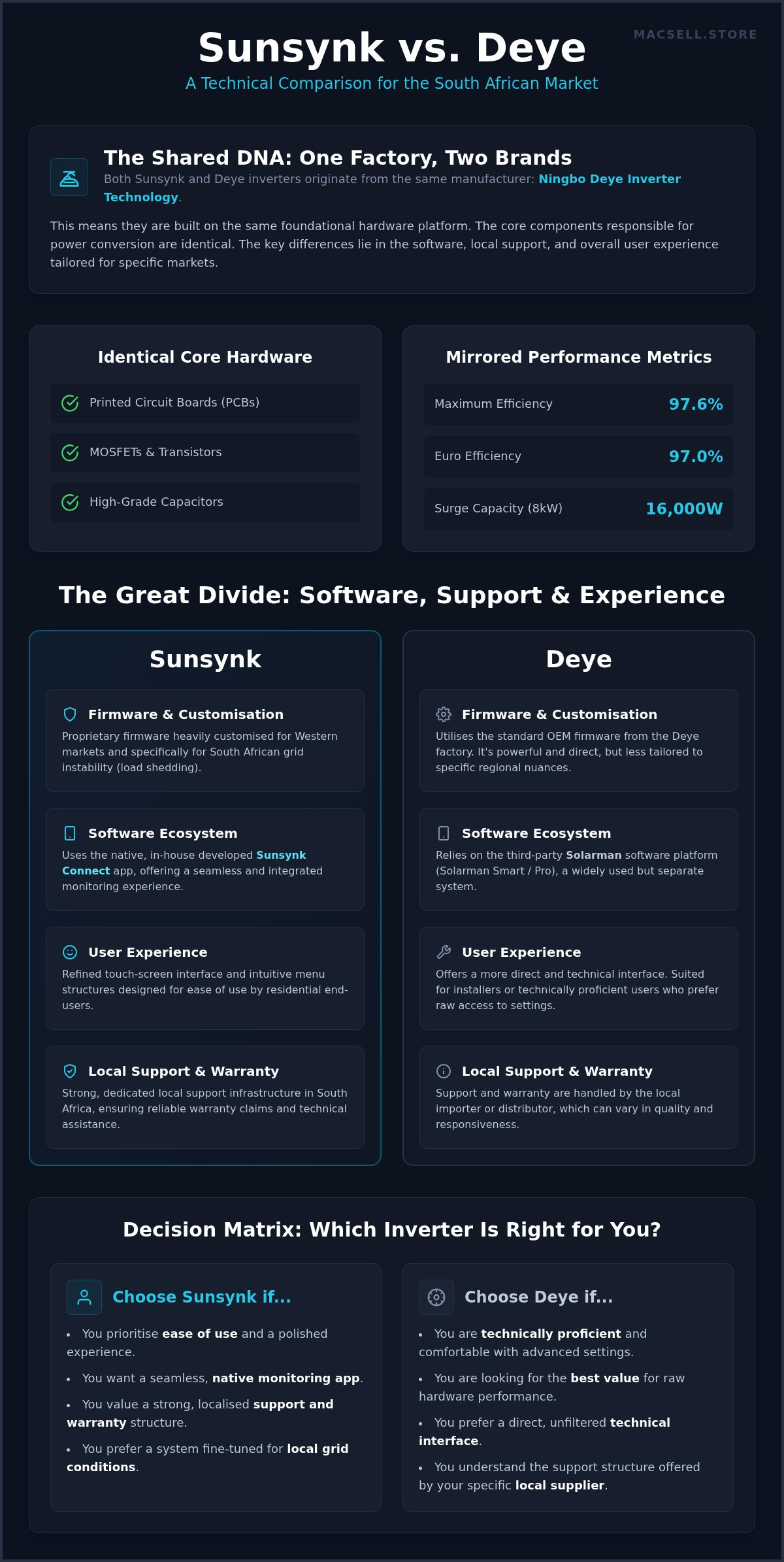
The core of any Sunsynk vs Deye inverter debate begins with a single factory: Ningbo Deye Inverter Technology. Deye operates as the Original Equipment Manufacturer (OEM) for several global brands. Whilst consumers often view them as competitors, they're built on the same foundational solar inverter technology platform. This shared architecture ensures that the structural integrity and basic power conversion capabilities are consistent across both product lines.
The Manufacturing Relationship Explained
The OEM model is standard practice in the global electronics sector. Deye provides the industrial capacity and basic hardware blueprints. Sunsynk, a UK-based engineering firm, partners with Deye to produce units that meet specific regional standards. This is why you'll see identical transformerless architecture in both brands. The physical layout, cooling fans, and terminal connections often appear indistinguishable because they originate from the same production line. It's a relationship where one company provides the "body" and the other provides the "brain."
Critical internal components remain consistent across both brands to maintain manufacturing efficiency. These include:
- Printed Circuit Boards (PCBs): The main control and power boards are largely identical in layout and circuit design.
- MOSFETs and Transistors: High-quality switching components are sourced from the same supply chain for both brands.
- Capacitors: Industrial-grade components designed for long-term thermal stability are used in both units.
Why Rebranding Matters for the South African Market
If the hardware is the same, the value is found in the translation layer. Sunsynk invests heavily in proprietary firmware that dictates how the hardware reacts to specific grid conditions. In South Africa, where grid instability and frequent load shedding cycles are reality, these software optimisations are vital. Sunsynk's engineering team customises the base Deye hardware to provide a more "Westernised" user experience. This includes a refined touch-screen interface and more intuitive menu structures that appeal to residential users.
The distinction between a Sunsynk vs Deye inverter often comes down to this software layer and the resulting support ecosystem. Sunsynk acts as a technical gatekeeper. They provide a specific firmware version that manages battery charging profiles and grid-tie feedback with higher precision. For users selecting a Sunsynk 8KVA & 2X Hubble AM2 5.5 KWh Combo Kit, this integration ensures the inverter and lithium batteries communicate without protocol errors. Deye remains the high-value, native alternative, offering the same raw performance for users who prefer a more direct, technical interface without the additional branding overhead.
Key Technical Specifications and Performance Metrics
Evaluating a Sunsynk vs Deye inverter requires a side-by-side analysis of the technical data sheets. Both brands report a maximum efficiency of 97.6% and a Euro efficiency of 97.0%. These figures represent the peak performance of the DC-to-AC conversion process. Whilst these numbers are identical, the real-world performance depends on the firmware's ability to manage fluctuating PV inputs during variable weather conditions.
Efficiency and Power Conversion
High-efficiency power conversion is standard across both platforms. Both units utilise advanced MPPT algorithms to maximise energy harvest during low-light conditions, such as overcast winter days. The MPPT trackers are designed to start at low voltages to ensure the system begins charging as early as possible. For the 8kW models, the MPPT operating voltage range is typically 125V to 425V. This wide range allows for flexible string sizing across various solar panel configurations and orientations.
Load Handling and Surge Capacity
Surge capacity is a critical metric for handling inductive loads like borehole pumps or large refrigeration units. Both the Sunsynk and Deye 8kW models provide a surge capacity of 16,000W for a duration of 10 seconds. This 2x rated power headroom is essential during the simultaneous restart of multiple appliances following a grid outage. The AC bypass current limit is generally rated at 40A or 50A depending on the specific model. This rating dictates how much power the unit can pass through from the grid to the load without engaging the inverter circuit.
Battery integration is managed via dedicated CANbus and RS485 communication ports. These protocols allow the inverter to receive real-time data from the battery management system (BMS). This ensures precise state-of-charge (SoC) readings and prevents over-discharge. Thermal management strategies differ slightly amongst the smaller units. The Sunsynk 5kW model uses active fan cooling, whilst the Deye 5kW equivalent often relies on passive cooling via a large rear heatsink. For high-capacity 8kW systems, both brands employ active fan cooling to maintain optimal operating temperatures under heavy loads. If you're planning a high-demand installation, you can view our range of hybrid inverters to compare specific model availability. This technical parity ensures that regardless of the badge, the core power handling remains robust and compliant with NRS 097-2-1 standards.
Software Ecosystem and User Interface Differences
The software layer is where the Sunsynk vs Deye inverter comparison becomes tangible for the end-user. Whilst the internal power electronics are identical, the operating systems and user interfaces are proprietary. This software determines how you interact with your energy data and how the system manages battery discharge cycles during peak demand periods. Sunsynk invests heavily in a localised experience, whereas Deye provides a more industrial, functional platform.
On-Device Navigation and Setup
Sunsynk units feature a large, colourful touch-screen interface. It displays a graphical flow of energy from PV panels to the inverter, battery, and house loads. This visual approach makes it easier for homeowners to monitor system health at a glance without navigating complex sub-menus. The setup process is streamlined through intuitive icons, though the depth of technical settings remains available for advanced users.
Deye utilises a traditional LCD with physical navigation buttons. The interface is menu-driven and text-heavy. It lacks the visual polish of the Sunsynk screen but offers a robust, distraction-free environment for technical users. Initial configuration on a Deye unit requires a deeper understanding of the menu hierarchy. For DIY-minded purchasers, the Deye system feels like a piece of industrial equipment, whilst the Sunsynk feels like a modern consumer appliance.
Monitoring Apps and Remote Control
Remote management is handled by two distinct applications. Sunsynk Connect is a dedicated, proprietary platform designed specifically for Sunsynk hardware. It allows for granular control over time-of-use settings and battery management directly from a smartphone. Remote firmware updates are a standout feature; Sunsynk technical support can push software patches and optimisations to your unit over the air, reducing the need for on-site technical visits.
Deye users typically rely on Solarman, a massive third-party monitoring platform. Solarman is highly capable and supports a vast range of inverter brands globally. It provides comprehensive data logging and performance analytics. However, because it's a generic platform, it may lack some of the brand-specific integration found in Sunsynk Connect. Data logging accuracy is high on both, but Solarman’s interface can feel clunky due to the sheer volume of supported devices on its servers.
For enthusiasts seeking even deeper integration, both brands are compatible with third-party tools like SolarAssistant and Home Assistant. These platforms bypass the manufacturer clouds to provide real-time, local data via the RS485 or CANbus ports. This flexibility ensures that regardless of the manufacturer's app performance, you can maintain full sovereignty over your energy data. Both systems support frequent firmware updates, though Sunsynk’s centralised control often results in a more coordinated update cycle for South African grid profiles.
South African Market Considerations: Warranty, Support, and Pricing
Selecting between a Sunsynk vs Deye inverter involves more than comparing upfront hardware costs. In the 2026 market, Sunsynk typically carries a premium of R5,000 to R10,000 over comparable Deye models. This investment doesn't purchase better internal MOSFETs or capacitors. Instead, it funds a localised support infrastructure and a more mature software ecosystem. High brand recognition also translates to better resale value in the South African property market, where a "Sunsynk-powered" home is often perceived as a premium asset by prospective buyers and insurers alike.
Warranty and After-Sales Service
Warranty terms differ based on your procurement strategy and system configuration. Sunsynk offers a 5-year standard warranty, which often extends to 10 years when purchased as part of an authorised kit with approved batteries. Deye frequently advertises a 10-year warranty as standard, though the efficacy of this protection depends heavily on the importer's local footprint. Registration is mandatory for both brands; you must submit serial numbers and a valid Certificate of Compliance (CoC) to the manufacturer portal within the required timeframe to activate protection.
Support structures in South Africa favour Sunsynk for rapid turnaround times. They maintain dedicated local repair centres capable of component-level fixes. Deye support is more decentralised. Whilst some distributors offer excellent "swap-out" policies for faulty units, others may require longer lead times for technical assessment. This makes the choice of a reliable retailer as critical as the hardware itself. Choosing a brand with a proven local track record reduces the risk of extended downtime during equipment failure.
Hardware Availability and Procurement
National stock levels for 5kW and 8kW units remain stable, though currency fluctuations impact the hybrid inverter price South Africa on a monthly basis. Buying individual components allows for customisation, but pre-configured hardware kits offer a simplified procurement path. Kits like the Sunsynk 8KVA & 2X Hubble AM2 5.5 KWh pairing ensure immediate communication compatibility and often simplify the warranty registration process. These kits are specifically designed to meet the high-demand requirements of South African households without the need for complex technical matching.
Reliability in procurement is essential for project timelines. Sourcing through authorised channels guarantees that the hardware is NRS 097-2-1 compliant for legal grid connection. This compliance is a non-negotiable requirement for insurance validity and the legal operation of your solar system. If you're ready to secure your hardware, you can browse our current inverter stock for national delivery across South Africa.
Decision Matrix: Selecting the Right Hybrid Inverter for Your Strategy
The final choice in the Sunsynk vs Deye inverter debate depends on your technical proficiency and your requirement for localised support. If you prioritise a refined user experience and direct manufacturer accountability in South Africa, Sunsynk is the logical selection. Deye serves the technically-minded user who values raw hardware performance and is comfortable navigating a third-party software environment to reduce capital expenditure. Both units provide the same industrial-grade power conversion, but the value is found in the software ecosystem you choose to live with.
Scenario-Based Recommendations
For standard residential load shedding protection, a 5kW hybrid unit is sufficient for essential circuits. However, the 8KVA model has become the sweet spot for South African households. It manages high-draw appliances like geysers and kettles whilst maintaining enough headroom for solar harvesting. If you're building a complex off-grid system with high PV input, the Deye platform offers excellent technical flexibility. For the average homeowner seeking a "set and forget" solution with a superior mobile app, the Sunsynk 8KVA remains the market leader.
The Power of Integrated Kits
Procuring hardware as a pre-configured kit eliminates the risk of communication errors between the inverter and the battery management system (BMS). The Sunsynk Hubble combo kit is a dominant choice because the firmware is specifically optimised for the Hubble AM2 lithium cells. This synergy ensures accurate state-of-charge reporting and protects the battery's lifespan through precise thermal and voltage management.
Investing in a home inverter and battery combo also simplifies the warranty registration process. Manufacturers are more likely to honour 10-year warranty extensions when they can verify that the paired hardware meets their technical compatibility standards. Before finalising your procurement, use this 2026 hardware checklist:
- NRS 097-2-1 Compliance: Verify the unit is legal for grid connection in South Africa.
- Communication Cables: Ensure the correct CANbus or RS485 cables are included for your specific battery brand.
- Firmware Version: Confirm the unit has the latest localised firmware for South African grid profiles.
- CoC Preparation: Plan for a registered electrician to issue a Certificate of Compliance to validate your warranty.
Whether you require the premium Sunsynk ecosystem or the high-value Deye hardware, selecting the right components is the first step toward energy independence. View our latest Sunsynk and Deye hardware inventory to secure your system components with national delivery.
Securing Your Energy Independence with Proven Hardware
The Sunsynk vs Deye inverter choice ultimately rests on your preference for software integration and local support infrastructure rather than internal hardware differences. Both brands provide the industrial reliability required for South African grid conditions, including NRS 097-2-1 compliance and high surge capacity. Sunsynk remains the premium selection for users who value a refined graphical interface and dedicated local repair centres. Deye offers a high-value alternative for technical users seeking the same raw power conversion at a reduced capital cost.
As technical hardware specialists and an authorised retailer of Sunsynk and Deye, we ensure your components meet the rigorous demands of 2026 solar installations. We offer national delivery across South Africa to streamline your procurement process. Browse our range of Sunsynk and Deye Hybrid Inverters to find the optimal unit for your system requirements. Energy independence is a long-term investment; choosing hardware with a verified local track record is the most effective way to protect your solar strategy.
Frequently Asked Questions
Are Sunsynk and Deye inverters made by the same company?
Yes, Ningbo Deye Inverter Technology is the Original Equipment Manufacturer (OEM) for both brands. Whilst the internal hardware components like the PCBs and MOSFETs are identical, Sunsynk is a UK-based engineering firm that customises the firmware and user interface for specific markets. This shared manufacturing origin ensures that both brands benefit from the same industrial-grade power conversion technology and structural build quality across their hybrid ranges.
Can I use a Deye inverter with a Sunsynk battery?
Yes, Deye inverters are compatible with Sunsynk batteries provided the communication protocols are correctly configured during setup. Most modern hybrid units use CANbus or RS485 ports to communicate with the battery management system (BMS). It's essential to verify that the specific firmware version on your Deye unit supports the Sunsynk battery's BMS protocol to ensure accurate state-of-charge reporting and safe discharge cycles for your lithium cells.
Which inverter has a better mobile app, Sunsynk or Deye?
Sunsynk Connect is widely regarded as the superior mobile application due to its dedicated, brand-specific design and intuitive user interface. It offers granular control over time-of-use settings and remote firmware updates directly from the manufacturer. Deye typically utilises the Solarman platform, which is a robust third-party application. Whilst Solarman provides comprehensive data logging, it lacks the seamless, integrated feel found in the proprietary Sunsynk software ecosystem.
Is the Sunsynk inverter worth the extra price compared to Deye?
The value of a Sunsynk vs Deye inverter depends on your requirement for technical support and ease of use. Sunsynk's higher price point covers localised repair centres, a more polished touch-screen interface, and a proprietary monitoring app. If you're a technically-minded user who prefers a lower capital outlay and doesn't mind a third-party app, Deye provides the same core hardware performance for a more competitive initial investment.
Do Deye inverters have a local warranty in South Africa?
Yes, Deye inverters carry a local warranty in South Africa, typically lasting 10 years. However, the efficacy of after-sales support depends on the specific distributor or importer. It's vital to purchase from an authorised retailer to ensure your hardware is registered correctly for national support. You must also provide a valid Certificate of Compliance (CoC) from a registered electrician to validate any warranty claims during the 10-year protection period.
Can I parallel a Sunsynk inverter with a Deye inverter?
No, you cannot parallel a Sunsynk inverter with a Deye inverter. Even though the internal hardware is manufactured by the same OEM, the proprietary firmware and communication protocols differ between the two brands. Paralleling requires identical firmware versions to synchronise the AC output and manage load sharing effectively. Attempting to parallel different brands will cause system errors and potentially damage the power electronics in both hybrid units.
Which inverter is better for managing load shedding schedules?
Both inverters are highly effective at managing load shedding schedules due to their advanced time-of-use settings. Sunsynk's graphical touch-screen interface makes the configuration process more accessible for residential users. You can easily programme specific discharge limits for different times of the day. Deye offers the same level of control through its menu-driven system, though it requires a more technical approach to navigate the setup sub-menus during the initial installation.
What is the surge capacity difference between Sunsynk and Deye?
There is no difference in surge capacity between comparable Sunsynk and Deye models. Both the 5kW and 8kW units are engineered to handle twice their rated power for a duration of 10 seconds. This 2x surge capacity is a standard feature of the shared hardware platform. It ensures that inductive loads, such as air conditioners or borehole pumps, can start safely without tripping the inverter's protection circuits or causing a system restart.