

Sunsynk vs LuxPower Inverter South Africa: 2026 Hardware Comparison
Choosing the cheapest inverter often results in higher long-term costs. Grid-interactive features must meet South African demand. You're likely tired of deciphering KVA versus kW whilst trying to keep your lights on. This Sunsynk vs LuxPower inverter South Africa hardware breakdown addresses technical jargon and battery incompatibility. It's essential to know if a system will run your geyser or communicate with Hubble AM2 units before you buy. High-end hardware requires precise integration to ensure reliability during extended load shedding.
This comparison provides a direct hardware analysis. We'll examine the Sunsynk 8KVA and LuxPower SNA5000 specifications. The focus remains on MPPT efficiency and real-world load management. You'll gain a clear understanding of which brand suits your specific load requirements. This guide breaks down essential hardware metrics. It moves you from technical confusion to a confident procurement decision. We prioritise technical accuracy to help you select a system that delivers consistent performance under heavy usage.
Key Takeaways
- Identify technical hardware differences between premium Sunsynk 8KVA systems and value-focused LuxPower SNA5000 units.
- Analyse MPPT efficiency and PV input ranges to determine which Sunsynk vs LuxPower inverter South Africa option best manages grid instability.
- Resolve battery compatibility issues by prioritising BMS communication requirements for Hubble AM2 lithium hardware.
- Distinguish between base load and peak load to select the correct 5kW or 8KVA hardware capacity for your property.
- Simplify procurement with pre-configured kits that guarantee technical matching between all system components.
The Hybrid Inverter Market in South Africa: Sunsynk and LuxPower Roles
The South African solar energy market is projected to grow to 16.88 gigawatts by 2031. This expansion is a direct response to persistent grid instability and escalating electricity tariffs. Deciding on a Sunsynk vs LuxPower inverter South Africa installation requires a clear understanding of hardware roles. Sunsynk is a premium, grid-interactive solution designed for complex energy management. It supports high-current discharge and sophisticated grid export functions. Conversely, the LuxPower SNA5000 is a robust, cost-effective alternative. It is frequently utilised for backup and off-grid applications where budget is a primary hardware constraint.
Hardware definitions are critical for regulatory compliance. Hybrid systems stay synchronised with the grid and require NRS-097-2-1 certification for legal connection. Off-grid units often operate independently of the grid frequency but use it as a secondary power source. Sunsynk currently holds an estimated 40% market share in the local hybrid sector. This dominance stems from its ability to blend power sources efficiently whilst maintaining strict safety standards. LuxPower remains a favourite for users prioritising essential backup without the requirement for complex grid-interactive features.
Why Hardware Choice Matters for Load Shedding
Frequent grid transitions stress internal relays and capacitors. Inferior hardware often fails after repeated daily cycles. Both brands provide rapid switch-over times to ensure sensitive electronics don't reset during outages. Durability in high-temperature South African environments is a technical necessity. Efficient cooling fins and high-grade fans prevent thermal throttling during peak summer months. Selecting hardware with a proven local performance history reduces the risk of component failure during Stage 6 cycles.
The Rise of the Sunsynk Ecosystem
Sunsynk secured its market position through technical reliability and integrated software. The Sunsynk Connect app, updated to version 1.17.15 in July 2026, allows for precise hardware monitoring and remote adjustments. Regular firmware updates keep the system compatible with new lithium battery technologies. This level of technical support is vital for long-term energy independence. For more details on market trends and hardware costs, see our hybrid inverter price South Africa buying guide.
Sunsynk vs LuxPower: Technical Specifications and Performance
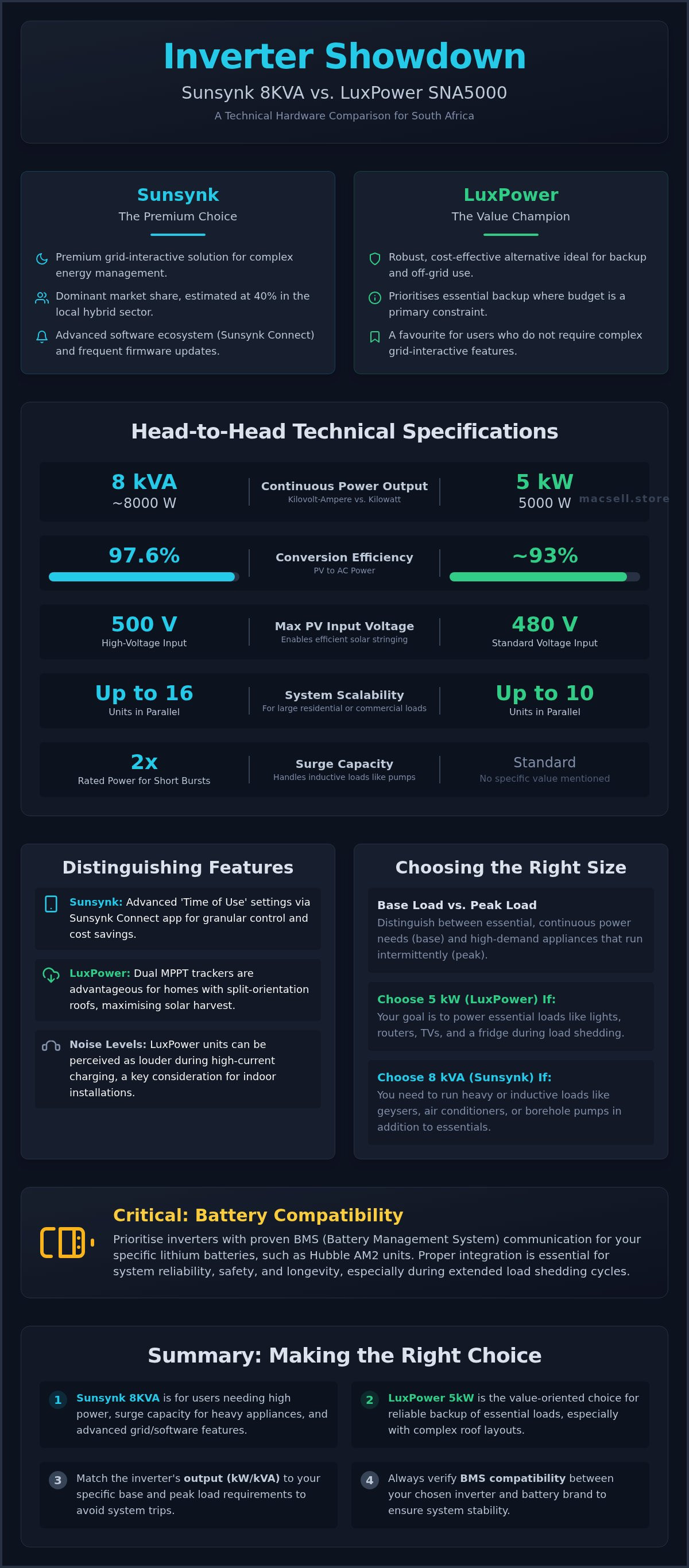
The Sunsynk 8KVA and LuxPower SNA5000 represent two distinct hardware tiers. Sunsynk utilises a high-voltage PV input range, typically reaching up to 500V. This enables efficient string configurations and reduces cable thickness requirements. The LuxPower SNA5000 operates with a slightly lower maximum PV input, usually around 480V. It features dual MPPT trackers. This is technically advantageous for South African homes with split-orientation roofs. Comparing the Sunsynk vs LuxPower inverter South Africa options requires looking at conversion efficiency. Sunsynk generally achieves 97.6% efficiency, whilst LuxPower maintains approximately 93% in standard operating conditions.
Parallel capability is a standard feature for both brands. You can parallel up to 16 Sunsynk units to manage massive residential or light commercial loads. LuxPower SNA5000 units support paralleling up to 10 units. Scaling hardware this way ensures the system handles peak demand without tripping internal breakers. Noise levels are a practical consideration for indoor installations. Sunsynk inverters use large internal fans that activate under load. LuxPower units are often perceived as louder during high-current charging cycles. If you require a silent installation near living areas, hardware placement is critical for user comfort.
Power Output and Surge Capacity
Understanding the difference between KVA and kW is vital for hardware procurement. A 5kW inverter provides 5000 watts of continuous power. An 8KVA unit, depending on the power factor, typically delivers around 8000 watts. Inductive loads like borehole pumps or air conditioners require high surge capacity. Sunsynk hardware is engineered to handle 2x the rated power for short bursts. This prevents system shutdowns when heavy motors start. Integrated surge protection hardware protects internal circuits from grid spikes. For those seeking reliable hardware, you can browse our current inverter inventory to find the correct capacity.
Monitoring and Smart Logic
Sunsynk Connect offers granular control over "Time of Use" settings. This allows users to prioritise battery charging during off-peak hours or solar peaks. The hardware integrates seamlessly with Wi-Fi modules for real-time data. LuxPower uses the LuxPowerView platform. It provides essential data on load, battery status, and solar yield. Remote technical troubleshooting is possible on both platforms. This requires a stable internet connection and the correct Wi-Fi dongle hardware. Ensuring NRS 097-2-1 inverter compliance is mandatory for any system interacting with the national grid.
Battery Integration: Hubble AM2 and Lithium Compatibility
Integration is the most common failure point in hybrid solar installations. In the comparison of Sunsynk vs LuxPower inverter South Africa hardware, the Battery Management System (BMS) dictates overall performance. Sunsynk excels in native communication protocols. It's engineered to read cell-level data from lithium banks in real-time. LuxPower SNA5000 units are highly compatible with local brands like Hubble and Pylontech. However, they often require specific CAN or RS485 cable configurations to function correctly. Managing discharge rates is vital for protecting the lithium battery lifespan. If the inverter pulls too much current during a heavy load, the internal BMS will trip to prevent cell damage. Sunsynk allows for granular discharge limits, whilst LuxPower provides robust, albeit simpler, battery protection settings.
Hubble AM2 5.5 KWh Hardware Synergy
The Sunsynk Hubble combo kit is a preferred hardware pairing in the South African market. This synergy exists because Sunsynk inverters are pre-configured with Hubble’s specific charging profiles. The Hubble AM2 5.5 KWh unit utilises high-quality prismatic cells and a proprietary BMS. Sunsynk hardware optimises the bulk, absorption, and float stages for these specific cells. This precision prevents overcharging and significantly extends the cycle life of the hardware. Using these components together ensures that the inverter doesn't struggle to interpret battery data during rapid state-of-charge changes. For a technical deep-dive on storage options, read our guide on lithium ion solar battery technology.
Closed-Loop vs Open-Loop Communication
Closed-loop communication means the battery and inverter exchange data continuously via a dedicated data cable. The inverter knows the exact State of Charge (SoC), voltage, and temperature of every cell. This increases system safety and efficiency by allowing the inverter to adjust its output based on the battery's real-time health. Open-loop systems rely on voltage settings alone. They're less accurate and can lead to premature battery degradation because the inverter "guesses" the capacity based on voltage drop. Hardware cabling is the foundation of closed-loop setups. You must use shielded RJ45 cables with the correct pinouts for the specific inverter brand. Troubleshooting communication errors often involves checking these physical connections. Mismatched baud rates or faulty cables are the primary causes of "BMS Comm Error" alerts on hybrid displays. Ensuring your hardware is correctly networked is the only way to guarantee 2026-standard reliability.
Sizing Your System: When to Choose 5kW vs 8KVA Hardware
Procurement starts with a load audit. Base load represents your constant consumption, including refrigerators, security systems, and standby electronics. Peak load occurs when high-draw appliances like kettles, stoves, or geysers activate. In the Sunsynk vs LuxPower inverter South Africa debate, 5kW units often fall short for modern households. A 5kW LuxPower SNA5000 or Sunsynk hybrid handles lights, Wi-Fi, and entertainment systems comfortably. These are entry-level hardware choices designed for basic energy security rather than total independence.
Large kitchens and climate control systems require 8KVA hardware. An 8KVA Sunsynk unit provides the overhead necessary to run a geyser and an air conditioner simultaneously whilst maintaining your base load. Attempting to run these on a 5kW system leads to frequent inverter tripping and hardware fatigue. Future-proofing your system is possible through paralleling, but starting with an 8KVA base unit is technically more efficient. It reduces the complexity of your distribution board and simplifies your hardware footprint.
The 8KVA Advantage for Energy Independence
The 8KVA model is the technical "sweet spot" for South African residential requirements. It allows for the management of multiple PV strings across different roof orientations. This is essential for maximising solar harvest throughout the day. This capacity ensures you aren't just surviving load shedding but maintaining a standard lifestyle during extended outages. Choosing the 8KVA Sunsynk provides the flexibility to add more solar panels later without needing a second inverter. For detailed sizing metrics and hardware lists, consult our backup power kit South Africa procurement guide.
Budget Considerations for Hardware Procurement
Balance initial hardware expenditure against long-term electricity savings. Buying the correct capacity now prevents expensive hardware replacements and rewiring costs in the future. Whilst LuxPower offers a lower entry cost for off-grid backup, Sunsynk provides a higher price-per-watt value when considering its grid-interactive features and local support. Investing in 8KVA hardware reduces your reliance on the grid during peak tariff hours, allowing for faster return on investment. It's a strategic choice for those aiming for complete energy autonomy. You can view our solar hardware collection to compare available stock levels for your specific capacity requirements.
Procuring Solar Components: The Logic of Pre-Configured Kits
Sourcing individual components from multiple suppliers creates significant technical risk. Mismatched voltages or incompatible communication protocols often lead to system failure during peak loads. Pre-configured combo kits eliminate these variables by grouping technically aligned hardware. MacSell Solar Outlet operates as a specialised hardware distributor. We ensure that every inverter, battery, and panel in a bundle works as a unified system. National distribution across South Africa allows for efficient logistics. This means delivering complete hardware sets directly to your site without the delay of split shipments. This streamlined approach reduces procurement time and ensures all components arrive simultaneously. It's the most efficient way to secure your 2026 energy requirements.
What is Included in a Professional Hardware Kit?
A professional kit includes the primary power electronics and energy storage required for a functional system. The core consists of a hybrid inverter, a lithium battery, and high-efficiency PV panels. Identifying the correct solar panel for home price is essential for staying within your procurement budget. MacSell focuses on premium brands like Sunsynk, LuxPower, Deye, and Hubble. These manufacturers provide the reliability required for the local energy landscape. By selecting a kit, you benefit from hardware that's been tested for synergy. This includes specific cabling and BMS settings that are often overlooked when buying piecemeal. It's a transactional decision that prioritises system uptime and hardware longevity.
Final Verdict: Sunsynk or LuxPower?
The Sunsynk vs LuxPower inverter South Africa choice depends on your specific application and load profile. Both brands offer robust hardware, but their roles in a power system differ based on technical requirements. Your decision should align with the following criteria:
- Choose Sunsynk for: Grid-tied homes, advanced monitoring, and maximum feature sets. It provides the most comprehensive framework for long-term energy independence.
- Choose LuxPower for: Reliable backup, off-grid cabins, and budget-conscious projects where essential load management is the priority.
Sunsynk remains the premium choice for complex grid interaction and sophisticated energy management. Sourcing high-quality hardware for 2026 projects requires a focus on technical specifications rather than just the initial price tag. Reliable energy starts with correctly matched components and a dependable distribution partner. Prioritise hardware that offers local firmware support and proven lithium compatibility to ensure your system performs under the stress of persistent grid instability.
Securing Your 2026 Energy Independence
Hardware selection determines the long-term success of your solar investment. The Sunsynk vs LuxPower inverter South Africa market offers distinct solutions for varying load profiles. Sunsynk remains the primary choice for complex, grid-interactive energy management whilst LuxPower provides a robust entry point for essential backup. Prioritising technically matched hardware, such as the Sunsynk 8KVA and Hubble AM2 pairing, prevents integration failures and maximises system lifespan.
MacSell Solar Outlet facilitates efficient procurement through national hardware distribution and a focus on premium combo kits. As technical experts in South African solar procurement, we specialise in high-performance configurations that deliver consistent results under grid stress. You can browse the latest Sunsynk and LuxPower hardware at MacSell Solar Outlet to secure the correct system for your property. Investing in verified hardware today ensures a reliable, autonomous power solution for the years ahead.
Frequently Asked Questions
Is the Sunsynk inverter better than LuxPower for load shedding?
Sunsynk is technically superior for load shedding because its firmware is optimised for rapid grid transitions and high-current battery charging. This ensures your batteries reach full capacity between frequent outages. Whilst LuxPower provides a robust backup solution, Sunsynk’s grid-interactive features offer better long-term reliability for users facing Stage 6 cycles. It is the preferred choice for those requiring a feature-rich, high-performance energy management system.
Can I use Hubble batteries with a LuxPower SNA5000 inverter?
You can use Hubble AM2 batteries with a LuxPower SNA5000 inverter provided you establish closed-loop communication. This requires a specific CAN or RS485 data cable to allow the inverter to read the battery's State of Charge (SoC). Using these components together is a common practice in South Africa, although some configurations may require a Cloudlink device to ensure the BMS data is interpreted correctly by the hardware.
What is the warranty period for Sunsynk inverters in South Africa?
Sunsynk hybrid inverters typically carry a 5-year local warranty in South Africa. This period is often extended to 10 years when the inverter is paired with Sunsynk-branded batteries or specific approved lithium partners. It is essential to confirm the warranty terms with your distributor during procurement. Maintaining a valid warranty requires the hardware to be installed according to the manufacturer’s technical specifications and safety guidelines.
Do I need a 5kW or an 8KVA inverter for a standard three-bedroom house?
An 8KVA inverter is the recommended choice for a standard three-bedroom house with high-draw appliances like geysers and air conditioners. A 5kW system is generally limited to essential loads like lights, refrigerators, and Wi-Fi. When evaluating Sunsynk vs LuxPower inverter South Africa options, the 8KVA Sunsynk provides the necessary power overhead to run multiple appliances simultaneously without overloading the hardware during peak consumption periods or grid outages.
Is LuxPower a hybrid or an off-grid inverter?
The LuxPower SNA5000 is primarily an off-grid inverter that can utilise the grid as a supplemental power source. It does not export excess solar energy back to the utility grid, which simplifies the municipal registration process. This makes it a robust and cost-effective choice for residential backup systems where the primary objective is energy security during load shedding rather than complex grid-interactive energy trading.
Can Sunsynk inverters be paralleled for more power?
Sunsynk inverters can be paralleled to increase the total power capacity of your system. You can connect up to 16 units in a single installation to manage large residential or light commercial energy loads. This modular hardware approach allows you to expand your solar array and battery bank over time. It ensures that your system can grow alongside your household’s increasing energy requirements without replacing the original unit.
What happens if my inverter hardware fails during load shedding?
If your inverter hardware fails during load shedding, the system will typically shut down or attempt to bypass to grid power if it is available. Modern units include internal protection mechanisms to prevent circuit damage from grid spikes or thermal overload. MacSell Solar Outlet stocks high-end hardware with established local support networks to facilitate technical assessments. Reliable hardware is critical to ensure your power remains stable during outages.
Are Sunsynk inverters NRS approved for grid-tie systems?
Yes, Sunsynk hybrid inverters are NRS 097-2-1 approved for grid-tied systems in South Africa. This certification is a legal requirement for any inverter connected to the national grid. It ensures the hardware meets strict safety standards, including anti-islanding protection. Using NRS-approved hardware allows you to formally register your solar installation with your local municipality, ensuring compliance with current national energy regulations and safety codes.