

Reliable Home Backup Power Supply: 2026 Hardware Guide
Buying a backup power supply based on price alone is the most expensive mistake a homeowner can make in 2026. The financial risk of trial and error with unbranded hardware often exceeds the initial cost of a premium, engineered system. It's frustrating to face a blackout only to realise your inverter cannot handle the start-up surge. Incompatible batteries and controllers create unnecessary failure points. We understand the confusion surrounding kVA versus kW ratings and the anxiety of investing in hardware that might be incompatible.
This guide provides a definitive hardware blueprint to ensure your energy security during load shedding. You'll learn how to size your system accurately and choose between proven brands like Sunsynk, Deye, and LuxPower. We'll move past the marketing hype to focus on the technical parameters that define a truly reliable backup power supply. By the end of this article, you'll have the technical confidence to procure a system that works the first time, every time.
Key Takeaways
- Identify must-run appliances and calculate total continuous load to ensure your hardware meets real-world power demands.
- Navigate the technical differences between Sunsynk, Deye, and LuxPower hardware to select the right hybrid inverter for your backup power supply.
- Distinguish between high-voltage and low-voltage lithium storage systems to maximise the efficiency and lifespan of your battery bank.
- Learn to organise your electrical circuits into essential and non-essential loads to extend runtime during prolonged outages.
- Streamline procurement by using pre-configured hardware combo kits that eliminate compatibility risks between inverters and batteries.
Defining the Modern Backup Power Supply: UPS vs Hybrid Systems
A modern backup power supply is a coordinated hardware assembly. It consists of two primary components: a power inverter and a battery storage bank. Whilst many consumers associate backup power with small desktop units, the 2026 technical standard has shifted towards high-capacity hybrid systems. A traditional Uninterruptible Power Supply (UPS) is designed for short-term bridge power, providing just enough time to shut down equipment safely. In contrast, a hybrid system provides sustained energy for hours or days during persistent load shedding. It functions as a local micro-grid that manages energy flow between the utility provider and your home.
Technical precision matters when selecting hardware. Pure Sine Wave output is a non-negotiable requirement for any reliable backup power supply. Modified sine wave inverters are cheaper but produce electrical noise that creates heat in motors and power supplies. This can degrade the lifespan of sensitive electronics or cause fridge compressors to fail prematurely. A Pure Sine Wave system ensures the electricity reaching your appliances is as clean as the utility grid supply.
Why Portable Power Stations May Not Be Enough
Portable "plug-and-play" units are popular for their simplicity, yet they often fail as a long-term energy strategy. These integrated systems typically suffer from poor repairability. If one internal component fails, the entire unit is often rendered useless. The hardware cost per kWh for portable Lithium Iron Phosphate (LFP) units also remains significantly higher than dedicated fixed batteries. Fixed lithium storage hardware, such as the Hubble AM2 5.5kWh, offers superior cycle life and thermal stability at a better price point. Permanent integration into your home's distribution board (DB) removes the need for extension cords. It allows the system to automatically energise pre-selected circuits, such as security systems and lighting, the moment the grid fails.
The Role of the Hybrid Inverter in Energy Security
The hybrid inverter is the brain of your backup power supply. Advanced hardware, such as the LuxPower SNA5000 Hybrid Inverter, does more than just convert DC to AC. It actively manages power flow from multiple sources including the grid, battery banks, and solar panels. A critical specification for energy security is the transition speed. To prevent sensitive hardware like gaming PCs or home servers from rebooting, the inverter must switch to battery power in under 20 milliseconds (ms). Hybrid inverters also provide future-proofing. You can start with a grid-tied backup system today and add solar panels later without replacing your core hardware. This modularity is the foundation of true energy independence.
How to Size Your Backup Power Supply: A Step-by-Step Calculation
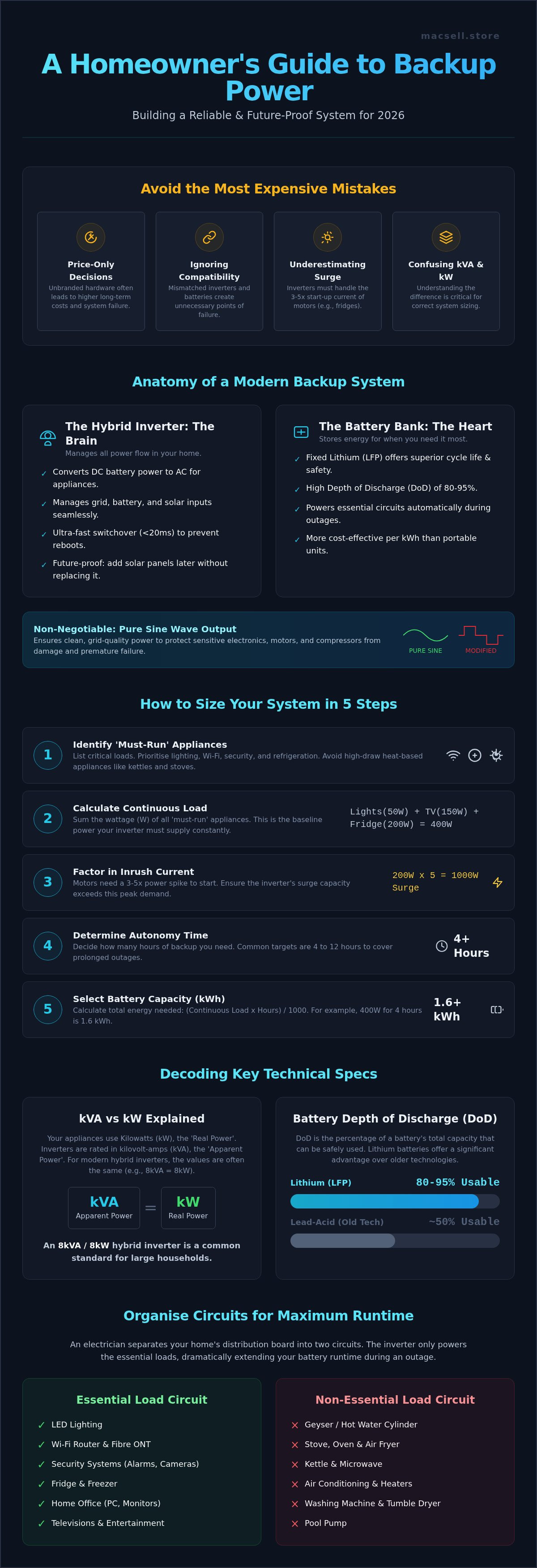
Sizing a backup power supply is a precise engineering exercise. Guesswork often results in system overloads or premature battery failure. Effective Power outage preparedness begins with a rigorous audit of your electrical demands. Follow these five steps to define your hardware requirements.
- Step 1: Identify 'must-run' appliances. Focus on critical loads such as LED lighting, Wi-Fi routers, refrigerators, and security systems. Avoid high-draw thermal loads like kettles or heaters unless your budget allows for significant over-speccing.
- Step 2: Calculate 'Continuous Load'. Sum the wattage of all identified appliances. This figure represents the baseline power your inverter must provide at any given second.
- Step 3: Factor in 'Inrush Current'. Motorised appliances like fridge compressors require three to five times their rated wattage to start. Your inverter must have sufficient surge capacity to handle these spikes.
- Step 4: Determine 'Autonomy Time'. Decide how many hours of load shedding you need to bridge. Common requirements in 2026 range from four to twelve hours.
- Step 5: Select battery capacity. Calculate the total energy required (Watts x Hours) and adjust for Depth of Discharge (DoD) limits. Lithium cells typically offer 80% to 95% usable capacity.
Understanding kVA vs kW in Inverter Sizing
Inverter capacity is often listed in kilovolt-amps (kVA), yet your appliances consume kilowatts (kW). This distinction is critical because the actual work done is measured in kW. An 8KVA hybrid inverter is the standard choice for large households as it typically provides 8kW of continuous output, allowing for simultaneous use of multiple appliances. Power Factor represents the ratio of actual power used in the circuit to the apparent power delivered to the circuit. When selecting hardware, always prioritise the kW rating to ensure your backup power supply meets your peak demand.
Calculating Battery Capacity for Long Outages
A lithium ion solar battery is the superior choice for deep cycling compared to lead-acid alternatives. To compare hardware accurately, convert Amp-hours (Ah) to Kilowatt-hours (kWh) using the formula: (Volts x Ah) / 1000. For example, a 48V 100Ah battery provides 4.8kWh of total energy. Always factor in a 20% safety margin to avoid fully depleting your cells, which preserves the hardware's cycle life. If you are unsure about matching components, you can browse our pre-configured hardware options to ensure perfect system synchronisation.
Choosing Between Hybrid Inverters and Lithium Storage Hardware
Selecting hardware for a backup power supply requires a focus on technical compatibility rather than brand popularity alone. In 2026, the industry standard for safety is Lithium Iron Phosphate (LiFePO4) chemistry. Unlike older lithium-ion variants, LiFePO4 offers superior thermal stability and zero risk of thermal runaway. Communication between the battery and inverter is equally critical. Modern systems utilise CANbus or RS485 protocols to allow the Battery Management System (BMS) to dictate charge and discharge parameters to the inverter. This prevents overcharging and extends hardware life.
The choice between high-voltage and low-voltage battery systems depends on your scaling requirements. Most residential installations utilise low-voltage (48V) hardware due to the ease of adding parallel batteries over time. High-voltage systems offer slightly better conversion efficiency but require specific, matched battery strings that are harder to expand incrementally. For most users, a 48V architecture provides the best balance of performance and future flexibility.
Sunsynk and Deye: The Powerhouse Choice
The Sunsynk vs Deye inverter debate centres on reliability and user interface. Both brands share a similar internal architecture, offering high-load performance and robust surge handling. These inverters feature user-friendly touchscreens that provide real-time data on energy production and consumption. Advanced monitoring via Wi-Fi allows users to adjust settings remotely to prepare for scheduled load shedding. A key technical advantage is their parallel capability; you can link multiple units to scale your backup power supply from a single-phase 5kW system to a massive three-phase industrial array as your energy needs grow.
Hubble Lithium Batteries: Efficiency and Longevity
The Hubble AM2 5.5kWh lithium battery is a high-performance storage solution designed for heavy discharge cycles. A significant technical differentiator is the 1C discharge rate. This allows a single AM2 battery to provide a full 5.5kW of power continuously, whereas many competitors are limited to 0.5C (half their rated capacity). This high discharge capability is vital for handling the peak demands of a modern household without tripping the BMS. With an expected cycle life of 6,000+ cycles at 80% Depth of Discharge, these units provide approximately 10 to 15 years of daily operation. This longevity makes them a more cost-effective investment than lead-acid or lower-tier lithium alternatives over the system's total lifespan.
Organising Your Essential Load Circuit for Maximum Runtime
A backup power supply is only as effective as the circuit design it supports. Achieving energy security requires a disciplined approach to load management. In 2026, the technical standard involves a physical separation of circuits within the home's distribution board (DB). This ensures that high-current appliances do not inadvertently drain the battery bank during an outage. An Automatic Transfer Switch (ATS) is the essential hardware component for this task. It facilitates the transition between grid and battery power in under 20 milliseconds, protecting sensitive electronics from power dips.
Inverter 'Work Modes' are equally vital during periods of intense load shedding. In Stage 6 scenarios, users should configure their hardware to prioritise battery state-of-charge (SoC). Setting a higher recharge threshold ensures the system is ready for the next scheduled blackout. This proactive management prevents the lithium cells from remaining in a discharged state for prolonged periods, which is critical for long-term hardware health.
What to Keep on the Backup Circuit
Categorisation is the primary method for extending runtime. By grouping appliances, you can ensure that critical systems remain online whilst non-essential items are shed automatically.
- Essential Loads: These circuits must remain active to maintain safety and connectivity. This category includes LED lighting, Wi-Fi routers, security systems, and refrigerators.
- Selective Loads: These are convenience items used intermittently. Televisions, laptops, and low-power fans are suitable if the battery capacity allows.
- Excluded Loads: Thermal appliances like geysers, ovens, and air conditioning units should remain on the non-essential side of the DB. These items will deplete a standard lithium bank rapidly. Only households with high-capacity 8kVA+ systems should consider backing up these loads.
Managing Peak Demand to Prevent Inverter Trips
Peak demand management prevents system shutdowns. A standard kettle or hairdryer can draw upwards of 2,500 Watts. On a smaller 3kW backup power supply, this load leaves almost no headroom for other appliances. If multiple high-draw devices start simultaneously, the inverter will trip to protect its internal circuitry. This is why understanding the kW rating discussed in previous sections is so vital.
Modern hybrid hardware includes 'Peak Shaving' features. This allows the inverter to supplement grid power with battery power to manage high-demand spikes without tripping the main breaker. Additionally, smart plugs can automate load shedding behaviour for non-essential items. You can program these to disconnect automatically the moment the system switches to battery mode. To secure your energy independence, procure your hybrid inverter and battery hardware from our curated inventory.
Procuring Your Hardware: Combo Kits and Component Compatibility
Procurement is the final hurdle in establishing a reliable backup power supply. Buying components from multiple sources often leads to communication errors between the Battery Management System (BMS) and the inverter. Pre-configured combo kits eliminate this risk by ensuring all firmware and communication protocols are synchronised before delivery. Selecting a national retailer with immediate stock availability is essential in 2026 to avoid the long lead times associated with imported hardware. It's better to invest in a verified pairing than to risk the high cost of trial and error with unbranded components.
The Sunsynk 8KVA and Hubble AM2 Combo Advantage
The inverter and battery combo featuring the Sunsynk 8KVA and Hubble AM2 units is the current benchmark for residential energy security. This system provides a robust 8kW continuous output, which comfortably manages the essential loads discussed in previous sections without hardware stress. It's a balanced solution for a standard family home. The Hubble AM2 5.5kWh lithium batteries are designed for seamless integration with the Sunsynk control logic. This allows for precise monitoring of the state of charge through the inverter's interface. If your energy requirements grow, the modular nature of this hardware makes it simple to add more Hubble units to increase your total backup duration.
Final Procurement Checklist
A successful installation requires more than just the primary inverter and battery. You must account for the peripheral hardware that ensures system safety and electrical compliance. Use a comprehensive solar power hardware checklist to verify you have the following items:
- DC Circuit Breakers: These must be sized for the battery bank's peak discharge current.
- AC Surge Protection: Vital for guarding against grid voltage spikes when the power returns after load shedding.
- Battery Cables: Ensure the correct cross-sectional area (mm²) to prevent heat build-up and voltage drop.
- DC Isolators: Required for safe maintenance and emergency system shutdown.
Ensuring these components are present before the procurement process ends prevents costly delays and technical failures. Browse the latest backup power supply hardware at MacSell Solar Outlet.
Securing Your Energy Independence in 2026
Establishing a resilient backup power supply is a technical investment that demands precision in both sizing and component selection. Success depends on matching high-discharge lithium batteries with efficient hybrid inverters that communicate via CANbus or RS485 protocols. By organising your distribution board into essential load circuits and utilising pre-configured combo kits, you eliminate the risks of system overload and hardware incompatibility. This modular approach allows you to scale your storage capacity as your household energy requirements evolve.
MacSell Solar Outlet provides the professional-grade tools required for this transition. We are specialist retailers of Hubble Energy batteries and leading stockists of Sunsynk, Deye, and LuxPower hybrid inverters. With reliable national delivery across South Africa, we ensure that premium energy hardware is accessible for your specific engineering requirements. Procuring verified, compatible hardware is the most effective way to guarantee long-term performance and peace of mind during grid instability. It's time to take control of your home's power security with hardware that works the first time.
Shop Premium Backup Power Supply Hardware at MacSell Solar Outlet
Frequently Asked Questions
What is the difference between a UPS and a backup power supply?
A traditional UPS provides short-term bridge power, giving you minutes to save data and shut down equipment safely. In contrast, a modern backup power supply is an engineered system designed to sustain your home for hours. These systems utilise high-capacity lithium batteries and hybrid inverters to manage persistent load shedding. Whilst a UPS is often a standalone plug-and-play unit, a backup system integrates directly into your distribution board to energise multiple circuits simultaneously.
How long will a 5.5kWh lithium battery last during load shedding?
Runtime depends entirely on your continuous electrical load. A 5.5kWh lithium battery, such as the Hubble AM2, provides approximately 5,000 usable Watt-hours at a 90% depth of discharge. If your critical load is 500W, which typically covers lighting, Wi-Fi, and a fridge, the battery will last for roughly 10 hours. Increasing the load to 1,000W will reduce this duration to 5 hours. Always calculate your specific wattage to ensure your energy security during outages.
Can I use my backup power supply to run a fridge and a TV?
Yes, a correctly sized backup power supply can easily power a fridge and a television. A standard fridge-freezer consumes between 100W and 200W once running, but you must account for the high inrush current required to start the compressor. Most hybrid inverters, like the LuxPower SNA5000, handle these surges without issue. By keeping high-draw thermal appliances off the circuit, you ensure there is enough capacity to run entertainment and refrigeration throughout a four-hour load shedding block.
Do I need solar panels for a backup power supply to work?
Solar panels are not a requirement for the system to function. A backup power system can operate as a grid-only solution, where the hybrid inverter charges the batteries from the utility supply whilst the grid is active. The system then discharges that stored energy during blackouts. However, adding solar panels provides the benefit of energy independence and lower utility costs. Most modern hardware allows you to start with a battery-only system and add panels later.
How many batteries do I need for an 8KVA Sunsynk inverter?
For an 8KVA Sunsynk inverter, we recommend a minimum of two 5.5kWh lithium batteries to match the inverter's high discharge capability. Whilst the system will function with a single battery, the 8kW output of the inverter can easily exceed the safe discharge rate of a single unit during peak loads. Using two Hubble AM2 units in parallel ensures the battery bank can provide the necessary current without tripping the internal management system or overheating the cells.
Is it better to buy a pre-built combo kit or separate components?
Buying a pre-configured combo kit is generally superior because it guarantees 100% technical compatibility between the inverter and the battery. These kits, such as our Sunsynk 8KVA and Hubble AM2 packages, ensure that communication protocols like CANbus are pre-tested and ready for use. Sourcing separate components increases the risk of firmware mismatches and communication errors. Combo kits also simplify the procurement process by including the necessary primary hardware in a single, verified bundle.
What is the lifespan of a lithium battery in a backup system?
High-quality LiFePO4 batteries typically offer a lifespan of 10 to 15 years depending on usage frequency and depth of discharge. Most premium units are rated for 6,000 cycles or more before their capacity drops below 80% of the original rating. This longevity far exceeds traditional lead-acid or gel batteries, which often fail within two years of regular load shedding. Maintaining the battery in a temperature-controlled environment and avoiding total depletion will maximise your hardware's operational life.
Can I install a backup power supply myself?
We do not recommend self-installation. A backup power system must be integrated into your home's distribution board, which involves working with high-voltage AC and high-current DC circuits. In South Africa, a legal installation requires a Certificate of Compliance (CoC) issued by a registered electrician for insurance and safety purposes. Incorrect wiring can lead to hardware damage, fire risks, or the voiding of manufacturer warranties. Always procure your hardware from a specialist retailer and engage a qualified professional for the physical integration.