

Sizing a Hybrid Inverter for South Africa (2026 Guide)
Selecting the smallest unit to save on costs often results in a system that trips the moment your fridge and borehole pump start simultaneously. Conversely, purchasing the largest available inverter might waste capital on capacity your battery bank cannot service. It is a technical calculation where precision matters more than guesswork. You are likely facing the daily reality of load shedding and the complexity of kVA versus kW ratings while Eskom tariffs escalate. Choosing between a 5KVA vs 8KVA inverter for home South Africa installations requires a clear understanding of peak demand and hardware limitations.
This 2026 guide provides the technical framework for accurate system sizing. We will cover inductive surge load calculations and mandatory NRS 097-2-1:2024 grid interconnection standards. We will compare high-performance hardware like the Sunsynk 8KVA and LuxPower SNA5000 to ensure your essential circuits remain active. We will also break down power factor adjustments and battery compatibility to move you from technical confusion to a confident hardware procurement decision before the September 2026 SSEG registration deadline. This is about practical reliability and ensuring your household remains operational through every power interruption.
Key Takeaways
- Identify the critical difference between continuous running loads and inductive surge loads to prevent system overloads during appliance start-up.
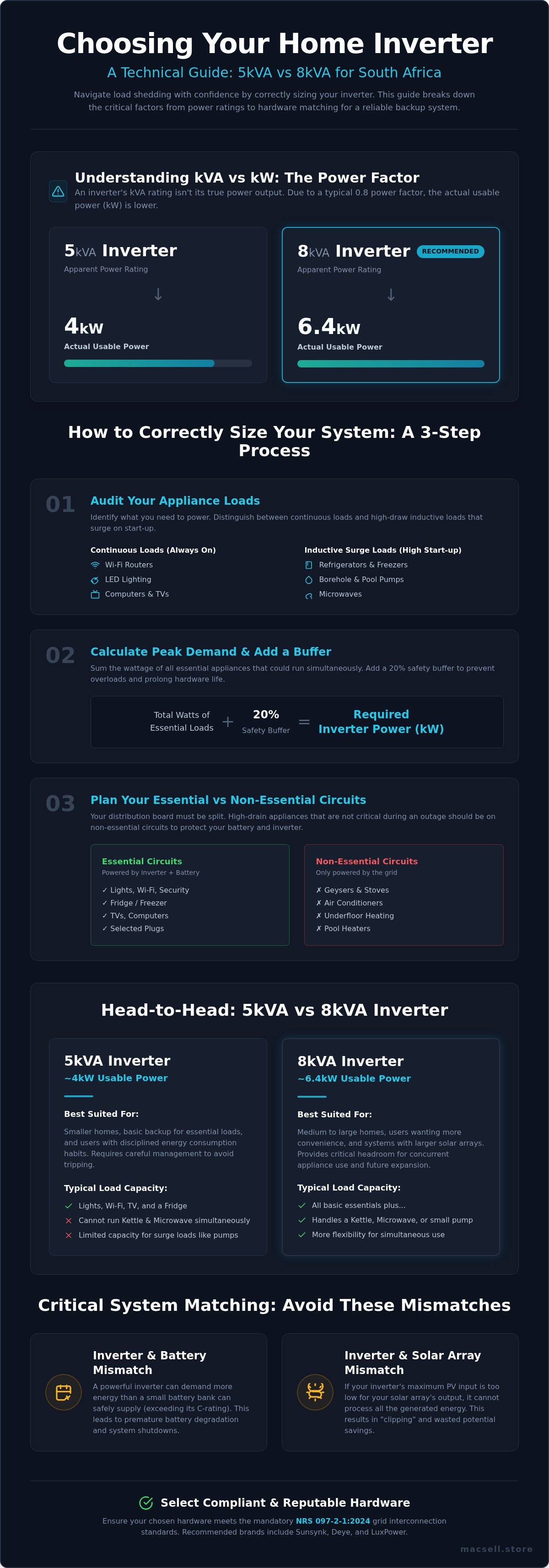
- Understand the 0.8 power factor conversion to recognise why a 5kVA rating often equates to only 4kW of actual usable power.
- Evaluate the technical specifications of a 5KVA vs 8KVA inverter for home South Africa installations to match hardware capacity with your essential circuit requirements.
- Avoid the battery-inverter mismatch trap by calculating C-ratings to ensure your lithium storage can meet the discharge demands of the inverter.
- Select compliant hardware from brands like Sunsynk, Deye, and LuxPower that meet the mandatory NRS 097-2-1:2024 grid interconnection standards.
Why Inverter Sizing is Critical for South African Load Shedding Resilience
A hybrid inverter acts as the central intelligence of your solar installation. It manages the flow of electricity between the national grid, your solar panels, and your battery bank. Understanding what a solar inverter does is vital for anyone planning a resilient system. In South Africa, the inverter must respond to frequent grid interruptions, often switching multiple times a day during Stage 4 or higher load shedding. Undersizing this component leads to frequent system trips and hardware fatigue. When deciding between a 5KVA vs 8KVA inverter for home South Africa applications, you must consider the total peak demand of your household. An 8kVA unit provides more headroom for concurrent appliance use, whereas a 5kVA system requires strict energy management to prevent the inverter from shutting down under load.
Distinguishing between a simple backup system and full solar-integrated independence is the first step in procurement. A backup-only system merely keeps the lights on, but a properly sized hybrid system allows you to use harvested solar energy to offset rising Eskom tariffs. If your inverter is too small, it can't process the full output of a large solar array, effectively wasting potential energy generation. This mismatch limits your ability to reduce grid reliance and extends your return on investment period.
The Essential vs Non-Essential Load Split
A standard residential installation involves splitting the distribution board (DB) into essential and non-essential circuits. You can't run high-drain appliances like geysers, ovens, or air conditioners on a standard inverter without rapidly exhausting your battery bank or exceeding the inverter's capacity. Essential circuits typically include LED lighting, Wi-Fi routers, security systems, and refrigerators. The physical wiring of your DB board dictates your hardware choice. If you want to include more heavy appliances in your backup plan, such as a microwave or a kettle, the Sunsynk 8KVA is often the minimum requirement to handle the combined load. Failure to separate these loads correctly results in the inverter tripping every time a non-essential appliance turns on during a power outage.
Single-Phase vs Three-Phase Requirements
Your home's connection to the municipal grid limits your hardware options. Most South African homes use a single-phase supply, but larger properties often have a three-phase connection. If you have a three-phase supply, you must either install a dedicated three-phase inverter or use three identical single-phase units, such as three LuxPower SNA5000 inverters, to maintain phase balance. Sizing for phase balance is critical. Overloading a single leg of your supply can lead to voltage drops or equipment failure. Accurate hardware procurement ensures your system handles these technical demands without constant manual intervention or hardware resets. This technical alignment is what separates a basic backup system from a fully integrated solar solution.
Step 1: Calculating Peak Demand and Inductive Surge Loads
To size your system correctly, you must compile a detailed load list using the nameplate ratings found on the back of your appliances. These ratings, measured in Watts (W), represent the maximum power the device draws under normal operating conditions. When comparing a 5KVA vs 8KVA inverter for home South Africa, the total wattage of all simultaneously active devices determines your requirement. You must distinguish between continuous load and peak load. Continuous load is the power needed to keep a device running, while peak load is the massive energy spike required to start it.
Applying a 20% safety buffer is standard technical practice. Running an inverter at 100% capacity for extended periods during Stage 6 load shedding increases heat generation and reduces the lifespan of internal components. If your calculated peak demand is 4kW, an 8kVA unit is often preferable over a 5kVA unit to maintain this buffer. This approach also accounts for South Africa's renewable energy landscape, where grid stability remains unpredictable and hardware resilience is paramount. Don't buy for today's needs alone; factor in future solar panel additions or increased battery capacity now.
Managing Inductive Loads: Pumps and Fridges
Compressor-based appliances like refrigerators and motorised equipment like pool pumps present a specific challenge. These devices require an inrush current that is often 3 to 5 times their rated running power. A 750W pool pump might pull 3kW for several seconds upon start-up. If your inverter cannot handle this momentary surge, the system will trip immediately. You must match the inrush current to the inverter's surge rating. Technical tip: Look for the peak kVA rating in the LuxPower SNA5000 price and technical reference guide (2026) to see how different models handle these spikes.
The Base Load Calculation
Base load refers to the constant power draw from vampire appliances like Wi-Fi routers, alarm systems, and TVs on standby. While individually small, a 200W base load consumes 0.8kWh during a 4-hour load shedding slot. This constant drain affects battery depletion rates more than occasional high-load events. Measuring your base load is essential when deciding on a 5KVA vs 8KVA inverter for home South Africa, as it determines your minimum discharge rate. Using smart meters or energy monitors provides accurate real-world consumption data, allowing for precise hardware selection. Before committing to a specific kit, you can browse hybrid inverter specifications to ensure the hardware aligns with your measured base load and peak requirements.
Understanding Power Ratings: kVA vs kW and Efficiency Factors
Inverter capacity is typically defined in kilovolt-amperes (kVA), but your household appliances consume power in kilowatts (kW). These two figures aren't identical. The Power Factor (PF) is the ratio that defines the real power available for use. For modern hybrid systems in 2026, a 0.8 power factor is the industry benchmark. This means a 5kVA inverter only provides 4kW of usable power. If you calculate your peak demand at 4.5kW, a 5kVA unit will fail. When evaluating a 5KVA vs 8KVA inverter for home South Africa installations, always calculate based on the kW rating to avoid nuisance tripping during load shedding.
Efficiency curves also dictate hardware performance. Most inverters reach their peak efficiency when operating at 40% to 70% of their maximum load. Running a system consistently at 90% capacity generates excessive heat and increases internal wear. Thermal derating is an additional risk during South African summers. If the ambient temperature in your battery room exceeds 40°C, the inverter might automatically reduce its output to protect its circuitry. Sizing up to an 8kVA unit provides the necessary headroom to stay within the optimal efficiency window even during heatwaves.
5KVA vs 8KVA Inverter for Home South Africa: Sizing by Household Type
Small flats with 1 or 2 bedrooms can often manage on a 3kVA unit for basic lights and Wi-Fi, but this offers zero capacity for kitchen appliances. Standard 3-bedroom family homes are the primary market for the 5KVA vs 8KVA inverter for home South Africa debate. This choice often depends on the LuxPower vs Sunsynk inverter hardware comparison, where specific needs for geyser control or borehole pumps dictate the final decision. Large estates with multiple geysers or extensive outdoor lighting should jump directly to 8kVA or 12kVA solutions to avoid the limitations of smaller hardware.
Paralleling Inverters for Scalability
Scalability is a major advantage of brands like Sunsynk and Deye. These manufacturers allow you to parallel multiple units, meaning you can start with one 5kVA inverter and add a second unit later as your budget allows. Synchronising multiple inverters requires identical hardware and firmware versions to ensure the load is shared equally amongst the array. While installing two 5kVA units provides redundancy, a single 8kVA unit is often more cost-effective for households that need higher capacity immediately without the technical complexity of a multi-inverter setup. This modular approach allows for growth without discarding your initial investment.
Matching Inverter Capacity with Battery and Solar Input
Procuring a high-capacity inverter without a corresponding battery bank is a common technical oversight. This mismatch creates a bottleneck where the inverter's potential remains inaccessible because the energy storage cannot meet the discharge demand. When comparing a 5KVA vs 8KVA inverter for home South Africa, you must evaluate the C-rating of your batteries. A C-rating defines the speed at which a battery can be discharged relative to its maximum capacity. For example, a 5.12kWh battery with a 0.5C rating can only provide 2.56kW of continuous power. Pairing a single 0.5C battery with an 8kVA inverter is a failure in design; the battery's Management System (BMS) will trip as soon as the load exceeds the discharge limit.
MPPT (Maximum Power Point Tracking) sizing is equally critical. Every inverter has a maximum DC input limit and a specific operating voltage window. You must ensure your solar string voltage falls within the inverter’s "sweet spot" to maintain efficiency. If the voltage is too low, the inverter won't start; if it's too high, you risk permanent hardware damage. Professional system design requires matching the total panel wattage to these MPPT parameters to ensure the hardware operates within its safety margins during peak South African solar radiation.
Battery Discharge and Inverter Demand
A single 5kWh battery might struggle to power an 8kVA inverter at full load, especially during the extended 4-hour slots typical of Stage 6 load shedding. To achieve true resilience, your battery bank must be sized for both peak discharge and total energy capacity. You can find detailed specifications in our guide to lithium ion solar battery technology to understand how different cells handle high-current demands. Sizing for autonomy means calculating your base load across a 4-hour window whilst allowing enough headroom for essential surges. If you need to run high-drain appliances during an outage, doubling your battery bank is often mandatory for an 8kVA system.
Solar Array Over-Sizing (DC-to-AC Ratio)
Oversizing your solar array by approximately 20% relative to the inverter’s AC rating is a standard strategy to maximise yield. This 1.2:1 DC-to-AC ratio ensures that the system produces enough power during cloudy South African winter days or early morning hours. Whilst this may lead to "clipping" during peak summer midday periods, where the panels produce more than the inverter can process, the overall daily energy harvest is significantly higher. This approach keeps your batteries charged even when solar conditions are sub-optimal. To secure the correct hardware for your array, you can buy hybrid inverters and lithium batteries directly from our inventory for national delivery.
Hardware Selection: Comparing Sunsynk, Deye, and LuxPower Solutions
Choosing the correct brand is as critical as the 5KVA vs 8KVA inverter for home South Africa sizing decision. The Sunsynk 8KVA remains the premium choice for high-load households due to its dual MPPT trackers and high DC input limits. It handles complex solar arrays across multiple roof orientations more effectively than entry-level units. Deye offers a versatile alternative with identical hardware architecture but different firmware priorities. Both brands provide robust parallel capabilities; you can synchronise multiple units to scale your system as your demand grows. For budget-conscious users, the LuxPower SNA5000 is the best-value off-grid hybrid. It provides reliable backup for essential circuits without the higher cost of a fully grid-tied Sunsynk unit.
Pre-configured combo kits offer the highest level of technical compatibility for South African users. These kits ensure the inverter's communication protocol matches the battery's BMS, eliminating the risk of communication errors that can lead to system shutdowns. A Sunsynk 8KVA paired with Hubble AM2 batteries is the gold standard for medium-to-large households. This hardware combination handles the rapid discharge cycles required during Stage 6 load shedding whilst maintaining a long operational lifespan. Selecting a kit removes the guesswork from hardware matching and ensures all components operate within their designed safety margins.
Technical Comparison: Sunsynk vs Deye
The user interface and remote monitoring features are the primary differentiators for South African users. Sunsynk's cloud-based platform provides granular data on solar harvest and battery health, allowing for precise system tuning via a mobile app. Deye’s monitoring is equally robust but often appeals to technical users who prefer manual configuration options. Local support and warranty availability are critical factors in the hybrid inverter price South Africa market. Both brands maintain a strong local presence, ensuring that spare parts and technical assistance are accessible if hardware issues arise. The Sunsynk 8KVA is the undisputed market leader for 2026 households requiring a balance of high performance and long-term reliability.
Procuring Your Hardware
Procuring hardware from a specialised solar outlet ensures you receive technical accuracy rather than just a retail transaction. You must verify stock availability for specific projects, such as the Sunsynk Hubble combo kit, which remains in high demand due to its proven performance. A successful installation requires more than just the core units. Your final procurement checklist must include:
- Hybrid Inverter: Sunsynk, Deye, or LuxPower SNA5000 based on your measured load.
- Lithium Batteries: Hubble AM2 or compatible high-discharge cells.
- Protection Gear: DC and AC surge protection, fuses, and isolators.
- Cabling: Correct gauge DC battery cables and solar string wires for minimal voltage drop.
This systematic approach to hardware procurement reduces the risk of project delays and equipment failure. By matching the 5KVA vs 8KVA inverter for home South Africa requirement with these specific brands, you secure a system capable of managing the national grid's unpredictability whilst reducing your reliance on Eskom.
Securing Long-Term Energy Reliability
Successful load shedding resilience depends on technical alignment between your inverter capacity, battery discharge limits, and peak surge demands. You now understand that the choice of a 5KVA vs 8KVA inverter for home South Africa installations is dictated by your essential load list and the 0.8 power factor conversion. Selecting an 8kVA unit provides the necessary headroom for inductive loads like pumps; whereas a 5kVA system remains a viable entry point for managed essential circuits.
Precision in hardware procurement prevents system fatigue and ensures your setup remains compliant with the September 2026 SSEG registration deadline. We are a Sunsynk and Deye Authorised Retailer and Hubble lithium battery specialist. We provide the technical expertise needed for a seamless transition to solar independence. View our 2026 Hybrid Inverter Range and Combo Kits to secure high-performance hardware with national SA delivery on all orders. Take control of your home's power requirements today with a system sized for the specific demands of the South African grid.
Frequently Asked Questions
How do I know if I need a 5kW or 8kW hybrid inverter?
You determine the requirement by calculating your simultaneous peak demand in Watts. A 5kW unit typically manages essential circuits like lights, Wi-Fi, and a fridge, but an 8kW inverter is necessary if you intend to run a kettle, microwave, or borehole pump during load shedding. Ensure you factor in a 20 per cent safety buffer to prevent the hardware from running at maximum capacity, which extends the operational lifespan of the internal components.
Can I run my air conditioner on a 5kVA hybrid inverter?
Modern inverter-type air conditioners can run on a 5kVA system provided the total household load remains below 4kW. However, older non-inverter units have high inductive start-up surges that often exceed a 5kVA inverter's surge capacity. For consistent cooling alongside other essential appliances, an 8kVA unit is the more reliable choice. Always check the nameplate rating of your air conditioner to calculate the specific inrush current requirements before connecting the hardware.
What is the difference between kVA and kW in inverter sizing?
kVA represents the total apparent power, while kW represents the actual real power available for work. In the South African market, most hybrid inverters operate with a 0.8 power factor. This means a 5kVA unit provides 4kW of usable power, and an 8kVA unit provides 6.4kW. Misunderstanding this conversion often leads to system overloads, as users attempt to draw 5kW from a 5kVA machine, which is technically impossible under standard operating conditions.
How many solar panels can I connect to an 8kVA Sunsynk inverter?
An 8kVA Sunsynk inverter features a maximum DC input of 10,400W across two MPPT trackers. This allows for approximately sixteen to twenty high-efficiency 550W panels, depending on the specific string configuration and voltage limits. You must ensure the total string voltage stays within the 125V to 500V operating window. Oversizing the DC array by 20 per cent is recommended to maintain battery charging efficiency during overcast winter conditions in South African provinces.
What happens if I undersize my inverter for my home?
Undersizing results in frequent nuisance tripping when multiple appliances start simultaneously. The inverter will enter an overload protection mode and shut down power to all essential circuits. Constant operation near 100 per cent capacity also generates excessive heat, leading to thermal derating and premature hardware failure. When debating a 5KVA vs 8KVA inverter for home South Africa installations, choosing the larger unit prevents these service interruptions and protects your long-term hardware investment.
Is a hybrid inverter better than a standard UPS for load shedding?
A hybrid inverter is superior because it manages solar input, battery storage, and grid power simultaneously. Standard UPS systems are designed for short-term backup of low-power electronics and lack the surge capacity to handle household appliances. Hybrid units like the LuxPower SNA5000 offer advanced firmware to prioritise solar self-consumption, significantly reducing your Eskom bill. They also provide faster recharge rates and better compatibility with high-capacity lithium battery technology for extended power outages.
Can I add more batteries to my inverter at a later stage?
Yes, most modern hybrid systems allow for parallel battery expansion. If you use Hubble AM2 lithium batteries, you can add additional units to increase your storage capacity as your budget allows. It is critical to ensure the new batteries match the chemistry and voltage of the existing bank. You must also update the inverter's BMS settings to recognise the increased total Amp-hour capacity to ensure accurate state-of-charge monitoring and balanced discharging.
Do I need a single-phase or three-phase inverter for my South African home?
This depends on your municipal electrical connection. Most residential properties use a single-phase supply, requiring a single-phase inverter. If your home has a three-phase connection, you must either install a dedicated three-phase unit or three identical single-phase inverters synchronised together. Using a single-phase inverter on a three-phase property only provides backup to one specific phase, leaving the rest of the house without power during load shedding interruptions. Deciding on a 5KVA vs 8KVA inverter for home South Africa must align with this phase configuration.