

Inverter Battery Price Guide: 2026 Hardware Comparison and Value Analysis
Why does one 100Ah unit cost a fraction of another seemingly identical model? The initial inverter battery price is frequently the most misleading metric in South African backup power planning. Most homeowners prioritise upfront savings, only to find their lead-acid or gel alternatives depleted after six months of intensive load shedding. You aren't just buying a plastic box of chemicals; you're purchasing a specific number of discharge cycles and a guarantee of hardware compatibility with your hybrid inverter.
We understand that the technical jargon surrounding LiFePO4 chemistry and depth of discharge creates unnecessary friction during the procurement process. This guide provides a direct hardware comparison to help you justify the investment in premium lithium components. We'll analyse the total cost of ownership over a 10-year horizon, verify compatibility standards for 2026, and explain why cycle life dictates value more than the purchase date. By the end, you'll have a clear framework to select hardware that survives the grid's instability without requiring frequent, costly replacements.
Key Takeaways
- Compare the long-term value of LiFePO4 technology against lead-acid alternatives by examining cycle life benchmarks.
- Evaluate how the total inverter battery price is justified through integrated Battery Management Systems and depth of discharge performance.
- Assess technical specifications for premium hardware from brands like Hubble and Sunsynk to ensure seamless component compatibility.
- Master a practical framework for sizing your battery bank based on essential load audits and required autonomy during power outages.
- Optimise procurement by identifying high-performance hybrid inverter and lithium battery combos designed for South African conditions.
Factors Influencing Inverter Battery Price and Performance
The total inverter battery price is rarely a reflection of raw capacity alone. While Ampere-hours (Ah) and Kilowatt-hours (KWh) provide a baseline for energy storage, technical variables like discharge rates and voltage architecture determine the system's actual utility. A 48V system often carries a higher initial cost than 12V or 24V alternatives, yet it offers superior efficiency and lower cable losses for high-demand applications. Selecting hardware based solely on the lowest inverter battery price often leads to system bottlenecks when running heavy loads.
Integrated Battery Management Systems (BMS) are critical for protecting your hardware investment. A high-quality BMS regulates thermal behaviour and prevents over-discharge, extending the life of the internal cells. Similarly, the discharge rate, often expressed as 0.5C or 1C, dictates performance limits. A 1C-rated battery can discharge its full capacity in one hour, allowing you to run power-hungry appliances like kettles or pumps that would trigger a shutdown on lower-rated hardware.
Capacity vs Usable Energy
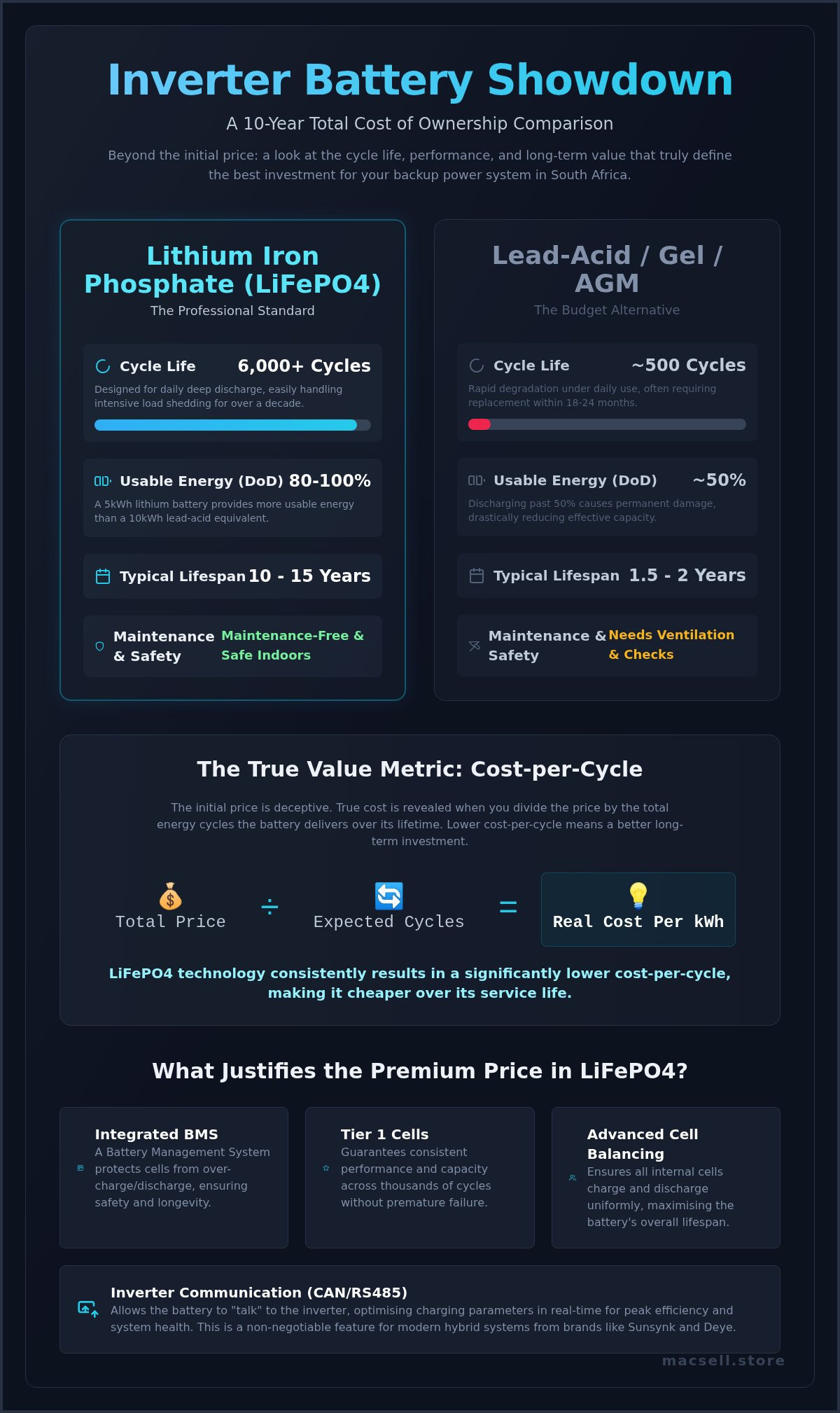
Total capacity is a theoretical value, whereas usable capacity defines what you can actually draw without damaging the unit. Modern lithium hardware relies on deep-cycle battery technology designed to handle regular discharge to 80% or 100% Depth of Discharge (DoD). In contrast, lead-acid variants typically fail if discharged past 50%. This means a 5KWh lithium battery provides more functional power than a 10KWh lead-acid bank, justifying the premium price through superior energy density and longevity.
Technical Build Quality and Enclosures
Hardware format significantly impacts both procurement and installation. Rack-mount units offer modular scalability for server-room environments, while wall-mount enclosures provide a compact footprint for residential spaces. The internal cell grading is equally vital. Tier 1 cells ensure consistent performance across thousands of cycles, whereas cheaper, ungraded alternatives often suffer from premature capacity loss. Professional-grade hardware includes the following features:
- Cell Balancing: Ensures all internal cells charge and discharge at the same rate.
- Communication Ports: Dedicated CAN or RS485 ports for inverter synchronisation.
- Thermal Management: Heat sinks or active cooling to maintain optimal operating temperatures.
Modern systems require precise synchronisation between the inverter and battery. These communication ports allow the BMS to "talk" to hybrid inverters like Sunsynk or Deye, ensuring the charging parameters are optimised in real-time. Without this digital handshake, the system operates on generic voltage settings, which often reduces the effective lifespan of the cells. Investing in hardware with robust communication capabilities is essential for long-term system health.
Lithium-Ion vs Lead Acid: Comparing Total Cost of Ownership
The initial inverter battery price for lead-acid hardware often attracts buyers looking for a budget entry point. This is a "sticker price trap" that ignores the operational reality of South African backup systems. While lead-acid units appear cost-effective, they typically fail within 18 to 24 months under the stress of daily load shedding. In contrast, Lithium Iron Phosphate (LiFePO4) technology is designed for a 10-year service life. A detailed total cost of ownership analysis reveals that lithium is significantly cheaper over its lifespan.
Cycle life benchmarks highlight the performance gap. Lead-acid batteries generally offer 500 cycles at a 50% depth of discharge, whereas LiFePO4 hardware delivers 6,000 cycles or more. Safety and maintenance also separate the two. Lead-acid batteries require regular terminal checks and dedicated ventilation to manage acid fumes. Lithium hardware is maintenance-free and safe for indoor installation. The weight-to-power ratio is another critical factor; a single 5.5 KWh lithium module weighs approximately 40kg, whereas an equivalent lead-acid bank would exceed 150kg and occupy four times the space.
The Cost-per-Cycle Calculation
To find the true value of your hardware, divide the procurement cost by the total expected cycles. Cost-per-cycle is the ultimate metric for solar ROI. For 2026 load-shedding kits, lithium-ion remains the professional choice because it costs less per month of service. You can browse high-performance Lithium Batteries to see how these specifications compare against legacy technology. Using this metric prevents the common mistake of overpaying for hardware that requires replacement every two years.
Performance Under Load Shedding Stress
Lithium hardware recovers rapidly. High charging speeds allow units to reach 100% capacity between frequent power cuts. Lead-acid chemistry requires a slow, multi-stage charge that often fails to complete before the next outage. Heat tolerance is another factor; lithium manages South African climates better, resisting the degradation that cripples lead-acid in warm environments. Lithium maintains consistent power output until empty, avoiding the voltage sag that causes inverters to trip early. This consistent discharge curve ensures that your essential appliances receive stable power throughout the entire backup duration.
Premium Battery Hardware: Hubble, Deye, and Sunsynk Standards
In the 2026 market, Lithium Iron Phosphate (LiFePO4) has established total technical dominance. This chemistry offers the thermal stability and cycle life required for South Africa's daily power cycles. While premium brands might increase the initial inverter battery price, they provide the infrastructure necessary for high-performance backup. Brands like Hubble, Deye, and Sunsynk aren't just selling storage; they're providing integrated power management systems that protect the long-term health of the cells.
The Hubble AM2 5.5 KWh module has become the industry benchmark for residential installations. Its capacity aligns perfectly with the energy requirements of a standard household during a four-hour outage. These units are designed for modular scalability. You can start with a single module and expand your bank as your budget allows or as your essential loads increase. This flexibility ensures you don't overspend on capacity you don't yet need, whilst maintaining the ability to grow your system in the future.
Hubble Lithium Battery Excellence
Hubble hardware is engineered for high discharge performance. This allows for heavy appliance support without triggering safety cut-offs. Integration features like the Hubble Cloudlink provide real-time monitoring and remote technical support. This digital ecosystem ensures compatibility with leading hybrid inverters like LuxPower and Sunsynk. By using a closed-loop communication protocol, the battery and inverter synchronise their charging cycles, which significantly reduces cell stress and optimises efficiency.
Deye and Sunsynk High-Voltage Options
High-voltage (HV) battery systems are increasingly common for larger 8KVA and 12KVA installations. These systems operate at higher voltages to improve round-trip efficiency by reducing current-related heat losses during the conversion process. Matching your battery voltage to the specific requirements of a 5kW or 8KVA inverter is critical for system stability. For users seeking a pre-configured solution, the Sunsynk Hubble combo kit offers a technically validated pairing. This synergy maximises the inverter battery price value by ensuring the hardware operates at peak efficiency from day one without the risks associated with mixing mismatched brands.
How to Size Your Battery Bank for Maximum ROI
Sizing your hardware correctly is the difference between a reliable backup system and a failed investment. A miscalculation in capacity leads to over-discharging, which compromises the longevity of the cells regardless of the initial inverter battery price. To maximise ROI, you must follow a methodical sizing framework based on real-world consumption rather than generic estimates.
Begin with a load audit. Identify essential circuits such as LED lighting, Wi-Fi routers, refrigeration, and security systems. Sum the wattage of these devices to establish your hourly consumption. For a standard four-hour load-shedding window, multiply this total by four to find your required energy in Watt-hours. When selecting hardware, apply the 80% Depth of Discharge (DoD) rule; if you need 4kWh of usable energy, a 5kWh battery is the minimum requirement to prevent deep-cycle stress. Matching these requirements ensures you don't overpay for unused capacity or starve your system during extended outages.
The 5kW vs 8KVA Sizing Dilemma
A common procurement error involves pairing a high-output inverter with insufficient battery capacity. Whilst an 8KVA inverter can handle heavy surges, a single 5.5 KWh battery often has a continuous discharge limit of 0.5C or 1C, which translates to approximately 2.7kW to 5.5kW of sustained power. Attempting to draw 8kW from a single battery will trigger the BMS protection or cause rapid voltage sag. Paralleling two or more batteries, such as those found in a backup power kit South Africa, allows the system to share the current load across multiple cells. This configuration reduces heat generation and ensures the inverter reaches its peak rated output without hardware failure.
Future-Proofing Your Procurement
Expanding a battery bank later is often more expensive than installing the correct capacity initially. Older cells and newer cells in the same bank can experience resistance imbalances, which limits the efficiency of the entire system. If you plan to integrate solar panels for daytime charging, ensure your battery bank is sized to handle the peak charge current from the array. For those transitionary systems, an off-grid solar kit South Africa provides the necessary technical headroom for future expansion. You can explore our full range of Hybrid Inverters to find hardware that supports high-capacity battery scaling and seamless solar integration.
Procuring Inverter Battery Hardware in South Africa
Direct procurement from a specialised distributor ensures you receive technically validated hardware designed for the South African grid. The final inverter battery price is often more favourable when purchasing through authorised retail channels that offer national delivery for high-capacity lithium modules. These components are heavy and require specialised logistics to ensure they arrive without internal cell damage. Sourcing through official channels also guarantees that you receive the latest 2026 production units with updated firmware, which is essential for municipal compliance and SSEG registration.
Pre-configured kits eliminate the compatibility anxiety often associated with mixing different hardware brands. By selecting a validated pairing, you ensure the Battery Management System (BMS) and the hybrid inverter utilise the same communication protocols. This digital handshake is essential for maintaining optimal charging parameters and protecting the 10-year service life of the unit. Without this synchronisation, the system may default to generic voltage settings, which can lead to inefficient charging and premature cell degradation.
Why Hardware Combos Offer Superior Value
Using an inverter and battery combo for home use significantly reduces technical troubleshooting during the setup phase. Manufacturers like Sunsynk and Hubble collaborate to ensure their firmware versions are synchronised for closed-loop communication. This integration allows the inverter to monitor cell-level data, adjusting the charge current based on real-time temperature and voltage. For installers and DIY enthusiasts, these combos provide a streamlined procurement path, ensuring all necessary components arrive in a single delivery.
Final Checklist Before Purchase
Before finalising your order, verify that all technical requirements are met for your specific installation site. A lower inverter battery price might indicate a lack of essential accessories or lower-grade internal components. Use this checklist to confirm your hardware selection:
- Protocol Verification: Confirm the battery supports CAN or RS485 communication with your specific inverter model.
- Surge Capacity: Ensure the battery's peak discharge rate can handle the inverter's maximum surge output without tripping.
- Accessories: Check if high-current battery cables and mounting brackets are included in the kit.
- Warranty Status: Verify that the hardware is sourced through an authorised retailer to ensure local warranty support is valid.
Authorised retailers provide the necessary technical documentation required for insurance and compliance purposes. National delivery services handle the complex logistics of transporting lithium-ion components across the country, ensuring your high-performance backup system is ready for immediate deployment. By following this structured procurement approach, you secure a reliable power solution that meets the technical demands of 2026 load-shedding cycles.
Securing Your Energy Independence with Validated Hardware
Selecting the correct backup components requires a shift in perspective; you must prioritise long-term cost-per-cycle over the initial inverter battery price. Modern LiFePO4 chemistry provides the thermal stability and discharge depth necessary to survive the rigorous demands of the South African energy landscape. By auditing your essential loads and ensuring technical synergy between your hybrid inverter and battery bank, you eliminate the risks of system bottlenecks and hardware incompatibility. These strategic choices transform a simple backup kit into a durable, high-performance energy asset.
MacSell Solar Outlet acts as an authorised retailer for premium brands like Sunsynk and Hubble. We specialise in high-capacity hardware, including 5.5 KWh and 8KVA configurations, designed for professional-grade reliability. Our national delivery network ensures that heavy lithium-ion components reach your site safely and efficiently. Browse the latest premium inverter battery hardware at MacSell Solar Outlet to find the exact specifications for your requirements. Investing in technically validated hardware today ensures that your backup system remains operational and efficient throughout the coming decade.
Frequently Asked Questions
How long does a lithium inverter battery last compared to lead acid?
Lithium-ion batteries typically last over 10 years with a cycle life of 6,000 or more at an 80% depth of discharge. In contrast, lead-acid or deep-cycle gel alternatives usually provide around 500 cycles. Under the stress of daily load shedding, lead-acid hardware often requires replacement within 24 months. While the initial inverter battery price for lithium is higher, its decade-long service life offers superior long-term value and reliability for South African systems.
Can I mix different battery brands with my Sunsynk or LuxPower inverter?
You can technically mix brands, but it's not recommended for high-performance hybrid systems. Modern inverters like Sunsynk and LuxPower utilise closed-loop communication protocols to synchronise with the Battery Management System. Mixing mismatched brands often forces the system into voltage-lead charging, which lacks real-time cell monitoring. For optimal safety and efficiency, stick to validated pairings like the Sunsynk 8KVA and Hubble AM2 combo kits to ensure seamless software and hardware integration.
What is the difference between a 12V, 24V, and 48V inverter battery?
Voltage architecture defines the system's efficiency and current handling. 12V and 24V systems are generally reserved for small, portable setups or light backup. Most residential hybrid inverters, such as the Deye or LuxPower 5kW models, require a 48V battery bank. Higher voltage reduces current-related heat loss and allows for thinner, more cost-effective cabling. Transitioning to a 48V standard is essential for supporting heavy household loads like pumps or refrigeration during power outages.
How many batteries do I need to run a house during Stage 6 load shedding?
A standard household typically requires between 5.5kWh and 11kWh of usable energy to survive four-hour Stage 6 outages. A single Hubble AM2 5.5 KWh module covers essential loads like lighting, Wi-Fi, and refrigeration. If you intend to run high-surge appliances like kettles or microwaves, paralleling two modules is necessary. This configuration ensures the battery bank can handle the peak discharge current without triggering a safety shutdown or damaging the internal cells.
Is it better to buy one large battery or two smaller ones in parallel?
Paralleling two smaller batteries is often superior for high-demand systems. This configuration shares the current demand across multiple Battery Management Systems, reducing thermal stress on individual cells. It also provides a level of redundancy; if one unit fails, the system remains operational on the second module. Paralleling allows you to achieve a higher total discharge rate, which is critical when matching battery output to the peak surge of an 8KVA inverter.
Why are lithium battery prices so much higher than deep cycle gel batteries?
The premium inverter battery price for lithium is driven by LiFePO4 chemistry and the integrated Battery Management System. Lithium cells offer higher energy density and a 100% depth of discharge, whereas gel batteries are limited to 50% to prevent permanent damage. A single lithium unit provides the same usable energy as a gel bank twice its size. When you factor in the 6,000-cycle lifespan, lithium is significantly cheaper per kilowatt-hour over its functional life.
Can I use a car battery for my home inverter system?
No, car batteries are designed for short, high-current bursts to start engines and are not built for deep-cycle applications. Discharging a car battery below 90% repeatedly will cause it to fail within weeks. Inverter systems require deep-cycle hardware that can handle sustained discharge over several hours. Using automotive batteries in a home backup system is a fire hazard and will likely damage your inverter's charging circuit due to improper resistance profiles and lack of communication.
What maintenance does a lithium solar battery require?
Lithium solar batteries are virtually maintenance-free. Unlike lead-acid variants, they don't require water top-ups or specific ventilation for acid fumes. You should ensure the terminals remain tight and free of dust to prevent high-resistance connections. Most modern units, like those from Hubble or Deye, include cloud-based monitoring. It's advisable to check for firmware updates periodically to ensure the Battery Management System remains compatible with the latest inverter software and safety protocols to maintain optimal health.