

Inverter and Battery Backup System South Africa: 2026 Buying Guide
Buying the largest battery capacity available won't guarantee energy security if your hardware isn't properly matched. Achieving a reliable inverter and battery backup system South Africa requires a technical understanding of how components interact under load. You've likely spent hours decoding jargon like C-ratings and Depth of Discharge whilst worrying about the high upfront costs of an incompatible setup. It's a common concern for those looking to protect their home or business from unpredictable grid instability.
This 2026 buying guide cuts through the marketing hype to focus on precise hardware specifications and system synergy. You'll learn how to select the perfect energy security solution that offers seamless switchover and enough storage to last through a four-hour power cut. We'll examine the performance metrics of industry-standard hardware; this includes Sunsynk 8KVA hybrid inverters, LuxPower SNA5000 units, and Hubble AM2 lithium batteries. This article provides a clear roadmap for building a system that supports immediate backup needs and future solar expansion.
Key Takeaways
- Distinguish between KVA and Kilowatt ratings to accurately size hardware for both baseload and peak load requirements.
- Identify why lithium-ion technology, specifically Hubble AM2 units, provides superior charging efficiency and a 6000-cycle lifespan compared to lead-acid.
- Evaluate a pre-configured inverter and battery backup system South Africa to ensure seamless hardware synergy and technical compatibility between components.
- Streamline procurement by sourcing premium hardware like the LuxPower SNA5000 directly from specialised retailers to maintain full control over your energy security setup.
Understanding Inverter and Battery Backup Systems
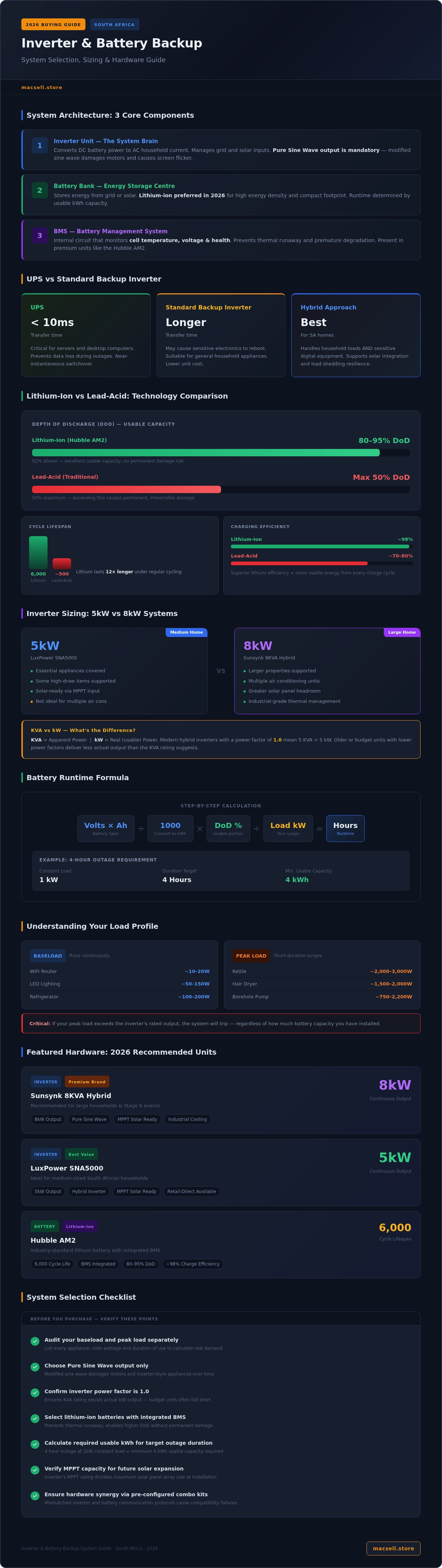
Distinguish between a UPS and a standard backup system before investing. A UPS (Uninterruptible Power Supply) provides near-instantaneous power transfer, typically under 10 milliseconds. This speed is critical for preventing data loss on servers or desktop computers. Standard backup inverters might have a longer transition period that causes sensitive electronics to reboot. In the context of an inverter and battery backup system South Africa, the goal is a hybrid approach that handles both general household loads and sensitive digital equipment without interruption.
The inverter serves as the primary power processor. It converts Direct Current (DC) stored in batteries into Alternating Current (AC) for household use. Pure Sine Wave inverters are mandatory for modern South African homes. Unlike modified sine wave units that can damage motors or cause screen flicker, pure sine wave hardware produces a smooth, consistent electrical signal identical to grid power. This ensures the longevity of expensive appliances like inverter-style fridges and LED televisions. Transitioning from basic backup to full energy independence starts with selecting an inverter capable of managing both grid and solar inputs effectively.
The Components of a Reliable Backup System
A robust system relies on three core hardware elements to function under heavy cycling:
- Inverter unit: Acts as the system brain. It manages the charging of batteries from the grid or solar panels and dictates how power is distributed across different circuits.
- Battery bank: The energy storage centre. Most 2026 installations favour lithium-ion for its high energy density and compact footprint.
- BMS (Battery Management System): A critical internal circuit in lithium batteries, such as the Hubble AM2, that monitors cell temperature, voltage, and health to prevent thermal runaway and premature degradation.
Why Hardware Quality Matters in 2026
South Africa's frequent load shedding cycles place immense physical stress on power hardware. Low-grade inverters often lack sophisticated thermal management, leading to overheating during rapid recharge cycles between outages. Premium brands like Sunsynk and Deye are engineered with superior heat sinks and industrial-grade cooling fans. Choosing high-performance hardware reduces the risk of component failure during Stage 6 events, where the system must cycle multiple times within a 24-hour period. Investing in quality ensures your inverter and battery backup system South Africa remains a reliable asset rather than a recurring maintenance expense. Inferior components often struggle with the high inrush currents required by modern household appliances, leading to frequent system trips or permanent hardware damage.
Sizing Your System: KVA Ratings and Battery Capacity
Selecting an inverter and battery backup system South Africa requires a precise audit of your energy consumption. You must distinguish between your baseload and peak load. Baseload includes essential electronics that run continuously, such as WiFi routers, LED lighting, and refrigerators. Peak load accounts for high-wattage appliances like kettles, hair dryers, or borehole pumps that draw significant current for short periods. If your peak load exceeds the inverter's rated output, the system will trip regardless of battery capacity.
Understanding technical specifications is vital. KVA (Kilo-Volt-Amperes) represents apparent power, whilst kW (Kilowatts) represents the real power the system can handle. Most modern hybrid inverters have a power factor of 1.0, meaning 5KVA equals 5kW. However, older or lower-quality units may have a lower power factor, reducing actual output. To determine battery runtime, calculate the total Kilowatt-hours (kWh) required. For a four-hour outage with a 1kW constant load, you need a minimum of 4kWh of usable capacity. Depth of Discharge (DoD) is a critical variable; lithium batteries typically allow 80% to 95% DoD, whereas lead-acid units should not exceed 50% to avoid permanent damage.
Inverter Sizing: 5kW vs 8kW Systems
A LuxPower SNA5000 hybrid inverter is often the right choice for medium-sized households. It handles a 5kW continuous load, which covers essential appliances and some high-draw items. Upgrading to an 8kW system, such as a Sunsynk unit, provides the headroom needed for larger properties or those with multiple air conditioning units. Sizing the inverter correctly from the start allows for easier solar panel integration later, as the inverter's MPPT capacity dictates how many panels you can install.
Battery Sizing: Calculating Amp Hours and Kilowatt Hours
Battery capacity is often listed in Amp Hours (Ah), but kWh is the measurement that matters for runtime. Multiply the voltage by the Ah and divide by 1000 to find the kWh. A 5.5 KWh lithium battery has become the residential standard because it comfortably covers a 1kW load for five hours at 90% DoD. For those requiring higher performance, linking multiple units in parallel increases storage capacity. Consult our backup power kit South Africa guide for detailed hardware configurations. You can browse our full range of technical components at macsell.store to find the exact match for your load profile.
Lithium vs Lead Acid: Which Battery Technology Wins?
Lead-acid batteries are increasingly obsolete for a modern inverter and battery backup system South Africa. Whilst the initial purchase price is lower, the cycle life is insufficient for frequent grid instability. A standard lead-acid battery provides roughly 500 cycles at 50% Depth of Discharge. In contrast, lithium-ion units like the Hubble AM2 offer 6000 cycles or more at 80% to 90% discharge. This means lead-acid banks require replacement every 18 to 24 months under Stage 4 or higher load shedding, whereas lithium lasts over a decade. Charging efficiency is another critical factor. Lithium-ion technology accepts higher charge currents, allowing a full recharge in under two hours. Lead-acid requires a slow saturation phase, often failing to reach 100% capacity between frequent power cuts.
Total Cost of Ownership (TCO) analysis over a 10-year period reveals that lithium is significantly more cost-effective than lead-acid. You also save on physical space and structural requirements. A single 5.5kWh lithium unit replaces a large, heavy rack of lead-acid batteries whilst weighing roughly 70% less. This makes indoor installations simpler and safer for residential properties where floor space and ventilation are limited. High-performance lithium cells maintain their voltage levels throughout the discharge cycle, providing consistent power to your inverter until the battery is nearly depleted.
The Hubble AM2 Advantage
The Hubble AM2 5.5 KWh Lithium Battery is a high-performance storage solution designed for the rigours of the South African grid. It features a robust internal Battery Management System (BMS) that communicates directly with premium hybrid inverters like Sunsynk and Deye. This integration ensures the inverter receives real-time data on cell voltage, current, and temperature, which optimises charging and extends hardware life. For a deeper technical breakdown of cell chemistry and discharge curves, refer to our lithium ion solar battery guide. This battery is engineered to handle high surge currents, making it ideal for an inverter and battery backup system South Africa that supports household motors and pumps.
Budget Alternatives: Mecer and Ecco Inverters
Entry-level brands like Mecer and Ecco serve basic backup needs for users with limited initial capital. These units are often suitable for simple plug-and-play setups involving LED lights, WiFi routers, and small electronics. However, users must accept trade-offs in monitoring software and system expandability. Most budget inverters lack the sophisticated parallel capabilities and high-speed MPPTs found in high-end hybrid models. Ensure any budget inverter is technically compatible with your chosen battery chemistry. Some older models are specifically tuned for lead-acid charging profiles and may lack the RS485 or CAN-bus ports required for lithium BMS communication.
Top Inverter and Battery Combo Kits for 2026
Pre-configured kits eliminate the compatibility risks associated with mixing hardware from different manufacturers. An inverter and battery backup system South Africa performs most reliably when the communication protocols between the battery management system and the inverter are factory-tested. This synergy ensures accurate State of Charge (SoC) readings and prevents the inverter from overcharging or prematurely disconnecting the storage cells. By selecting a bundle, you ensure that the discharge rates of the batteries are perfectly matched to the peak output capabilities of the inverter.
The Sunsynk 8KVA & Hubble AM2 Combo
The Sunsynk Hubble combo kit represents the current gold standard for residential power security. This pairing is a favourite amongst South African installers because the Sunsynk 8KVA hybrid inverter features a highly responsive MPPT and sophisticated parallel capability. You can link multiple units to scale power as your requirements grow. The Hubble AM2 batteries communicate via CAN-bus protocol; this allows the Sunsynk mobile app to provide granular data on cell health and discharge rates. This hardware combination comfortably handles the high surge currents of modern households whilst maintaining thermal stability during the rapid recharge cycles required between frequent outages.
Hybrid Inverter Versatility
Deye solar inverters offer exceptional versatility by managing three distinct power inputs simultaneously: grid, battery, and solar. This hardware supports AC Coupling, which allows you to integrate the backup system with existing grid-tied solar installations without replacing the original equipment. For mid-range requirements, the LuxPower SNA5000 provides a robust 5kW output that integrates easily with most lithium storage options. Home offices with lower power draws may find Mecer or Ecco UPS systems sufficient for maintaining internet connectivity and light electronics. These entry-level systems provide a reliable bridge for those not yet ready for a full hybrid conversion.
When selecting your hardware, refer to the hybrid inverter price South Africa guide to compare technical specifications against your budget. You can purchase these pre-configured kits and individual components directly from our warehouse at macsell.store to ensure you receive genuine, high-performance hardware for your installation.
Procuring Your Hardware: The Retail-Direct Model
Sourcing an inverter and battery backup system South Africa directly from a technical warehouse provides transparency in hardware selection. Traditional "all-in-one" installation quotes often include significant markups on core components like the Sunsynk 8KVA or LuxPower SNA5000. By procuring the hardware yourself, you ensure that every part of the system meets the high-performance standards required for long-term energy security. Once you own the kit, you can organise a qualified electrician to perform the final connection to your distribution board. This model is ideal for serious DIYers and property owners who prefer to manage their own energy infrastructure whilst controlling total project costs.
Before your electrician arrives, verify their specific experience with hybrid inverter systems. Ask if they are familiar with the BMS communication requirements of lithium batteries. A professional installer must understand how to configure the inverter software to match the battery discharge curves. Ensure they are prepared to provide a Certificate of Compliance (CoC) upon completion. This document is essential for insurance purposes and future property valuations. Sourcing hardware directly allows you to separate the technical procurement from the labour, ensuring you don't compromise on component quality due to an installer's limited stock or brand preferences.
What to Look for in a Hardware Supplier
Reliable suppliers maintain consistent stock levels of premium brands rather than generic alternatives. Technical support should focus on hardware specifications and compatibility rather than vague sales narratives. Because lithium batteries are heavy and require specialised handling, verify the supplier's national delivery capabilities before ordering. A specialised retailer acts as a technical partner. They provide the exact components needed for a scalable energy security solution without the unnecessary fluff found in retail showrooms.
Final Checklist Before Purchase
Review the physical dimensions of your chosen hardware. Confirming the inverter and battery combo for home use fits your available wall space is a critical step. Most lithium units and hybrid inverters require specific clearances for cooling. Check the following before finalising your order:
- DC Protection: Ensure you have the correct fuse disconnectors and surge protection devices for your specific KVA rating.
- Cable Requirements: Verify that the battery-to-inverter cables are of the correct gauge for the expected current draw.
- Mounting Surface: Confirm the wall can support the weight of a 5.5kWh lithium battery, which typically exceeds 40kg.
Browse our full range of UPS Power Backup Systems to secure the specific hardware required for your energy independence project.
Securing Your Energy Independence for 2026
Selecting an inverter and battery backup system South Africa requires a focus on hardware synergy and technical specifications. You've learned that matching a high-performance Sunsynk or LuxPower inverter with Hubble lithium storage provides the most reliable defence against grid instability. Prioritising lithium technology ensures a 6000-cycle lifespan and rapid recharge capabilities that lead-acid alternatives can't match. By sourcing your hardware directly from a specialised retailer, you eliminate unnecessary markups and maintain complete control over the quality of your installation.
As an authorised stockist of Sunsynk, Deye, and LuxPower hardware, we provide the technical components needed for high-performance energy security. We offer national delivery across South Africa for all lithium-ion storage units and hybrid inverters. View the Full Range of UPS Power Backup Systems to find the exact hardware for your home or business. You're now equipped with the technical knowledge to build a system that delivers seamless power and long-term reliability.
Frequently Asked Questions
How long will a 5kW inverter and 5.5kWh battery last during load shedding?
A 5.5kWh lithium battery provides approximately 4.9 usable kilowatt-hours at a 90% Depth of Discharge. If your constant load is 1kW, the system will last roughly five hours. Reducing consumption to a 500W baseload extends this to nearly ten hours. High-draw appliances like kettles will rapidly deplete these reserves. Always calculate your specific wattage requirements to ensure your inverter and battery backup system South Africa meets your runtime expectations.
Can I use a hybrid inverter without solar panels initially?
Yes, hybrid inverters function perfectly as grid-only backup systems. The unit charges the battery bank from the municipal supply whilst the grid is active and switches to battery power during outages. This approach allows you to secure immediate energy protection without the upfront cost of solar panels. You can add photovoltaic panels later as your budget allows, provided your chosen inverter, such as a Sunsynk or Deye unit, has a built-in MPPT.
What is the difference between a Sunsynk and a LuxPower inverter?
Sunsynk inverters are generally positioned as premium hybrid units with advanced parallel capabilities and highly detailed mobile monitoring apps. They are often preferred for larger 8KVA installations. LuxPower, specifically the SNA5000 model, offers a robust and cost-effective solution for medium-load requirements. Whilst both brands support lithium communication, Sunsynk provides more granular control over complex power flows and multiple input sources. Choosing between them depends on your specific scaling needs and budget.
Is it possible to add more lithium batteries to my system later?
Most modern lithium batteries, including the Hubble AM2 5.5kWh, support parallel connection. This allows you to expand your storage capacity as your energy needs grow. You must ensure that the new batteries are the same model and voltage as your existing units to maintain system balance. Check your inverter's technical manual to confirm the maximum number of batteries it can manage via its BMS communication port before adding more units.
Why is my inverter making a loud fan noise during charging?
Inverters generate significant heat during the rapid recharge cycles required after load shedding. The internal fans activate to maintain thermal stability and protect sensitive internal components from overheating. This is normal behaviour for high-performance units like the Deye or Sunsynk models, especially when charging a depleted battery at high currents. Ensure your inverter is mounted in a well-ventilated area with the manufacturer's recommended clearances to allow for efficient heat dissipation and noise reduction.
Do I need a special certificate of compliance (CoC) for a backup system?
A Certificate of Compliance (CoC) is legally required for any fixed electrical installation in South Africa. This document confirms that your inverter and battery backup system South Africa was connected according to national safety standards. Without a valid CoC, your household insurance may reject claims related to electrical fires or hardware damage. Ensure your qualified electrician provides this certificate immediately after the installation is finalised to protect your investment and property.
What happens to my backup system if there is a surge when the power returns?
Grid returns often coincide with high-voltage surges that can damage sensitive electronics. Quality hybrid inverters include basic surge protection, but we recommend installing dedicated DC and AC surge protection devices (SPDs) within your system's breaker box. These components act as a physical barrier, sacrificing themselves to prevent the surge from reaching your inverter or battery bank. Using a high-performance system ensures your hardware remains isolated from these grid instabilities during the switchover phase.