
Low Voltage vs High Voltage Solar Systems South Africa: 2026 Buying Guide
The standard 48V battery bank is no longer the default choice for high-demand South African properties. You likely recognise the frustration of energy loss during peak periods or the technical concern of cables overheating when your system hits maximum load. System efficiency depends on more than panel wattage; it relies on how your architecture manages current. Understanding the choice between low voltage vs high voltage solar systems South Africa is critical for any property owner prioritising hardware longevity and performance.
This 2026 buying guide provides the technical precision needed to master these two distinct architectures. You'll learn how to reduce energy waste through higher voltage strings and why HV systems allow for smaller, more manageable cable requirements. We’ll evaluate the compatibility between premium hardware like Sunsynk and Deye inverters with high-performance lithium batteries. This analysis ensures you select a system capable of handling large loads without the thermal bottlenecks or energy waste common in traditional low-voltage setups.
Key Takeaways
- Identify the core technical differences in low voltage vs high voltage solar systems South Africa to eliminate energy waste and prevent cable overheating.
- Gain insight into how high voltage architectures improve round-trip efficiency by minimising conversion losses during heavy load periods.
- Master the requirements for matching inverter voltage ranges with lithium battery stacks to ensure hardware compatibility and system safety.
- Compare initial hardware costs against long-term energy yields to determine the most cost-effective path toward total energy independence.
- Streamline your procurement process by identifying specialised high voltage kits designed for high-demand residential and commercial properties.
Defining Low Voltage and High Voltage Solar Architecture
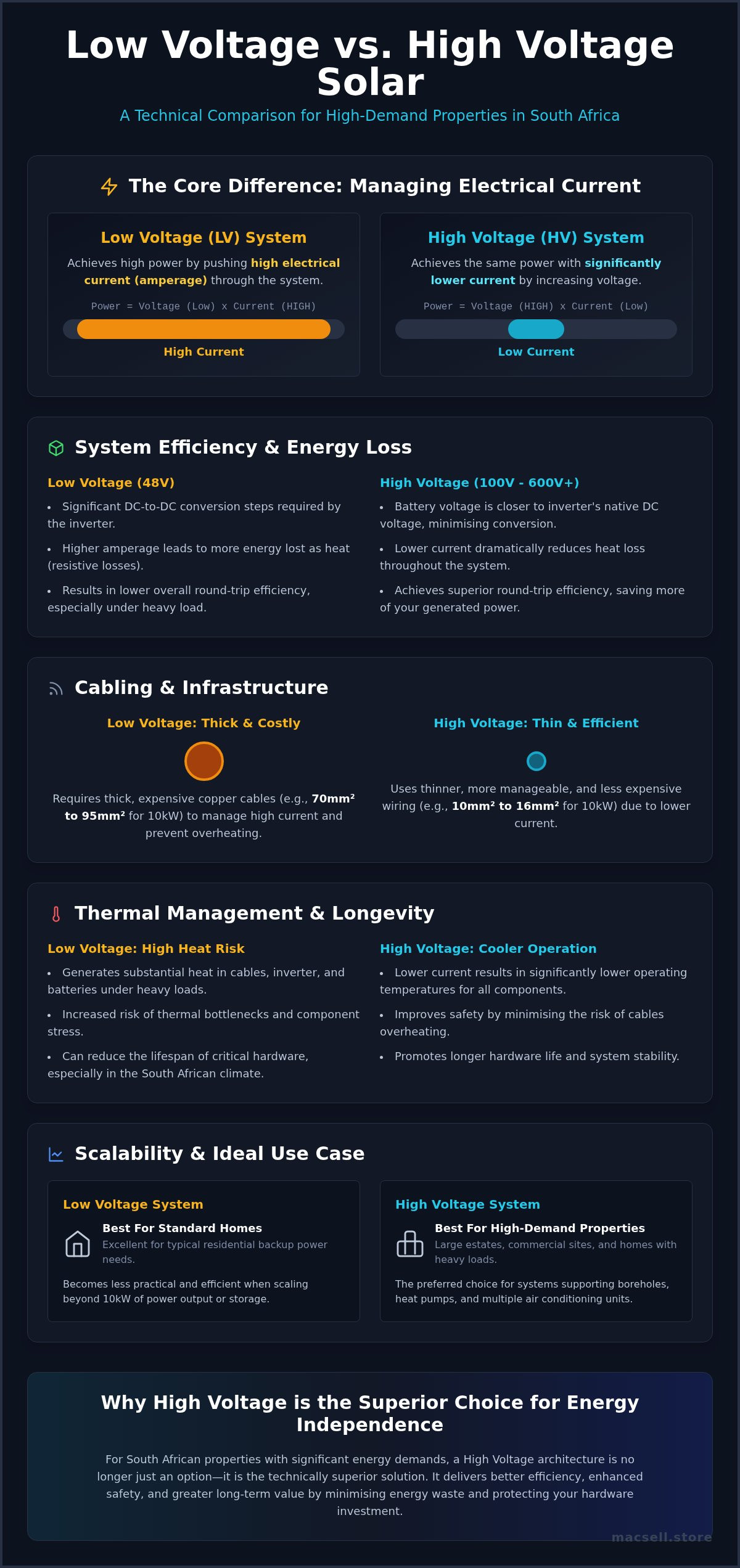
The architecture of a photovoltaic system basics installation determines how energy moves from panels to storage and eventually to your appliances. In South Africa, the technical choice between low voltage vs high voltage solar systems South Africa centres on efficiency and scalability. Low voltage (LV) systems operate primarily at a nominal 48V. High voltage (HV) systems typically range from 100V to over 600V. This distinction affects the role of DC-to-DC conversion within the inverter. LV systems require significant conversion steps to move power between battery banks and AC loads, often resulting in thermal energy loss. HV systems minimise these steps, providing a more direct path for high-capacity energy throughput.
The South African market shift towards HV is driven by the need for energy independence in properties with high-draw items like boreholes, heat pumps, and multiple air conditioning units. Basic hardware components for an HV-ready solar installation include high-string voltage inverters, BMS controllers capable of managing high-voltage stacks, and DC isolators rated for higher potential differences. These components must be precisely matched to ensure the system remains stable under the pressure of constant load shedding cycles.
The 48V Standard: Low Voltage Basics
The 48V standard became the universal choice for residential backup because of its safety profile and modularity. It is the foundation for common hardware like the LuxPower 5kW inverter or the Sunsynk 8kVA models paired with Hubble AM2 5.5kWh batteries. However, limitations appear when scaling beyond 10kW. To achieve high power at low voltage, the system must increase amperage. High current requires thick, expensive copper cabling and generates substantial heat. This makes LV architectures less practical for large estates or commercial-scale residential properties with heavy peak demands.
The High Voltage Evolution: 100V to 600V+
HV systems evolve by series-linking battery cells to increase total voltage rather than current. This shift allows for smaller cable diameters and reduced resistive losses across the installation. Components for an HV-ready system include specialised hybrid inverters from Deye or Sunsynk and stackable battery modules designed for series connection. High voltage systems serve as the preferred choice for commercial-scale residential loads due to their superior thermal management and energy throughput. This architecture supports rapid charging and discharging cycles, ensuring the system remains stable under the pressure of large appliances and constant load shedding cycles.
The Technical Edge: Why High Voltage Systems Outperform 48V Setups
High voltage architectures provide a distinct technical advantage by addressing the physics of power transmission. When evaluating low voltage vs high voltage solar systems South Africa, the primary differentiator is current. A standard 48V system must push high amperage to meet significant power demands; this generates resistive heat. High voltage systems operate at lower current levels to deliver the same wattage, which significantly improves round-trip efficiency during both charging and discharging cycles. This design follows established photovoltaic system design principles where increasing system voltage reduces energy dissipation across the hardware chain.
Internal conversion efficiency also improves. Modern hybrid inverters, such as those from Deye or Sunsynk, operate internally at high DC voltages. When paired with a 48V battery, the inverter must boost the voltage significantly before converting it to 230V AC. High voltage battery stacks already operate closer to the inverter's native DC bus voltage. This eliminates intensive conversion steps and reduces energy loss. The result is lower operating temperatures for both the inverter's power electronics and the battery cells, which is vital for hardware longevity in the South African climate.
Cabling and Infrastructure Efficiency
High voltage systems utilise thinner copper cabling because they carry less current. Whilst a 10kW 48V system might require heavy 70mm² or 95mm² cables to prevent overheating, an HV equivalent can often achieve the same result with 10mm² or 16mm² wiring. This reduction in cross-sectional area minimises the risk of thermal issues in high-demand environments where systems run at peak capacity for extended periods. It also simplifies the hardware layout for large-scale installations, offering a cleaner and more efficient infrastructure for properties with extensive energy needs. You can explore these specialised high voltage hardware options to see how they fit your specific property requirements.
Rapid Charging and Discharge Rates
Efficiency in power delivery translates directly to faster recharge cycles between outages. In the context of frequent load shedding, HV batteries often offer superior charging precision. The relationship between high voltage and the Battery Management System (BMS) allows for more accurate cell balancing and monitoring. This precision enables the system to manage high-surge appliances, such as boreholes or compressors, amongst heavy household loads without triggering safety cut-offs. With Eskom tariffs increasing by 8.76% as of April 2026, the ability to store and deploy energy with minimal loss is a critical factor for long-term energy independence.
Comparing Practicality: Low Voltage vs High Voltage for South African Homes
Practicality in solar procurement involves balancing upfront expenditure with operational reliability. When choosing between low voltage vs high voltage solar systems South Africa, users must consider how hardware architecture influences daily energy yield. Low voltage systems, typically 48V, offer a lower entry price but incur an "efficiency tax" through higher conversion losses. High voltage systems demand a more significant initial investment but recover costs via superior energy throughput and reduced thermal stress on hardware components. This makes HV the logical choice for properties where energy independence is the primary objective.
Scalability also differs between these two architectures. Adding capacity to an LV system involves paralleling batteries, which can lead to imbalances if cable lengths are not identical. HV systems utilise series-connected stacks. This configuration ensures uniform current across all cells, which improves the precision of the Battery Management System (BMS). When budgeting for a full setup, check the current solar panel for home price to ensure your array provides enough voltage to trigger the HV inverter's most efficient operating range. Maintenance expectations for HV lithium-ion stacks are generally lower due to the reduced current flow and lower operating temperatures compared to high-amperage 48V setups.
Hardware Cost vs Performance ROI
The hybrid inverter price South Africa for high voltage models is generally higher than standard 48V units. This price gap exists because HV inverters require advanced power electronics to manage high-string voltages safely. However, the performance ROI is often superior for large-scale residential loads. HV systems minimise energy waste during the DC-to-AC conversion process. More of your stored battery power reaches your appliances. Over a 10-year lifespan, the cumulative energy saved by an HV system often offsets the initial hardware premium.
Space and Installation Footprint
High voltage battery modules are designed for vertical stacking. This creates a compact footprint compared to bulky 48V battery banks that require extensive floor space or heavy-duty shelving. A stacked HV configuration allows for better organisation of the hardware room, facilitating optimal airflow and simplified cable management. Modern architectural designs favour this streamlined look. It integrates more cleanly into utility rooms or garages. Maintenance is simplified because HV stacks are modular, allowing for easier cell monitoring and individual module replacement without dismantling the entire energy storage bank.
Selecting Your High Voltage Hardware: Inverter and Battery Compatibility
Selecting high voltage hardware requires precise technical alignment between the energy storage bank and the power electronics. When comparing low voltage vs high voltage solar systems South Africa, the compatibility between the inverter's DC input range and the battery stack's nominal voltage is the most frequent point of failure. An HV inverter might require a minimum startup voltage of 160V. This means a single 48V battery module is technically insufficient. You must read the technical datasheet to identify the "Battery Voltage Range" and ensure your chosen lithium stack operates within those parameters throughout its discharge cycle.
Communication protocols like CAN or RS485 must be synchronised between the hardware components. Without correct handshake protocols, the Battery Management System (BMS) cannot communicate state of charge (SoC) or temperature data to the inverter. This leads to inefficient charging or sudden system shutdowns. Reading a technical datasheet for HV compatibility involves checking the maximum charging current and ensuring the battery stack can sustain the inverter's peak discharge requirements during high-demand periods.
Top-Tier HV Inverter Brands
Sunsynk and Deye provide the most robust HV-compatible hardware in the South African market. These units feature advanced load management, allowing users to prioritise essential circuits during grid instability or load shedding. Deye is a leading choice for HV systems in 2026 because of its high-efficiency power electronics and broad compatibility with third-party battery stacks. When researching the Deye inverter price South Africa, ensure you are looking at the specific high-voltage models, as these require different internal components than their standard 48V counterparts.
Matching the Battery Stack
The lithium ion solar battery configuration in an HV system relies on series-connected modules to reach the required voltage threshold. Most residential HV inverters require a minimum of three to four battery modules to initiate the startup sequence. This series architecture includes unique hardware protections, such as high-voltage DC breakers and specialised BMS controllers that monitor cell voltage across the entire stack. This ensures the system remains stable even under the high-current demands of large residential loads. Matching these components correctly prevents thermal bottlenecks and ensures the longevity of your storage investment.
View our authorised High Voltage collection for national delivery.
Procuring High Voltage Solar Kits from MacSell Solar Outlet
Procuring high-performance hardware requires a supplier with deep technical inventory and logistical reliability. MacSell Solar Outlet functions as a specialised distributor for the South African market, providing the precise components needed for high-efficiency energy storage. The specialised High Voltage collection simplifies the transition from traditional 48V setups by offering hardware specifically engineered for high-draw residential and commercial environments. Navigating the technical landscape of low voltage vs high voltage solar systems South Africa is more efficient when you can access detailed datasheets and pre-configured kits in a single location.
Hardware-only procurement is the preferred route for independent contractors and experienced property owners who prioritise technical accuracy over bundled services. By focusing on the supply of premium inverters and batteries, MacSell ensures that every component in a kit is matched for communication protocol synchronisation. This modular approach allows for national delivery of heavy hardware, ensuring that properties across the country can access the latest high-voltage architectures. Technical specifications on the online store are categorised to facilitate quick comparisons of battery voltage ranges and inverter throughput capacities.
Standout Products in the HV Collection
The HV collection features high-string voltage hybrid inverters from Deye and Sunsynk, designed to manage DC inputs exceeding 500V. These units provide superior load management, allowing users to stabilise essential circuits during prolonged grid instability. Whilst the Sunsynk Hubble combo kit remains the benchmark for high-performance 48V installations, those upgrading to HV architectures can utilise similar modular battery stacks to scale storage capacity vertically. These modular HV battery stacks are designed for series connection, reaching the high voltage thresholds required to trigger the peak efficiency windows of modern hybrid inverters.
Your Next Steps for Energy Independence
Use the collection filters on the MacSell website to isolate hardware based on your specific voltage and power requirements. It's essential to verify that your chosen hardware meets national compliance standards for SSEG registration. This is particularly relevant given the Eskom fee waiver deadline on 30 September 2026, which offers significant savings for registered grid-tied systems. Once your technical requirements are defined, you can procure the necessary hardware for a future-proofed energy system. Browse the full High Voltage Inverters and Batteries collection to secure your hardware for national delivery.
Future-Proofing Your Energy Independence with High Voltage Architecture
The choice between low voltage vs high voltage solar systems South Africa determines your property's long-term energy efficiency and hardware longevity. High voltage systems eliminate the thermal bottlenecks common in 48V setups, allowing for leaner cabling and superior round-trip performance. By matching high-string inverters with series-connected lithium stacks, you ensure your system handles peak household demands without unnecessary energy waste or conversion losses.
MacSell Solar Outlet is an authorised retailer of Sunsynk and Deye, providing the technical expertise required for high-performance hardware procurement. We specialise in pre-configured kits and offer national delivery across South Africa to support your transition to HV architecture. As high voltage hardware experts, we ensure every component meets the rigorous demands of the local energy landscape. View our High Voltage Inverters and Batteries collection to secure the most efficient hardware for your energy independence. Transitioning to a high-voltage system is a strategic step toward a more reliable and efficient energy future.
Frequently Asked Questions
What is the main difference between low voltage and high voltage solar batteries?
The primary distinction is the operating voltage range and how the modules connect. Low-voltage batteries typically run at a nominal 48V while high-voltage alternatives range from 100V to over 600V. High-voltage systems connect modules in series to increase potential difference, keeping current levels low. This architecture differs from the parallel connections found in standard 48V systems. Understanding low voltage vs high voltage solar systems South Africa is essential because this choice dictates your entire hardware ecosystem.
Can I use a high voltage battery with a standard 48V inverter?
You cannot use a high-voltage battery with a standard 48V inverter. Hardware compatibility is strictly defined by the inverter's DC input range. A 48V hybrid inverter, such as the LuxPower SNA5000, lacks the power electronics to manage high-voltage stacks. Attempting this connection will cause immediate hardware failure or safety hazards. Always verify the "Battery Voltage Range" on your inverter datasheet to ensure it matches your chosen lithium battery stack's nominal voltage.
Are high voltage solar systems safer than low voltage ones?
Safety in high-voltage systems is achieved through reduced current and heat. Because high-voltage architectures operate at lower amperage, they experience significantly less resistive heating in the cables and connectors. This reduces the risk of thermal-related failures compared to high-current 48V setups. However, high-voltage hardware requires specialised DC isolators and circuit breakers rated for higher potential differences. Both architectures are safe when you use premium, compliant hardware from authorised retailers like Sunsynk or Deye.
Why are cables thinner in a high voltage solar system?
Cables are thinner in high-voltage systems because the current (amperage) is lower. Power is the product of voltage and current. By increasing the voltage, the system delivers the same power with far less current flow. This allows for the use of 10mm or 16mm copper wiring instead of the heavy 70mm cables required for 48V systems. Thinner cabling reduces the cost of balance-of-system components and simplifies the physical hardware layout for large properties.
How many battery modules do I need for a high voltage setup?
A high-voltage setup typically requires a minimum of three to four battery modules. Most residential high-voltage inverters have a minimum startup voltage, often around 160V or higher. Because individual lithium modules are usually 48V or 51.2V, you must link several in series to reach the required threshold. The exact number depends on the inverter's specific startup parameters. Always check the minimum battery modules specified in the hardware guide before procuring your energy storage bank.
Does a high voltage system charge faster during load shedding?
High-voltage systems often charge more efficiently during load shedding windows. This is because they bypass the intensive DC-to-DC conversion steps required by 48V systems. By operating closer to the inverter's native DC bus voltage, the system experiences less energy loss during the charging cycle. This efficiency allows the batteries to recover capacity faster when the grid or solar power is available. It ensures your storage is ready for the next scheduled power outage.
Is high voltage solar hardware more expensive to maintain?
High-voltage solar hardware is not more expensive to maintain and often proves more durable. The reduced current flow leads to lower operating temperatures for the inverter's power electronics and the battery cells. Lower thermal stress generally extends the lifespan of the hardware components. Additionally, modular high-voltage stacks allow for easier monitoring and individual module replacement. This streamlined maintenance profile makes them a practical choice for high-demand residential systems seeking long-term energy independence.
Can I upgrade my existing 48V system to high voltage later?
Upgrading an existing 48V system to high voltage requires replacing the core hardware. You cannot mix low-voltage batteries with high-voltage inverters or vice versa. If you currently use a 48V Sunsynk or LuxPower system, you must replace the inverter with an HV-compatible model and procure a new series-linked battery stack. When evaluating low voltage vs high voltage solar systems South Africa, it's best to choose the architecture that meets your long-term energy needs from the start.